

Three Legends Conspire
The Marathon’s 2,500th Anniversary
Three Legends Conspire Several ancient Greek legends and a 19th-century Greek peasant inspire a unique athletic event: the marathon. And then export it to Boston. by Hal Higdon
“R
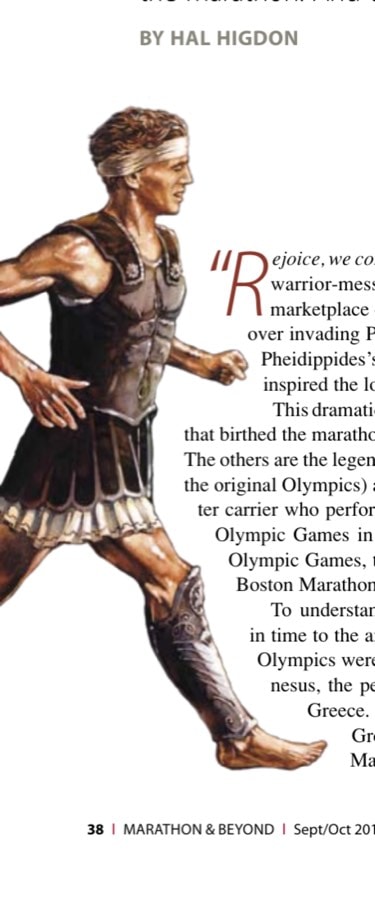
ejoice, we conquer!” was the fabled dying cry of the Greek warrior-messenger Pheidippides as he rushed into the marketplace of Athens with the news of the Greek victory over invading Persians in the battle of Marathon in 490 b.c.
Pheidippides’s supposed run gave birth to a legend that inspired the long-distance running event. This dramatic tale is only one of three intertwining legends that birthed the marathons of today, including the Boston Marathon.
The others are the legend of King Pelops of Greece (who established the original Olympics) and the story of Spiridon Louis, a Greek water carrier who performed splendidly at the revival of the ancient
Olympic Games in 1896. Then, inspired by the revival of the Olympic Games, the Boston Athletic Association founded the Boston Marathon a year later in 1897. To understand the Boston Marathon means going back
in time to the ancient Greek Olympics. In ancient times the Olympics were contested not in Athens but in the Peloponnesus, the peninsula that forms the southern extreme of Greece. This area owes its name to Pelops, an early
Greek monarch, and thus the story of the Boston Marathon begins some 2,800 years ago.
Crafty Pelops, founder of the first Olympics Long before the birth of Christ, a man named Pelops sought the hand of Hippodamia, the beautiful daughter of King Oenomaus, whose kingdom included a fertile valley in southwestern Greece. Pine and olive trees grew within the valley, which was surrounded by high mountains. Through it ran the winding Alpheus River. The valley was known as Olympia.
The king decreed that to win Hippodamia, a prospective husband had to escape with her in a chariot, pursued by the king with much faster horses. If King Oenomaus caught the escaping couple, he killed the suitor with his spear. Before Pelops, 13 suitors had sought to win the princess and failed, the legend tells us.
But crafty Pelops bribed the royal charioteer to loosen a wheel on the king’s chariot. During the chase the wheel came off, and King Oenomaus died in the crash, which reportedly occurred at Olympia. Later, in honor of his victory over the king, Pelops instituted a religious and athletic celebration that became known as the Olympic Games, according to the legend.
The earliest Olympics Chariot races were not included in the early sporting contests held at Olympia, although eventually they would become part of the blend of events that became the Olympic Games. The first Olympic victory for which we have records is that of Coroebus, a cook from Elis, who won a sprint race in 776 b.c. The symbol of victory in the early Games was a laurel wreath instead of today’s gold medal. The top sculptors of the era carved statues of the Olympic champions, and thus their names and deeds survive to the present day.
Archaeologists suggest that from the evidence of ruins found within the original enclosure for the Games, athletic competitions and religious celebrations were probably held at Olympia for several centuries before somebody recorded the name of Coroebus. Nevertheless, 776 b.c. became established among the ancient Greeks as beginning the First Olympiad. Each Olympiad—the period between the Games—lasted four years. The Olympics would continue more than 1,000 years before the Roman emperor Theodosius I abolished the Games in a.d. 394. His reason: they had deteriorated into a spectacle rather than a sporting event— too many chariot races.
“Rejoice, we conquer!” Next comes the legend of Pheidippides, a warrior messenger (or hemerodromos) in the service of the Greek general Miltiades. In 490 b.c., Persian armies under the command of Darius sailed to invade Greece near the plain of Marathon, northeast of Athens. According to the legend, Miltiades first sent Pheidippides trotting to
Marathon: A Hero’s Journey
▲
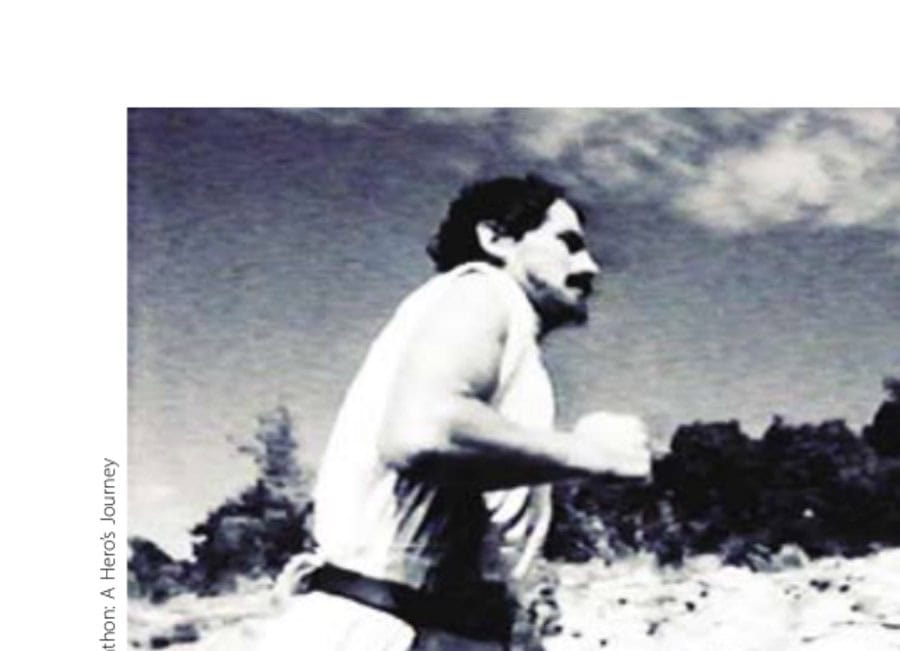
Pheidippides, shown here on his way to Sparta, came from a long line of Greek warrior messengers.
Sparta seeking reinforcements for his 10,000 troops, who were outnumbered three to one by the Persians. The messenger received promises of help from the Spartans and then returned to fight the battle of Marathon with his comrades. The Spartans never did provide reinforcements because a religious holiday interfered, but Miltiades prevailed anyway, thwarting the invasion. According to the Greek historian Herodotus, 6,400 Persians died in the battle but only 192 Greeks were lost. Joyously, Miltiades dispatched his messenger to Athens with news of the victory. In The Story of the Olympic Games, John Kieran and Arthur Daley present a dramatic description of this run: “Though he had fought through the battle as a common soldier and endured the heat and the hardship of the day,
Pheidippides tossed aside his shield, stripped himself of his armor, and set off over the hills toward the distant city. It was about eight leagues (roughly 40 kilometers) from the plain of Marathon to the marketplace at Athens, but Pheidippides, spurred by
the good news he was bringing, ran doggedly up and down the slopes and along the level stretches. As he went on, his lips became parched and his breath came in painful stabs. His feet were cut and bleeding. But the Acropolis loomed in the
distance. Pheidippides plunged ahead. He entered the city streets. The elders of Athens heard a great shout and saw an exhausted runner staggering toward them. ‘Rejoice, we conquer!’ gasped Pheidippides, and, his message carried and his goal
attained, he dropped to the ground and died.” Latter-day historians have doubted the veracity of the legend of Pheidippides, which didn’t surface until Plutarch told the story in the first century a.d., more
than 500 years after the battle of Marathon. Author James F. Fixx attempted to authenticate the Pheidippides legend and concluded that, while the messenger sent by Miltiades to Sparta most likely bore that name, he was not the same messenger
sent with news of the victory from Marathon to Athens. Still, Fixx considered the legend an agreeable, if unlikely, fiction.
Regardless of its origin, the story of the Greek messenger who died with news of the victory at Marathon on his lips had a romantic ring to it. It should have been true! The legend remained alive in the imaginations of the Greeks as well as those who revered the classical era.
Among those romantics who believed in the legend was Baron Pierre de Coubertin, a French nobleman who admired the strong athletic tradition that was linked to the educational system as in ancient Greece. To inspire his countrymen, Coubertin convened an international athletic congress in Paris on June 16, 1894. Of the 2,000 people who attended, primarily attracted by Coubertin’s hospitality, most were unaware that his motive for hosting the meeting was to revive the Olympic Games. Originally, Coubertin planned that
the first modern Olympiad would begin with a world’s fair scheduled for Paris in 1900. When the Greeks learned of Coubertin’s Olympic revival plans, they insisted that the date be pushed four years earlier to
1896 and the Games first be held in the country of their birth. Coubertin saw the logic in this link between old and new, even though Olympia lay in ruins. So he encouraged the Greeks to host the Olympic Games in the more
populous Athens. Near the heart of that city were the remains of the Herodes Atticus stadium, dating back to 330 b.c. George Averoff, a wealthy Greek businessman living in Egypt, pledged funds to restore the stadium to its original glory. Rebuilt,
this new Olympic stadium would provide seats for 70,000. During the Games an additional 50,000 would watch from the surrounding hillsides. These spectators would witness at least one event never before contested,
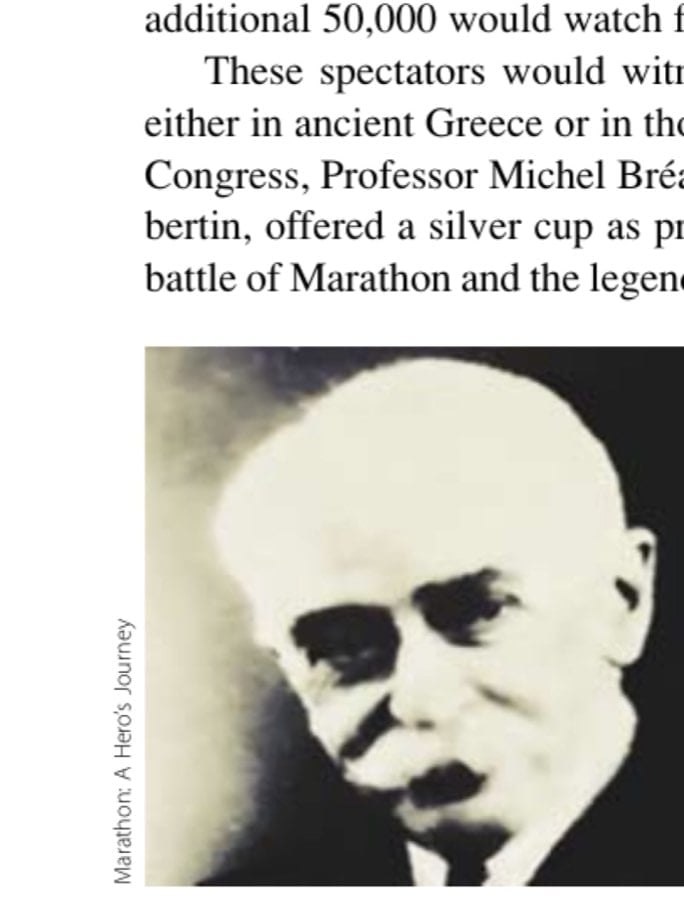
either in ancient Greece or in those modern days: a marathon. At the 1894 Paris Congress, Professor Michel Bréal, a classical literary scholar and friend of Coubertin, offered a silver cup as prize for a “marathon race,” commemorating the
battle of Marathon and the legend of the messenger who brought the news of victory to Athens. Coubertin apparently paid little attention to the offer at the time, but Greek organizers took Bréal’s suggestion
more seriously. They began making plans for a footrace that would trace the route of the messenger, a distance of about 40 kilometers, or 25 miles.
Baron Pierre de Coubertin led the movement to revive the Olympic Games.
▲
Marathon: A Hero’s Journey
The first modern Olympiad
Going the distance Nothing in the Olympic tradition suggested that the classical Greeks competed at distances anywhere near 40 kilometers. Their messengers certainly ran that far, and farther, but not their athletes. Early Olympic athletes ran a sprint race of about 192 meters known as a stade. Later, grandstands where spectators could watch the Games were constructed beside the sprint straightaway—the origin of the word “stadium.”
As Olympiads passed, Games organizers added an up-and-back race in which runners ran to a post at the end of the straightaway and then back, about 400 meters. The longest event was reportedly 24 stade lengths (about three miles), which is the equivalent of the 5,000 meters run in the Olympics today.
The ancient Games included an event in which warriors ran in armor for eight stade lengths, or about a mile. These competitors carried a shield and wore a helmet and leg protectors—but nothing else since Olympic athletes traditionally competed nude. According to one tale, an early Olympian’s belt slipped, causing his tunic to drop. After he won, others began running minus encumbering clothes. (This tale, too, probably owes more to legend than to fact.)
While amateur sportsmen in the 19th century rarely ran farther than a few miles in competition, professional athletes—both walkers and runners—frequently competed in events that sometimes lasted for days, even months. In 1867 Edward Payson Weston, sometimes referred to as the man who invented walking, walked from Portland, Maine, to Chicago, Illinois (a distance of 1,226 miles), in 26 days. But nobody yet had coined the term “marathon” to describe these distance races. Until 1896, “Marathon” remained merely an obscure plain somewhere outside Athens, known only to those well versed in the history of Greece.
The B.A.A. aims for Athens Despite Coubertin’s lofty goals, his revival of the ancient Olympic Games attracted relatively little attention at first, even among Europeans. Compared with what would come later, it was a minor event. Most Americans certainly did not yet take the Games seriously. A U.S. Olympic Committee was still far in the future, and we held no Olympic Trials. In fact, anybody able to pay his own way could become an Olympian. For the first modern Olympics, only 13 Americans competed. Not too many athletes from other countries bothered to go to Greece, either. After all, the jet plane had not yet been invented; travel by ship consumed several weeks.
As it is today, the centerpiece sport of the first modern Olympics was “athletics,” which is called track and field in the United States. Toward the end of the 19th century, athletics was a sport practiced mostly in Great Britain or by those whose roots were English. This included the United States, or at least those cultured
Americans who attended eastern colleges or belonged to clubs such as the Boston Athletic Association, referred to more simply as the B.A.A. In 1887 the B.A.A. built its own nine-story clubhouse in Boston’s Back Bay area, with racquet courts, a swimming pool, Turkish baths, and a running track. B.A.A. runners competed in track meets wearing singlets with the club insignia, featuring the head of a unicorn. In Greek lore the unicorn served as an attendant to the heralds, or royal messengers. B.A.A. members arriving at the clubhouse passed a bronze unicorn-head statue in the lobby that contained a gas flame by which they lit their cigars. The club also had its own golf course, The Unicorn, named after its emblem. The unicorn remains central to the B.A.A. logo today.
John Graham, a coach and trainer for the B.A.A., was born in England in 1861 and later emigrated to the United States, where he taught athletics at Harvard University. After visiting Germany in the late 1880s for additional training in physical education, Graham became coach for the B.A.A.
When Graham learned of Coubertin’s plans for an Olympic revival, he became intrigued with the idea of leading a B.A.A. team to Athens. He discussed the idea with potential team sponsors as well as his athletes. The plan appealed to his runners. At an indoor meet in January 1896, Arthur Blake won a 1,000-yard race. Afterward, he was quoted as saying, “I’m too good for Boston. I ought to go over and run the marathon at Athens.”
Oliver Ames, a former governor of Massachusetts, and Arthur Burnham, a stockbroker, helped raise money for a B.A.A. team. In addition to Blake, the members included William Hoyt, a pole-vaulter; Thomas Burke, a sprinter; Ellery H. Clark, a high jumper; Sumner and John Paine, marksmen; and Gardner Williams, a swimmer. As coach, Graham accompanied them. The group departed on March 2, 1896, from New York City harbor, having been joined by several other athletes, including Robert Garrett, a shot-putter and captain of the Princeton track team. Garrett personally paid for several of his Princeton teammates to come along as well.
The U.S. Olympic team changed ships in Hamburg, Germany, and then stopped at Gibraltar, where team members trained on playing fields used by British officers. On one sightseeing trip, Blake trotted behind the carriages to train for the marathon.
Greeks target the marathon Greek runners also practiced for the long-distance race, which promised their best chance for victory. At that time track and field held little popularity in Greece. Organizers of the Greek Olympic team reasoned that, although they might not be
able to compete against the English-speaking athletes in the sprints, jumps, and throws, they might well succeed in the newly created marathon race. Greece held several trials over the marathon route in the fall of 1895 to select
and encourage competitors for the marathon. Among those chosen was a runner named Vanitekes, who had won several earlier runs. Practicing along the road between Marathon and Athens, Vanitekes smiled and nodded to his countrymen,
who applauded his training efforts. Placing fifth in an open trial, also earning a spot on the Greek Olympic team, was a 22-year-old peasant, Spiridon Louis. Louis was not an athlete in the traditional sense. He had developed natural endurance by delivering fresh water twice
daily from his home village of Amaroussion to Athens, a distance of nine miles. His training was his work, since he jogged beside his mule. Coubertin later would reveal that Louis spent two nights before the marathon on his knees praying in
front of holy pictures. The day before the race, according to one source, he fasted. Still another story had him consuming an entire chicken for his prerace meal. The legend of Spiridon Louis would continue to grow beyond these tales and become
part of the history of the Boston Marathon and of marathoning in general.
The legend of Louis
Marathon: A Hero’s Journey
Twenty-five men toed the starting line near the village of Marathon on April 10, 1896, at 2:00 p.m. Four were foreigners to Greece, including the runners who had placed first, second, and third in the 1,500 meters earlier in the Games. Edwin
Flack, an Australian living in Great Britain who competed for the London Athletic Club, had won the 1,500 meters. Arthur Blake of the B.A.A. had placed second, ahead of Albin Lermusiaux of France. The fourth non-Greek was a Hungarian
named Gyula Kellner; he was well versed in longer distance events, which at that time were popular in Eastern Europe, and had won a 40-kilometer time trial in three hours in Budapest. Lermusiaux was considered some
what of a character by the Americans. On first meeting the Frenchman, one of the B.A.A. athletes quizzed him about his events. Lermusiaux replied that he ran the 100-meter dash and the marathon. Asked to explain how he
▲
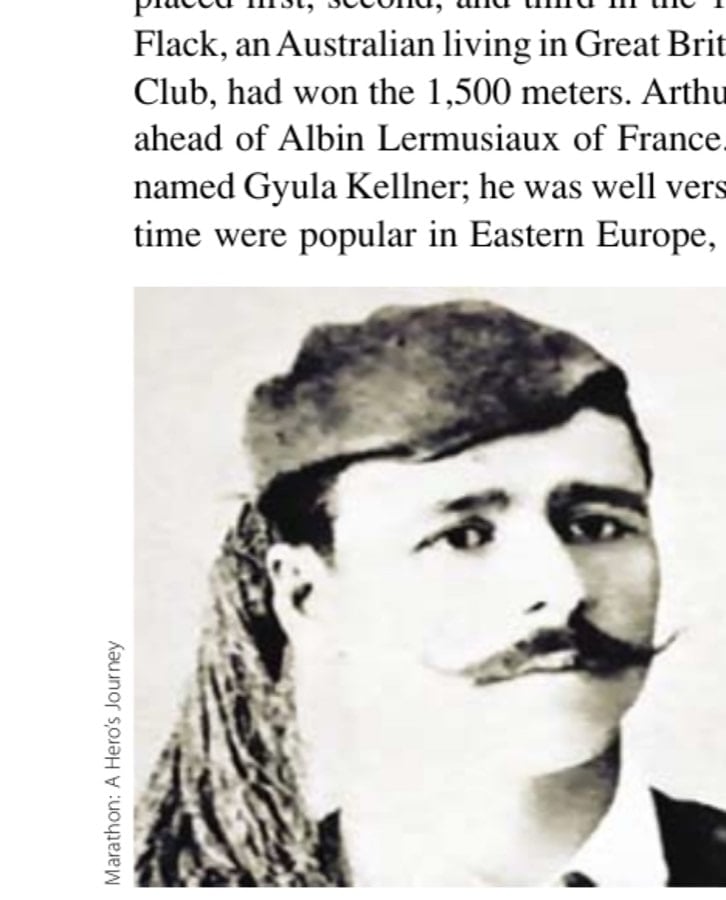
Spiridon Louis joined the ranks of the great Greek heroes after his victorious run from Marathon to Athens in the first Olympic marathon.
trained for such an odd combination, Lermusiaux replied, “One day, I run a little way very quick. The next day, I run a long way very slow.” Before the start, Lermusiaux stood sipping from a flask of brandy. A Colonel Papadiamantopoulos fired a starting pistol. The Frenchman dashed to the front, reportedly establishing a lead of three kilometers by the village of Pikermi, 15 kilometers into the race. (Three kilometers is nearly two miles, an unlikely margin at this stage, so his lead may have been exaggerated in race reports.) Flack trailed, with Blake and Kellner nearby, followed by three Greeks, including Georgios Lavrentis of Marousi. Spiridon Louis padded along somewhere back in the pack.
In this era before instant communications, horsemen dashed ahead to report results of the marathon to the crowd waiting in the Olympic stadium. The early reports looked bad for the Greeks, who had no color analyst to inform them that in marathons a steady pace wins the race.
Patience would prove particularly important on so demanding a course. The race began on the plain of Marathon—which means just that. Except for one hill, the first half of the original marathon was notably flat, teasing even experienced runners to push their paces beyond their means. Past 20 kilometers, those impetuous runners pay for any early excesses as they ascend a series of hills. They crest the final hill just past 30 kilometers (about 20 miles) at a point referred to as The Wall by present-day marathoners. Beyond this point untrained marathoners experience new dimensions of pain. Finally, the last quarter of the race features a hammering descent through the suburbs of Athens before reaching the finish line in the Olympic stadium.
The non-Greeks leading the marathon (except for Kellner) were milers who had never before competed at such a long distance. Blake faltered first. At 23 kilometers he fell and failed
to rise. Blood from broken blisters stained his shoes. Several Greeks also faltered and climbed into a hospital van trailing the field. Lermusiaux held the lead coming through the village of Karvati, where several spectators ran from the crowd to offer him a victor’s wreath as he passed beneath a flowered arch of triumph.
The Frenchman could hardly have felt triumphant. He sipped sugared wine as he ascended the mountains separating the plain of Marathon from Athens. As Lermusiaux struggled, Flack moved into the lead. Encouraged by his coach, who rode beside him on a bicycle, Lermusiaux repassed the Australian. Soon, however, Lermusiaux began to weave from one side of the road to the other. Coach and athlete collided. Lermusiaux fell, yet he rose and continued.
As Flack regained the lead, a Greek runner emerged from the trailing pack. Spiridon Louis caught and passed Flack near 33 kilometers. Reportedly, Louis played tricks with runners he passed, slowing down to allow them to recatch him, then surging ahead to demoralize his rivals. His strategy worked on Flack. According to reports, Flack fell in a heap and was raving while being carried to the hospital van.
Two Greeks—Louis and Harilaos Vasilakos—continued in the lead, so close their shoulders once bumped. Eventually, Louis began to edge away from his countryman. A horseman darted ahead to bring news to the crowd at the stadium, including King Georgios and his two sons seated in the royal box. Cannons boomed, announcing the approach of the marathoners. Along the streets, girls threw flower petals before their feet. Boys darted from the crowd to sprint beside their new heroes.
Prince Constantinos and his brother Prince Georgios descended from the royal box to greet the leader as he turned onto the track. Shouts arose from the crowd as Spiridon Louis came into view, threading his way between twin walls of people in the infield. Both princes jogged beside him as he ran the final steps to the finish line and almost carried him across the line. Pacing a runner in this manner was grounds for disqualification, but on that day nobody was about to lodge a protest. Spiridon Louis, winning in 2:58:50, became the first marathon champion in history.
Looking ahead After a long trip by ship from Athens and by train from New York City, the B.A.A. athletes finally returned home on May 7, 1896. Reporters questioned them about the athletic competition and seemed particularly fascinated by the race from Marathon to Athens. Blake, who had dropped out of this first marathon, laughingly referred to it as the 23-mile straightaway. Nevertheless, the marathon race had impressed B.A.A. officials, including Coach John Graham. Soon after returning to Boston, he and others within the club began making plans to contest a race at a similar distance. The rest, as they say, is history.

This article originally appeared in Marathon & Beyond, Vol. 14, No. 5 (2010).
← Browse the full M&B ArchiveMore like this
1,000+ stories from 19 years of Marathon & Beyond
The complete archive of the legendary long-distance journal — digitized and free to read.
