

Time to Run Long
Nonrunners stare incredulously and demand of regular runners, “How do you find the time to run?” Even good runners who regularly race in 5Ks and 10Ks ask marathoners: “How do you find the time to run so much?”
Quite frankly, I also used to ask those questions. After I left the freedom of student life and started working too much, I cut way back on running. At times, I even quit altogether. Hitting 35 jolted me into renewed exercise. But then having twins and a third son (who really wishes he were a triplet) pulled me away from running. Eventually, however, when I looked over my fat stomach to read a scale at almost 200 pounds, I was shamed and scared into regular exercise.
Still, as an attorney and legislator who wants to be a decent husband and father, even when I was working out more regularly, I could not see running the longer distances. I thought that much running simply would take too much time.
Then I got in with the wrong crowd. I started running with folks who had busy professional careers, committed family responsibilities, and also many successful marathons. They showed me that I could run more and still do more. They pushed, pulled, and encouraged me into running longer distances with them.
Following are suggestions that have worked for distance runners who want both to run and to fulfill the other responsibilities in their busy lives. You can fit distance running into your life, particularly if you are willing to be a bit creative and thoughtful about what you are doing. And it can be a great fit.
MOST RUNNING TIME IS NOT SPENT RUNNING You probably already doubt me. It’s OK. Lawyers are used to being doubted and legislators doubly so. But consider this fact: if you run any distance anyway, you already invest the overwhelming majority of the time needed for distance running. You already buy running gear, get new shoes, and shop for other clothing or running-related items.
Michael Hughes
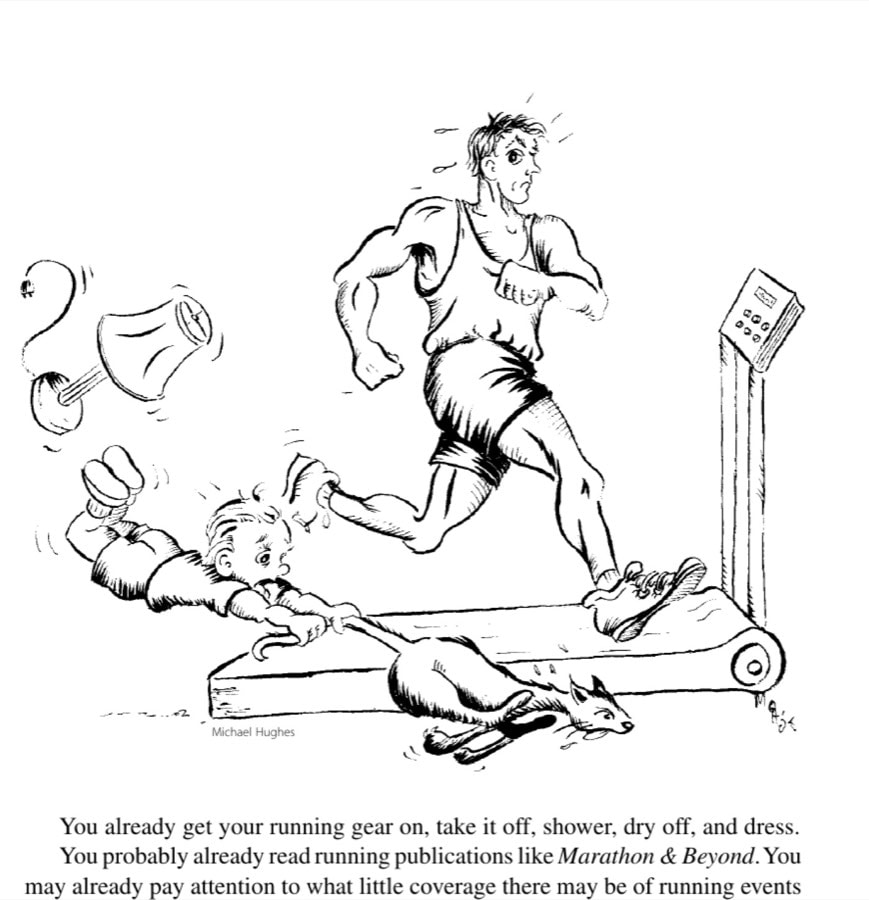
You already get your running gear on, take it off, shower, dry off, and dress. You probably already read running publications like Marathon & Beyond. You may already pay attention to what little coverage there may be of running events in the newspaper. You may read a running club’s newsletter. You may occasionally watch track and field or other running events on television.
You probably already arrange to run with friends. You commute to and from friends’ homes or wherever you meet to run. You visit with friends both before and after your runs. You probably already stretch—or know that you should. You may keep a running journal—or know that you should. You already wash and dry those smelly running clothes—or everyone else knows that you should.
You may invest considerable time going to and from races, waiting for them to begin, waiting for your trophies afterward. You probably read and watch for notices about more races. Most of this you already are doing, plus running a significant amount of time anyway. So, what’s left to add? How much more time will it take?
A few more minutes on some runs. Maybe no more time on most runs, but a few minutes on a few, and perhaps another hour or two running longer once a week or two. You are already making most of the investments. You just are not getting the maximum returns!
You have all of the fixed costs either way. If you run long, your marginal costs are exactly that: marginal. And the extra time to run long is really only a small percentage of the total time involved.
So, if you are paying the price already, why not go ahead and invest a bit more for a much greater return? If you do, you can shrink that extra time to a minimum. If you are creative enough and do not mind doubling up, you might even find that it takes no more net time to move from a short- or medium-distance runner to a long-distance runner. Here is how:
RUNNING AS A MEANS OF TRANSPORTATION Once upon a time, people in this country thought of their feet as means of transportation. Today people in other countries such as Kenya still walk and run to get places. Is it any wonder that in 1999 at least 106 Kenyan marathoners had run faster than 2:14 but only two Americans had?
When you want or need to go somewhere, what about running there? Sometimes I lift weights with a friend at a college campus a few miles from my home. If I run there, it takes longer than driving. But it takes considerably less net time to run there than to have to both run and then drive also. And what a great way to get loose before lifting, thus saving still more time since I don’t have to stretch or warm up when I get to the weight room.
One running buddy sometimes runs to another town to race 5Ks. He also bikes to races. He does well each time, but most important, with a minimum amount of time he grows stronger. I have run to another town to speak at the celebration of a high school basketball state championship team. Those young women and their parents did not mind that I was sweaty. They had perspired plenty achieving their success.
Need to go to the office? Want to go check on a friend? What about saving gas and building your strength? What about using those legs to run there? When you get back, your run will be done and then you can do other things.
TELEVISION TIME My wife and I did not like what television was doing to our family. It was taking our children away from us. It was taking us away from our children. I would find myself watching a ball game on television instead of playing one with our young sons.
So we pulled the plug, so to speak. With essentially three exceptions, the television is not turned on in our home. One exception is when my wife’s parents come to visit. Who am I to tell my beloved mother-in-law she cannot watch television or to deny my father-in-law the chance to watch sports with his grandsons? Their presence invokes what I call the Outlaws Rule. Another exception is the Final Four Rule, which means that we can watch the NCAA Finals, either men’s or women’s. (After all, the coach of the Tennessee Lady Vols is a friend from college days and we do bleed orange.) More recently, as my wife has wanted to encourage our boys to run, there has developed the Treadmill Rule.
Some other times Nancy will let our boys watch television in our home but only while one runs on the treadmill. If no one runs, no one watches—and off the television goes. Similarly, if there is a sporting event I really want to watch, then I’ll get on the stationary bike while the guys take turns on the treadmill. This way I waste less time watching sports and invest more time working out myself.
A treadmill means that if you want to watch television, then you can get your running done at the same time you are watching. Of course, this works better for those of you, like my wife, who are coordinated enough to run on a treadmill. (That is why I’m on the exercise bike.) This way, running and even running considerable distance do not have to take away from something else you want to do.
FAMILY MOVIE NIGHT Often our family celebrates the boys’ good grades, other accomplishments, or anything special with what we call “family movie night.” The guys get to pick out a movie at the rental place—with some adult supervision, of course—and we order pizza and have a great evening together as a family. If your children are like ours, when the movie goes on, they do not want to talk with us. They just want Nancy and me to be nearby. So, if we work out on the treadmill or bike in the same room with them, they are happy. A movie that lasts an hour or two is enough or more than enough for almost all my runs.
SOCIAL HOURS So-called progressive dinners are popular with some. Many people like to party, and many organizations and places have social hours. What about getting together with favorite friends and having a social hour—or two or three—running? For those who like to be part of a social elite or a members-only club, this is it. If you cannot run and talk, or at least listen while you run, then you cannot attend these events.
I am blessed with many wonderful friends. The ones I visit with most are the ones with whom I work, hunt, or run. It does not take many runs to get to know someone pretty well. Hills or speed work or a sufficiently long run will pull the hubris out of and the barriers down from most of us. And if the joy of the time together does not bring you closer, the shared suffering will!
When I think about the crowd at the downtown YMCA in Nashville that gathers weekday mornings about 5:15 or so, a smile comes to my face. When I think of the women and men from three or four counties in my home area who gather Sunday early before church for a long run, I cannot help but grin. When I think of friends in other places with whom I run when we are together, I happily recall memories of runs filled with more laughter.
If life is a banquet, some of the best feasting can take place on runs. Distance running helps make new friends and enjoy old friends as they become dearer still.
MEMORY DRILLS Among my happiest memories of running are two certifiably crazy guys who talked me into running with them while they trained for a marathon. One was a medical resident, another a law school classmate, and they decided they wanted to run a marathon. I had really only started running regularly a year before and had never run more than a 10K. I sure had more sense than to attempt something like a marathon.
But they were my friends, and so, eventually, I agreed to run with them on some of their training runs. Of course, as you probably already guessed, they hooked me. While I injured myself and did not complete a marathon with them, before I got hurt we had some great times.
At one point, one of them shared a poem he had memorized. Then I decided to type some lines on index cards. When we would get on a quiet stretch of road, one of us would read the lines and the other two would chant them back. It may sound silly and funny, but it actually was fun and edifying. It took our minds off of how many more miles we had to run and made the miles fly by quickly.
I never hear the Rev. Martin Luther King’s “I Have a Dream” speech without both thinking of that day in Washington in 1963 when he spoke it and also those days in Nashville in 1979 when we memorized much of it.
To this day, I can recite portions of Isaiah 40, pausing as we did when we memorized it on a long run: God gives strength to the weary and increases power to the weak. Even youths grow tired and weary,
and young people stumble and fall. But they who wait upon the Lord shall renew their strength. They shall mount up with wings as eagles. They will run and not be weary. They will walk and not be faint. Isaiah 40:29-31 What is it that you would like to memorize? What is it you wish you could quote, if only to repeat it to yourself or perhaps your children? Your runs can do double duty as your mind trains while your body also does.
RACE LESS I enjoy going to races. I am not fast enough to win anything unless I happen upon a race with small enough age categories and very few in my age group. But I enjoy the fellowship and seeing old friends and making new ones.
But I also know races typically involve driving to get a friend. Then traveling to a 5K or 10K in another town or another part of a city. Registering. Waiting around. Stretching. Warming up. Lining up. Running the race itself. Cooling down. Drinking or snacking or both. Waiting around. Too often waiting around and around and around. Watching the awards being given out. Then finally returning home.
In the same amount of time a short race takes, you could have done a threehour run, or at least a two-hour run. You may think I am kidding or exaggerating, but think again. Notice what time you leave for a race and what time you return.
Granted, racing is fun, and all of us need the fellowship and some of us want the competition. But in the same amount of time, you can get in the week’s long run—or two of them! So, what if you raced less and ran more? If you run races, you have time to run distance.
CROSS-TRAINING If you like other forms of exercise and do not want distance running to crowd those out, you are fortunate. Your distance running may be helped by your crosstraining. The summer and early fall before I completed my first marathon, I biked and swam a lot as I prepared for and competed in triathlons. I had a good running base coming out of the winter and spring, then slowly increased the distance on longer runs while still swimming and biking.
Printer: Insert Reebok Dealer ad
Printer: Insert Adirondack Marathon ad
Going into the first marathon, I thought I had made a mistake by doing the other exercises and not focusing exclusively on running. In fact, however, I think I avoided injuries as I increased the length of my runs by cross-training on days in between runs. In essence, I was better off running four and sometimes five days a week while biking and swimming the other days than if I had tried to run seven days a week. I avoided overuse injuries while still building fitness. So, if there is another sport or form of exercise you do not want to give up for running distances, don’t. Just alternate them and slowly build the distances you run when you do run.
DOES RUNNING LONGER TAKE LONGER? OK, now is the time for the confession. I admit that I do invest more time running now than when I never went beyond 10K, but it is not nearly as much time as you may think, and the rewards and benefits are greater.
The time costs may be greater, but so are the benefits. And I firmly believe the cost-benefit analysis shows that running more has more than paid off for me. I am healthier than I have ever been. The last time I saw my doctor, he said my cholesterol was too low and instructed me to eat more meat. My father had his first heart attack when he was a little older than I am now. I may go the same way and even younger, but distance running has given me a resting heart rate in the 30s. Distance running is one thing I can do to try to be around and see my boys grow up.
My beloved bride, Nancy, knows and will not hesitate to tell you how much happier I am when I am running regularly and running longer. Someone once said anyone who runs more than five miles is not doing it for physical health. I admit it. I do it more for my spiritual and emotional health.
Put all that together and the distance running is more than worth it. But then add in one more benefit. Just two days before I wrote this, one of our young twins announced he wants to do “a bunch of 5Ks” this year. And he says he would also like to “try some 10Ks, too.” His brother also wants to join with him.
The boys do have one condition, though. They want their old man and my young bride to run with them. Won’t those be “long runs” well worth the time?
This article originally appeared in Marathon & Beyond, Vol. 9, No. 2 (2005).
← Browse the full M&B ArchiveMore like this
1,000+ stories from 19 years of Marathon & Beyond
The complete archive of the legendary long-distance journal — digitized and free to read.
