

To the Next Acorn
When I crossed the finish line of the Vermont City Marathon, I mustered a very brief whoop of victory, and exactly one second later, I was leaning up against a fence, sobbing. My body ached, my legs wobbled, and my black visor had turned almost white with salty sweat. But what left me so weepy wasn’t physical pain but mental exhaustion. I had allowed those 26.2 miles to get the best of me; I had let the distance overwhelm me right out of the starting gate, allowed my mind to undermine what my body was trained for and capable of doing. I had no injury, illness, or heat wave to blame for such a challenging race. Despite all of the ways I trained myself to avoid them, I succumbed to my mental demons.
Going into this marathon, I knew how susceptible I was to the mental battle of distance running. During my first marathon seven months earlier and during many of the long training runs for this one, I had fought against the curse of self-doubt. My pattern on training runs looked like this: I run comfortably along, chatting with friends for about the first eight or 10 miles. I then begin to ache in my body from the pounding on the road and soon, often with little warning, I separate from the others, become quiet, and my thoughts go inward, quickly becoming lonely and dark. I feel the weight of fear of failure press onto my chest, and I nearly panic that I won’t finish the run. I have too far to go. I am not strong enough. I am not cut out for distance running. I can’t do this.
It is no small feat, then, that I never bailed on a long run, that I always succeeded in pushing through that dark space either by putting on some music, focusing on my breathing, or using positive self-talk. I would turn my focus onto what my body was doing and stay out of my head. Even just repeating: “I’m running. I’m running. I’m running” forced my attention to my legs. Eventually, the dark cloud of negative thoughts would dissipate, and I would come out the other side, usually, and not coincidentally, as the remaining distance got smaller and smaller, as the end was in sight. And yet, the next time I was halfway through a long run, my insecurities would come down upon me again.
▲
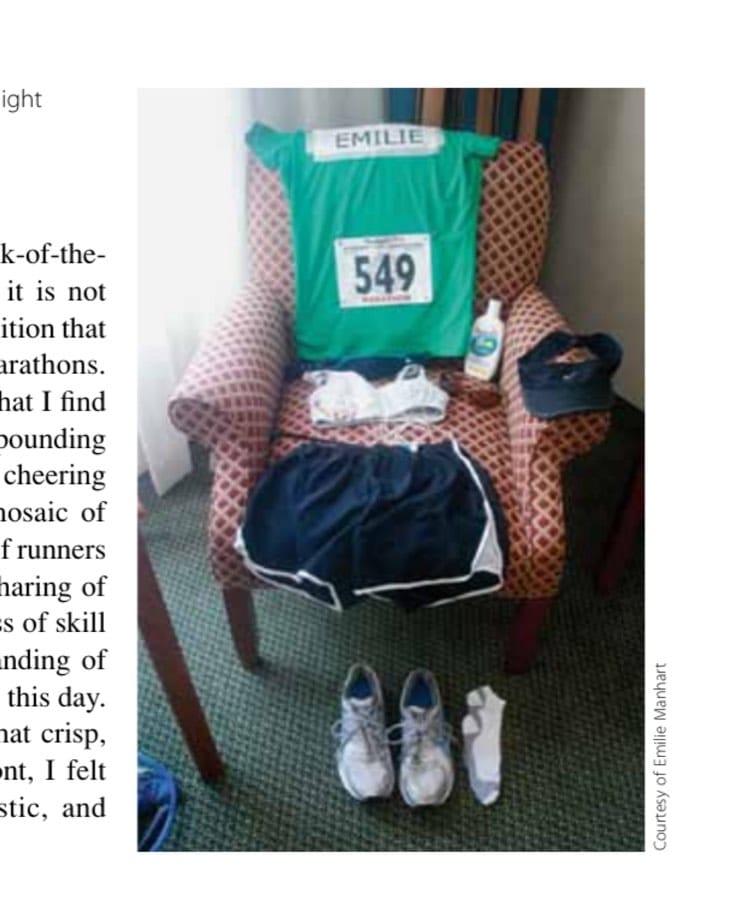
Everything is laid out the night before for a good race.
Courtesy of Emilie Manhart
I will always be a back-of-thepack distance runner, so it is not hope for victory or recognition that draws me to running marathons. It’s the spirit of the race that I find to be so electrifying: the pounding of feet, the solid wall of cheering spectators, the moving mosaic of bright colors as the pack of runners stretches out ahead, the sharing of a single purpose regardless of skill or pace, and the understanding of all the work that preceded this day. When the gun went off that crisp, spring morning in Vermont, I felt inspired, strong, optimistic, and determined to stay calm.
The onset of trouble In the first miles, I took in the crowds and the sounds of the cowbells ringing and even appreciated the charming Burlington neighborhoods I was weaving in and out of. And then, just like that, I hit mile five and my enthusiasm crumpled. Very suddenly, running felt too hard. My attempts at positive thoughts failed me, and I felt my chest tighten with worry that I would never finish. No one around me seemed to be having a hard time, so I beat myself up for that, too. What was wrong with me?
I suffered through painful mile after painful mile, unable to enjoy or even really notice the cheering crowds or the smiling volunteers handing me cups of Gatorade. Lake Champlain was out there shimmering in the sun and kept showing up through the trees, and I couldn’t force myself to see it or care. My demons spoke up. Mile eight: “This is too hard for you.” Mile 12: “You can’t do this.” Mile 15: “You have too far to go. You might as well quit.” After mile 18, I would stop to walk through a water stop and it would take a full minute to start running again. “And now you’re walking?”
When I made the final turn for the last five miles, the point at which most marathoners begin to really struggle, I wanted to die. By the time my body was
© brightroom.com
▲
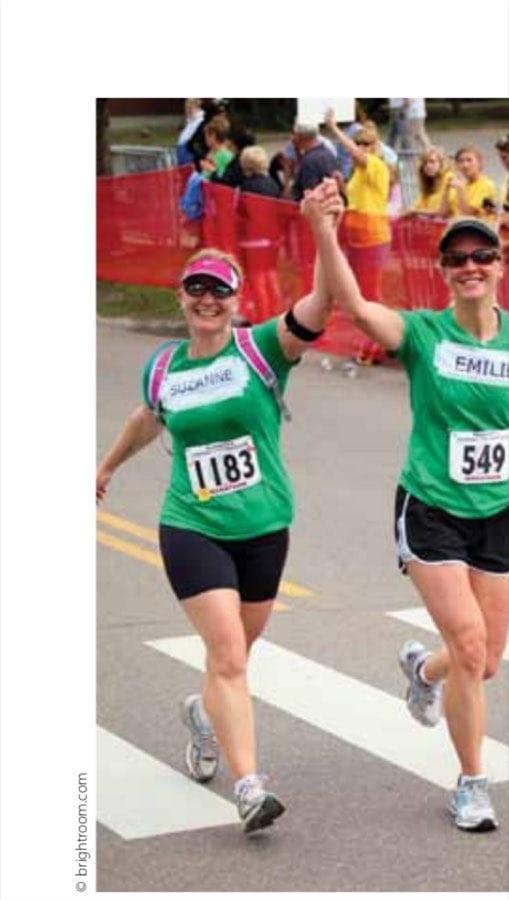
Emilie and her friend Suzanne find joy in the early miles of the marathon.
legitimately exhausted and my joints truly starting to ache, my mind had already done permanent damage. I had been too hard on myself, and I had very little mental stamina left to get me over those last miles.
I began a series of sad little bargains with myself: just run to that next tree. Just run to that next acorn. And so it went: mental fatigue, physical pain, and acorn counting. I eventually made it to mile 25, and
I could feel the end, so I ran. Crossing that finish line meant that I had covered the physical distance, but more important, it meant that those voices in my head would finally shut up. I had utterly failed at my most important goal for this race. I cried my way to the
postrace food tent and slumped into a chair in the corner. The mind games of the marathon were not over yet. My postrace misery, once I had rehydrated, wiped the salt crystals off of my face, and eaten some ice cream,
quickly shifted into relief and, miraculously, to joy. Only a few hours after I was sobbing at the finish line, the memories of my suffering were already fading away. My legs were stiff and tender to the touch. I was sticky with sweat, I had blisters
between my toes, and my hair was a wreck. And yet, with my finisher’s medal around my neck, I could feel the worst moments being deleted from my mind. I said aloud: “It’s happening: I’m starting to feel like that was all actually a lot of
fun after all.” What is that all about? Edmund Hillary said about climbing Mount Everest: “It is not the mountain we conquer but ourselves.” And so it was for me during the marathon. I remember it as “fun” because I accomplished it. I finished it, and for almost all of the mara
thon, I thought I would not. My success is not covering 26.2 miles, which, if you think about it, is a fairly random measure of fitness or endurance. If the marathon were only 22 miles, or if it were 35.7 miles, would I feel any differently about it?
If I had gotten to what I thought was the end of the marathon, and the crowds yelled at me that I had another mile to go, wouldn’t I have kept running? I admit that my body was not as close to collapse as I had told myself it was. It was my brain that was screaming: “Enough! Enough!” But if I absolutely had to keep running, say, in order to save my own life or the lives of my children, I know that I could have continued on.
After all, it’s only a marathon Thinking back on my experiences in Vermont, I’m still frustrated that I let my mind have such power over my body, which was perfectly well trained to run the distance without excessive suffering, or worse, without walking breaks. I have had many more long runs since then to think about my experience, and this is what I’ve come to: it is a privilege to train for and run a marathon. How lucky am I that the hardest thing I’ve ever had to do is to run a marathon? I’ve never been pushed to my physical limits by necessity, never experienced real danger, never had to escape a war zone with my children on my back or been forced to sleep outside in freezing temperatures. If we had to walk everywhere, lug water buckets from the river, or forage for our own food, we would probably not then drive to the gym in the evenings and hop on a treadmill on which we run and run and run but go nowhere.
ad
Courtesy of Emilie Manhart
▲
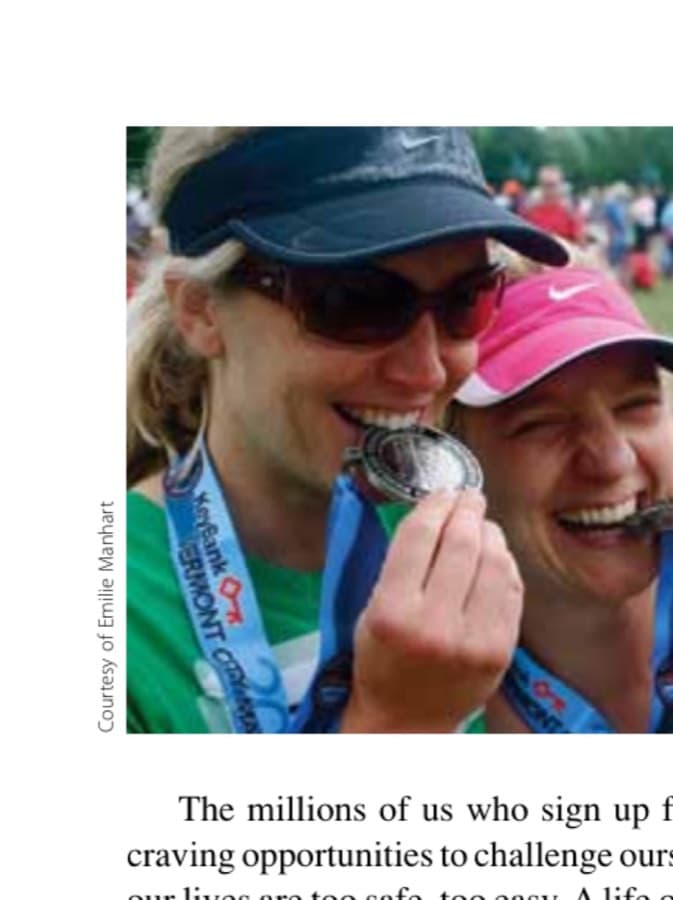
After the tears dried, Emilie is delirious with exhaustion and relief.
The millions of us who sign up for endurance events each year are clearly craving opportunities to challenge ourselves in meaningful ways, perhaps because our lives are too safe, too easy. A life of privilege means we get to choose the way
in which we want to test our limits. Aside from this gift of perspective and gratitude for having the kind of life that allows me to run for recreation, I have learned the other key strategy to help quiet demons during long runs: self-confidence. It may be stating the obvious for
me to say that the more long runs I complete, the less likely I am to be overcome with self-doubt. Sports psychologist Cheryl Hart writes: “Almost every issue I deal with among athletes comes down to self-confidence. In sports psychology, it’s
called self-efficacy: whether they believe they are capable of performing a specific task. Being new to the sport, they question whether [they] have the capability to even do it at all.” Self-efficacy is indeed what I lacked as a new runner. I have
learned to remind myself that just two years before my first marathon, I couldn’t run a mile. Every long run I enter into my training log means my legs are getting stronger, but more important, it means that my mind will begin to remember and
to trust that I have done this before. I can do this. I entered the world of running and signed up for my first race to see what I was made of, and the marathon has given me answers: I am strong and vulnerable,
capable and overly emotional. My heart swells a little every time I look at my race medals hanging on a hook in my bedroom, because I know what I went through to earn them; I know what they stand for. And even though I said I would never do
it again, I plan to run another marathon next year. But next time, I don’t want the primary focus to be overcoming my fears. I hope to cover those miles with my body, to trust my legs, to believe in all the long runs I have finished, and to just feel lucky
that I have the choice to be out there in the pack of like-minded souls.
This article originally appeared in Marathon & Beyond, Vol. 17, No. 1 (2013).
← Browse the full M&B ArchiveMore like this
1,000+ stories from 19 years of Marathon & Beyond
The complete archive of the legendary long-distance journal — digitized and free to read.
