

Tony, Here’s Why
Recently, my son sent me an e-mail. He was bummed out; his running was going poorly, his new job demanded too much of his time, and he was concerned that he might be slighting his young family. “Why run?” he asked. It just added to the pressures of life, and the running was unsatisfactory anyway. “Why did I continue running?” he asked me.
I knew the story well; I’ve asked it of myself, time after time, and I responded with my typical insensitivity. “Who said life was fair?” I also quoted one of Dr. George Sheehan’s favorites, “Anything worth doing is worth doing poorly.” In hindsight, these two glib remarks probably contradict each other. My point, at the time, was that running wasn’t always fun. Then why run? Why indeed? I rediscovered the answer, again, just a few days later. Hey, Kid, you know I’ve always run. I was running before you were born, and I’ve never stopped. As I write this, I’m 62, having started running in high school at 16. Maybe that’s why I’m small and lean (like you, on prunes), walk funny, and can’t bend down very well. Of course lots of guys my age are in this condition, but few of them ran so hard to get there, and even fewer still run.
We live in a great place for running: mild weather, hills that are either open grazing land or wooded, and natural beauty that others lust for. While I chose to retire here, I won’t speak poorly of any of the many other locations where we’ve lived. I’ve almost never met a place where I couldn’t run; sometimes it just takes a little imagination.
Today, I drove to the Point Reyes National Seashore and ran some coastal hills. It was a particularly bright and cool morning. In those three and a half hours of running, I saw more Fallow deer, quail with propeller beanies, and other wildlife than I saw people. Those few folks I met were there for the same reasons I was: to run, hike, look, and leave.
Starting down the dirt road that becomes Bear Valley Trail, the first turnoff on the right is a rough and rooty single track up a goodly hill that climbs 1,200 feet in two miles. It was part of my strategy to get all the elevation gain out of the way early; by the time I had mostly hiked to the top, I and the morning had warmed up.
I was just running easily, hiking some of the uphills, looking out from Coast Trail at the rock-strewn beach. One particular break in the dunes stopped me short. From where I approached, it seemed to be as clean and sharp a cut as a knife through cake. I went to the edge and looked down at least 100 feet into a steep ravine that finally spilled out on the water. The upslope hillside clearly showed how the soft, underlying soil had slumped and washed out. The phrase “ravages of nature” went through my mind. Whoa! Where did that thought come from? Not only was it a horse’s-ass pretentious expression, but it was wrong. This was nature: building up, wearing down, always changing. The run provided me a lot of time to think about what I was doing and why I was doing it. By the time I got back to the car, I knew, again, why I was out there, past the point of “fun.”
CREDENTIALS? My scrapbooks record about 40 formal marathons, with a handful of single-digit finishes, maybe eight organized ultras up to 50 miles, and that many unorganized ones. I’ve raced both roads and trails. My road PR of 2:38:38 was run in Oak Ridge—tied for fifth. Before heading home that day, I stopped in a McDonald’s and asked for a dozen regular burgers and a coffee. When I noticed the young woman lining up several cups, I corrected her. “Only one coffee. It’s all for me.” I never had any aspirations to go for 100 miles; the time commitment just seemed unreasonable. I’m not unreasonable, am I?
This morning, I took out a map of the United States and counted 34 states I clearly remember running in. Since we’ve driven across the country several times, it is likely I’ve run in a few more, wherever we had stopped for the night.
In addition to North America, there have been runs on four other continents and in 20 countries, from Sweden in the north, to New Zealand in the south, and Indonesia on the equator. Sometimes, my business-travel partners just had to wait in the bar while I ran.
I’ve met Bill Rodgers on the back roads of Natick and jogged the return leg of Peachtree with Frank Shorter, after he had beaten me. I’ve been asked, nicely, to keep my shirt on when running in both the land of Islam and the land of Baptists. I’m glad I could contribute to their agreement on something.
High school cross-country was my early favorite. In college, I didn’t run on the team. I wasn’t good enough and didn’t have the time. So I ran on my own, usually on the cross-country course. After I graduated, moving around, running out the door and down the road was often the most practical option. Whenever I could, I would find the back roads and trails. My opportunities to run were sometimes limited. I ran infrequently and imprudently in Vietnam. I chose not to run during short visits to Bangkok and Cairo, although I did do several vertical
laps of the 30-story hotel there. As my knees became increasingly cranky, I’ve pretty much left the roads alone.
TRAINING? I’ve never really trained. I’ve always just run. The only coach I ever had was in high school, and he had little time to spare for us third-stringers. I would sometimes pick a particular marathon two months ahead and plan an orderly approach to it. Often, however, I would just jump into a marathon of convenience. Sustained mileage of about 75 per week, with periodic speed work, kept me in a constant state of race readiness—good enough to race well, not good enough to win. I’ve tried the two-a-day, 100-mile week, and it just left me dazed and exhausted.
BATTLE SCARS? Yeah, I have some. When we came back from living overseas, I was in my early 40s. Shortly after a trail 50-miler, I did something bad. I don’t know what it was; I was on the high school track, doing easy 220s, and it was as if I had stepped in a hole and turned or stretched something in my foot, except that I hadn’t. Of course, I continued running on it. A favorite workout at the time was 30 minutes through town to the track, then 5 × 1 mile at just under six with a 440-walk recovery, and 30 minutes home. The pain continued to build until I finally went to an emergency room one weekend, after a 10K. The X-ray didn’t indicate any specific thing wrong. Months of doctor visits and additional tests never did identify any specific, correctible injury. I was on anti-inflammatories for months, but I continued running, until I was in nagging pain that shouted at me constantly. One day in Korea, I just had to quit kidding myself. It was stationary biking and alternative workouts for months. That pain persisted for most of the next 10 years, and my left heel is permanently enlarged.
Both knees have had meniscectomies, and every year one locks up and costs me weeks of gimping around. I can’t blame the two rotator cuff operations on running, but you can guess just what I would land on when taking a spill in a trail race. It’s also hard to fly with one wing tucked close to the chest.
Was it worth the injuries? Wrong! That implies that injuries and running are all behind me. Is it worth it? There is no neat answer to that. None of the running injuries were of the sort for which not doing any one run would have made a difference. (Chronic injuries?) The overuse would have accumulated, whether it had been on a Saturday in March or weeks, months, or years later. Either I am a runner, or I’m an ex-runner.
The one incident I would have avoided, had I really thought about it beforehand, was when my buddy dropped the tree on me and first tore up my rotator
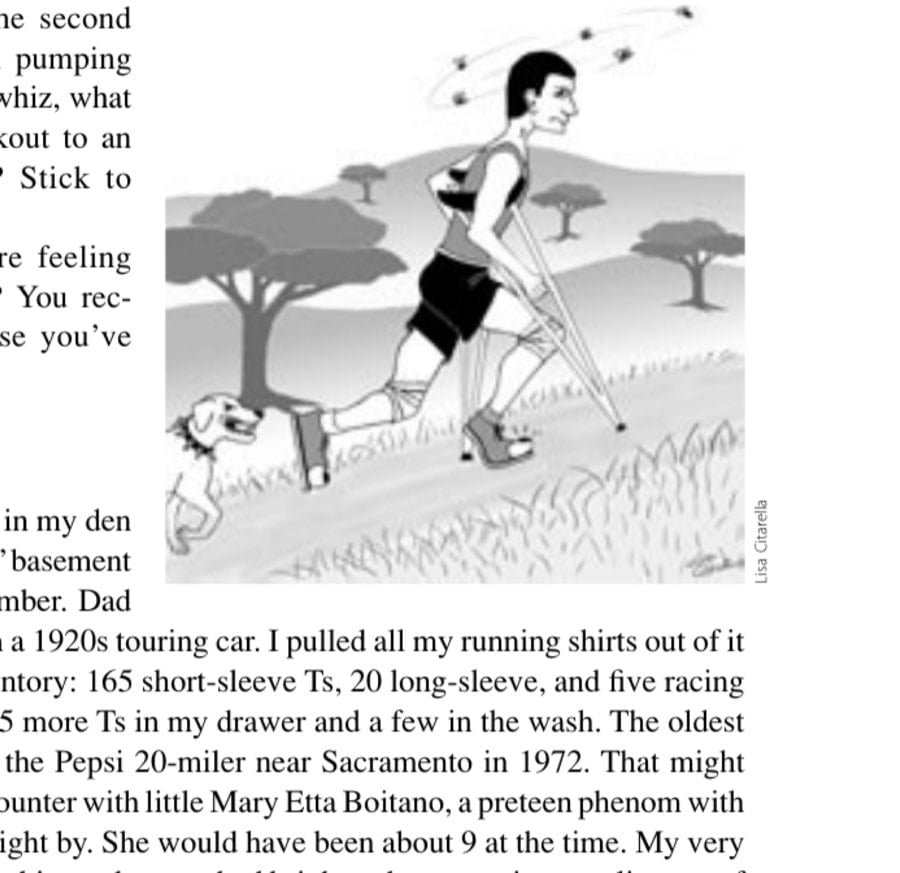
cuff. (Traumatic!) The second cuff injury was from pumping iron. Now, computer whiz, what is an alternative workout to an alternative workout? Stick to running, I guess. Downtime? You’re feeling bad about downtime? You recognize it only because you’ve been up!
The old trunk that sits in my den had been in my parents’ basement as long as I can remember. Dad said it’s the trunk from a 1920s touring car. I pulled all my running shirts out of it recently and took inventory: 165 short-sleeve Ts, 20 long-sleeve, and five racing singlets. There were 15 more Ts in my drawer and a few in the wash. The oldest I can identify is from the Pepsi 20-miler near Sacramento in 1972. That might have been my first encounter with little Mary Etta Boitano, a preteen phenom with pigtails who breezed right by. She would have been about 9 at the time. My very first T that wasn’t just white underwear had bright red roses on it, compliments of Four Roses whiskey. When your dad is in the liquor business, the stuff he brings home has ads on it. I quit buying Ts when it’s optional in the race entry fee.
Each shirt is a memory, and there are way too many to go into now. No question my favorites are the ones at which the original replacement drink flowed freely. Bud, this shirt’s for you! Some admittedly stretch the concept, such as my 1,000th Boston Hash. Recently, my T brought a startled reaction from someone who misread “Nipmuck Marathon” as “Nip Tuck Marathon” (you know, the TV show). The NYC Marathon of 1974 was sponsored by Olympic Airways, and my shirt has the five colored rings. Every four years, that shirt would get me smiles and nods as I ran down the street. Now we’re both a little faded.
My least favorite is a yuck-green doctor’s scrub from a hospital run in Mississippi. It reminds me of the smock I wore in kindergarten when I finger-painted; it also reminds me why I never wanted to be a doctor.
Before T-shirts and credit cards, plastic was what you won at a race, plastic trophies with ads that fell apart on the shelf. At Ann Arbor, I was given a trophy with a female figure on it. I really didn’t mind; I always considered her to be Ann. I won my age group in the 15-miler on Saturday, and Monday being a holiday, I did 50 on the well-marked course. Hi-C was my reload drink.
Lisa Citarella
MEMENTOS?
WHO WAS THAT MASKED MAN? In more than one town where I’ve lived, strangers have said to me, “Aren’t you the guy I see running all over?” A few years ago I met up with a man who had been on that overseas assignment with us 20 years before. We met again at a company function, along with our wives. The next day, he told me his wife had asked him, “Wasn’t that the man who was always running across the desert?” He told me he had replied, “He still does, dear, he still does.”
More recently, after I had returned here from an absence of 12 years, a man at church said, “You’re the guy I used to see at the track all the time, aren’t you? I was the coach there.” He would see me there again. Your old man’s an urban legend.
IN SUMMARY Now, I’ve heard that many people live happy, productive lives without running or any other form of exercise. Good for them. They have the right to risk their health. Maybe they spend their time watching TV and are good to their dogs. Some guys, and now women, have done more than I have, and to them I willingly bow and scrape. I’m satisfied with my accomplishments so far. The biggest kick is that I knew early on that I had no particular talent. But I found I enjoyed it, and I kept on doing it throughout the ’60s and ’70s when few others were. When they all started showing up outdoors in shorts, I was already there. Sometimes I resent the newbies, those who started running later in life, who tend to do very well in age-group competition. They don’t carry my scars.
A nonrunner might nod with a superior grin on his full face if I were to admit that some of my life’s greatest moments have occurred when running. Don’t tell Mom what I said, but you know what I mean. Pity the poor soul who has never experienced the exhilaration of individual, needless effort. The string of good memories continues to grow for me. For a conservative guy, racing has been my big risk-taking. I’m lucky that we’re now allowed to just run. It used to be race or retire. This new concept has allowed guys like me to continue doing what we enjoy. In my own mind, I am still racing, even if no one notices.
Junior, they say that after you die, your nails will keep on growing. If you ever find me inert on the trails behind the house, don’t do anything rash. Just take me home and lay me in a sunny spot. When my toenails have all grown back, it’ll be OK to plant me. You can have the shirts.
So, having given your question a little more reasoned consideration, is it worth it? Let me answer definitively with a question. “What do you think?”
This article originally appeared in Marathon & Beyond, Vol. 10, No. 5 (2006).
← Browse the full M&B ArchiveMore like this
1,000+ stories from 19 years of Marathon & Beyond
The complete archive of the legendary long-distance journal — digitized and free to read.
