

Training Characteristics of the 2004 U.S. Olympic Marathon Trials Qualifiers
One day, while at the track with one of my athletes who was training to qualify for the 2004 U.S. Olympic Marathon Trials, I began to wonder how other runners who had already qualified train. Was it similar to what I was having my athlete do? How many miles a week were they running? How much of their training volume was run at specific intensities? Did they use strength training? Unfortunately, there is little research on the long-term training of distance runners, leaving much unknown about training for endurance performance. Most of the information on the training of runners is found in books and magazines. So at that point, with the 2004 U.S. Olympic Marathon Trials right around the corner, I decided to take a scientific approach to find answers to the above questions.
Two hundred fifty-five athletes (104 men, 151 women) qualified for the 2004 U.S. Olympic Marathon Trials by running 2:22:00 or faster (men) and 2:48:00 or faster (women) within two years of the event. They were all given a questionnaire asking about their physical characteristics, training history, financial support, personal records for various distances, and training characteristics. All questions pertained to the entire year preceding the 2004 Olympic Trials. Ninety-three athletes (36.5 percent) responded to the questionnaire (37 men and 56 women) and were divided into two categories—elite (sub-2:15 for men, sub-2:40 for women) and national-class (2:15 to 2:22 for men, 2:40 to 2:48 for women).
Physical characteristics and performance
If you have ever seen a 200-pound person run a marathon, you know that lighter is better. Low body weight increases economy (the amount of oxygen used at a given speed) and body-temperature regulation and decreases shock upon landing (Berg 2003). So it’s not surprising that the U.S. Olympic Marathon Trials qualifiers weigh less than the general population. But don’t think that if you keep losing weight, you will get faster. At the level of performance of these runners, there was no relationship between how fast they ran a marathon and their weight, height, and age, because elite runners had similar physical characteristics as national-class runners (see Average Physical and Performance Characteristics table below).
As expected, marathon performance was significantly correlated to performance for 5,000 meters, 10,000 meters, and the half-marathon. Since races lasting longer than three minutes depend primarily on aerobic metabolism, it is no surprise that those who are fastest at 5,000 and 10,000 meters are also fastest in the marathon. It is no coincidence that all six athletes who made the Olympic marathon team were very successful on the track at shorter distances before moving up to the marathon.
Training history
If you usually run by yourself or have been trying to get faster on your own, you are not alone. Even Olympic Trials qualifiers train alone and/or without a coach. An interesting finding of this study is the number of Olympic Trials qualifiers who either did not have a coach or trained alone during the year preceding the Trials. Only 51 percent of men and 69 percent of women trained with a coach, and 65 percent of men and 68 percent of women trained alone. If those numbers are not revealing enough, 46 percent of men and 29 percent of women trained alone and without a coach!
It is unheard of for Olympic Trials-caliber athletes in other Olympic individual sports, such as swimming, speed skating, gymnastics, and cycling, to train by themselves and without a coach. While the lack of equipment or facilities needed makes it easier for runners to train in solitude, the above numbers indicate the need to organize coached training groups for marathoners who exhibit potential, as this surely represents an area in which these marathoners can improve their performances.
Financial support
Sixty-two percent of men (elite: zero; national-class: 72 percent) and 57 percent of women (elite: 45 percent; national-class: 60 percent) had a full-time job as their primary source of income. Because national-class runners were significantly more likely to have a full-time job than elite runners, the obvious question is, “Does having a full-time job prevent a runner from becoming elite?” While not working full time certainly allows more time for training, only the elite women ran more than national-class women; the elite and national-class men ran similar volumes.
Training volume
Despite their relative homogeneity in performance and their elite status among the nation’s marathoners, the U.S. Olympic Marathon Trials qualifiers trained very differently from one another, as there was great variability in the data. While the many different responses suggest that there may be many paths to success, it may also be an indication that these runners, especially those who train alone and/or without a coach, are not optimizing their training.
For the year preceding the Olympic Trials, the male marathoners averaged 90 miles per week with a peak mileage of 120, while the female marathoners averaged 72 miles per week with a peak mileage of 95. The men also ran more times per week and did more long runs (≥20 miles) than did women (see Average General Training Characteristics table on the next page).
Although women have been running marathons in the Olympics for more than two decades, there may still be a lingering belief that women are at greater risk of injury than men and therefore should not run as much as men. However, female runners don’t have a greater risk for stress fractures than do male runners as long as they don’t have one or more of three associated characteristics—menstrual ir-
Average Physical and Performance Characteristics
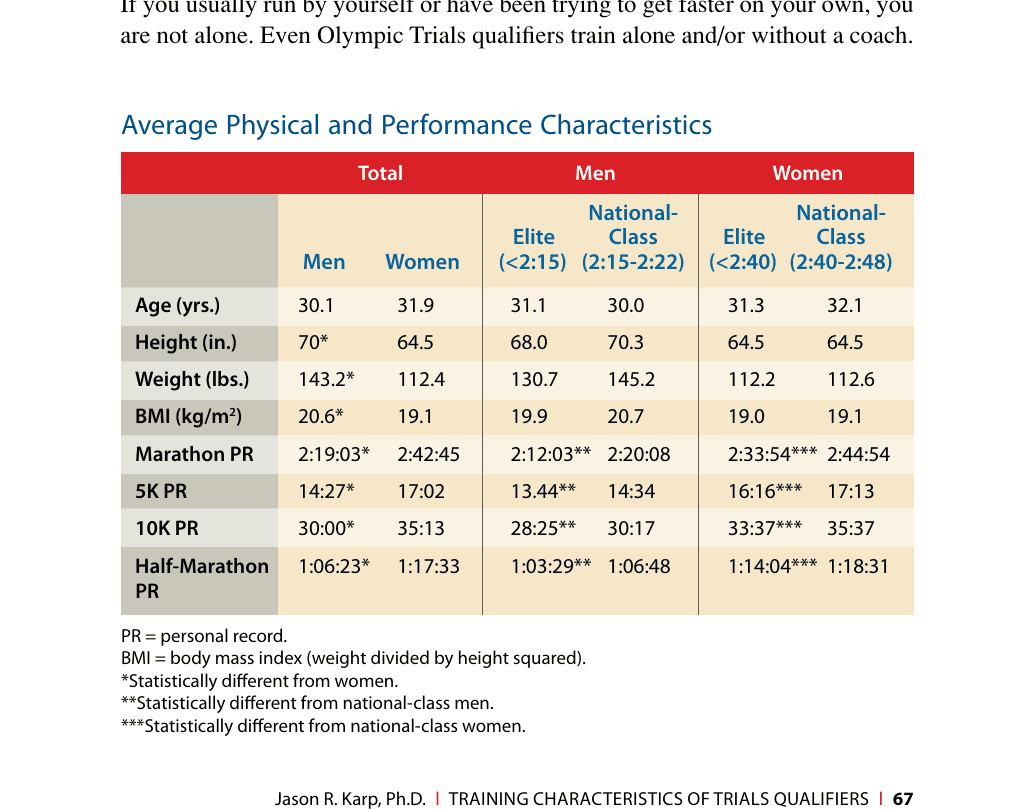
| Total | Men | Women | ||||
|---|---|---|---|---|---|---|
| Men | Women | Elite (<2:15) | National-Class (2:15-2:22) | Elite (<2:40) | National-Class (2:40-2:48) | |
| Age (yrs.) | 30.1 | 31.9 | 31.1 | 30.0 | 31.3 | 32.1 |
| Height (in.) | 70* | 64.5 | 68.0 | 70.3 | 64.5 | 64.5 |
| Weight (lbs.) | 143.2* | 112.4 | 130.7 | 145.2 | 112.2 | 112.6 |
| BMI (kg/m²) | 20.6* | 19.1 | 19.9 | 20.7 | 19.0 | 19.1 |
| Marathon PR | 2:19:03* | 2:42:45 | 2:12:03** | 2:20:08 | 2:33:54*** | 2:44:54 |
| 5K PR | 14:27* | 17:02 | 13:44** | 14:34 | 16:16*** | 17:13 |
| 10K PR | 30:00* | 35:13 | 28:25** | 30:17 | 33:37*** | 35:37 |
| Half-Marathon PR | 1:06:23* | 1:17:33 | 1:03:29** | 1:06:48 | 1:14:04*** | 1:18:31 |
PR = personal record.
BMI = body mass index (weight divided by height squared).
*Statistically different from women.
**Statistically different from national-class men.
***Statistically different from national-class women.
regularities, disordered eating, and osteoporosis—collectively called the female athlete triad (Nattiv 2000).
Another potential reason why the men ran more than the women is that the men’s U.S. Olympic Marathon Trials qualifying standard is more difficult to achieve than the women’s qualifying standard. While the men’s standard (2:22) was 13.6 percent (17 minutes) slower than the men’s world record (2:04:55), the women’s standard (2:48) was 24 percent (32.5 minutes) slower than the women’s world record (2:15:25). Simply put, in order to qualify for the Olympic Trials, men had to attain a better performance than did women. The more difficult men’s standard is likely due to their greater depth of competition. While 99 men ran within 13.6 percent of the world record, only nine women ran within that same percentage of the world record. Other factors that may have caused differences in training volume between sexes include time to train, coaches’ prescriptions, and prior training experience.
Among these runners, the amount of training has a greater influence on women’s marathon performance than it does on men’s. A number of training characteristics were statistically different only between elite and national-class women and statistically correlated only to women’s marathon performance, likely due to their greater range of performances. Elite women trained for more years, ran more miles, and ran more times per week compared with their national-class counterparts. Moreover, women’s marathon performance was correlated to each of these training characteristics. Of these, the number of weekly runs explained the greatest amount of variance (41 percent) in women’s marathon performance. Thus, the better female marathoners (but not the better male marathoners) simply run more.
One of the criticisms of U.S. distance runners is that they don’t run enough or as much as their predecessors of the 1970s and 1980s. From the little scientific documentation available, it seems that the marathoners who qualified for the 2004 U.S. Olympic Trials do run as much as their predecessors. Pollock (1977) reported that elite male U.S. marathoners of the 1970s ran 100 miles per week, while Sparling, Wilson, and Pate (1987) reported that elite female U.S. long-distance runners of the 1980s ran 75 miles per week. However, today’s American marathoners run less than their foreign counterparts (see Amount of Training at Different Intensities of U.S. Olympic Marathon Trials Qualifiers and Foreign Runners table on page 75). Billat et al. (2001) reported that male French and Portuguese elite and high-level runners ran 128 and 104 miles per week, respectively, and female elite and high-level runners ran 103 and 93 miles per week, respectively. Billat et al. (2003) reported that male Kenyan runners who did little speed work ran 108 miles per week, while those who did lots of speed work ran 98 miles per week over an eight-week period. Elite Kenyan female runners who did lots of speed work ran 79 miles per week.
Training intensity
While speed work seems to be the preferred method of training at most high schools, adult distance runners traditionally perform most of their training at a low intensity. In my study, men ran 74.8 percent (elite: 75.9 percent; national-class: 74.9 percent) and women ran 68.4 percent (elite: 70.7 percent; national-class: 67.8 percent) of their yearly mileage slower than marathon pace, with no statistical difference between elite and national-class runners. Lots of aerobic running induces many physiological and biochemical adaptations needed for good endurance, including increases in the number of red blood cells and hemoglobin to transport oxygen, a larger muscle-capillary network to provide more oxygen to your muscles, and an increase in muscles’ density of mitochondria, microscopic “energy powerhouses” responsible for aerobic metabolism. However, it has not been scientifically tested whether performing the majority of training at a low intensity, at the expense of more race-specific training, is the most effective way to train.
Although it makes practical sense to train at race pace, this was not the strategy of U.S. Olympic Marathon Trials qualifiers. Men averaged only 9.7 percent (elite: 7.5 percent; national-class: 9.9 percent) and women averaged 12.8 percent (elite: 12.1 percent; national-class: 13.0 percent) of their yearly training at marathon pace, with no statistical difference between elite and national-class runners. Also, despite the importance of the lactate threshold to distance-running performance and the closeness of its corresponding speed to marathon race pace, men averaged only 10.3 percent (elite: 12.6 percent; national-class: 10.0 percent) and women averaged 12.3 percent (elite: 10.2 percent; national-class: 12.8 percent) of their yearly training at lactate-threshold (tempo) pace, yet again with no statistical difference between performance levels. Despite the relatively low amount of race-pace training, U.S. marathoners run more of their weekly training distance at marathon pace and lactate-threshold (tempo) pace than do foreign distance runners. Both men and women increased the amount of training performed at marathon pace and tempo pace throughout the year, as time got closer to the Olympic Trials.
The marathoners did very little interval training to prepare for the Olympic Trials, averaging only one interval workout a week throughout the year. Men averaged 5.2 percent (elite: 4.0 percent; national-class: 5.2 percent) of their yearly training at or faster than 10K race pace and 3.0 percent (elite: 1.0 percent; national-class: 3.1 percent) at or faster than 5K race pace. Women averaged 6.5 percent (elite: 7.0 percent; national-class: 6.4 percent) of their yearly training at or faster than 10K race pace and 4.8 percent (elite: 5.5 percent; national-class: 4.7 percent) at or faster than 5K race pace (see Average Specific Training Characteristics table below). Not only did men and women do similar amounts of speed work, so did elite and national-class athletes. Now, if you are wondering,
“If elite runners don’t do more high-intensity training than national-class runners, what makes them elite?” you have just asked the million-dollar question. This finding suggests that improvements in performance for runners already at the national-class level do not result from a greater amount of intense training, but rather from their genetic ability.
It appears that U.S. marathoners run slightly less at high intensities than their foreign counterparts. While it is difficult to claim that the success of foreign athletes, specifically the Kenyans, is a result of their high percentage of training at high intensities, it is possible that training at high intensities contributes to their performances. Coetzer et al. (1993) found that elite black South African runners, who trained at a higher average intensity than their white counterparts, were able to sustain a higher percentage of their V̇O2max during races longer than 5,000 meters. The black runners also had a statistically lower blood-lactate concentration after submaximal and maximal exercise and took a statistically longer time to grow fatigued during repetitive quadriceps isometric contractions. While a high weekly training volume at submaximal intensities improves endurance performance by increasing capillary and mitochondrial volumes, training at a high intensity is more effective for increasing V̇O2max (Billat 2001). Further improvements in endurance performance have been shown to occur by adding interval training to elite distance runners’ training programs (Billat et al. 2002).
Strength training
Collectively, U.S. marathoners included little strength training in their training programs. During the year of training preceding the Olympic Trials, the men averaged less than one and the women averaged less than two strength-training workouts per week. About half of the runners did no strength training at all, and some used strength training only during periods of the year when they were injured and couldn’t run. So, either the nation’s elite marathoners do not believe that strength training will make them better marathoners, or they did not have the time to do strength training because of the time they devoted to running.
Whether strength training is beneficial for distance-running performance is questionable. Strength training may lead to improved endurance performance in previously untrained subjects (Marcinik et al. 1991), while more-experienced, highly trained athletes may not benefit from traditional strength training (Helgerud 1994) and may even be hampered by it, especially if it is performed at the expense of more sport-specific training (Hoff, Helgerud, and Wisløff 2002). Some research has shown that explosive strength training (Hoff, Helgerud, and Wisløff 1999; Paavolainen et al. 1999) and plyometric training (Spurrs, Murphy, and Watsford 2003; Turner, Owings, and Schwane 2003) improve running economy and endurance performance by increasing muscle-power production.
Altitude
Unlike East African distance runners, whose altitude training has become legendary through the popular media, only 24 percent of male and 16 percent of female U.S. Olympic Trials qualifiers trained at altitude, and they did so only because they already lived there. The success of the Kenyan and Ethiopian distance runners notwithstanding, there is little scientific evidence that training at altitude is better than training at sea level for improvements in V̇O2max or sea-level performance (Chapman and Levine 2000; Wilber 2001). There is some evidence that living at altitude and training at sea level (that is, “live high/train low”) may improve sea-level performance (Stray-Gundersen, Chapman, and Levine 2001) by inducing the red blood cell production associated with altitude exposure while maintaining sea-level training intensity. Interestingly, most of the best U.S. distance runners have historically been born and trained at sea level. If altitude were the secret to success, you would expect a disproportionate number of elite U.S. distance runners to live at altitude. Although U.S. distance runners train less at altitude than do the East Africans, it is unlikely that this is the reason for their apparent inferiority.
Beyond running at a pace slower than marathon pace, there is no consensus among U.S. Olympic Marathon Trials qualifiers as to how to train for the marathon. Because many of these athletes train alone and without a coach, further research is warranted on the reasons why they train the way they do. There needs to be greater communication between coaches and scientists to understand which characteristics are most important for the marathon.
So if you want to make it to the next Olympic Marathon Trials, train as these runners do. And if you still don’t qualify, choose different parents.
References
- Berg, K. 2003. Endurance training and performance in runners: Research limitations and unanswered questions. Sports Medicine 33:59-73.
- Billat, V. L. 2001. Interval training for performance: A scientific and empirical practice. Sports Medicine 31:13-31.
- Billat, V. L., A. Demarle, M. Paiva, and J-P Koralsztein. 2002. Effect of training on the physiological factors of performance in elite marathon runners (males and females). International Journal of Sports Medicine 23:336-341.
- Billat, V. L., A. Demarle, J. Slawinski, M. Paiva, and J-P Koralsztein. 2001. Physical and training characteristics of top-class marathon runners. Medicine and Science in Sports and Exercise 33:2089-2097.
- Billat, V. L., P. M. Lepretre, A. M. Heugas, M. H. Laurence, D. Salim, and J-P Koralsztein. 2003. Training and bioenergetic characteristics in elite male and female Kenyan runners. Medicine and Science in Sports and Exercise 35:297-304.
- Chapman, R. F., and B. D. Levine. 2000. The effects of hypo- and hyperbaria on performance. In: Garrett, W. E., and D. T. Kirkendall, eds. Exercise and Sport Science. Philadelphia: Lippincott Williams & Wilkins, 452-453.
- Coetzer, P., T. D. Noakes, B. Sanders, M. I. Lambert, A. N. Bosch, T. Wiggins, and S. C. Dennis. 1993. Superior fatigue resistance of elite black South African distance runners. Journal of Applied Physiology 75:1822-1827.
- Helgerud, J. 1994. Maximal oxygen uptake, anaerobic threshold and running economy in women and men with similar performances level in marathons. European Journal of Applied Physiology and Occupational Physiology 68:155-161.
- Hoff, J., J. Helgerud, and U. Wisløff. 2002. Endurance training into the next millennium: Muscular strength training effects on aerobic endurance performance. American Journal of Medicine and Sports 4:58-67.
- Hoff, J., J. Helgerud, and U. Wisløff. 1999. Maximal strength training improves work economy in trained female cross-country skiers. Medicine and Science in Sports and Exercise 31:870-877.
- Marcinik, E. J., J. Potts, J., G. Schlabach, S. Will, P. Dawson, and B. F. Hurley. 1991. Effects of strength training on lactate threshold and endurance performance. Medicine and Science in Sports and Exercise 23:739-743.
- Nattiv, A. 2000. Stress fractures and bone health in track and field athletes. Journal of Science and Medicine in Sport 3:268-279.
- Paavolainen, L., K. Hakkinen, I. Hamalainen, A. Nummela, and H. Rusko. 1999. Explosive-strength training improves 5-km running time by improving running economy and muscle power. Journal of Applied Physiology 86:1527-1533.
- Pollock, M. L. 1977. Characteristics of elite class distance runners—overview. Annals of the New York Academy of Sciences 301:278-282.
- Sparling, P. B., G. E. Wilson, and R. R. Pate. 1987. Project overview and description of performance, training, and physical characteristics in elite women distance runners. International Journal of Sports Medicine 8, Suppl 2:73-76.
- Spurrs, R. W., A. J. Murphy, and M. L. Watsford. 2003. The effect of plyometric training on distance running performance. European Journal of Applied Physiology 89:1-7.
- Stray-Gundersen, J., R. F. Chapman, and B. D. Levine. 2001. “Living high—training low” altitude training improves sea-level performance in male and female elite runners. Journal of Applied Physiology 91:1113-1120.
- Turner, A. M., M. Owings, and J. A. Schwane. 2003. Improvement in running economy after 6 weeks of plyometric training. Journal of Strength and Conditioning Research 17:60-67.
- Wilber, R. L. 2001. Current trends in altitude training. Sports Medicine 31:249-265.
Is this a trick question?
That was my first thought when Jan asked me, “Do you want to go to the Cayman Islands in December?” In central Illinois, December is when you start to get some really cold days, along with that first 1-inch snowfall that makes you think that all the other drivers must have just moved here from Florida, because nobody appears to be able to drive in snow. And then some more cold. And wind.
So, despite knowing nothing about the Cayman Islands, I gambled that “yes” was the right response.
Turns out, there are occasional perks to being married to the publisher of Marathon & Beyond. The plan was for us to fly to Grand Cayman, visit the sights, run the race, visit some more of the island, and then write an article for the magazine. Worked for me. And we couldn’t have left Illinois at a better time. It was snowing and 17 degrees on our drive to O’Hare in early December.
Three islands
The Cayman Islands are three peaks of a submerged mountain range running west into the ocean from the eastern end of Cuba. This British territory consists of a small island called Grand Cayman and two much smaller islands called Little Cayman and Cayman Brac.
If the ocean level were a little higher, the Cayman Islands would barely exist. Much of Grand Cayman is less than 12 feet above sea level, and its highest point reaches 80 feet. The Bluff on Cayman Brac, at 140 feet, is the highest point among the three islands. So, good news—we would not have to face the double whammy of hills and heat in the race. Unlike other Caribbean islands, Grand Cayman is completely flat.
It’s also a sitting duck for hurricanes. On September 12, 2004, the category 5 Hurricane Ivan gave Grand Cayman a taste of higher sea levels. A storm surge
This article originally appeared in Marathon & Beyond, Vol. 13, No. 3 (2009).
← Browse the full M&B ArchiveMore like this
1,000+ stories from 19 years of Marathon & Beyond
The complete archive of the legendary long-distance journal — digitized and free to read.
