

Training With The Gunks
INTRODUCTION
Whether this is your first marathon and your goal is simply finishing or this is your last marathon before you hang up your jock strap or Jog Bra, read on. If you are one of the millions of aging runners, like me, who still believes that your best marathon lies ahead, read on.
Finally, if you have decided that you don’t want to simply run the marathon but want to race the marathon, read on. Train with us, the Shawangunk Runners, and have the race of your life. It won’t be easy, for there is no magic formula. But if your desire is great enough and you are committed to devoting an entire training season to racing the marathon, welcome to the Gunks.
Me? My name is Fred Stewart. I’m an army brat who grew up with runners, as my father was the army track and field coach back in the early ’60s. Every day as the sun would set, that’s where I found myself, on the track at Fort Campbell, Kentucky, where the Army track team was based. Even then I was intrigued with training techniques and used to go to all the meets and watch the great runners of the day compete. Training was much different back then. For example, every day in practice, the half milers would usually go out and race a hard half, jog around for an hour or so, and come back and do it again. It seemed to make sense at the time, but in retrospect, although my father loved the sport, I can’t say he was on the cutting edge of sports physiology.
I ran in high school, but my passion waned and I didn’t run again until late in the running boom of the ’70s. I ran the New York City Marathon in 1985 and 1986. I forget my 1986 time, but I know I ran 3:25 in 1987. My training was highly suspect. I ran the same loop most days with little deviation and logged in a long run on the weekend. For various reasons, I didn’t run again until 1997 when I totaled a mere 510 miles. I would run in the good weather but pack up
my running gear at the first sign of winter. When all was said and done, I was training each year in an attempt to get back to where I had ended the year before. Realizing this, I knew that I had to commit to a lifestyle change. I decided that I would train through the winter. As a motivational tool, I told everyone who would listen (or not). Friends, family, workmates, runners, nonrunners—everyone knew that I ran on Mondays, Wednesdays, and at least one day on the weekend.
On Mondays, the Onteora runners, a local Kingston, New York, group, would meet at Dietz Stadium and run an eight-mile loop around Kingston. The group could be substantial during the nice weather, but it really thinned out in the winter. I remember one evening in particular. The sky was dark, and you could barely see a foot ahead of you. It was a full-scale blizzard. Despite the travel advisory, I trudged out to Dietz. I was shocked when not only Joe and Robert showed, two of the Monday night stalwarts, but also Kevin. I was dumbfounded. Yet when I asked why, Kevin simply said, “Stew, we just couldn’t have you run by yourself.” I’m a sap and never told him, but it brought a tear to my eyes. My first run of 1999 was on January 2, and my last run of the year was on December 31. I’ve been running year-round ever since with an occasional lull due to injuries. Currently I’m 56 and am training for a marathon in Richmond, Virginia, on November 13. My goal is to break three hours. Call me Stew. Running is my passion; I’m a Shawangunk Runner. To the rest of the local running community, we’re known as “the Gunks.”
The Gunks usually run two marathons a year. Our spring marathon for the past three years has been the Key Bank Vermont City Marathon held in Burlington. Our fall marathon has varied. In 2001, we ran Portland, Maine—to date my PR of 3:03:53. The next year we ran Philly, and last year we ran Albany, my personal disaster. Have you ever run a marathon and at mile one felt out of sorts? Yes, mile one! I should have stopped then. The pace was not too quick, but it just didn’t feel right. Mile two was just as bad, and I groused the entire way to a 3:19:56.
Looking back, I’m certain my attitude played a major part of my undoing, but to struggle so early is the most awful thing that can happen to any marathoner. It was patently ugly. I immediately began scrambling for what I termed my redemption marathon. Knowing that I would get no support from most of the crew, I enlisted Kevin as my sole training partner for our secret marathon, and we trained together for eight weeks. We would steal away on many days for our secret marathon pace runs, and on Fridays we would ordain various conflicts that forced us to miss the regular workout, while instead we would run long tempos on the Hurley Flats. Eight weeks later we flew with Kathee (my fiancée), into Jacksonville. I was somewhat redeemed with a 3:07:48, but it did not go over very well with the Gunks. They felt betrayed. Chrissy took it particularly hard and went so far as to say he didn’t know if he could ever trust me again. It was as though I’d had
an affair and was attempting to make amends. For the longest time, whenever Kevin or I could not make a workout, someone would invariably say, “Oh, off to another secret workout?” Eventually the gang forgave, and we began training for Vermont in mid-December 2003. Vermont is fun. We rent a bed-and-breakfast near the start and book the entire house. The race itself is on Sunday, and Memorial Day is the next day, so we stay over and have a big party. The marathon and the relay are a favorite of our local running community, so we get quite a group and have a grand time. We traditionally have a pool where everyone guesses the various times of all the local participants with a point system depending on whether you are within one, three, five, or 10 minutes. We randomly rotate the reading of the entries, and I remember last year Chrissy saying, “Oh, geez, this must be worth bonus points. Anne correctly predicted that Stew would crash and burn.” He was kidding, but you get the drift. We certainly have a good time.
Training this year was not as much fun. The winter was unusually bitter, and running seemed harder than in previous years, but nonetheless, there we were once again: Burlington, Vermont, May 30. I ran OK—3:11—but once again short of my goal. I found myself second-guessing my entire training program. I knew I hadn’t done enough speed workouts. I could have done this; I should have done that.
It hit me during the following week. As a group, the Gunks are quite serious about their training and their marathon racing, yet we tend to train the same year after year. We do have fun, but I think the training has gotten stale. I decided to take the initiative.
Through the years, I’ve studied everything from Anderson to Zen regarding marathon training. Anything I could get my hands on: the journals, the Internet coaches, the computer programs, Chi running, heart rate training—everything. I knew I had to do some tweaking. During this time, I’ve developed a list of my favorite workouts. In fact, one year I told Chrissy about my favorite eight workouts and during the next training season he ran every one with me on the track. He even slummed it and ran my pace. The key is to fit in the pieces to form a schedule that encompasses all the elements required to race the marathon at your best level, while still maintaining flexibility and of course avoiding injury. Believe it or not, it’s actually more difficult than it seems. All of a sudden, you find yourself with a TLT (tempo-long-tempo) scheduled during a week in which you’ve already had a difficult speed workout and a tempo workout, so you cross it out and put it back a week. No, there’s a race on that weekend. How about the week before? No, that week has Yassos and a killer tempo run. But when all was said and done, I had a schedule with enough long runs to build my endurance, enough speed work to quicken my pace, and finally enough tempo (my true love) to enable me to race the entire 26.219 miles. Make no mistake, tempo will give you the edge that will allow you to run your marathon faster than you could ever
imagine. Unfortunately, it might also be the one ingredient that persuades you to bail out and try another program.
THE CAST
Fred Stewart
So here we are, the Shawangunk Runners, committed to running the race of our life. Join us. Kevin Roach is 43 and not a bad marathoner. He can clip off a mile in five minutes and a 10K in 36 minutes. His marathon best is 2:57. We won’t see much
of Kevin in the early weeks of the program, as he has recently had a minor surgical procedure and is using this as an opportunity to take some time off. Kevin’s Richmond goal is an aggressive 2:52. Chris Peone, age 45, is faster than Kevin but has given up on the marathon.
He’s a great natural runner, simply beautiful to watch, but he seems to have some gastrological problem. We all know he can run 6:20s forever, certainly has on our long Sunday runs, but come race day, you’ll eventually find him alongside
the racecourse heaving his guts up. Although he officially has given up on the marathon, Chrissy still trains with us and in fact teamed up with Jim to run the two-man marathon relay in Vermont. They won the masters division easily, av
eraging 6:17. Chrissy will join us in Richmond but will run the 8K along with Kathee Mayer and Laurel Krastel.
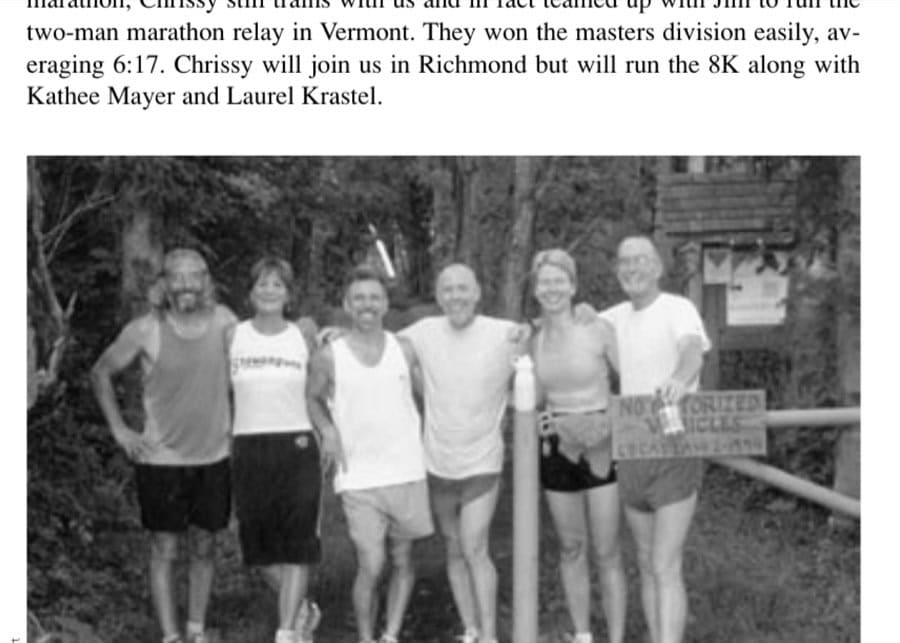
▲ The Gunks (from left)—Lou, Kathee, Chrissy, the author, Anne, and Kevin—on the Rail Trail.
▲
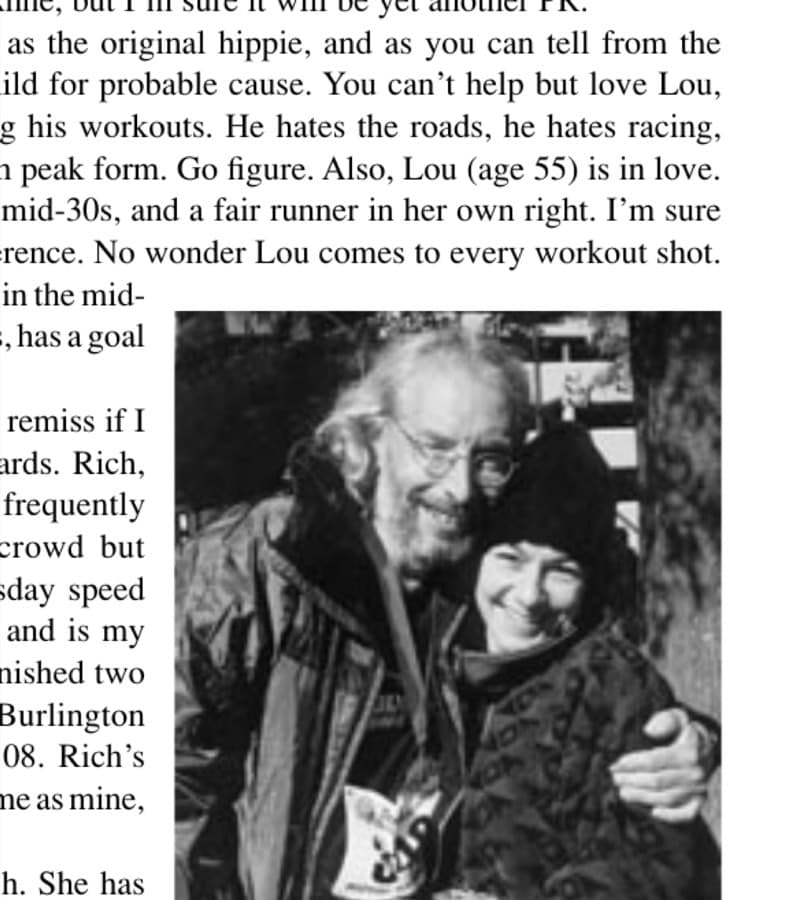
Lou and Laurel met through the Gunks.
Fred Stewart
Anne Gullickson just turned 40 this year and is (age and sex graded) the best runner in the group. She is a single working mom, teaching at the Rondout Elementary School. A mother of two, she shares the kids every other week. This frequently plays havoc with her training schedule. She trains as hard as or harder than any of us and gives every race 100 percent. She is the gutsiest runner I know. She has a strong heart but little leg speed, and in fact has yet to break 40 minutes in a 10K. She did, however, set a PR last year in Albany (Mohawk-Hudson) when she ran an impressive 2:58! Anne did accompany us to Vermont but didn’t run because of a stress fracture caused by, you guessed it, overtraining. I specifically remember the Wednesday evening she had just finished a difficult speed workout. The weekend was jammed, so she found herself doing her tempo workout the very next morning. That was it. She has been out for a full three months but has just started to run again and hopes to join us for our fall marathon. It’s too early to predict a goal time for Anne, but I’m sure it will be yet another PR.
Lou Gross we refer to as the original hippie, and as you can tell from the picture, he is the poster child for probable cause. You can’t help but love Lou, despite his tendency to dog his workouts. He hates the roads, he hates racing, and he never seems to be in peak form. Go figure. Also, Lou (age 55) is in love. Laurel is a real catch: hot, mid-30s, and a fair runner in her own right. I’m sure I needn’t note the age difference. No wonder Lou comes to every workout shot. Lou, who has been running in the mid3:20s over the last few years, has a goal of 3:15 for Richmond. And finally, I would be remiss if I did not include Rich Edwards. Rich, a computer programmer, frequently trains with the Onteora crowd but is a regular at our Wednesday speed workouts. Rich is my age and is my foremost competitor. He finished two minutes ahead of me in Burlington with a very respectable 3:08. Rich’s goal for Richmond is the same as mine, sub-3:00.
Beth Glace is our coach. She has been around since day one. She is petite, cute, and a new (single) mother— at the age of 43. I had a crush on her briefly, but somewhere I think it must
have been written that you weren’t officially a Shawangunk Runner unless you had a crush on Beth at some time. Beth works for NISMAT—Nicholas Institute of Sports Medicine and Athletic Trauma—in New York City. Her actual field is sports nutrition, but she possesses a wealth of knowledge about training and is the presiding coach and president of the club. On occasion, there are clashes. Anne, for example, gives Beth some credit, but when it comes to distance running, she finds it difficult to accept advice from someone who has never run a marathon. I disagree. Beth has a real good grasp of the demands and rewards of various training techniques. Although not always in 100 percent agreement, I run every phase of my training plan by Beth for her input. More on this later.
OK, so there you have it. These are my regular marathon training partners. These are the Shawangunk Runners. (It’s pronounced ShawnGum, but Gunks will do.) They are a group of perhaps two dozen hard-core runners that have been together for years. The stories go back to the ’70s when Beth, Steve, Jan, Stuart, and too many others rented a loft in New Paltz and on the weekends would stuff themselves into a Volkswagen and travel to various races across the country. There were the midnight runs, the naked track workouts, but I digress. That was the ’70s. This is the year 2004.
The Gunks are a loosely knit group of runners who train in the Shawangunk Mountains, located about 70 miles north of New York City. There are no dues and no official membership list. If you train with us, you are one of us. Although some of the original Shawangunk Runners have moved on, their legend lives and they are still considered Shawangunk Runners. Oddly enough, decades later, many of the original core are still around—a little bit older but still quite competitive.
Norm Goluskin is a great example. He is a 66-year-old Gunk who trains with us regularly. Two years ago Norm and his team from the Central Park Track Club in New York City set an age-group world record in the two-mile relay. Norm runs with us on our Wednesday, Friday, and Sunday runs but has yet to compete with us in a marathon. Do note that he has run New York in 2:43! A few days ago, Norm proclaimed that we were having too much fun and that he would be competing with us more during the upcoming season.
Then there are the Tri-Geeks, Don, Doctor Mike, and Myron among them—a pretty darn good group of runners, but alas, that is not their true love. I have affectionately labeled them the Tri-Geeks. They sometimes participate in our various workouts but simply do not buy into the philosophy that to excel in any sport you must train sport specific. They’re nuts. Now don’t get me wrong, I am all for cross-training. I think that during injuries or other downtime, cross-training is an excellent way to maintain your cardiovascular efficiency. In fact, I think that all runners should specifically develop into their training programs time away from running, and I encourage cross-training as a way to maintain overall fitness. But, hear me loud and clear. To excel in any sport, you must train sport specific.
Kathee, by the way, is my fiancée, and before we even get started on this training program, I suggest you get the support of your spouse or loved one(s). Without them with you 100 percent, you might as well take up golf. Proper marathon training requires an enormous amount of time, and if you are to do it properly, it is imperative that you have the support of all those around you. I think it was Bill Rodgers who once said that he would never lose a marathon to someone with a real job. That was during the ’70s when marathoning was coming into its own. Bill realized the incredible demands on your lifestyle that the training required.
Our goal is simple—race the marathon. That being said, let me begin by setting out the plan to fulfill that goal. Our group just completed the Vermont City Marathon in Burlington, and unlike other years, I have decided that my best course of action is a much-needed rest. Every year we collectively finish a marathon, show up for the Wednesday speed workout the very next week, and either run or not depending on how sore we are while we relive our marathon experiences. This continues on Friday when we may or may not do our tempo run, but the trash talking has already begun.
By Sunday, we are all at Spring Farm where we begin our weekly long run. No, we don’t immediately launch into 20-milers, but there we are doing an easy 12 to 15 the first Sunday following a hard effort. I am now convinced that we get back to hard-core training too soon. Runners simply hate to take time off and in fact frequently anticipate they will be taking training time off because of various injuries during the season. This is stupid! All runners should build into their schedules a specific time period for rest. Cross-training is fine: biking, swimming, or whatever it is you like to do, but you should take some time off from running at least once if not twice a year. That is where I am right now, as a matter of fact. As I said, usually I launch immediately into the training regimen for the next marathon, but this year I have decided to take 10 days off with no running and then run easily for the next week. Practice what I preach.
THE SCHEDULE First let me point out that I encourage flexibility. The training will follow a basic scheme but is not intended to be rigid. In general, we do our speed work on Wednesdays at Rondout, a local high school track. Our tempo runs are on Friday evening on carriage trails in the Shawangunk Mountains. Our Sunday long runs usually begin at 8:30 A.M. along the same trails. These are the Gunks’s core workouts. On Mondays, we occasionally join the Onteora group for their night run, but more often than not, a few of us will get together and run on one of the many rail trails in our area. On the odd days, Tuesday and Saturday, I generally call up Anne, Chrissy, Kevin, or Lou, or some combination of these, and we’ll again run the Rail Trail. Thursday is my day off, and frequently I will meet a group in Kingston and go for a bike ride.
The total daily mileage is also flexible, particularly the easy days. For example, my program typically calls for eight miles on Monday. The reason for this magic number is that the loop we run with the Onteora crowd in Kingston is eight miles. Our rail-trail runs are simpler in that they are always measured out-and-backs.
Personally, I think one of the keys to our training schedule is not necessarily what I had scheduled but how we trained. Here you will see what happened and, I hope, learn from the experience of the Gunks. Who ran well, and why? What really happens to this group of closely knit runners? Perhaps the knowledge of their running schedule will provide more insight into the world of training than you might think.
I’ll begin our schedule with 22 weeks remaining until the marathon. This is a somewhat arbitrary number, in that it might have been 18 or 28. My reasoning . is that I want to include at least eight to 12 weeks of VO2max leading into our emphasis on longer tempo and MP workouts. Everything preceding this phase is base building. As noted earlier, you should have a good, solid base before entering this phase of training, and base building is nothing more than miles, lots of miles. Most of the Gunks are entering with 22 weeks remaining. A few are taking a bit more time off.
I include no hill work, using the track exclusively for my speed workouts. Nor do I use any sets of really short stuff like 20 x 200s or 10 x 400s. I’ll leave that to the young kids. Every time I find myself getting up on my toes and cranking out quarters in the high 70 seconds, I end up with an injury.
THE BASE You should begin with a solid foundation of running. Now is not the time to begin a massive increase in total weekly mileage. All marathon programs begin with a basic foundation, a solid base from which to build. It’s not that our group will forgo this, as we have built a base over many years of training. If you haven’t already developed a solid base, get back to the drawing board and revisit us in a few months.
I suggest a base of somewhere near 45 miles a week. This schedule calls for a minimum weekly mileage of 42 with a maximum approaching 70. If 70 is too high, you might want to adjust your program using a specific percentage of the week’s total mileage. If that is the case, I suggest that you not take the miles from the long run or key workouts. A simple solution is to take an additional easy day off, reduce the mileage from the easy days, or skip the doubles.
LONG RUNS Long runs are the very basis of the marathon training. You shouldn’t, however, launch immediately into 20-milers but gradually add a few miles every other
week or so to the long run. I would expect that once the Sunday runs move from 12 to15 miles, you’re ready to go. Seventeen and over is what I have arbitrarily defined as a long run. Except for the tempo we throw into a few of the long runs, the pace should feel reasonably comfortable. Anywhere from 45 seconds to a minute and a half slower than goal marathon pace is acceptable. Faster runners should lean more toward the faster pace. Keep in mind that to break three hours in the marathon, you must be under a 6:53 mile. I suggest that these runners do their long runs at about an eight-minute pace. If your goal marathon pace is eight minutes per mile (a 3:30 marathon), you should be running your long runs closer to 9:15 to 9:30 pace.
Although conventional wisdom has changed over the last few decades, I am strongly in favor of running no farther than 22 miles. I’ve seen many schedules that call for running 22, then 24, and finally 26 miles in the weeks before the marathon. If you want to imagine what your muscle fibers look like after running 26 miles, visualize an old shipping freighter’s frayed rope lines.
My feeling is that training programs that incorporate weekly speed work and tempo runs should not also beat you up on your long run. Somewhere around 2 hours, 40 minutes or so should be the maximum time spent on your long Sunday run. Thus, if you are running eight-minute pace, 20 miles is fine. If you are running your long runs significantly slower, you may stay out there longer, but certainly never over three hours. Once you’re in this gray area, I seriously believe that there is a negative return on your investment.
. VO2MAX TRAINING
. The next phase of training is what I refer to as VO2max training. I will not plagiarize someone’s work by giving you a detailed explanation of the specifics . of VO2max. Simply put, running relatively short durations of 3K to 5K speed stresses the entire oxygen processing system. This includes not only the delivery of oxygen to the muscles but also the removal of carbon dioxide and lactic acid from those muscles.
I usually don’t run at 3K speed, leaving that to the under-40 crowd or those specifically training for shorter distances. I always find that at that speed, I am too close to the edge. If you are so inclined, you may run at a slightly faster pace, but be extremely careful. Always warm up thoroughly and be prudent. Most runners tend to run their speed workouts too fast. If, for example, you intend to run sets of 1,000s at 5K pace and your most recent 5K was 18:38, that’s a six-minute-mile pace, or 90-second quarters on the track. Why then do we insist on running 85s? That’s 20 seconds per mile faster than we should be running. So be careful, this is where you can get injured.
Our speed sessions are usually held on Wednesday on the Rondout track during the summer months. Beth is our coach and always has a workout prepared for us that depends on the particular racing season. Beth knows that our goal is the fall marathon, but she realizes that the spring and summer are the best times for marathoners to get in the speed work. She is flexible and frequently has different workouts for the distance runners and the milers, but it riles her when we come to the workouts with our own agenda. She’s right. With somewhere between six and 15 runners, it becomes disruptive to the workout to have several coaches. I, for example, like 1,000s and 1,200s at 5K pace early in the training cycle, with a gradual deemphasis on speed later in the season as we lean toward slightly longer runs at tempo pace. In practice, however, I go along with whatever Beth has prescribed, and in reality it never is that much of a variation of what I was planning. For example, for the first workout of my schedule, I had planned on running 5 × 1,000 at 5K pace. In practice, Beth’s workout was one mile at 10K pace; 400 recovery (we now did some butt kicks and skipping); 2 × 1,000 meters at 5K pace; 600 recoveries; then 2 × 400 at 3K pace with 400 recoveries—all in all, a pretty fair workout. A tick short at 2 3/4 miles (I prefer three to four miles), but as Beth noted, this was our first speed workout of the season, we had just completed a hard marathon two and a half weeks earlier, and I have a race on Saturday. What was I thinking? .
Bottom line, in the early months of the schedule, we are working on VO2max. Whether they are 800s, 1,000s, or 1,200s is not that important, so long as you incorporate some variation of these distances done at anywhere from 3K to 5K speed. The reason I prefer 1,000s or 1,200s at 5K pace is that you spend more time in the goal-training zone than at shorter distances. Whenever someone asks what the workout is (or Beth hasn’t made it to the track), I always respond, “5 × 1,000.” I have many such workouts in my schedule. What we actually do may well be a different story. These are far and away the most difficult workouts to do alone, and I encourage you to find several training partners who will commit to a specific day to meet for this workout. Even if your fellow runners do not run the same pace as you, simply receiving encouragement while on the track makes this workout easier. I remember several years ago going to the track by myself to run 10 × 400. I actually ran 2 × 200, and then bagged it. Track work is not fun when you’re alone. Of course, not everyone has a track available. Although a track is best, you should attempt to run your weekly speed workout on an accurately measured flat course that has little or no traffic.
Track work will also beat you up. A guideline is not to exceed three to five miles of speed work in any week, or somewhere between 5 percent and 7 percent of your total weekly mileage. We usually wind up with three to four miles of speed on Wednesday. In fact, the only time we max out at five is the final week of Yassos.
YASSOS Yassos were the brainchild of Bart Yasso of Runner’s World magazine. One of Bart’s favorite workouts was intervals of 800 meters. He noticed that if he wanted to run a 2:50 marathon, he would gradually work up to 10 × 800 at a 2-minute, 50-second pace. Likewise, if you wanted to run a 3:30 marathon, you would run your halves on the track at 3 minutes, 30 seconds (1:45 quarters). He suggests an equal time for recovery. Upon further study, he found that this formula tended to be true for most runners, whether they be the 2:10 elites or the four-hour marathoner.
This is a grueling workout and one of the most taxing that we do. I love it. When I finish one of these sessions, I know I am in shape. It seems that every year someone brings up Yassos, and an argument ensues. “That’s just stupid,” Kevin once said. “I can run 2:30 halves forever, yet I can’t run a 2:30 marathon.” That is certainly true. I explained that being able to run the Yassos successfully didn’t mean you could run your goal-marathon pace, but, if . you couldn’t run the Yassos, you don’t have the speed and VO2max ability to run at your goal-marathon pace. So while running the Yassos isn’t a guarantee for success, not being able to run them is a sure sign of failure. Given a proper season of speed, tempo, and long runs, the Yassos (simply another speed workout) will be yet another piece of the puzzle.
TEMPO (T) Tempo running is perhaps the single most valuable training tool after the long run. Most marathoners realize that they must get their long run in, but too frequently their other days are nothing more than easy runs, perhaps a repeat of their favorite local loop. If you were to ask me what single item I would change about your normal running routine, my response would be to simply add one T run a week. I guarantee your times will decrease dramatically.
Tempo pace is the pace that you can maintain for about an hour. It is just below the pace that builds up lactic acid in the muscles. This is why elite athletes can run T pace for a half-marathon. They’re done in about an hour and are sucking down a brewski while we still have three miles to run. Mortals like us need to run our half-marathons a bit slower than T pace. Knowing this, but not being entirely satisfied with this definition, I attempted to run the Dutchess half last year at T pace. The day was perfect, and I not only ran my miles at T pace, which was 6:40, but I also ran with my heart rate monitor, which validated this pace. The gentleman was just announcing my 15K split (1:02) when I locked up. I was done. It seemed strange at the time, but I now understand exactly what was happening as my heart rate steadily declined over the last four miles. I simply could not work hard enough to keep it elevated.
There are other ways to define T pace without my above test. One year Beth rigged us up to various lab equipment at Lenox Hill Hospital. Chrissy, Kevin, Anne, Lou, and I ran at varying speeds on a treadmill. We had strapped on all sorts of heart monitoring equipment and wore a face mask that measured, among other . things, VO2max. At specific intervals, blood was drawn to measure lactic buildup. Even the testing had become competitive, and we tapered for the event.
T pace is usually about 25 to 30 seconds per mile slower than your 5K pace, or 12 to 15 seconds per mile slower than your 10K pace. Another way to judge T pace, particularly when you are on trails or other areas that aren’t specifically measured, is that the pace that seemed easy only moments ago is now becoming quite taxing—not a race pace, but a pace in which you could talk but just don’t want to.
A tempo run should ideally last for 20 to 30 minutes and will enhance your ability to run at an accelerated pace for long periods of time. T runs provide incredible results while not beating up your body like racing and speed work. I incorporate some form of T in most of my training weeks and occasionally during the long runs.
CRUISE INTERVALS Cruise intervals are shorter tempo runs with short breaks. For example, 5 × 5 with one-minute recovery is a five-minute T run followed by one minute of easy running, completed five times. They are less taxing than T runs but provide a great stimulus to your overall training. During the early minutes of the first run, you will be thinking to yourself, This is easy. Talk to me in half an hour.
I sometimes use cruise intervals during my long runs. They simulate the sensation your body feels late in the marathon. I will note that this is a point of contention with Beth. She loathes my scheduling tempo runs in the long run. Her feeling is that the long run is difficult enough, even at an easy pace, and that tossing in tempo is only inviting an injury. She certainly has a point, particularly since the Gunks are no longer young pups. But I do love the workout and feel that it has tremendous benefits. I never use tempo in a Sunday long run when I have already run tempo on Friday. In fact, I rarely have more than two fast-paced runs in any week.
EASY RUNS At the very least, every other day is an easy day. By “easy,” I mean just that. Too often, runners find themselves racing their easy runs. The runners who meet in Kingston on Mondays are a good group, but far too often this turns into the Monday night race. Easy days are meant to be recovery days, allowing your muscles to adapt to the hard training completed during the prior day(s). Continuous difficult workouts actually are detrimental as they impede this adaptation. This program calls for several easy runs per week. Keep them as such. Relish them,
for they do serve a purpose. Anywhere within a minute or two minutes slower than marathon-goal pace is perfect.
DAYS OFF Days off also play an integral part of any training schedule. Do not run on these days. Cross-training is fine, but running is strictly forbidden. I usually take one day off per week. Thursday seems to work best in my schedule, but your best day will more than likely depend on your specific life schedule. Choose the day that is best for you, but don’t end up with back-to-back hard workouts. In fact, I encourage you to take two days off.
RACING I’ve included a few races along the way. Racing is a great way to assess where you are in your training. If, for example, you have raced a 10K in 6:45s, you can hardly expect to race the marathon in 7:00s, which is more likely your tempo. Exactly how much racing you should attempt before the marathon is debatable. Two years ago, Kevin was racing so much that he always seemed to be tapering for a race.
The other extreme is no racing, which we have been guilty of in prior years. Although not as bad as overracing, it too has many drawbacks. Lou, for example, just hates racing. I know what the problem is. He doesn’t want to hurt. As a consequence, when we twist his arm and insist that he is going to race, I think the effort is just not there. That will change this year.
ad

In this program, I’ve included several races. Feel free to adjust the schedules accordingly. For example, I didn’t plan a half-marathon five weeks before Richmond. I wanted to race a 10K or a half somewhere in the three- to four-week time frame before the marathon. The calendar dictated that this was the event. I also wanted a 10K early in the schedule to help me assess where I am, but I would have preferred a few more weeks to recover from the marathon. Flexibility is important, and the local race schedule frequently dictates your battlegrounds.
There are a few more races in the schedule, but other than another half, these are more fun runs than races. The Gunks sponsor several races a year including a summer series, and being a Gunk, I will be there. Do note, however, that there is nothing wrong with using a race as a training run. For example, you might enter a local 10K, warm up for two miles, run three miles of T, and then warm down for a mile. I’ve frequently done this and shall do so in this schedule. It’s actually a lot of fun.
DOUBLES I have included an occasional double in the schedule. I frequently will use these on my recovery days. Usually the morning run of a double will be three or four miles of very easy running. They tend to increase the blood flow without being taxing. Use them simply to loosen up and to get the muscles warmed up.
TAPER The taper is extremely important, and few get it right. What most marathon runners don’t realize is that it is best to err on the side of conservatism. Thus we will start our taper three weeks out from the main event with 75 percent of our mileage. The next week, we will reduce our mileage further, running 50 percent of our maximum mileage. The week of our marathon, we will run less than 25 percent of our maximum mileage in the days leading up to the marathon. Our key workouts will still be demanding, with the same intensity as normal, but the overall mileage will be significantly less.
Our discussion of the taper will also focus on diet. If you recall, Beth’s field of expertise is sports nutrition, and the role of your diet in marathon training, specifically in the days leading up to the race, can’t be overstated. I won’t bother you with the details, but I can categorically state that my demise during our last marathon was a direct result of my diet. I felt as though I had literally jogged through the first half and in fact told Rich at mile 12 that I was going to run negative splits for the first time ever . . . bonk! Later, as I explained what had happened to Beth, she said, “Hmm, tell me about your diet.” In our next issue: The Gunks get serious by starting their 22-week training program leading up to the Richmond Marathon, in Virginia.
This article originally appeared in Marathon & Beyond, Vol. 10, No. 2 (2006).
← Browse the full M&B ArchiveMore like this
1,000+ stories from 19 years of Marathon & Beyond
The complete archive of the legendary long-distance journal — digitized and free to read.
