

Triplethe Fun
In 2007, I had been doing Ironmans for about six years and wished to attempt something longer. It was a natural choice to go for one of the multiples of Iron distance. After looking around I found a double Ironman in Virginia. Then I noticed on the website that there was a triple held on the same October weekend! Well, how can I do a double when there is also a triple? I had found my race—the aptly named “Tri Tri,” which was also the U.S. National Championships.
When you do a race of such a magnificent distance, you are required to supply your own support crew to look after you. I managed to persuade my dear friend Peter “Skipper” Sawko to come out and crew for me. He had not been to America before, so it was a chance for him to see a bit of it, even though half the time he would be sitting in the middle of a forest attending to my needs day and night! I also hired another crew member from a list provided by the race organizer to give Pete a break and the opportunity for some sleep.
We landed in Washington, hired a car, and drove down to Virginia. We got there late in the evening and found where we were staying—an old plantation manor house that had been bought by one of the descendants of the slaves that worked on it.
The next day (Thursday) was the day before the race, and we had to get ready for the start on Friday morning at Lake Anna State Park. The park is home to numerous deer, large copperhead snakes, and bears. Also many large sea eagles soared overhead. After setting up our tent near race HQ, we headed to the supermarket to get three days’ worth of food. We could not risk getting too little, so we went a bit overboard. If it did not need heating or cooking and could be eaten with your hands, we bought 10 of it along with about eight crates of water and 100 bottles of Gatorade. We stashed it all in our tent and headed to the pasta party.
Ah, yes! The pasta party The pasta party that night was interesting. I have never felt so out of depth in my life. I ate dinner next to the winner of the race from the past three years. He
told me it was the hardest triple-iron course in the world and that it would be the hardest race I have ever done. Great. Terrific. Then we all had to stand up one by one and say a few words about who we were, what we had done, and where we came from. It went a little something like this:
Bloke #1 (the guy I was sat next to) had done 19 doubles, 20 triples, and 4 decas (10 times iron distance!). Bloke #2 (little wiry Brazilian guy) does most of the 78.6-mile run of the triple Ironman barefoot!
Bloke #3 had done 35 Ironmans in the last year and was trying to get it ratified by Guinness World Records. Bloke #4 was a Vietnam vet who had lost a leg on a land mine and was trying to become the first-ever physically challenged athlete to finish an ultra triathlon over Iron distance!
Bloke #5, Arthur, was a 69-year-old judge from Yorkshire who drinks cups of tea all through the race and does the run in sandals and walking boots. He was leaving after this race to go to Mexico to start the deca next month!
At about this point, I put my head in my hands and wondered what the hell I was doing there. Bloke #6 (me): “Hi there. First time above Iron distance. Wish me luck!” (Chuckles nervously and sits down.)
It was strange to think that I was sitting there with a selection of the most extraordinary endurance athletes on the planet and yet very few people outside the world of ultra triathlons knew who they were.
After the party we went back to the plantation to try to get some sleep before the big event kicked off. I would not sleep in a bed for three days, so I wanted to make the best of it.
The swim: 7 1/4 miles On race morning I woke up at 5:30 a.m. and promptly knocked a full bottle of Gatorade all over the bed. If this was my clumsy moment for the day, then I was glad it had already happened. We got down to the race site, set up the food and drink, and then found someone with a pump so I could put the finishing touches on my bike. With half an hour to go, I started getting into my wetsuit.
Just before the swim, I met for the first time the extra support crew member that I had hired from the race director. His name was Eddie, and he came with prior experience, seemed like a nice chap, and would prove to be essential when Pete needed sleep. Mist on the lake, all 19 of us walked into the water and stood around chatting. At 7:00 a.m. the race director then said, “OK, guys, off you go.”
We all stood there looking at each other. He said, “Go on! Get going!” We all laughed, said, “OK then,” and got swimming.
I immediately settled into the steady, easy rhythm that I had found in training. Most of the field shot off ahead, but I let them go on the first of 18 four-tenthsmile loops. I had to stick to my own pace. The turnaround point at the start of the swim lap was only about knee deep, and I had arranged with Pete to periodically wade out 20 feet to meet me with a drink and some fuel (Jelly Babies). This worked out well. At one point he came out a lap early, but it was fine as it was a welcome distraction. I kept a constant steady pace. Beyond the 5K mark my shoulders started to ache, as I thought they would. The air cleared and it was turning into a beautiful, clear, sunny day. At about 6K I got an air bubble deep in my ear, which sounded like a chain saw. I planned to take 3 3/4 to four hours, but it became clear in the last third (of the swim) that I would take much longer. My shoulders really ached in the closing kilometers, and I decided against pushing on to catch some people. I was maintaining a constant stroke rate and effort, which I was glad about, and was soon on the last lap. I got out of the swim after 5 hours, 32 minutes in second-to-last place. To this day I still do not know why I swam so slowly.
I felt really tired and sleepy as I made my way to transition. I got into my bike gear at less than stellar speed. I mounted my trusty steed at about 1:00 p.m. and rode up the hill to the bike course and nearly straight into another cyclist! Note to self: “Ride on the right-hand side of the road!”
The swimmer I had beaten out of the water was Arthur. His wife, Mary, stood on the beach waiting for him. He does not like the swim, but he is known as the “Freight Train” for his unbelievable speed on the bike, so I knew it wouldn’t be long until I saw him.
The bike: 336 miles The course for the bike was a five-mile out-and-back on a mildly undulating forest road repeated 67+ times. I decided to wear two pairs of padded cycling shorts and a couple of handfuls of lube for protection from the evils of saddle soreness. I had looked on the web and found a great product called Bag Balm (from Vermont), which farmers use on cows’ udders to protect them from chafing.
When I set off on the bike, I needed to refuel from the swim. We worked out a good system where Pete would hand me a plastic cup containing a few things such as a couple of cookies, some crisps, or a quarter of a bagel every other lap. Also, every other lap I got a full water bottle with a surprise flavor in it. Pete kept telling me I was not drinking enough as I was not getting through a bottle every two laps (10 miles), so I started drinking more. It was a hot day (high 80s Fahrenheit), and he thought I was going to get really dehydrated. I got to the point where I was stopping every lap to pee, so I drank less than planned.
As expected, Arthur appeared not long after I got onto the course, and he was riding at a blistering pace, pushing a massive gear. He is not a runner and will plod most of the triple marathon, so he makes up loads of time on the bike. It was impressive to see a man of 69 years doing the sort of speed a much younger man would do in a 25-mile time trial! When I asked him about it later, he said, “I like to get an Ironman bike distance (112 miles) under my belt before it gets dark.”
A lot of people rode in little groups or pairs to wile away the time. It was also the first time that you really got to meet the other athletes. With the good weather and the novelty of being on the bike, I put in some decent lap times and was feeling great. I was feeding and drinking OK and enjoying being out there. Then the sun went down very quickly and it was pitch black. We all lit up, and most people had head torches as well as bike lights. All I could see coming toward me were anonymous lights on the other side of the road, and in front was just a small, hypnotic patch of light on the ground from my light plus the odd glow stick to mark the road. I felt alone until I came to the end of a lap where, out of the darkness, the base camp appeared like an oasis. It also became impossible to grab the cup, as I needed all my wits about me and both hands on the bars to stay in a straight line. Even taking a drink from a bottle stored onboard was dangerous.
My problems started in the night. I would manage a few laps and then have to sit down, shut my eyes, and regroup. As I was riding along, my eyes got heavy and then suddenly I would jolt awake! I was starting to microsleep, not great when you are doing 20 miles per hour down a hill. The only way to stop nodding off was to have little sleeps. I limped back to the camp, told Pete I needed to sleep, lay down, and fell instantly asleep. We had a prior arrangement that he would give me 15 minutes and no more. When the 15 glorious minutes were up, he opened the tent and said “Out!”
That’s the kind of support crew you need. A couple of times during the race, I was really shutting down mentally from sleep deprivation and asked for 30 minutes instead. In a way that was worse, as my mind was able to get into a deeper sleep plus it was harder to wake back up again and get going. I was shocked at how hard the exhaustion hit during the night. I would go from fine to falling asleep and swerving all over the road, unable to do anything about it, in a matter of a couple of minutes. I felt that if I could just survive the night without crashing, then I would be fine. I was begging for the day to break.
Finally, at 6:00 a.m., the sky started to lighten and turn blue. Suddenly my energy returned and the warmth of the rising sun meant that a lot of my fuel was no longer going into just keeping me warm. What I did not realize about endurance racing for this long, and what no one had told me, is that the big secret behind ultraracing is mindfulness—the capacity to remain present here and now even under duress.
I had hoped to be off the bike by Saturday afternoon, but given my nighttime slowdown, that was a bit optimistic. I set a target of 5:00 p.m. instead. The day was hot, and I was starting to struggle. I had been on the bike for over 24 hours, and it was starting to wear me down. It turned out that my target to be off the bike by 5:00 p.m. was unrealistic. The Saturday daytime was not nearly as bad as the night before, but I just could not string consistent laps together. It was a huge effort to turn the pedals. At 6:00 p.m., the sun went down and I found myself turning my bike lights back on for another evening of hell! I could not deal with the idea of riding in the dark again. The sleep demons lurked once more. I was struggling to stay awake for any length of time. Eventually, at about 7:45 p.m., I finished the bike section and was very relieved. The 336 miles had taken me 30 hours, 40 minutes, and 11 seconds, including stops. I decided to have a second 30-minute kip before starting the run, climbed into our tent, and removed two pairs of not very nice bike shorts along with many strata of Bag Balm!
The run: 78.6 miles When I set off on the run around 8:30 p.m. in the dark with my head torch, it was a relief to be on my feet. Ahead were 39 laps, each just over two miles. I walked the first lap just to get my legs back and make sure there was no pain anywhere before I started running. I picked up the pace to a decent shuffle/run; however, every other lap I needed to sit down for a few minutes. After a few laps like this, Pete (and I) worked out my average time per lap and multiplied it up to see when I should finish. We figured that if I carried on at my current pace, I would finish outside the cutoff time! This was terrible news. I did not feel I could go any quicker. I would have to cut out the rest periods as much as possible and hope that did the trick. I had a lot of sponsor money riding on this race, and finishing outside the cutoff simply was not an option. I grabbed food when I needed it and made sure I did not sit down. Sure enough, sleep deprivation hit again, and I had a minisleep.
At about midnight, the winner, Beat, crossed the finish line. He finished in 41 hours and won for the fourth year in a row. The look of pain in Beat’s eyes showed what the effort had cost him. The second-place finisher was barefoot Brazilian Sergio, who was only 10 minutes behind. Sergio clawed back almost three hours during the run, taking 14 1/4 hours for the three back-to-back marathons.
I had read about hallucinations during ultras but never experienced them before. I was expecting it but thought they would just be something you ignore and carry on going. In fact, they were totally convincing. During the dead of night, they actually began to happen. I started jumping out of the way of big glass vases on glass pedestals that were in the road that I thought could be knocked over. I started seeing hanging baskets everywhere. I thought I was going to trip over all the albino armadillos that were running around my feet. When I looked at the
trees lit up by my head torch, I saw skyscrapers reaching up into the sky and then had a panic attack because I did not know where I was. I saw white elephants in the forest, not to mention the glass William Shakespeare faces hanging in the trees. As stupid as they all sound, it was complete reality as I was seeing it with my own eyes—a very strange feeling indeed. I started clock-watching again, begging for the sun to rise on what would be the final day. The dazzling head torches, the hallucinations, the extreme tiredness, and the knowledge that I had to go quicker just to make the cutoff were destroying my mind, and keeping going was getting harder.
Pete used my bike to keep me company on a few laps. He even ran a few laps during the nighttime. It was extremely welcome, as I needed to keep my mind occupied. If I stopped for any reason, I would fall asleep. Halfway through one of the run laps, we paused at a metal barrier. I stood holding it. Next thing I know I hear, “Sam!”
I had fallen asleep standing upright in bright sunshine. As long as I kept going I was OK. One guy sticks in my mind from the nighttime. I don’t know his name, but he was really struggling by Saturday/Sunday night and his running was over with. He was resigned to the death march, so his wife walked with him through most of the night, pushing their baby in a push chair. Like the night before, the sky started to turn a dark blue, and the day was on its way. Words cannot describe the joy I felt at seeing the dawn and knowing that at the end of this day I was going to be lying down in a real bed. That made the pain worthwhile. An hour later and the head torches came off, and gradually the day warmed up. It had been a very cold night, and all my layers started to slowly come off. It was going to be another scorcher of a day, 90-plus degrees Fahrenheit! On the same day a fellow club member was running the Chicago Marathon, when the race was stopped after 3 1/2 hours because 250 runners had been hospitalized from the heat and there was a lack of water on the course! Closer by in Washington, two runners died from the heat in a local 10-mile race. It was not the best weather for running.
During the run I did quite a few laps with a guy called Shawn. We were about the same age, and it was his first time above Iron distance, too. We had chatted a bit on the bike and now were keeping each other going on the run. I stopped at the base camp for some food, so our laps got out of sync. A few laps later I saw him lying on the side of the road with his support crew all around him. With just eight laps (16 miles) to go, he had collapsed with heat exhaustion. Sadly, he did not finish.
The race organizers produced some sausage and egg muffins, which were the greatest thing I ever tasted. Something savory! I had gotten sick of Gatorade and all sweet foods. I switched to water. We kept on running and running and running. By midday I was into my third marathon and saw more people finishing the race.
▲ Photos courtesy of Sam Smith
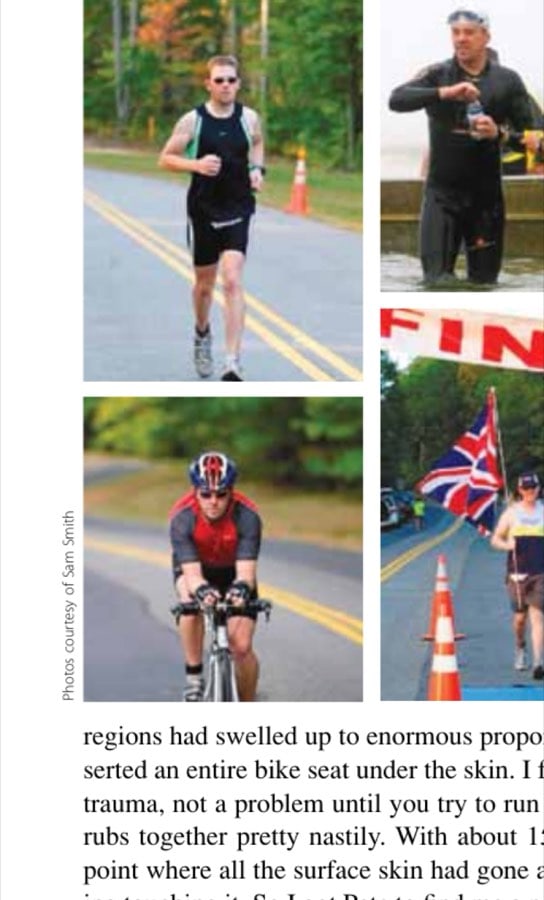
Trying at the Tri Tri.
A woman from Texas won the women’s race and set a North American record. The previous five-time winner, Kathy, had a bad race. During the run she collapsed from heat exhaustion. She still finished nine hours ahead of me!
Arthur was another person who did not do well in the heat. He often had to stop and douse his head in cold water. I started to get some serious chafing problems. After getting off the bike, I noticed that my nether
regions had swelled up to enormous proportions. It looked like someone had inserted an entire bike seat under the skin. I found out later that I had compression trauma, not a problem until you try to run for nearly 80 miles. Then everything
rubs together pretty nastily. With about 15 miles to go in the run, I got to the point where all the surface skin had gone and I could not put up with any clothing touching it. So I got Pete to find me a pair of baggy shorts in my luggage that
I could use instead of the Lycra ones I was wearing. It just about did the trick. With only four laps to go, I became aware that there were two guys about half a lap behind me who were catching up. I pushed on as hard as I could to hold them
off. With a couple of laps to go, I could feel big blisters forming on the soles of my feet. Usually I would stop and sort them out, but I wanted to keep those guys behind me. I ended up with some pretty nasty blisters.
Normal Ironman events are noteworthy for their scale, tremendous community involvement, media attention, and hyped-up energy. The finishing line of an Ironman nearing the 17-hour time limit is unforgettable. The finish line for the
Virginia Triple consists of two people holding a “Finish” banner over the timing mat as the athlete carries the flag of his or her country. It is located on a remote road in a little park lined with a hodgepodge of tents and canopies. The spectators
amount to the crews for the athletes. Picture a local 5K event and reduce the scale
a bit. As unassuming as this may seem, the heart and soul of the Tri Tri event is clear. The finish was the best I have ever had at a race by a huge margin. We were chip–timed, so everyone knew when you were heading out onto your last run lap. The organizers sent someone a few hundred meters up the road with the flag of your country. When you were coming back, you took the flag and ran down into the camp toward the finish line while all the support crews cheered you in. And if you thought it could not get any better than that, they also played your national anthem over the speakers. Brilliant! At the line the race director waited for every competitor, shook hands, and had his photo taken with you. I had run 78.6 miles in 21 hours, 20 minutes and finished the race in 59 hours, 10 minutes (the cutoff was 60 hours), good for 13th out of 15 finishers and 19 starters. It was a huge relief to get in under the cutoff, our earlier calculations incorrect.
We did not have much time to relax afterward as the award ceremony was going to start in 1 1/2 hours in a vineyard a few miles away. That included dinner and drinks into the night, and we had to head off to Washington the next morning, so packing up my bike and tent had to be done straight after I finished. Pete had done a fantastic job during the last few laps of the run, dismantling my bike and getting it into the box along with loads of other bits. All I had to do was put the lid on it, tie it up, and chuck a few things in the car, which was all I was good for! My feet were in a real state with very swollen, large blisters on the base and all over the toes. At the ceremony I caught up with a few people, especially Shawn, whom I tried to persuade to have another go next year, but he was resisting.
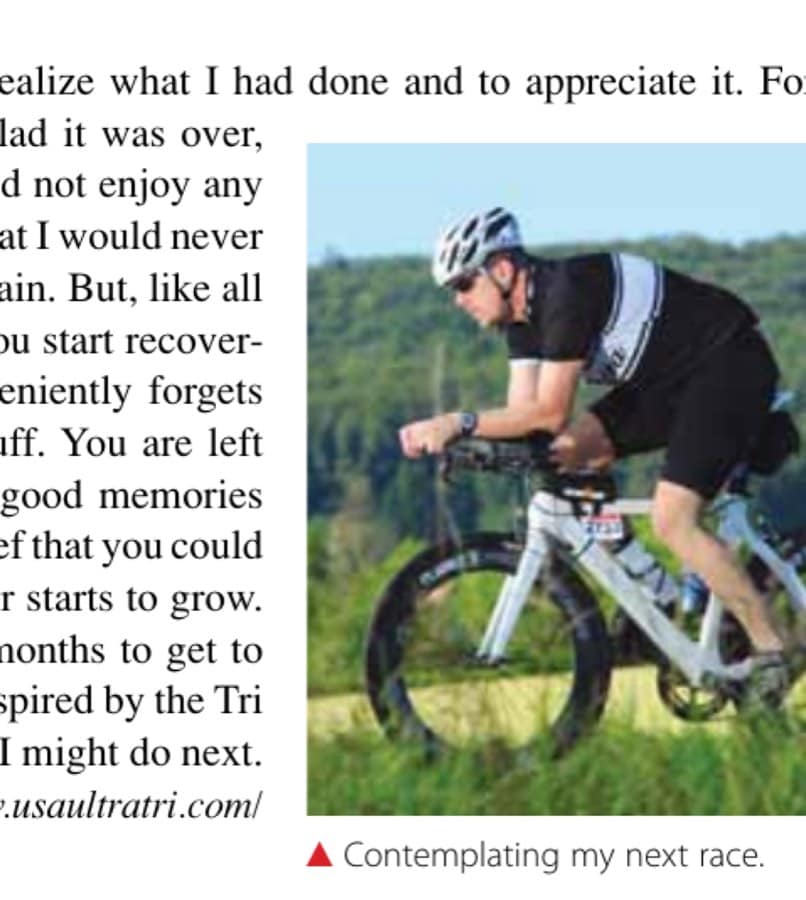
It took me a while to realize what I had done and to appreciate it. For weeks afterwards I was just glad it was over, tired, believing that I did not enjoy any part of it and thinking that I would never do anything like that again. But, like all long races, it is when you start recovering that the mind conveniently forgets all the pain and bad stuff. You are left with the nostalgia and good memories and then the seed of belief that you could tackle something greater starts to grow. It took me about four months to get to that point. I had been inspired by the Tri Tri and wondered what I might do next. Race website: http://www.usaultratri.com/ ▲ Contemplating my next race. races_va.htm
Courtesy of Sam Smith
In retrospect
This article originally appeared in Marathon & Beyond, Vol. 19, No. 5 (2015).
← Browse the full M&B ArchiveMore like this
1,000+ stories from 19 years of Marathon & Beyond
The complete archive of the legendary long-distance journal — digitized and free to read.
