

Twelve Hungry Men
This is the story of 12 madmen on a voyage of attempted Arthurian scope. No armor did they wear, yet this ad hoc Coloradoan band remained an incendiary force out for adventure and, if ordained, the slaying of a dragon or two. Their journey would take them almost 3,000 miles in six days, much of it spent within two small steel-and-glass compartments generously provided by Volkswagen. These vans, one red and one white (which we dubbed Big Red and White Lightning), became temples of splendid isolation from the rest of the world, in which these 12 knights of Colorado could laugh at their fellow man’s follies as they hurled ever closer to their quest for a day’s glory.
Their mission remained a simple but challenging one: to relay run from the slopes of Mount Hood to the glistening half-mile-wide beach in Seaside, 192 miles to the west, faster than any other team. In the end, they would not win. Ah, but before, during, and after their test in the Oregonian crucible—the spirited camaraderie; the witty exchanges; the endless predictions, prognostications, and posturing; the japery, foolery, and lunacy; the tireless teamwork; the sharing of running and meals; and the chivalrous acceptance of a mission only partially accomplished—those were the nonpareil experiences that would turn their fivestate voyage from tedious to memorable.
Back in 1993, the Hood to Coast Relay (HTC) had been dominated for five of its 12 years by the Athletics Fast/In Sport Killer Bs, a Portland-based squad that relied upon metronomic running combined with yellow outfits and a thorough knowledge of the course and its 36 stages ranging from 4.4 to 6.2 miles each. It had last been beaten in 1990 by Black Flag, an armada of skilled distance men up from the innards of California and led by miler Jeff Atkinson. In that year, Black Flag set the then-extant course record of 16:03:54, or 5:02.5 per mile, on a course measuring 191 miles rather than the 192.7 miles in 1993.
Brent Friesth is a Boulder resident, Olympic Trials marathoner, and mild-mannered insurance agent who prides himself on his aerobic star clients, a multiplicity of framed magazine covers depicting such clientele abounding on two walls of his office. In the spring of ’93, he got the idea that a few of the local lads, if so
P. J. Christman
disposed, might cruise out and smoke the Bs into submission. In coming up with this notion, he faced one of his toughest sells. As no prize money was offered by HTC, it became Friesth’s task to find some Boulder and Colorado ringers who would participate in a challenging event for no more than the love of sport and a chance to drink beer and eat junk food for a week.
Fortunately, of course, there are celebrities in both obscure and renowned running Meccas continually tying on their shoes with alacrity for the sheer exhilaration of movement and fresh air as well as for pay. Friesth found some of the heavier artillery of Colorado responsive. Among the celebrities enlisted for the team were Mark Plaatjes, who just two weeks before the ’93 HTC had won the World Championships marathon gold medal; former marathon world record holder Steve Jones, of Wales; U.S. road champions Mark Coogan and Don Janicki; and New Zealand Olympic marathoner Derek Froude. This nucleus from three nations and Friesth were combined with former Adams State University stars Dave Cuadrado and Rick Roybal, erstwhile Big Eight champion Chuck Trujillo, Boulder up-and-comers Steve Richards and Gerry Ostheimer, and Welsh marathoner Peter Williams.
If there was to be any kryptonite for this super team, it would be a touch of overconfidence in spite of less-than-peak fitness for the entire lot. Plaatjes, Jones, and Froude had eased back since the World Championships marathon two weeks earlier, and of the remaining team members, only Richards had recently displayed improvement on past performances. Yet the dozen doyens and debutants
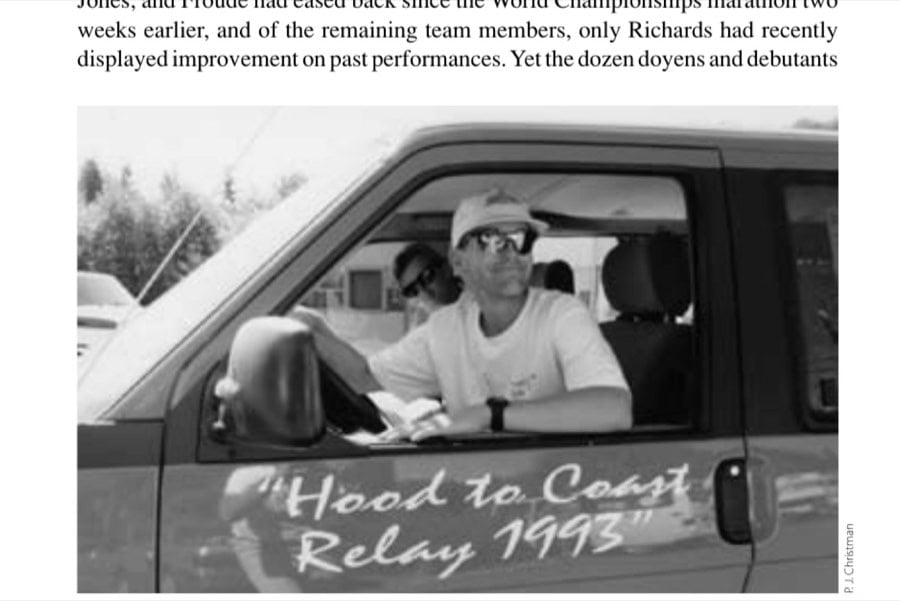
Left to right: Derek Froude and Brent Friesth in Big Red.
contemplated the departure and subsequent opportunity with relish and remained convinced that surprise entrants or no, their team, the Trio bar/Volkswagen Rocky Mountain Oysters, would come back to Colorado victorious.
Day 1—Boulder to Twin Falls Although most of the team has at least met each of the other members, their initial several hours of the trip are spent reading magazines, asking questions about one another, and downing Trio bars and bananas while contemplating their sanity and the desolate mesas of northern Colorado. This is the gestation process by which a group of individuals either becomes a team or remains disappointed in their decision to participate. Fortunately, Jones is in our van. The former RAF airframe mechanic is the quintessential wit and could easily have even the most dour and phlegmatic depressive in convulsions with his constant repartee. With his short hair, lanky frame, and nervous energy combined with staccato laughter, the wicked Welshman intermittently shoots out glib zingers loosening up the towering twins, Richards and Ostheimer. They aren’t really twins, but both are over 6 feet tall. Richards, in real life a precocious computer programmer, is driving but spends much of the journey hunkering over the impenetrable tome Moby Dick. Ostheimer normally studies biochemistry, but the pleasant fellow with an easy manner and Nero curls just the day before departure has filled in after former California International Marathon winner Danny Gonzalez backed out because of work obligations. Froude is reading. With his swept-back, wavy blond locks, he not only looks English but has the wry sense of humor to match. He is a keen observer of the sport and has the grinning confidence of one who invariably knows what he’s talking about and rarely suffers fools. When entering a conversation on a variety of topics, Froude seldom speaks carelessly but often adds a sardonic twist to his remarks. He is reading an article on British half-miler Martin Steele in a Sunday Guardian magazine left behind in Boulder by Scottish coach Brian Scobie.
Climbing to the high plains of Laramie, Wyoming, we gradually wend our way through what are reputed to be diamond-field areas recently purchased by the South African conglomerate De Beers. The vans are in train, as is Plaatjes, who is piloting his family in his golden Toyota four-wheel-drive.
Traversing Wyoming’s vast, empty rolling plains and mountainous terrain, the vistas are so expansive that the thought occurs to us that the world, or certainly Wyoming, is far from overpopulated. Whizzing along at 85 to 90 miles per hour, there is the feeling that you are on a treadmill, farm animals or wildlife like flies on the endless ochre veldt stretching to the horizon. Plaatjes’s daughter Gené is in our van, and while she is an attractive and amusing 9-year-old, she has taken to tinkering repetitively with a tiny video game emitting those obnoxious manufactured explosions and musical jingles that proliferate in video arcades.
P. J. Christman
Still, we have set the table up between the two backward-facing seats and the three-person couch, and Jones has been introduced to hearts. The card game is a simple one, of course, but countless hours are to be spent with the schadenfreude of casting the queen of spades or hearts upon unwitting or luckless players, somewhat like bee stings. And of course, this frivolous pastime is consistently aided by the downing of an extensive variety of candy with lots of colors and naughty ingredients. The miles pass easily, and people from Colorado driving by honk or wave enthusiastically as they see the HTC ’93 sign, team name, and sponsorship logos on our sleek transport vehicles.
Meanwhile, careering down a colorful canyon of Utah, a huge semitrailer truck doesn’t like being passed by the team’s red conveyance and Plaatjes’s Toyota. To add a little drama to the day, the huge juggernaut draws abreast of another to block our two vehicles from proceeding. Of course, eventually our skillful drivers escape, but Plaatjes, his wife, Shirley, and the members of Big Red recount with expletives the tale as we hydrate at one of those interstate rest stops where pedestrianism reveals that your legs feel like they have been in irons.
Early that evening, Big Red gets separated from White Lightning during a gas stop. In the darkness of 9:30 p.m., the luminous white van sits on the side of I-84 at a Twin Falls, Idaho, exit. After 25 minutes, the tour’s beer sponsor and annotator votes that our red van already has passed and its occupants lodged at a scenic wayside motel. Jones demurs. Five minutes later, Big Red pulls up from behind. After due consultations, a mere hundred meters off the highway and with the cool Idaho night enveloping us at a stop sign in the middle of nowhere, 12 of us recount the day’s more amusing highlights while imbibing the first several cans and bottles of the sponsor’s liquid refreshments. In the distance can be seen one of those giant truck stop’s lighted signs alternately advertising . . . GAS . . .
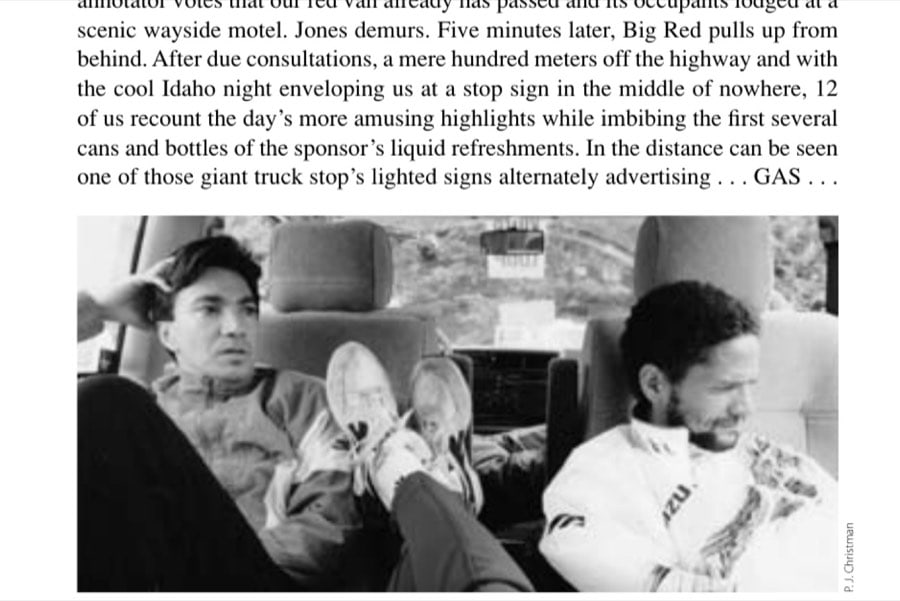
Rick Roybal (left) and Mark Plaatjes relax in the van during the ride to Oregon.
CHICKEN FRIED STEAKS . . . and other important necessities of the road. Farther west along the highway a neon sign, THE AMBER INN, filters through the night air. Plaatjes and family decline the offer to accompany us on the walk up the road from the Amber Inn to the huge 24-hour truck oasis. Inside, robust drivers furtively eye our motley, thin-bodied crew. We ponder over ordering half or full orders of chicken-fried steaks. “You’ll never eat a whole one,” our waitress says matterof-factly—not the sort of idle preemption to toss out casually among ravenous distance runners. But she is right. When we receive these bovine sacrifices on plates, it is parried by more than one that the delay has been caused by the additional slaughter and hammering required in attaining these picnic-platter-sized morsels. “It says here they provide a cardiologist,” Cuadrado says upon observing the size of his victuals. The wax beans are devoid of taste due to prolonged simmering, the mashed potatoes have what appear to be Mount St. Helens ash mixed in, and the deep-fried scone looks double the size of a Dunkin’ Donuts apple fritter. Got the picture? The food is difficult for our group to down without myocardial infarct but countered by the magnitude of our undertaking. And the salad bar hasn’t even been mentioned. You can only surmise that truckers, generically, must be real hungry fellas. Late that evening, Jones and Froude get caught up in watching Clint Eastwood in Heartbreak Ridge on telly. There will be more heartbreaking ridges within 72 hours.
Day 2—Twin Falls to The Dalles After a short drive to Boise the next morning, we pick up Coogan, the man with the Eddie Murphy laugh, having flown there to visit his brother and sister-in-law. At late breakfast, Plaatjes learns that the newly formed Nike–Portland Mambu Baddu (in Swahili, reputedly meaning “The best is yet to come”) team’s famous leader, Alberto Salazar, is anxious “to put a minute on him” in the HTC final leg. “
OoooOOhhhhh,” Plaatjes emits, with the turned-down lips and raised eyebrows of a man with a challenge afoot, to some serious howls. That afternoon we start cruising along the vast Columbia River canyon, sunlit palisades towering on the opposite Washington side. Several of Big Red’s occupants jump ship to join in White Lightning’s hearts games and are duly initiated by fire. But not Paul Astorino, or “Lady Astor,” as he is nicknamed for the game, along with “Marky Mark” (Coogan), “Jonesy,” “Grasshopper” (Ostheimer, the kung fu-style initiate), “Brentster,” and others. Astorino is along as a trained massage therapist but also proves to be a shrewd hearts player. His extroverted personality and mordant utterings remain catalytic in keeping the Jones-CooganPlaatjes-Froude and other rejoinders flowing. Unfortunately, with the incredible inhalation of junk food, Trio bars, fruit, and liquids varying from Endura to tincture of grains to carbonated chemicals, vaporous emissions become a frequent hazard.
“Oh, man,” several groan, waving arms and opening windows to freshen the atmosphere. Still, the team is starting to gel. Optimism and humor prevail as we arrive at an upmarket motel adjacent to a towering Columbia River bridge and dam in The Dalles. “I can see we’re at sea level,” Coogan intones, “because I haven’t taken a breath yet.”
Later, most trot across the bridge into Washington and back to stretch their legs, their circulation dead from van syndrome. That evening, Coogan and Plaatjes entertain the others during modern-motel-room cocktail hour with tales of World Cross, World Championships, and other remarkable running anecdotes. By dinnertime, we have reduced Big Red’s rolling weight considerably by having polished off a few more cans and bottles of the original 12-case load of male-bonding beverages.
The next day, Plaatjes is sought out for telephone interviews after the word has filtered to the Portland press that a team of ringers from Colorado has reached Oregon. Janicki, having driven his family out separately for a vacation, has now joined the group. A KOIN-TV crew induces him to appear on camera as amused teammates look on and heckle. “We plan to sting the bees,” the man with the intense eyebrows tells the reporter. Plaatjes, though knowing that he will be running the 11th and Salazar the 12th leg in the race, intentionally stirs it up for Portland television audiences by saying that he looks forward to competing against Salazar.
Day 3—The Dalles to Mount Hood and Beyond D-Day has arrived, but the Oysters and other elite teams do not set off until 9:40 p.m., so there’s time to kill. In Jones and Coogan’s room, several are watching an old cowboy movie on TV. Suddenly, on screen, a man falls off a cliff. “That’s your leg, Gerry,” someone says to Ostheimer, adverting to the first leg’s 2,000foot drop down Mount Hood’s slopes.
P. J. Christman
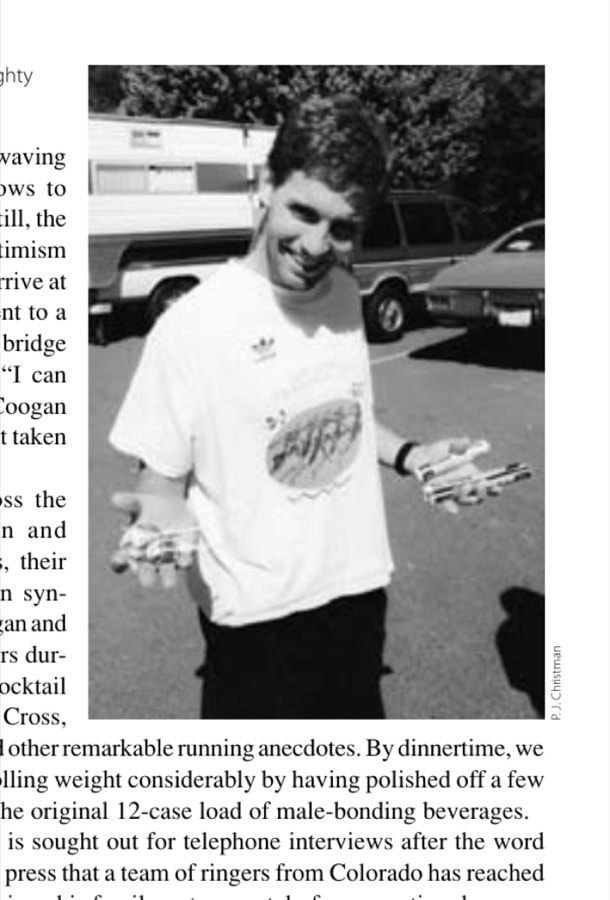
Mark Coogan with his naughty candy.
Our lunch stop (where we add Chuck Trujillo, who has flown to Portland) is 20 miles down the Columbia on a restaurant deck overlooking the river. Someone points out that the cars passing over a nearby bridge’s ironwork sound like the buzzing of Killer Bs. The river is so wide that it has whitecaps, and many windsurfers tack back and forth in the distance. Nearby, one neophyte is attempting to get out of the water and onto his board. He does but then finds himself involuntarily pushing the sail toward and away from himself. All eyes are upon the hapless windsurfer losing his balance. “OhhhhHHHHHH!” we loudly blare in unison and with rising inflection as he slowly topples into the water.
Playing cards are sliding off the table as Richards careers around corners on the way up Mount Hood. Remarks are made regarding the futility of hurrying to the top only to face hours of waiting. Finally, White Lightning inhabitants cynically badger him into slowing, and for the first time, we see isolated team runners trundling down the road’s shoulder in the opposite direction. At the Timberline Lodge—appearing very much like the exterior of the hotel in The Shining—the parking lot is jammed with vans, hundreds of them, their swaddled runners milling, the whole scenario nestled below the famous bald peak. The Oysters slowly roll out from amid van detritus such as Trio bar wrappers, pretzel bits, banana peels, soft drink containers, and other jetsam scattered throughout their mobile card room. From below a banner adjacent to the huge wooden lodge, an announcer sets off another 40 or so teams with names such as Doctors, Lawyers and Real People; We’re on Drugs and We Oughta Be; Road Kill; Sleepless in Seaside; Passing Wind; Bookin’ Babes; Lactic Acid Heads; Blood, Sweat & Beers; and other pithy monikers. For the first time, the apprehensiveness and electric excitement that accompany an impending competition have begun to set in. The 6,000 feet of elevation’s air is a cool 40 degrees Fahrenheit or so, and the Colorado crusaders head inside the lodge. “
The Bs rely on organization and balance,” HTC marketing manager Greg Miller, a glib former Killer B, relates to several Oysters assembled on the stairs of this James Bondian ski lodge. “All 12 are capable of running between 24:30 and 23:30 (for a five-mile leg).” Miller continues, point by point, to go over key nuances of the race. There is a certain, perhaps unintended element of condescension in the race official’s remarks, as if, try as they might, the Oysters will have a difficult time unseating the Bs. He advises making a move on the flat legs through Portland, because “that’s where the Bs will try to put the hurt on you.” When this strategic pearl is passed on to a group of Oysters, there is a decided lack of enthusiasm from some of the veteran performers, with words to the effect of “Who’s he to tell us how to run?”
There is a great deal of last-minute passing out of Day-Glo vests, flashlights, numbers, and assorted other paraphernalia just before White Lightning, the van designated always to travel with the runner in progress, takes off at 9:20 p.m.
down into a tunnel of pitch black. By odometer, we find an obscure highway-side parking lot, where at 9:40 p.m. we start our chronometers. “Grasshopper must be at the mile,” Coogan soon says. “How much time has elapsed?” someone asks. “
Three minutes,” Coogan replies. Eventually, by car light, Mambu Baddu’s Tim Julian and then Ostheimer spin by, and finally Killer Bs’ Jason Humble. Later, there will be some contention as to who the first individual having reached checkpoint 1 was, Ostheimer claiming that he passed Mambu Baddu’s runner (David Harding) just before the line.
Soon we’re off down a dark, forested highway toward the next checkpoint, 1,500 feet lower in elevation. “The flashlight is worthless,” Ostheimer informs. “Could you see anything with it?” “Nothing.” As we proceed by leg maps, odometer calculations, and headlamps along highways and byways bordered by occasional bobbing flashlight beams, first Mambu Baddu and then the Bs develop a commanding lead. Astorino is in the back rubbing down legs, the navigator is hovered under a ceiling light scrutinizing a map, and Janicki before his leg is peering inscrutably over the steering wheel into the void. The team is nervous being several minutes behind. Going through everyone’s mind is whether the ringers from Big Red, waiting at exchange point 6, can reel in their two prime adversaries.
Day 4—Portland to Seaside As the night progresses, slowly but surely the Oysters erode their rivals’ initially imposing margins. Janicki, Cuadrado, and Richards bite off a minute or so. Somewhere in Oregon near a Safeway parking lot, various and sundry team members and spectators are huddled under street lamps. Suddenly, up the highway and barely visible as a silhouette comes Mambu Baddu runner Andy Maris, and after more elapsed time, Killer B Don Stearns. Then suddenly, his scrabbling gate identifiable, Jones crests over the hill, closing in behind the B like a scorpion at full tilt. To rousing cheers, he streaks abreast of Stearns, blasts by into a sharp turn, and effects the exchange to Plaatjes. A nearby Bs team member shakes his head, then mutters: “The fuckin’ former world record holder passing off to the fuckin’ world champion.” Such profundities aside, the B-sting did indeed send optimistic Oysters sprinting for their vehicular passport to exchange 11.
In a shopping center parking lot at the penultimate team member’s first of three (36 for 12 members) exchange zones, Mambu Baddu’s Shannon Butler comes in just 27 seconds ahead of Plaatjes to the jubilation of the Oysters. It will be the last time that the adventurers from Colorado will have cause for celebration.
The second 12 legs begin along the Portland waterfront, each exchange point looking like a late-night rodeo for vans. More than 200 more registered teams join
P. J. Christman
the 750 en passant, making at least 12,000 thinclads serially streaming toward Seaside. As the race is nocturnally devolving, so are the energy levels of the Oysters and support crew. Even though the Bs are far enough behind to be unable to ponder “putting the hurt” on them, the Oysters are falling farther and farther behind Mambu Baddu. The tone of joviality subsides into fatigue-induced, unexpressed disappointment. There is talk of faking an injury and dropping out a slower runner, a tactic the proposer says that the Killer Bs often use to ensure victory. The scribe cogitates upon the ethical considerations of such a desperate move while joining other HTC participants in obtaining a café latté in a convenience store. The purchase is just one of a continuous flow of hard currency to local merchants from the hungry and thirsty lemmings swarming through Oregonian burgs and countryside. The 10th or so cup of coffee briefly reinfuses energy into the tired chronicler. Soon Oysters scream encouragement at Janicki as he strides along a four-lane highway in the gloam. Maybe daylight will reenthuse the Oysters.
Then again, maybe the rapidly increasing light will merely make their exhaustion more palatable. During leg after leg up winding roads over very hilly and forested Cascade Range terrain, a four-minute gap becomes seven, then 10, then 12. The Oysters’ humor starts to return because they can finally acknowledge that they have lost. No more pressure. It’s over. The Oysters have beaten the Bs but have lost to Mambu Baddu. After all the conversationless, jaundiced scrutinizing and psychological strutting of each team at earlier checkpoints, the Oysters and Mambu Baddus finally share an early-morning spirited exchange at checkpoint 26. All along the route, Plaatjes has been quietly asked for autographs, and that is how the ice is broken by several Mambu Baddu team members while Salazar
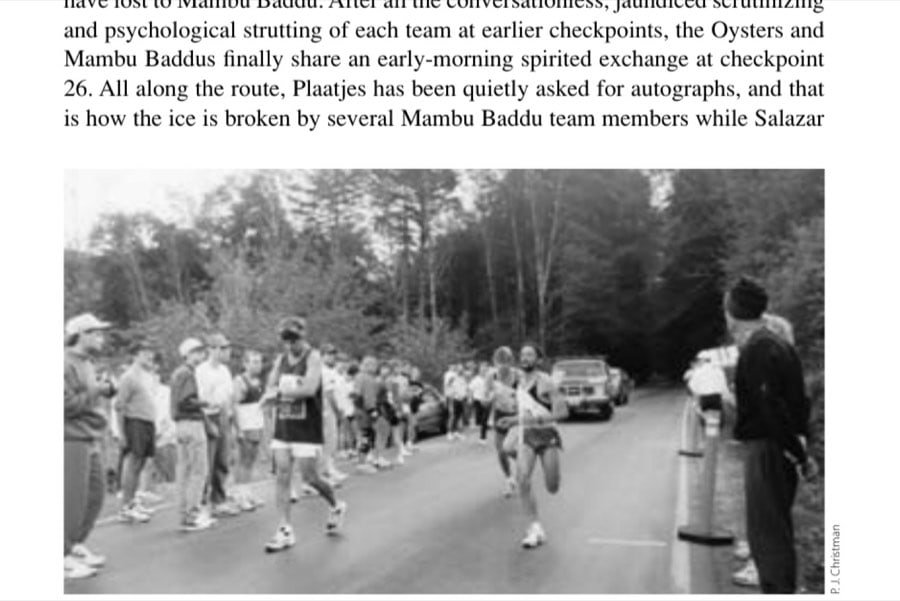
Derek Froude hands off to Mark Plaatjes.
amusedly looks on. Butler, a voluble fellow who once won the U.S. Cross Trials and who is married to Vicki Huber, is not up to full strength since Achilles surgery in June. Plaatjes has beaten him on the first two of their legs. The pair begin kidding each other to the delight of both teams as Salazar looks on with arms folded. “
Let’s make it all or nothing on the third,” the Mambu Baddu pontiff says, putting a hand on each of their shoulders. “Let’s put everyone together on the last leg and see who are the five fastest,” Coogan throws out before punctuating his suggestion with Murphyesque laughter.
Just a bunch of japery amid fresh Oregon pine-scented air in the middle of a country road, the boys trading barbs and munching cookies sold by two women from nearby church steps. The essence of the trip, really.
As each Oyster finishes his final leg, water bottles are furtively replenished with beer, as it is illegal to have open containers in motor vehicles. A rival shoe company team inquires whether there might be any extra liquids available. The Oysters duly comply and learn at the next checkpoint that their beneficiaries have been busted to the tune of $240 by the Oregon Highway Patrol. C’est la guerre.
There are fewer and fewer earlier-starting teams found scuttling through the rolling arboreal tunnels in western Oregon. On an interminable winding ascent through such a dense, deciduous domain, a stoic Janicki quietly pads by a disgorged van. The Oysters know that only a miracle will provide a win, but shouts of encouragement are thrown by weary collaborators. “Come on, Don, go, go,” and so forth. Later, Coogan will tell Jones, “I told Janicki to pick it up.” “Yah, well, he’d have to after your leg,” Jones will quickly reply.
At some checkpoint arrived at in a sleep-deprived stupor, we come upon the lead women’s team, Girls Just Wanna Have Fun, long since having left early Seattle-based challengers, Disciples of Atalanta, behind. One diminutive GJWHF team member is standing, arms akimbo, beside us. She has the legs of Dietrich and the purple outfit and tasseled locks of a misguided soul, having stayed up most of the night before falling asleep in her car. THE GIRLS is painted in white on the back of her shorts. “Did you treat yourself?” she yells to a teammate just having completed her leg and now emerging from the team van. “Yah, I had a double shot,” the scribe thinks she replies. He turns to an Oyster. “Man, these Girls can partee. She just had a double shot after her leg.” “
She said she had double stuff,” the nearby purple person corrects with a smile. “That mean two Oreos with only one side each.” Soon at a checkpoint, we’re standing on a hillside in the morning sun when the navigator goes to climb into a full van. “Sorry, no room,” Plaatjes says. The navigator moves to Big Red as White Lightning sets off west. Only one van is permitted to proceed to the next checkpoint on a narrow road, the second van mandated to
proceed by alternate route to Seaside. Several miles down the alternate route, Big Red comes upon a lost White Lightning making a U-turn— your soporific earlymorning boo-boo. With no navigator, lead vehicle White Lightning has allowed a highway patrolman to divert it the wrong way. Meanwhile, at checkpoint 33, Richards strides in and is forced to wait almost three minutes for Jones to arrive with the errant van. At this point, nobody cares. Get to the beach!
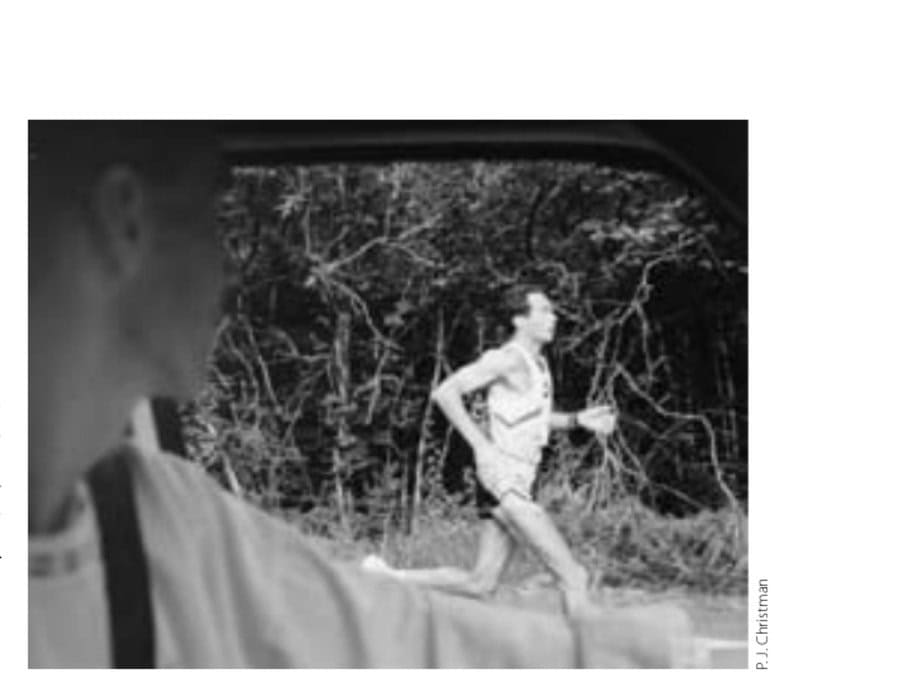
The gleaming sands and concrete boardwalk of Seaside are choked with people. The sea is so far across the beach that the air is fresh and clean with no hint of fishiness. Before us lies a scene reminiscent of Lawrence of Arabia. Stretched over a portion of the huge, shimmering, sandy expanse, large white canvas pavilions adorned with gently billowing flags are interspersed between the twin finish line towers and a large concert stage. Farther in the distance loom green hills meeting the hazy Pacific.
The first teams to arrive are walkers, and you can only suppose that they set off from Portland on Memorial Day. They unabashedly stride across the sandy gantlet beside the team-gathering pen as crowds cheer these last 75 yards from boardwalk to banner. A few of the Oysters gather in the pen with a cooler of sponsorship beverages (all perfectly legal on the beach in Seaside). They are tired but surprisingly enthusiastic. Then comes the Mambu Baddu team, looking as if they have freshly laundered white-and-red singlets and shorts. Waving their Nike banner, the proud youths trot en masse to the line and cross to a substantial home-state ovation. Seventeen minutes later, Froude, the anchor runner for the Oysters, lopes in to still-rigorous applause and decidedly more enthusiastic response from nearby pen mates. Later, the Rocky Mountain Oysters learn that each team is supposed to jog the last sandy meters together. They are not pleased by this information omission.
The rest of the afternoon and early evening are spent downing food from tent purveyors, schmoozing with other teams and sponsors on the beach, and reduc142 l MARATHON & BEYOND l Sept/Oct 2008
P. J. Christman
The passing Oyster van checks out Mambu Baddu team leader Alberto Salazar.
ing Big Red’s rolling weight while leaning against our boardwalk motel’s wall in the late afternoon sun. There is something anticlimactic about not being able to enjoy the fruits of defeat, but who’s energetic enough to care? Most are in bed by 8:30 p.m., too tired to party any longer. Jones, always the gentleman posing as a jester, falls asleep in the back of Plaatjes’s four-wheel-drive so that others in our 21-strong entourage might enjoy the comfort of our three rooms’ few beds and couches.
Days 5 and 6—Seaside to Boulder The next morning we begin the 1,400-mile drive home. There are more amusing episodes en route. For instance, a strange car having joined our 90 mph caravan is picked off the back for speeding by a highway patrolman, while our three vehicles continue storming unimpeded across endless, undulating arid prairies.
Yet mile by mile, a subtle wistfulness begins to insinuate itself as each of us anticipates a return to his less-isolated urban reality. For some, of course, there is the mainly unspoken disappointment in having finished second, and the questions of whether revenge can be extracted 12 months hence and whether each will find himself a part of another such unique summer adventure.
In actuality, no team of ringers was sent in ’94, but Plaatjes and others still talked confidently of eventually sending a team with no weak links. Yet the important thing, when all is said and done, is that during that halcyon August of 1993, each of the knights of the square table participated in a modern-day adventure, which may have a sequel. “
We’ll use this as our Pearl Harbor,” Coogan smirked somewhere in the Wild West on the trip home. “They’ve awakened a sleeping giant.”
P. J. Christman
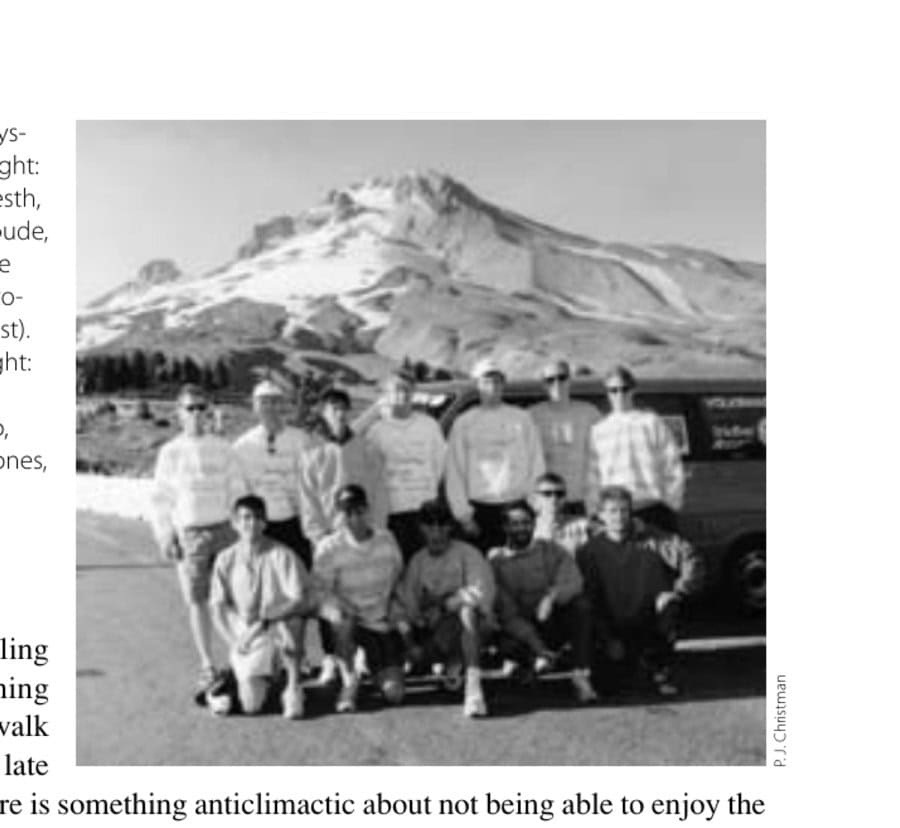
Rocky Mountain Oysters: Top row, left to right: Don Janicki, Brent Friesth, Rick Roybal, Derek Froude, Gerry Ostheimer, Steve Richards, and Paul Astorino (massage therapist). Bottom row, left to right: Dave Cuadrado, Mark Coogan, Chuck Trujillo, Mark Plaatjes, Steve Jones, and Peter Williams.
This article originally appeared in Marathon & Beyond, Vol. 12, No. 5 (2008).
← Browse the full M&B ArchiveMore like this
1,000+ stories from 19 years of Marathon & Beyond
The complete archive of the legendary long-distance journal — digitized and free to read.
