

Ultimate Running
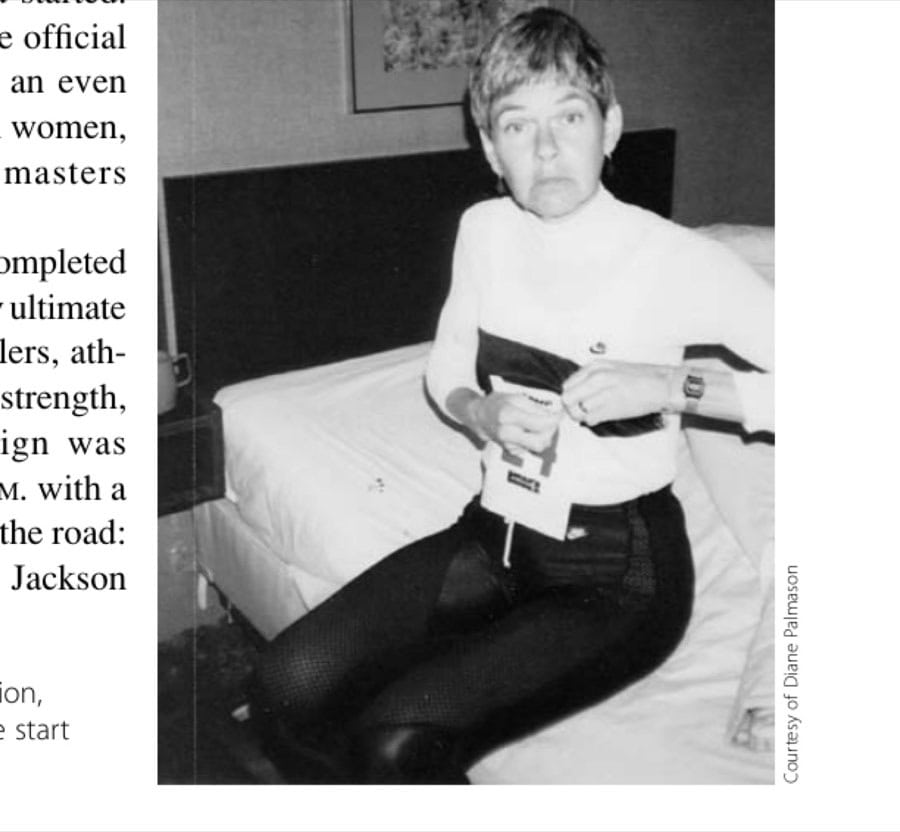
The author, with apprehension, pins on her race number at the start of her Ultimate day.
Courtesy of Diane Palmason
It was all Don Kardong’s fault! If he hadn’t competed in The Ultimate Runner in 1986 and then written a story in the Runner about how much fun he had had (at 37, he finished fifth behind four 20-somethings), I would not have been sitting on the edge of a motel-room bed, pinning number 24 on my singlet, and wondering what I had gotten myself into.
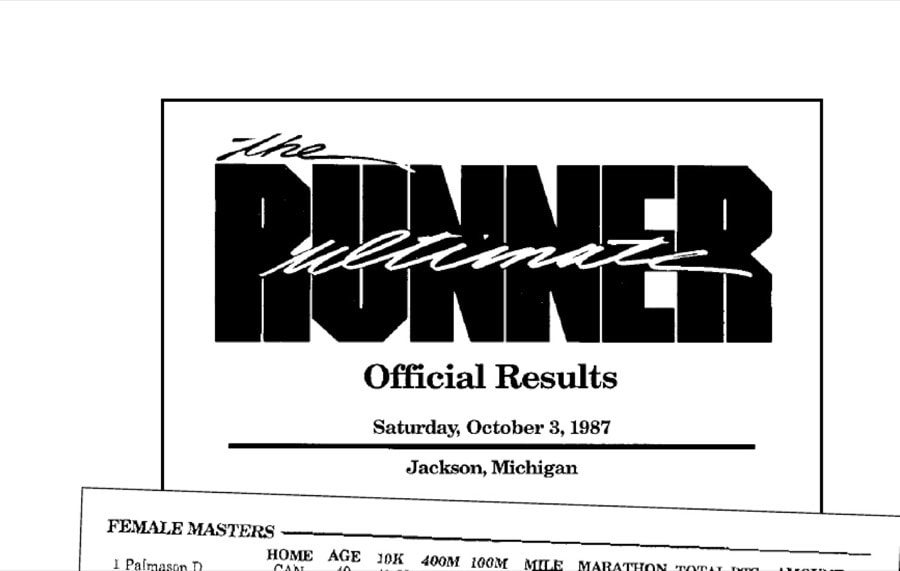
It was Saturday morning, October 3, 1987, and I was in Jackson, Michigan, getting ready to run more than 33.7 miles before the day was over. To be exact, I and all the other entrants hoping to become ultimate runners covered 54 kilometers, 304 meters that day. Rather, most of us did. The program listed 130 entrants, but Michigan Runner later reported that 115 had started. Finishers? According to the official results, the final tally was an even 100: 42 open men, 14 open women, 35 masters men, three masters women, and six wheelers.
One hundred of us had completed an event designed to identify ultimate runners and ultimate wheelers, athletes who had it all: speed, strength, and endurance. The design was simple. It started at 8:30 a.m. with a test of speed endurance on the road: a 10K race from a park to Jackson
Community College (JCC). Then it was on to the college track to check our speed, with sprints of 400 meters and then 100 meters. Next, and still on the track, the event that demands both speed and endurance: the mile. Finally, it was back onto the roads to measure endurance with (what else?) a marathon. That was it. Five races run one after the other, with a little break for lunch (if you were fast enough) before the 2:00 p.m. start of the marathon.
Why would anyone want to enter such an event? Why did I? Don’s article had, in fact, made it quite clear that this would be no picnic. His title referred to “The Combat Zone.” Another article, written by Jim Harmon for Runner’s World, was titled “The Ultimate Challenge.” Maybe that was it. In 1987 I was 49 years old. At age 46, I had run PRs in distances from 5K to the marathon, and I was pretty sure I wasn’t going to be able to top any of those times in the last few months before I turned 50. I needed a different challenge. Why not The Ultimate Runner?
How Do I Get Into This Thing, Anyway? The first challenge was figuring out how to enter. Remember, this was in the days before Web sites and online entry forms. But help was close by—in the office right next to mine. At the time, I was working for Sport Canada, the federal government agency that supported Canada’s amateur sport organizations. My colleague, Joy Harrison, had always been supportive of my running activities, so I took a copy of Don’s article next door for her to read. She was laughing at Don’s description of his breakfast problems when she suddenly exclaimed, “Mike McGlynn! I know Mike McGlynn. We used to work together at the Y.” She was referring to the creator, along with Charlie Kuntzleman, of this whole, crazy five-in-oneday event. McGlynn, an associate professor in the health and fitness department of Jackson College, was now also the race director of The Ultimate Runner. Joy contacted him and, in no time an entry form was sitting on my desk. Challenge number one overcome.
Challenge number two? How do you train to race five different distances that demand such different sets of muscle fibers, energy systems, and mental abilities? In the months that followed the confirmation that my entry had been accepted, I worked out a 10-day rotation. • • • • • • •
Day 1—marathon training: that is, run long Day 2—easy recovery Day 3—100-meter training: speed drills and short sprints Day 4, 6, and 8—easy recovery Day 5—10K-type tempo running Day 7—something for the 400 Day 9—repeats on the track for the mile
• Day 10—another easy recovery run or maybe even a rest day. Then back to the beginning. Because most of my training and racing since I started running in 1975 had focused on road races from 5K to the marathon (with one fling at an ultra: see Marathon & Beyond, Volume 10, Issue 1), days 1 and 5 involved familiar stuff. I had tried running a few 800- and 1,500-meter races in the early ’80s, with some success. And in my first running career, as a high schooler from 1950 to 1954, I had been a sprinter, racing 60, 75, and 100 yards. I had even been allowed to run as far as 220 yards as a member of Canada’s British Empire and Commonwealth Games teams in 1954, but I had never raced either 440 yards (too far for girls in the ’50s) or 400 meters. How would I train for that?
Fortunately, my older son, Craig (the cyclist in my ultra adventure), had become a national-level 400-meter-hurdles runner. By 1987, he had been training seriously with several gifted coaches including another colleague of mine at Sport Canada, Ken Porter. Craig and Ken had taught me to do sprint-type drills: the hops, skips, and bounds that they had assured me could help distance runners, too.
If Arthur Says It Is So, It Is So Arthur Lydiard had confirmed for me that such training was valuable. I had met him at the Lydiard Running Camp in Scarsdale, New York, in 1983. He had us all, high school cross-country runners as well as men and women in their 30s and up, doing marches, skips, and high-knee runs across grassy soccer fields and learning how to do uphill bounding and fast-leg downhill running in his famous hill triangles. I pulled out my notes from camp and my copy of Running With Lydiard with its “Middle-Distance Track—Women” schedules, and did what I could.
Fitting all of that into my schedule as a full-time manager at Sport Canada made for a busy summer, and soon it was time to pack for the trip to Jackson. It was a long drive from Ottawa—so long that we arrived too late to participate in Joe Henderson’s “Ultimate Runner Trivia Quiz,” not that I would have been able to win anyway. The experienced Ultimate Runner types present that year included several winners from the previous year and John L. Parker, best known for writing the classic running novel Once a Runner. John’s article on the Ultimate, “Then the Vulture Eats You,” became the title for a great collection of short stories on the joys of being a distance runner. I hadn’t seen that article before I arrived in Jackson, so I didn’t know about the vulture! Scott Hubbard, who was covering the event for Michigan Runner, knew so much about the Ultimate that he didn’t even consider entering it. He won the quiz instead.
Don’s biggest problem come race day, according to his article, was what he should eat to keep himself fueled for all of the day’s events. For me, as I awoke that Saturday morning and checked the weather, the problem was what to wear.
It was overcast and cold, with a blustery wind. I chose tights and long sleeves under my singlet—and stayed in the tights all day, as the temperatures never did get out of the 40s. Thus attired, and fueled with my favorite premarathon food (banana, graham crackers and honey, and a mug of strong tea) I shared a ride to the nearby park for the 8:30 a.m. start of the 10K.
With only 115 runners, the start was nothing like the mob scenes we’ve become accustomed to in 21st-century 10Ks. Someone pointed out the previous year’s masters winner, Nina Bovio, and I considered keeping her in my sights. However, following Don’s advice, I had projected some goal paces for myself for some of the events. Though I had run 36:19 for 10K three years earlier, I decided to be cautious for this first event and aim for 42:00. Nina pulled away from me and was soon out of sight. OK, I thought. If she can run that fast at this early stage and still finish the other events strongly, she deserves to win. And I let her go. I finished in 41:29, well behind Nina’s 39:45.
Stuck on the Track for Three Events We finished the 10K on the JCC track and got ready for the next three events. We were assigned to heats of eight for the 400 and 100 meters—men first, youngest first. The first 400 started at 10:00 a.m., but I, being the oldest woman (by eight years), was in the last heat. This gave me a little time to consider my strategy. Ha! Since I had never raced a 400, I had no idea. Surely I could run faster than 82.0, my goal pace per lap for a 5:30 mile. I finished in 75.9, which, considering that I ran 68.21 at age 65, 16 years later, was not that great—but faster than all but eight of the young women, so I was satisfied. Faster than Nina’s 80.1, also.
10:45 a.m. Time to warm up for the 100 meters as the first of the men’s heats got started. Warming up was a challenge. I remember huddling by the wall of the field house, trying to get out of the biting, cold wind. I had run the 100 (yards) back in the ’50s, but I doubted that my time then, even if I could remember it, would have any relevance to what I could do this day. Strategy here? Never mind the starting blocks. Just go as fast as I could. A photo taken near the finish shows me tightening up completely: head back, face grimacing. So much for the sprinter’s lean at the tape. I finished in 15.8, faster than all but three of the women, including Nina’s 17.3.
Such a nice warm-up all the preceding was for the fourth event—the mile. These races started at 11:15 a.m., and, since the heats could be much larger, my turn came up quickly—far too quickly. In the 10K, I had pretty much emptied my slow-twitch fibers. The 400- and 100-meter races had depleted my fast-twitch fibers. What was left? Not much, as it turned out. Although the vulture subsequently ignored me in the marathon, he certainly swooped down on me in the third lap of the mile. Ouch. So much for my 5:30 goal. I struggled across the line in 6:03.8, once again ninth among the women, with Nina behind me in 6:06.0.
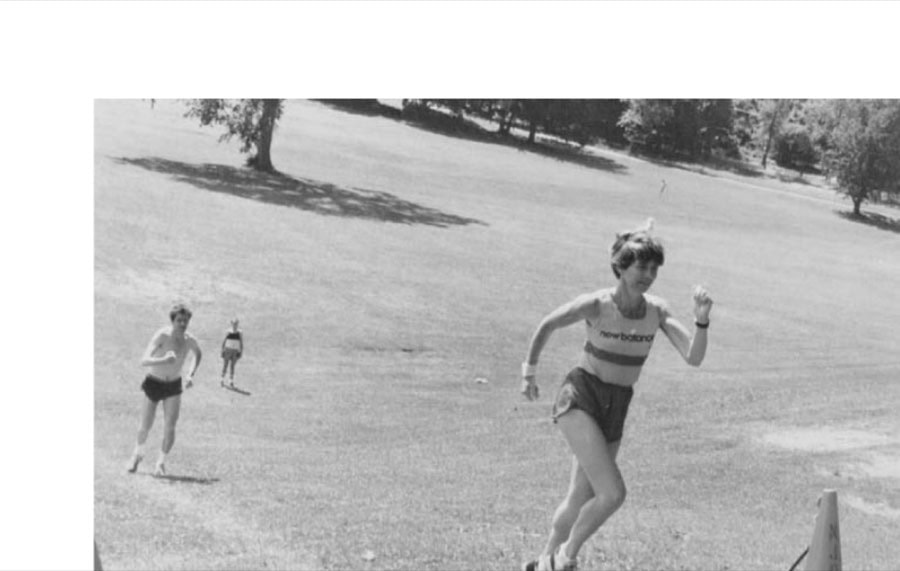
Courtesy of Diane Palmason
The author at Arthur Lydiard’s camp in 1983, learning hill-bounding.
Hurray! Break time before the 2:00 p.m. start of the marathon. I headed for the field house. Hurray again. The heat was on. The gym looked like a crisis center. Rows and rows of army cots were set up, many already occupied by tired runners trying to get themselves ready, mentally as well as physically, to run 26.2 more miles that day. First stop was the kitchen, ably staffed by an army of volunteers serving up carbohydrates in every combination you could think of. I opted for boiled potatoes—lots of them—with lots of salt, washed down with some kind of replacement drink, and then headed for my cot. I had a small cassette player with ear plugs. The goal was to block out the nervous, excited buzzing around me. I slipped in a tape of “Classics of Meditation” and tried to sleep.
The Classics Didn’t Help Forget it! Time to warm up and head over to the start of the marathon. What pace? It had been only three years since I had run my marathon PR, a 2:46:21, but that had been on a perfect day, when I had arrived at the start rested, tapered, and eager to go. Don had set his marathon goal at least 25 minutes slower than his best times. I allowed for my overall slower pace and added almost 35 minutes, for a goal of 3:20. At this point, I wasn’t in the least concerned about where I stood in the overall results. All I wanted to do was finish. And this I did, only slightly off my goal despite two stops in the porta-potty. Too many potatoes? My 3:20:38
placed me fourth among all the women, first master ahead of Nina’s 3:24:31 and first master overall with a total of 1092.4 points. This placed me eighth of all the women, with Nina just two places behind me in 10th with 1021.8.
It should be noted here that the organization required to get 115 athletes of different ages and paces through all these different events—keeping them fed and watered along the way—was of monumental proportions and required a lot of people. It seemed like the entire population of Jackson was out there, timing, guiding, and cheering us on. You would have thought that the end of the marathon would be the end of the day. But no! On to the banquet and the evening’s entertainment. The results were announced, the awards were given out, and then John L. Parker took center stage. I don’t recall the title of his presentation. I do remember him walking back and forth among us, deadpan, swinging a roll of toilet paper in one hand and a rubber chicken in the other, while we all laughed until the tears ran down our cheeks. We were finally exercising the only muscles we hadn’t drained that day: our belly-laugh muscles.
We all decided that it had been great fun and that we would be back next year. That didn’t happen. It could almost be said that the event collapsed under the weight of its own success. In the following years, so many runners wanted to enter that it just became too much for McGlynn and his trusty crew of hundreds of volunteers. The event is no more, though Scott Hubbard tells me that McGlynn directs a very popular 10K in the Jackson area each June. Check it out. The man knows how to organize a high-quality event.
This article originally appeared in Marathon & Beyond, Vol. 12, No. 6 (2008).
← Browse the full M&B ArchiveMore like this
1,000+ stories from 19 years of Marathon & Beyond
The complete archive of the legendary long-distance journal — digitized and free to read.
