

Ultrarunning Power Couple Makes Grand Slam History
“One hundred miles of heaven and hell.”—Wasatch Front 100 motto
Stan and Chrissy Ferguson purposely never mentioned the words “Grand Slam” for fear it would jinx their chances of attaining their goal. The strategy seems to have worked as the ultrarunning power couple hit their target of becoming the first married couple to complete the Grand Slam—a feat that involves finishing four 100-milers in less than four months. The races in the Slam are some of the oldest trail runs in the nation: the Western States (WS) 100 (California), the Vermont 100, the Leadville Trail 100 (Colorado), and the Wasatch Front 100 (Utah). “
To us, it’s neat we were the first, but the main gratification comes from just us both getting through it,” said Stan Ferguson. “Running is a very individual activity, but for this there was the added element of counting on each other to persevere when things got tough.”
Stan said that if you look across all 100-milers and participants, you’ll find that essentially two-thirds of those who start a race finish. “So if you take that percentage over four events, statistics indicate a person has a one in five chance of completing all of them,” he said. “And for two specific people to finish all four—well, the odds get really low.”
So how did this foray into ultras come about? Rewind a few years. Before she became a firefighter, Chrissy worked in the semiconductor industry in Northern California. Her boss was always talking about running ultras and kept trying to qualify to enter the WS 100. “In 1992 he was going to run American River 50, and I decided I would run that one ultra—just because I thought I could kick his butt,” she said. “I wound up running pretty well—finishing third (woman) overall, and I had fun. So then I decided I wanted to run Western States. Problem was, that
was only a few months away, and the only way left to get in was to win the last automatic qualifying race, which was the Nugget 50. I ran it and actually won, so I got into WS. I had some difficulties, but I finished. After that I was hooked.”
One of the people who helped Chrissy as she was getting started in the sport was Suzi Thibeault (now Suzi Cope). “She had this gorgeous belt buckle from the Arkansas Traveller (AT) 100,” said Chrissy. “I wanted that buckle. I also thought if I could win a 100-miler, it would ensure I could get in WS again. I went and did it (and won), and the people there were so nice I kept going back each year.” A few weeks before her fourth AT (in 1995), Chrissy, who was part of the worldrecord team that won a gold medal for the U.S. during the 1995 World Challenge 100K, learned her pacer had torn a calf muscle and wouldn’t be able to run with her. The pacer told her not to worry, he would find someone for her. That person was Stan, a software developer just getting into ultrarunning. By the time the race was over, Chrissy said, she knew she was going to marry him.
The two, who live in Conway, Arkansas, got married at the AT prerace meeting the following year. In 2001 they took over the reins of the race from Lou (who was one of the first women to complete the Grand Slam) and Charley Peyton, who had started the event and directed it for 10 years. “That race means so much to me, because it significantly changed my life,” said Chrissy.
Shall we try a Grand Slam? According to the duo, taking on the Grand Slam endeavor required two long years of training; support from family, crew and pacers; money; and a “little bit of a luck factor . . . or at least the avoidance of bad things happening.” Stan credits Beth Simpson, an ultrarunner from Wisconsin, for sparking the Slam idea when in December 2007 she e-mailed him: “Congratulations you two on WS entrance!” it read. “We will be seeing you there! Do you know that if you two did the Grand Slam, you’d be the first married couple to do so! Food for thought, huh!” “
At first, we both leaned toward not doing it, but after time and much thought we decided to give it a try,” said Chrissy. The first attempt, however, didn’t go as planned. A lot can happen over 100 miles. Due to a sprained ankle at Leadville (less than 10 miles into the race), Chrissy missed the Halfmoon (70-mile) cutoff by four minutes, which pulled the plug on completing the Slam in 2008. Instead of running Wasatch, she paced Stan the last 25 miles.
Both were granted entry into Western States. However, because of the forest fires in California near the course, the race was canceled and the Arkansas Traveller 100 (Chrissy and Stan serve as race directors) became the last leg of the Slam that year. Chrissy served as race director for the day so Stan could run. He was one of only six who finished all four Slam races that year.
“Looking back on the ankle sprain at Leadville, I now know that it was just not meant to be that year,” said Chrissy. The next year, 2009, would have to be the year instead.
2009: Grand Slam attempt, round two The journey begins: Western States 100, June 27–28 “Life is short; running WS makes it seem longer.”—Unknown Western States takes place in California, along the middle portion of the Western
States Trail. Beginning in Squaw Valley, site of the 1960 Winter Olympic Games, the trail ascends from the valley floor to Emigrant Pass, a climb of 2,550 vertical feet in the first four miles. From the pass, following trails used by the gold-and-silver miners of the 1850s,
runners travel west, climbing an additional 15,540 feet and descending 22,970 feet before reaching Auburn. Most of the trail passes through remote and rugged territory, much of which is accessible only by foot, horse, or helicopter. Entrants
are normally selected by a lottery conducted in early December. Because the 2008 run was canceled due to wildfires throughout Northern California, only returning 2008 entrants were guaranteed the opportunity to enter in 2009. Stan’s experience
© Joe McCladdie
From the instant we had mentally committed to attempting the Slam again this year, I had my goals completely established. I wanted to finish Western States in under 24 hours (to get the silver buckle), Leadville in under 25 hours (to get the big-ass silver-and-gold buckle), Wasatch in under 30 hours (to get the Spirit of the Wasatch/ Cougar buckle), and the Slam as a whole in under 100 hours. That left 21 hours for Vermont. There is no special award or recognition for
▲
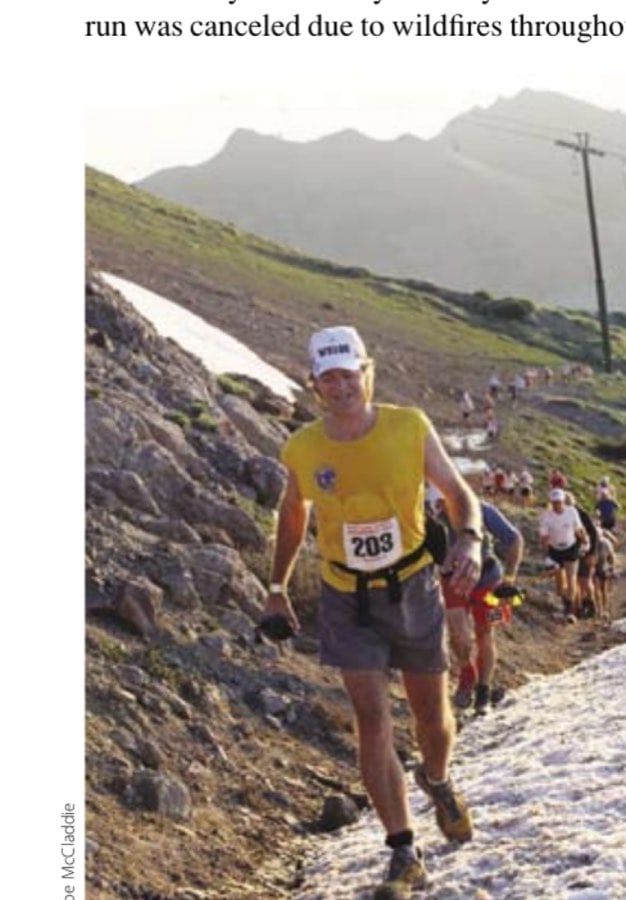
Stan Ferguson early in the 2009 Western States 100, the first leg of his Grand Slam journey.
finishing the Slam in under 100 hours, but in my head that was just a nice goal, a sort of dividing line. While certainly they have had hotter days for past Western States 100s, it was definitely a hot one this year. The temperature in Auburn was 104 degrees
Fahrenheit on Saturday and 109 on Sunday. Also, from Chrissy’s and my experience, we think the current course is the most difficult version there’s ever been. Duncan Canyon is back, some of the trail
that was incorporated during its absence was retained, and nearly all road has been removed. But enough excuses. I do feel I was adequately prepared and should have been capable of achieving my goal of sub-24. Whatever the reasons, I finished in 26:22:17 and was glad to be in.
The forecast for the weekend was hot—and hot it was! Between Lyon Ridge and Red Star Ridge is a rock formation called Cougar Rock. As runners climb the rock, a photographer takes your picture with the valley and mountains in
the background. A long-time ultrarunner and dear friend Red Spicer had passed away the previous August, and his daughter gave a portion of the ashes to Lou Meyers to spread where he thought fit. Lou asked me to take the ashes with me
to Western States and spread them at Cougar Rock since Red had run the race and had a poster-size picture in his home of his climbing Cougar Rock. The morning of the race, I packed Red’s ashes in my pack and carried them to the rock, where
I spread them and wished him well. Deep Canyon 2, also known as El Dorado Canyon. From the bottom of the canyon before the Devil’s Thumb (48 miles) aid station to Michigan Bluff (55 miles), it was like being in the movie Night
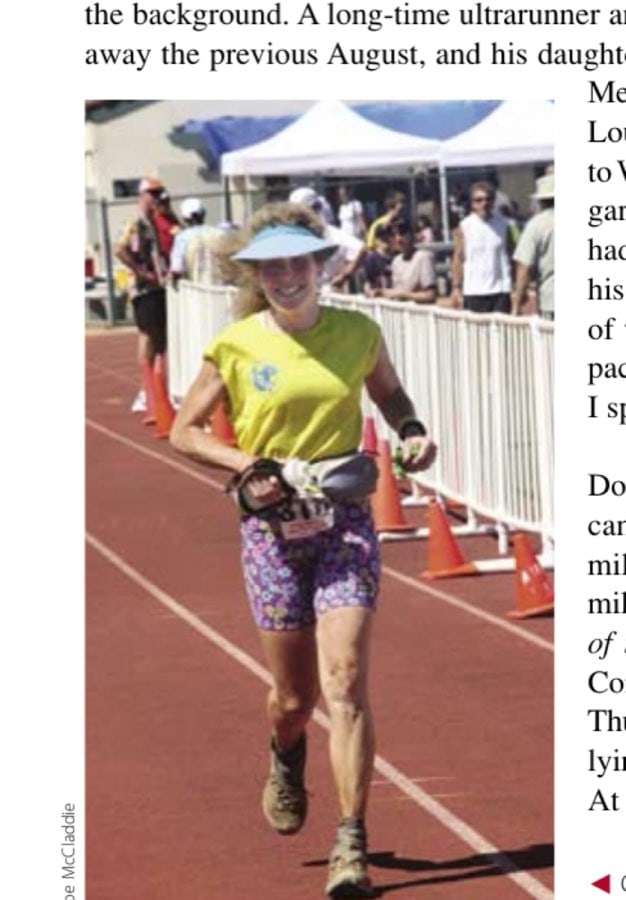
of the Living Dead but during the day! Coming out of Deep Canyon into Devil’s Thumb, three runners were either sitting or lying in the fetal position along the trail. At the Devil’s Thumb aid station, there Chrissy Ferguson finishes her Western States 100 in 29:29:00.
▲
© Joe McCladdie
Chrissy’s experience
were many cots with runners and more sitting in chairs looking like burnt toast. On the way down the canyon, even more runners lined the trail needing help. Foresthill (62 miles). Meeting Joyce (pacer) was like getting a battery charge knowing I didn’t have to run by myself. It took a lot of pressure off knowing that no matter what, I couldn’t quit because there’s no way she would let me. Cutoff time of race: 30 hours. My finishing time: 29:29:00. Fifth Western States finish. Stats: starters 399, finishers 238.
Vermont 100, July 18–19 The Vermont course starts and finishes at Silver Hill Meadow. The route is a shamrock loop, consisting of 70 percent dirt or jeep roads with the rest on wood trails (there are a couple of miles of pavement). The course both climbs and descends 14,000 to 15,000 feet. Belt buckles go to finishers under 24 hours.
Stan’s experience Faced with nearly a two and a half hour deficit on my Slam time goal after one event, my adjustment was to reset my Vermont goal to sub-20 and try to beat that by as much as I reasonably could. It added some pressure, but I thought I could
use that to my advantage. Chrissy thought it was stupid for me to try to run that fast, but with the relatively long five-week recovery period before Leadville, I saw nothing to lose by giving it a shot.
The run itself was essentially just working the plan. I actually finished in 19:33 (give or take about 15 seconds), but a timing snafu put my official time as 19:36:09. I hoped this didn’t wind up costing me in my sub-100 quest. On a
positive note, I ran my first sub-20-hour 100-miler in eight years. Chrissy’s experience
© John Miller / Spectrum Photography
I’m sure most runners who have completed a 100-miler have three target times when they start a race: number one is best case, number two is what you will be happy with, and number three is what you won’t beat yourself up over.
▲
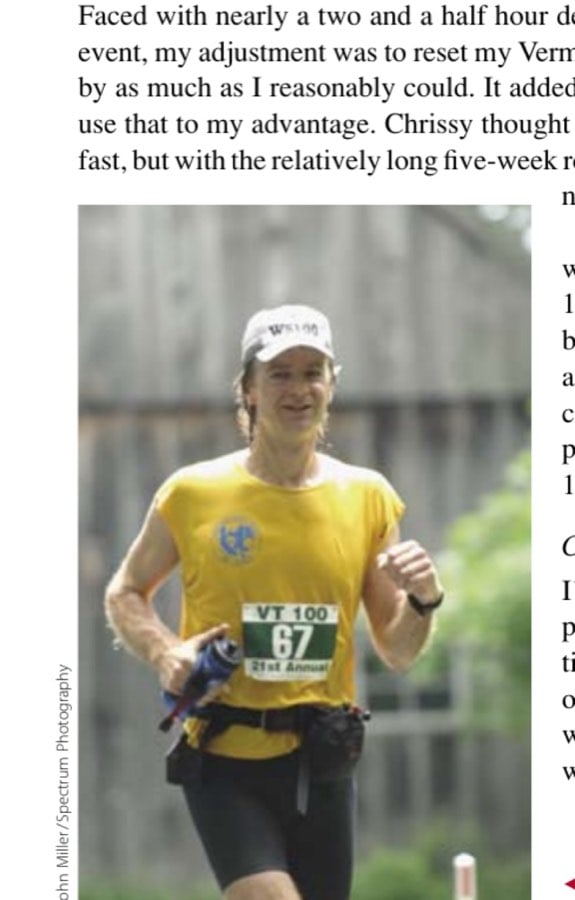
Stan Ferguson ran his first sub-20-hour 100-miler in eight years at the Vermont 100.
© John Miller / Spectrum Photography
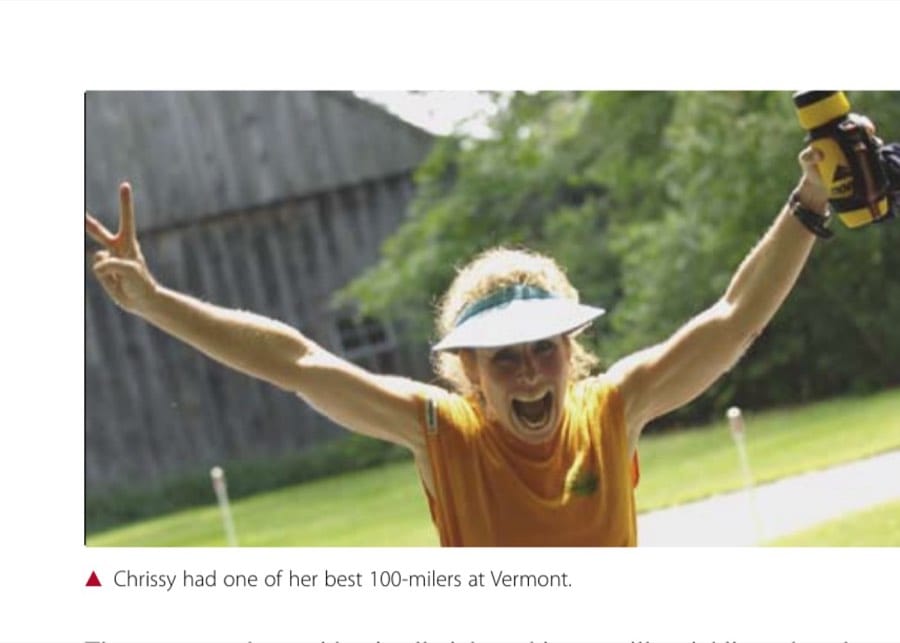
▲ Chrissy had one of her best 100-milers at Vermont.
The race started out with rain all night and it was still sprinkling when the race started at 4:00 a.m. I knew from past experience this would mean the horse trails would be muddy and that as soon as the horses started running an hour later and caught up with us, the trails would be trashed.
At no point in the race did I really have a bad spell or bonk, which is very unusual. I’ve completed 28 100-milers, and out of those 28 I’ve had three races where I felt great the whole duration of the distance, which are pretty low odds. It’s OK if you feel bad in a 5K, but feeling bad in a 100-miler can make for a very long day and a longer night. Finished in 23:25:26 on the Vermont time. Silver belt buckle.
Eighth Vermont 100 finish. Ran Western States three weeks prior.
Leadville Trail 100, August 22–23 The course route involves 50 miles out and back in the midst of the Colorado Rockies. The lowest point is 9,200 feet, and the highest is Hope Pass at 12,600 feet. The majority of the course is on forest trails with some mountain roads. Pacers are allowed on the course after the 50-mile point.
Stan’s experience My mission was the big (sub-25:00) buckle, and anything less would be a disappointment. We followed the same pattern as last year. Chrissy went out two weeks early to acclimate, and I followed a week later. We got to see Lance Armstrong win the bike race. It was a circus again, with even more riders, more spectators, and a whole bunch of camera crews on foot, motorcycles, and helicopters filming
for an upcoming movie on the race (more details on the movie can be found at www.raceacrossthesky.com). A major and tragic event that occurred the week before the race was the crashing of a Black Hawk helicopter on Mount Massive. From my 26:20 performance in 2008, I had a pretty good feel for where I needed to trim some time. I felt the keys were to run the section from Halfmoon to Fish Hatchery (all on road and a net downhill) and to run more of the “boulevard” back into town at the end if I needed to. Coming in to Twin Lakes outbound (40 miles) at precisely 25-hour pace, I made a regrettable decision to go light on the out-and-back trip over Hope Pass and to Winfield. I picked up a bottle of Ensure to carry for extra calories and had another waiting at Winfield for the return trip. Unfortunately, I decided to forgo the weight of carrying my third water bottle. After a laborious up and over Hope Pass, I came into the Winfield turnaround at 2:35 p.m.—just five minutes over 25-hour pace but 3 pounds under my race check-in weight. That wasn’t much, but it was enough to convince me that some of my recent lack of pep was due to dehydration. This I worked on, but it was not to be a quick resolution. The return climb up the steeper side of Hope was an extreme struggle, so much so that I didn’t even mind the frequent stops to let the late out bounders by on the narrow trail. By the time I reached the top, I had major leg cramps. These got so bad that at one point I stopped to empty something out of my shoe, and it took several minutes to work through the process as I couldn’t raise my foot or bend down without something completely knotting up. Fish Hatchery: This is where Joyce ( pacer) met me to pace me in to the finish. I had about six and half hours to cover the remaining 23 miles if I was to claim the big buckle. I trotted onto the red carpet and crossed the finish line a moment before 4:44 a.m. (24:43:55). Big-buckle time!
Chrissy’s experience Probably one of the most-asked questions about the Leadville 100 is, “What makes it such a hard race to finish?” After starting this race five times and completing it only twice, my answer is: elevation. Leadville starts at 10,200 feet, climbs over Sugarloaf Mountain at 11,400 feet and over Hope Pass at 12,600 feet, and goes over both twice—once on the way outbound and again on the way back. This is the biggest of the elements. Also—the tight cutoff times at the aid stations, the lack of aid stations, and the weather.
On August 19, at around 2:00 p.m., a Black Hawk helicopter from the 160th Special Operations Aviation Regiment of Fort Campbell, Kentucky, was on a routine high-altitude training mission 85 miles southwest of Denver and crashed into the side of Mount Massive at 14,200 feet. All four solders were killed. The
▲
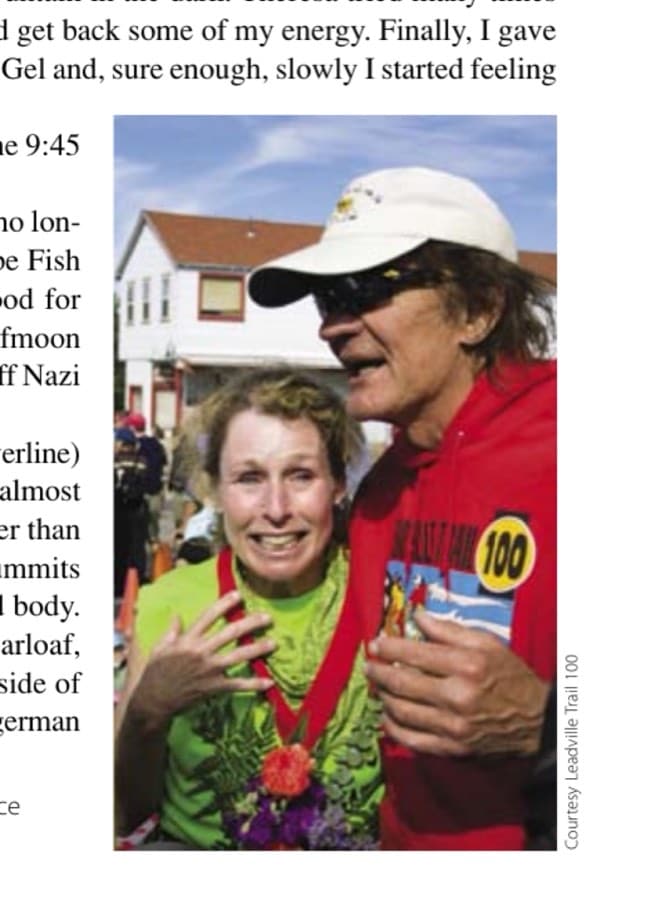
Chrissy celebrates at Leadville with race founder and president Ken Chlouber.
Courtesy Leadville Trail 100
Army confiscated the Halfmoon campground for the command post to retrieve the wreckage off the side of the mountain. This left the Leadville race directors with the problem of what kind of course change to make since Halfmoon is the 30- and 70-mile aid stations, and the road to Halfmoon is part of the course. Runners were rerouted onto Pipeline Road, which is used for the 100-mile bike race and then onto a private road to the Colorado Trail. The footing on the new route was better, but the course was slightly longer because of the change.
I arrived two weeks prior to race day in hopes of acclimating to the high altitude. On race-day morning, we woke to clear, starry skies and cool temperatures. Just before getting to the Hope Pass aid station, I started feeling pretty bad. Just before the top, I had to stop and regroup because I felt so bad. The biggest problem with altitude is you just don’t know when you’re going to have trouble with it. Just about halfway up the mountain, I threw up all the nutrition I had consumed at the Winfield aid station (big bummer). As I looked at the never-ending switchbacks and the dot-sized people way ahead of me, I felt I would never get there. When we finally made it to the Hope Pass aid station, it was getting dark and I was sending invitations to my pity party.
I ate some soup. Theresa (pacer) grabbed a couple of Power Gels, and we slowly made our way down the mountain in the dark. Theresa tried many times to get me to eat more so that I could get back some of my energy. Finally, I gave in and sucked on a packet of Power Gel and, sure enough, slowly I started feeling better and running faster.
Twin Lakes aid station: Made the 9:45 p.m. cutoff by one minute. Since the Halfmoon aid station no longer existed, the next cutoff would be Fish Hatchery at 3:00 a.m. This was good for me since last year I missed the Halfmoon cutoff by four minutes, and the cutoff Nazi ended my dreams.
Sugarloaf Mountain (aka the Powerline) is only 11,400 feet, but after running almost 80 miles you would swear it’s higher than Hope Pass. Plus, it has three false summits that really play with your mind and body. Once we made it to the top of Sugarloaf, we ran all the way down the other side of the mountain and ran and walked Hagerman
Pass Road. I dreaded getting back on the Colorado Trail for the short one and a half miles to May Queen. This section is mostly downhill with many iceberg rocks that catch tired feet and make you fall. It’s way easier to fall uphill than downhill, if you know what I mean. To my surprise, the trail didn’t seem so bad or so long. By 6:00 a.m., we were into the May Queen aid station. I had only 13 miles left to go. I had four hours to run/walk my way to the finish. All of a sudden the reality was setting in—I was going to finish with time to spare! 29:36:04 finish.
The home stretch: Wasatch Front 100, September 11–12 The course stretches from Layton to the Homestead in Midway. There is a cumulative elevation gain of around 26,882 feet and a cumulative loss of around 26,131 feet throughout the course.
Stan’s experience Last year, the final 20 miles at Wasatch were mostly a death march. I was confident in being able to cover that section an hour faster, in addition to the extra few minutes needed to improve from my 31:16 to a sub-30. But to reach my Slam goal required a 29:17:30 or better—meaning essentially a two-hour improvement was needed. My main strategy was to travel lighter. In lieu of an actual pace chart, I carried a small card with my arrival times and intervals between each aid station last year. (Those who have done mountain races know that the actual mileage between two points means very little.) Combined with the fact that it was a warm day and night (requiring little extra clothing to be carried), using my previous data to know how much water and fuel to take for each section was a definite benefit.
Maybe it was due to the lingering effects of Leadville—just 20 days earlier— but I never felt very energetic and I never, ever got really comfortable running downhill. A motto of Wasatch is “100 miles of heaven and hell.” If you took a poll, I think the responses of where the hell is would overwhelmingly be the section between Rock Springs and Pot Bottom. You have the Dive, the Plunge, and then a whole bunch of steep ups and downs that seem totally unnecessary. I pushed more through this section than at any other point in the race. And when there was finally some good, runable trail, I actually felt like I was truly running. Coming in at 29:00:54, I was thrilled.
Wasatch has a great system for tracking runners and projecting their arrival at the next checkpoint. Their estimates are typically dead on. When Chrissy became 30 minutes late getting into Pot Bottom, we got concerned. When she was an hour late, we were really concerned. Finally she arrived, and when her anticipated finish time was calculated, it was for 4:47 p.m.—just 13 minutes under the 36-hour cutoff. I expected her sooner, since she had chastised me so much last year when I ran very little of that last section. By 4:30 we were closely watching a section
of the road that we could see through the trees, nearly half a mile away. Waiting, waiting . . . finally, two matching lime-green shirts popped into view. Her finish time was 35:46:31. Chalk another one up for the Wasatch time estimates. To wrap up a quest that took almost two years from its inception is quite a relief. It was a significant time commitment (not to mention monetary), required numerous things to go right, and involved a bunch of people. Next year: something a little less involved.
Chrissy’s experience I had heard the horror stories of how hard Wasatch was since I started running ultras in 1992. At one time it was the hardest 100-mile race in the world. Then along came Hardrock, which took the title and moved Wasatch to second. Wasatch has almost 27,000 feet of climbing and 26,000 feet of descent. Think about that: that’s only 2,000 fewer feet than climbing to the top of Mount Everest from sea level and the equivalent of running Athens Big Fork Marathon four times in elevation gain and mileage.
The race starts at 5:00 a.m. at a little park trailhead northeast of Salt Lake City at the base of the Wasatch Mountains. When the gun went off, we were immediately on a narrow trail that ran along the base of the mountain for about three miles. There were many times in the first few miles the runners bottlenecked because of the width of the trail versus the number of runners trying to jockey for position. A few years ago, after she finished the Grand Slam, Liz Walker told me the first 18 miles and the last 25 miles were the hardest of the race and that she sat down halfway up the first climb and cried because her legs were so tired from the three previous 100s. As I made the first climb, those words were ringing in my head along with the thoughts of what the other miles would bring. I was scared of the unknown. When we finally made it to the top of what’s called the “Chin Scraper,” you crest the top of the mountain and the top of the world. You could see all of the Salt Lake City valley and the lake. It was so worth the climb!
The climb up Katherine’s Pass is the highest elevation point but not the longest. Brighton is at about 8,000 feet, and you climb to the top of the pass at 10,400. Last year I made this climb with Stan in the dark. This year I got to see it in the daylight, and it was beautiful. As we climbed the mountain, I looked up the trail to see a moose standing alongside the trail just ahead of us. I shouted to my pacer, “Paul, look at the big-ass moose!” and as I pointed the moose was jogging down the trail in our direction and not stopping. Paul and I both jumped off the trail and hid behind a combination of a big rock and a tree beside the trail. The moose stopped at the tree/rock and just looked at us. I climbed around the other side of the tree/rock to the back of the moose and yelled, “Get out of here!” The moose then saw another runner and pacer and ran down the trail toward them. They too jumped off the trail. Other runners came up the trail, and finally the moose ran up
Courtesy of Stan Ferguson
the mountain away from all of us. That’s only the second time I’ve seen a moose in real life. I’ve heard stories of how they can be very aggressive and will stomp you to death if you piss them off. At each aid station we came into after Brighton, I made time on the splits that we had from Stan’s race last year.
Wrong turn: At Rock Springs aid station (88 miles), our dream of finishing under 35 hours was destroyed when I took a wrong turn about 200 feet out of the aid station and then ran down a very steep trail for 30 minutes before another runner coming back up the hill told us we had taken a wrong turn. As we climbed back up the steep rocky trail to find where we had missed the turn, I began to panic. We were now past the 36-hour predicted-time cutoff. I started to cry and told Paul I had to finish this race for Stan. It was Stan’s birthday today, and my finish and the coveted Grand Slam couple’s finish was his birthday present.
After doing the math, we were now at least 10 minutes behind the 36-hour predicted finishing time, which meant I was going to have to run my ass off to finish under the official time. Crap! From that point on if I could run, I did; if I couldn’t run, I walked as fast as I could.
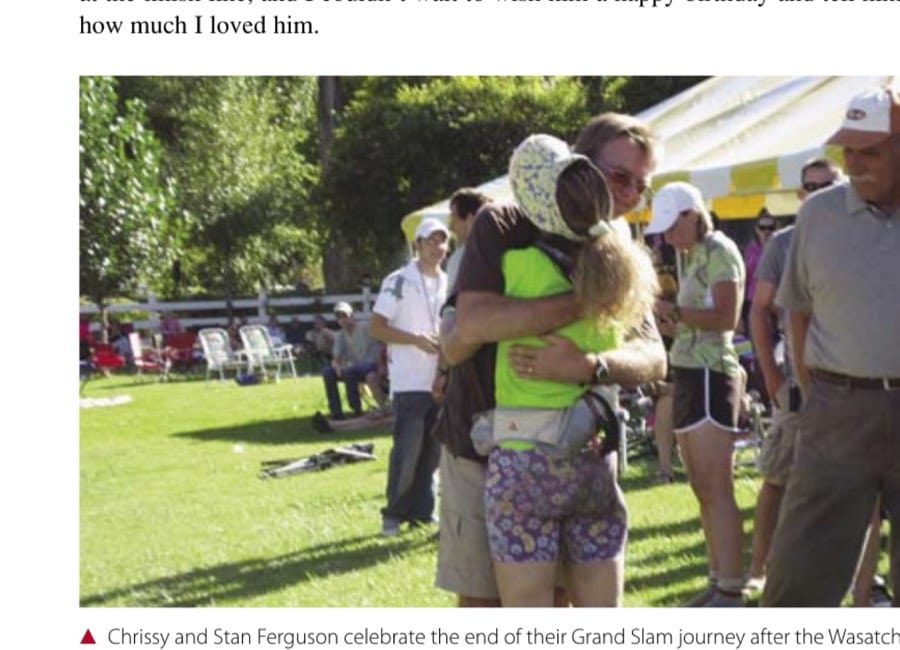
Coming into Homestead and crossing the grass field to the finish was one of the happiest moments in my running career. I could see Stan waiting for me at the finish line, and I couldn’t wait to wish him a happy birthday and tell him how much I loved him.
▲ Chrissy and Stan Ferguson celebrate the end of their Grand Slam journey after the Wasatch Front 100.
Training for the Grand Slam The duo mostly did separate routines during training. “On shorter runs during the week we might actually run together, or sometimes we’ll go somewhere and both run, but our paces are too different to do major training runs side by side,” said Stan. The couple kept their focus on one race at a time. “Neither one of us prepared any differently than we would for a single 100-miler,” said Stan, “at least for one of the western 100s. You have to get as ready as you can (in Arkansas) for the big ups and downs you find in some of those. The best thing we’ve found for this is the steep road up a nearby ‘mountain,’ Mount Nebo at about 1,800 feet. We would do as many as five repeats up and down it. After WS, the first race in the Slam, it was just a matter of getting as recovered as possible before the next race.” As for fuel during races, Chrissy likes “real” food (sandwiches, for example), supplemented with Ensure. Stan typically eats Snickers for much of a race, along with Ensure. At the aid stations, he generally seeks out fruit—his favorites being cantaloupe, honeydew melon, or watermelon— and he will do gels (no particular favorites) later in the race. The gaps between each race in the Slam were three weeks, five weeks, and three weeks. “For the three-week recoveries, there was just barely time to get running again before tapering for the next one,” said Stan. “Even during the five-week span, there were no long runs more than a couple of hours or so. I think the most important thing we did was to do as much walking as possible in the first two or three days after a race. Chrissy’s a big Stair Master fan, so she would do that to get a better workout if she wasn’t quite up for running yet.” The Fergusons said two other couples should be noted for their Grand Slam accomplishments: In 1997, Martha Swatt and Wendell Robison of Wyoming completed the Grand Slam. They were not married at the time but did marry later. Martha’s cumulative time was the fastest of any woman at that time. Separately, Miles Krier completed the Grand Slam in 1997, and his wife, Barbara Frye-Krier, completed it in 2001. So what advice do the Fergusons have for other couples thinking of taking on the Slam? “Mainly just be prepared and know it will most likely be very stressful at times,” said Stan. “Probably like a couple who is building or remodeling a house.”
This article originally appeared in Marathon & Beyond, Vol. 14, No. 4 (2010).
← Browse the full M&B ArchiveMore like this
1,000+ stories from 19 years of Marathon & Beyond
The complete archive of the legendary long-distance journal — digitized and free to read.
