

Vancouver International Marathon
SOME MARATHONS artificially affix status to their event by adding the word “international.” But for a marathon to truly burnish the international in its name, the race committee must expend a fair amount of time and energy soliciting and then coddling the foreign runner with the foreknowledge that what works in Germany fails in Japan.
A marathon that has been successful marketing to foreign countries takes on a flavor that is distinct: Besides the good-natured attempts of runners to converse in languages not their own, there is a very colorful clash and commingling of unfamiliar logos and race T-shirts, equally unfamiliar shoe models, sometimes seemingly absurd warm-up routines, and the distinct aroma of exotic muscle liniments and potions.
The Basics
| Vancouver International Marathon (& Half-marathon) |
| PHONE: 604/872–2928 |
| FAX: 604/872–2903 |
| REPRESENTATIVE TO AIMS: Gordon Rogers |
| CHAIRMAN, VANCOUVER MARATHON SOCIETY: Colin Atkinson |
| YEAR RACE ESTABLISHED: 1971 |
| SANCTION: BC Athletics and Athletics Canada |
| CERTIFIED: Assn. of International Marathons & Road Races (AIMS, 5/95) |
| START TIME: 7:00 A.M. |
| COURSE RECORD HOLDERS (NEW COURSE WAS INAUGURATED IN 1989): |
| Male: Gary Henry, Australia, 2:13:14 (old course) |
| Makato Sasaki, Japan, 2:17:24 (new course) |
| Female: Gail McKean, Canada, 2:44:53 (old course) |
| Yuka Terunuma, Japan, 2:43:16 (new course) |
| PRIZE MONEY: |
| 1st place: $2,000 (Canadian dollars) |
| 2nd place: $1,000 (Canadian dollars) |
| 3rd place: $500 (Canadian dollars) |
| TIE-IN EVENT: Variety Club 5K Walk for Kids |
| NO. VOLUNTEERS: 1,500 |
| MARATHON FINISHERS IN ’96: 2,060 |
| HALF-MARATHON FINISHERS IN ’96: 1,772 |
| PROPORTION MALE/FEMALE COMBINED RACES: 60% male; 40% female |
| COURSE MARKING: every kilometer, miles 1, 5, 10, 15, 20 |
| NO. FIRST AID STATIONS: start/finish + 7 on-course |
| NO. AID STATIONS: start/finish + 14 on-course |
| FUTURE RACE DATES: 04MAY97, 03MAY98, 02MAY99, 07MAY00 |
| ENTRY COST FOR 1997 EDITION: |
| By 01APR97: Full $40 (U.S.), $55 (Cnd.); Half $25 (U.S.), $33 (Cdn.) |
| By 25APR97: Full $60 (U.S.), $75 (Cnd.); Half $30 (U.S.), $40 (Cnd.) |
| After 25APR97: Full $75 (U.S.), $99 (Cnd.); Half $36 (U.S.), $50 (Cnd.) |
| OFFICIAL HOTEL: Holiday Inn Downtown 604/684–2151 |
| FOR INFO ON VANCOUVER: Where Vancouver, 2208 Spruce St., Vancouver, B.C. V6H 2P3, Canada, 604/736-5586, fax: 604/736–3465, e-mail: 76632.716@compuserve.com |
| GETTING THERE: Canada is one of the most pleasant “foreign” countries an American can visit, made more so by the long history of friendly relations between the two countries. You do not need a visa to enter Canada, but it wouldn’t hurt to take along your passport if it’s handy. Some form of current ID is a necessity. Vancouver International Airport is served by more than half a dozen major carriers. Driving is also easy, especially since most modern vehicles are equipped with speedometers with both mile- and kilometer-per-hour markings. The simplest route to Vancouver from the United States is to drive north on Interstate 5 in Washington State, make the border crossing at Blaine, and continue north on Canada Highway 99. |
CITY BY THE SEA
It is much easier to organize a successful international marathon in a city that owes its very existence and prosperity to the international markets. Vancouver in Canada’s British Columbia definitely qualifies in that regard. In fact, has qualified in that regard for more than a century.
In her 1986 book On the Shady Side: Vancouver 1886–1914, Betty Keller put it this way: “As a port city, the end of the rail line, and the natural jumping-off point for both the exotic east and the chilly but rich north, Vancouver saw more than its fair share of ‘skippers’; most ships left with a stowaway or two tucked into the hold, and many docked with similar uninvited guests.”
Within the last decade Vancouver has experienced a burst of immigration, especially from Hong Kong as that city readies for its reversion to Chinese control. There has been so much immigration from Hong Kong, in fact, that Vancouver is often referred to as “Hong Couver” and now holds the distinction of having the second largest Chinese metropolitan population outside China—second only to San Francisco.
And then there are its other similarities with San Francisco: Built on a series of hills and enjoying ready access to the Pacific Ocean, spanned by numerous and distinctive bridges and obliged to endure a mild climate, boasting a magnificent urban park and more than a dozen ethnic neighborhoods, Vancouver easily qualifies as the San Francisco of Canada. It also wrestles with some of San Francisco’s problems: escalating real estate prices due to the very finite land availability, drug traffic that comes with ready access to international commerce, the occasional blighted neighborhood, and a subculture of runaways, homeless, and panhandlers. Fortunately for visitors, Vancouver’s panhandlers have quite a ways to go to equal the aggressiveness of those on San Francisco’s Market Street.
In fact, jogging the downtown streets of Vancouver to loosen up a few days before the city’s annual international marathon, one senses little danger even on side streets with mean reputations. If danger lurks in Vancouver, it is a more benign danger than exists in most cities.
A few years from now, the potential danger might be downright illusionary. After nearly a decade of halting development in the False Creek area (site of the 1986 International Exposition), construction of apartment/condo buildings, hotels, and business complexes is as aggressive as the panhandlers aren’t. The panhandlers may simply be nudged out of town by encroaching prosperity.
The similarities to San Francisco continue. San Francisco has wrestled for decades with finding a brilliant course in a dramatic city. Unfortunately, that which makes the city dramatic, also makes a brilliant marathon course impossible. When a city such as San Francisco or Vancouver has water as a boundary, expansion of the city is impossible, land becomes extremely expensive, and there is a compacting effect; when the city’s dramatic vistas come partially from inner-city hills, a course with hills is inevitable—the same applies to crossing bridges. Bridges work because of cantilevering, which involves high points.
Life is compromise. In the case of the San Francisco and Vancouver courses, some unappetizing course miles are required fare in exchange for all of the miles that are tantalizing and fulfilling and often unforgettable.
THE GATHERING POINT
The Vancouver International Marathon and Half-marathon begin and end on Pacific Boulevard between B.C. Place Stadium and the Plaza of Nations at False Creek. The fact that they begin and end in the midst of what was Expo 86 is appropriate for a race that could boast in 1996 of hosting entrants from nine Canadian provinces, 34 states in the United States, and 29 foreign countries, including but not limited to Australia, Cuba, the Czech Republic, Holland, Hungary, Italy, Japan, Mikulas, Poland, Serbia, Singapore, and Slovakia.
Of the 4,294 marathon and half-marathon entrants in 1996, more than 500 were from Japan, the largest foreign contingent after the United States, which had more than 700 entrants.
The marathon and half begin together at 7 A.M. The warming up and milling about before the start is so international that it resembles a United Nations in its underwear, with two minor differences: Nearly everyone is
Must See/Must Avoid
EVERY major city in the world features an array of attractions that make it unique and that enlighten and entertain visitors. And, because of its very size, every major city is saddled with areas it would rather have vanish in a puff of smoke. The following is a brief consideration of both.
GO SEE IT
Stanley Park. If someone were to take a backhoe to Chilco St., it would be no great feat to turn Stanley Park into an island. The 1,000-acre park features a 5.5-mile seawall and 22 miles of forest hiking trails that are favorites of runners. Named after Lord Stanley (who also has the NHL Stanley Cup named after him), the park boasts a rose garden, the Shakespeare Garden, totem poles at Lumbermen’s Arch, and the Vancouver Cricket Club. You’ll find gaggles of swans, ducks, and Canada geese at Lost Lagoon. The park is also home to the Vancouver Aquarium, the Pitch n’ Putt golf course, and the Children’s Farmyard and miniature Railroad. Stanley Park is a must do.
Granville Island (not to be confused with Granville St.). For all the bad rap cities take, they occasionally do things right. Granville Island is one of them. Vancouver took an abandoned industrial site under the Granville Bridge along False Creek and turned it into a northern version of San Francisco’s Fishermen’s Wharf/Pier 39. Think of Granville Island as CEEC: culture, education, entertainment, and culinary. The Emily Carr College of Art maintains two galleries on the island, the Performance Works usually has a play in production, and also located here are The Arts Club Mainstage and The Arts Club Revue Theatre. The Granville Island market is an outdoor melange of fresh produce, chocolates, seafood, pastries, cheeses, and so on. The Kids Only Market offers 25 specialty shops aimed directly at the tykes, and there’s nonstop entertainment. The place is literally swarming with arts and crafts shops, crawling with free entertainment, and weighed down with good places to eat.
Gastown. Named after “Gassy” Jack Deighton who, in 1867, opened Vancouver’s first hotel/bar (Deighton House), Gastown aims to give the impression that you’ve stepped back a century. There are brick sidewalks and period lighting, the steam clock—the only one of its kind in the world—and plenty of shopping and dining opportunities, including the Steamworks Brewpub.
Canada Place. The complex juts out into Burrard Inlet and is topped by what appear to be five giant sails. The complex is a favorite port for cruise ships and serves as the Vancouver Trade Convention Center. The Pan Pacific Hotel is on the premises, as is the CN IMAX Theatre, a five-story-high screen beefed up by wraparound digital sound that features 30- to 40-minute films that put you in the midst of the action.
Science World. Within a few hundred yards of the marathon start/finish area, Science World is one of the few Expo 86 buildings that was kept intact after the world exhibition ended. It looks like a giant silver ball but is in effect a batch of ongoing science fair experiments where you can do everything from blow square bubbles to make your shadow vanish. The jewel of Science World is the OMNIMAX 3D theatre—one of the largest domed theatres in the world.
Terry Fox Monument. Just off Beatty St. North at the northwest side of B.C. Place Stadium is the moving monument to Terry Fox, the young Canadian who, while suffering from advancing cancer, attempted to run across Canada on one leg. This is a good place to visit just before and just after the marathon.
AVOID IT:
Granville Street. One of the more colorful streets in Vancouver (some of it is closed off to traffic), Granville Street is also central to the subculture of runaways and druggies. It is also home to porn arcades and pawn shops, although not for its entire dozen blocks. There are no problems here during daylight (except for the occasional panhandler), but the street is best bypassed after dark.
smiling, and everyone is intent on moving together in the same direction.
Chairman Colin Atkinson and the race committee take pains to encourage international harmony with a reception for the marathon’s Japanese sister cities on Friday night before the race, and they host an international breakfast Saturday morning.
PRERACE KINKS
If the prerace activities has an Achilles’ heel, it is the Fitness Expo and race packet pickup.
City Square is a mall constructed within and around an historic building. The marathon society has its offices on the second floor in the City Square complex, so it is a natural site for race pickup. There is also a Running Room store in the complex, which is a plus for hyped runners looking for race weekend bargains. Unfortunately, as a bustling commercial mall, City Square offers little space for setting up expo exhibits. Exhibits must be squeezed between posts, in what little space is available that will not terminally hamper traffic. On the plus side, for a modest extra fee, runners can attend seminars on the second floor conducted by the always-personable, always-insightful, always-inspirational Olympic 10,000-meterman Jeff Galloway. Jeff offers one seminar late in the day on Friday, and two seminars on Saturday. Unfortunately, the room in which Jeff speaks and fields questions is becoming too small for his increasing and well-deserved popularity.
Also unfortunate is the fact that while most of the major hotels are conveniently within a few blocks of the start/finish area, City Square is a mile away across the Cambie Bridge, which spans False Creek. On the positive side, walking a mile to City Square to pick up one’s race packet and then walking back can loosen the legs and release pent-up energy the day before the race.
The race packet features several discount coupons for local running and shoe stores, and the race T-shirts are usually colorful and well-designed. The marathon T-shirt is distinctly different than the shirt for the half.
DINING AND SLEEPING
A Saturday evening pasta-loading is available from 4 P.M. until 8 P.M. at the Holiday Inn Downtown, the host hotel. The pasta selection is excellent, but not quite as much fun as the carbo loading was through 1995 when it was hosted by a major rice company and offered more than 30 rice dish entrees—tempting enough to lure even those runners not traditionally fans of rice.
Most runners opt to find their own prerace meal. Like San Francisco, Vancouver is a virtual smorgasbord of international food. Popular Gastown, the city’s oldest and most colorful section, offers everything from excellent food downstairs at the Steamworks Brewpub to East African food at the Kilimanjaro restaurant near the gas clock. There are scores of Italian and Oriental restaurants throughout the city.
One of the luxuries of the start/finish lines being located at B.C. Place Stadium is that there are at least four hotels within three blocks of this area (the brand new Rosedale on Robson, the Sandman Inn, the Hotel at the YWCA, and the Georgian Court Hotel), which means a runner can sleep late, then literally roll out of bed and land at the starting line. Even the official hotel, the Holiday Inn Downtown, is a mere dozen blocks from the start. A good brisk walk to the start can get the kinks out of the legs and get the heart up to speed very effectively.
THE START
The start area on Pacific Boulevard is efficiently set up. Pacific Boulevard is generously wide and easily accommodates 4,000 runners until they string themselves out, and Steve King (the voice of the Hawaii Ironman) does the announcing at the finish. More on Steve later.
On the downside, since the marathon caters to the international market, the Japanese Syndrome is in effect at the start: Very enthusiastic but very slow runners (often elderly Japanese women) line up in the first several rows and then become mobile traffic cones to faster runners attempting to come up from back in the field. Japanese runners, like runners from several other countries, also tend to run in groups, which form clots that are sometimes difficult to negotiate as the course narrows. There is also a tendency among Japanese runners to go out at a suicide pace, burn out, and then stop abruptly, heedless of the fact that there might be a fast runner directly behind them.
THE HALF OF IT
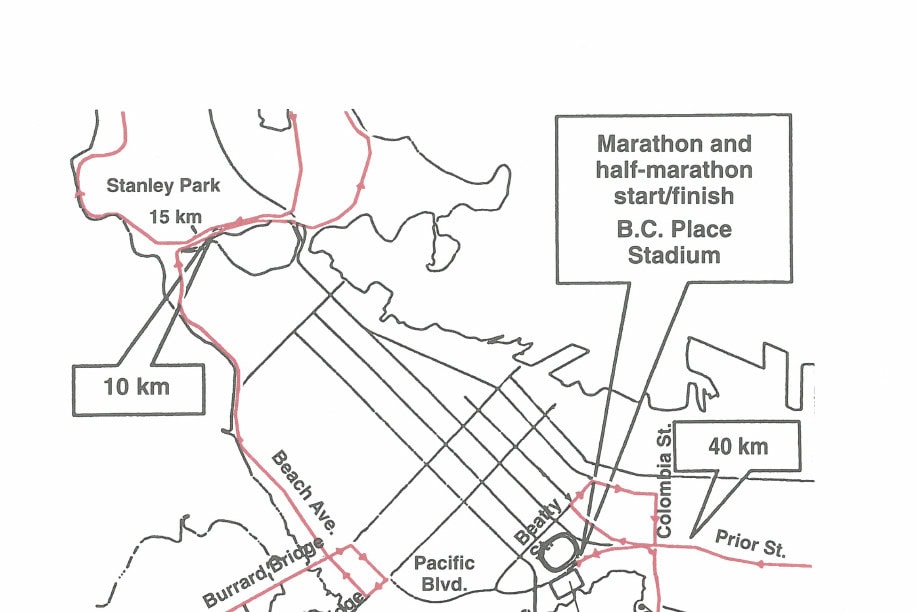
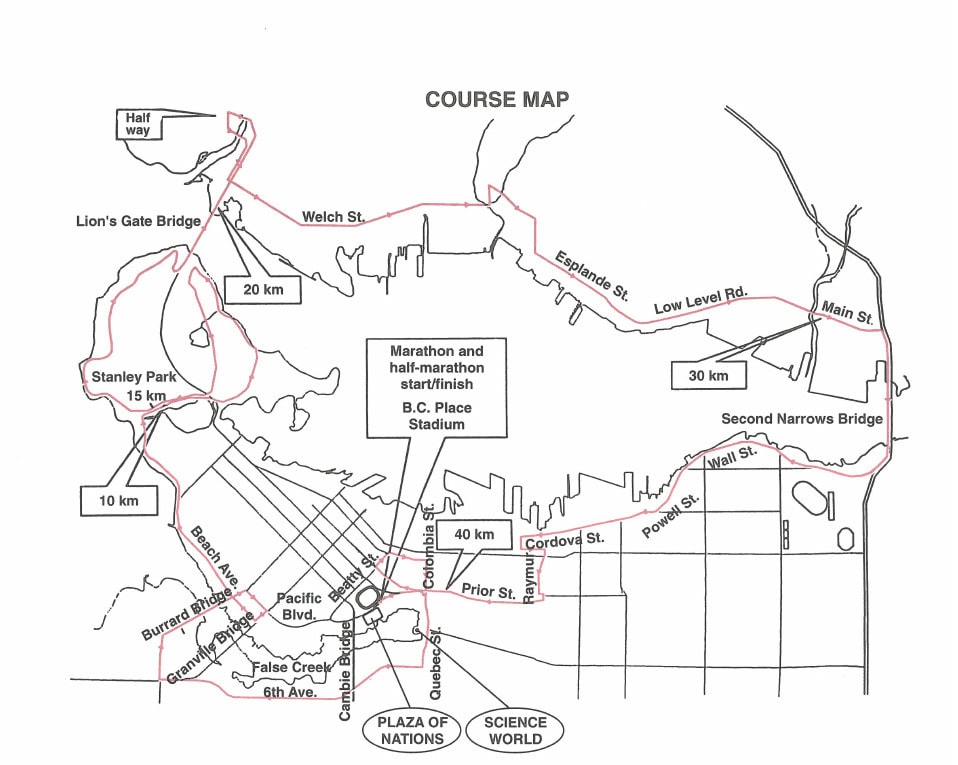
For half-marathoners, the course never has an opportunity to get old. The first several miles are along generously wide streets around False Creek and then paralleling it on the south side until crossing the Burrard Bridge, the highest point on the half-marathon course. The course then runs along Sunset Beach and English Bay Beach, apartments on the right and a greenbelt between the street and the beach on the left. The course proceeds into Stanley Park, one of North America’s most beautiful urban parks. At 15K, the marathoners continue through the park, and the half-marathoners turn back toward English Bay Beach, where they retrace their steps along the water, run under both the Burrard Bridge and the Granville Bridge, and finish the course along the northern side of False Creek.
The course offers variety, features no overwhelming hills, is scenic for most of the route, and finishes on the flat, so if you’ve got anything left
you can use it up in the last half-mile. There are no surprises within the last mile, either, because you can see the dome of the B.C. Place Stadium and meter your remaining energy accordingly.
THE FULL
The marathon course is somewhat more challenging. After marathoners split from their half-marathon brethren, they proceed around the western edge of Stanley Park before squirting out onto Lion’s Gate Bridge for a long, steep, dramatic (no acrophobics allowed) downhill across First Narrows into North Vancouver. As scenic as the first half of the marathon is, the second isn’t, which is fine if a runner tends to narrow down the focus during the second half of the race. The course runs past factories, parallels railroad tracks, runs through some middle-class residential neighborhoods, until, at about 31K, it rises over Second Narrows Bridge, the last hill in the course, and although certainly nothing close to Lion’s Gate Bridge, still a minor challenge. From that point, runners have a relatively simple if not especially dramatic 10K race to the well-organized finish at B.C. Place Stadium.
Some veteran marathoners thrive on the challenges within the course.
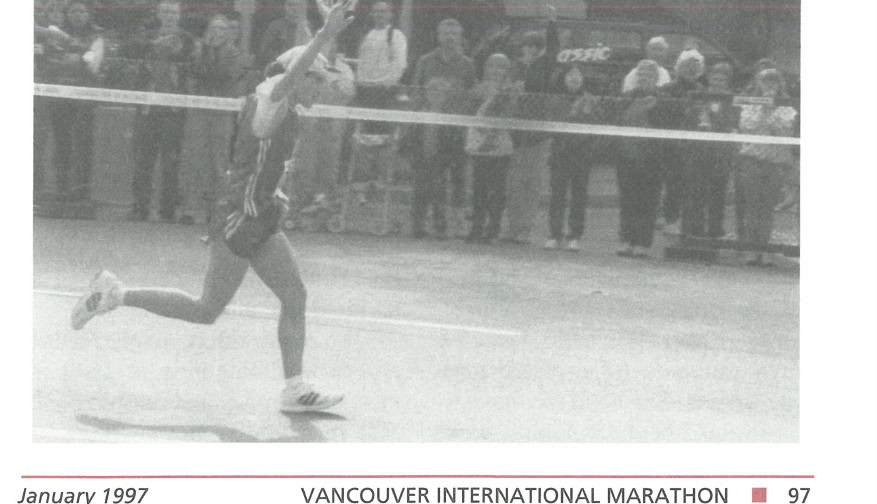
A 53-year-old male Oregon veteran of 53 marathons we spoke with puts it this way: “This marathon is great, the course is very scenic and varied, to the point of favoring the runner. It is a combination of a lot of marathons plus a challenge with the number of hills and their placement along the course.” A 32-year-old female Vancouver native who did the 1996 race as her first marathon says this: “I especially liked the challenging route and the fact that it includes both the Lion’s Gate and Second Narrows bridges.” A 28-year-old male Edmonton, Alberta, runner who set a 3:17:02 PR at the 1996 race, feels the event is well organized, even though the venues (number pickup, pasta feed, start/finish, etc.) are too far apart. “I would definitely run the Vancouver Marathon again!” he enthuses. He also has a few choice words about the volunteers who lined the course: “Great! Well done!”
THE FINISH
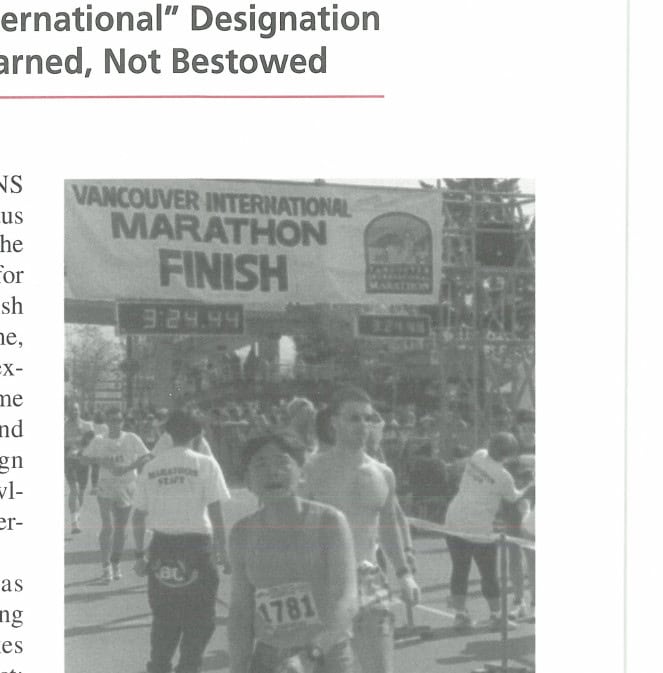
A word about Vancouver’s finish area: Two pedestrian overpasses within the final hundred yards provide ideal spectator perches; a fenced-off area under the wall of the stadium allows for runners to recover (and receive medical attention if necessary) and begin their carbo-reloading process with fresh fruit, a variety of muffins, bottled water, and so on; and announcer Steve King does his thing. If you run Vancouver, have a friend or family member take a tape recorder to the finish area and ask them to start recording 15 minutes before you are expected to finish. Steve King is a walking-around supercomputer. As runners approach, Steve rattles off more information about them than the government has in its files, some of it from files he maintains, some of it from recesses of his brain that are frightening to contemplate. Long after you’ve recovered from the race, you’ll want to play and replay the tape of Steve doing his commentary on your marathon finish—and on the secrets and statistics of your life even you’d forgotten.
The Bottom Line
We have weighed various aspects of a marathon within a 1,000-point scoring grid. Besides the author of the article, a dozen runners at the race were randomly chosen to score the race for us. (VIM = Vancouver International Marathon) The results follow:
1. HISTORY/TRADITION
The race has a long and noble tradition, and it is an honor and pleasure to be part of that ongoing tradition.
[Possible points: 30 VIM score: 24]
2. ENTRY FORM
The race entry form is clear, concise, attractive, complete, and makes entering the race very simple.
[Possible points: 20 VIM score: 15]
3. ENTRY COST
Considering that for most races, entry fees cover only between 30 to 50 percent of the cost of putting on the race, the value for the dollar relative to this race is very good.
[Possible points: 30 VIM score: 29]
4. LOCALE/SCENICS
The race is held in an area that has ease of access, is in a scenic locale, offers adequate food and housing services, as well as nonrace activities for family and friends.
[Possible points: 50 VIM score: 45]
5. REGISTRATION
Registration is well-organized, run efficiently, and does not bog down unnecessarily.
[Possible points: 20 VIM score: 18]
6. PRERACE ACTIVITIES
There are adequate activities such as pasta feeds, parties, and so on, during the days before the race.
[Possible points: 50 VIM score: 42]
7. EXPO
The expo offers a fair number and variety of booths relative to the race’s size, features quality exhibitors, and good guest speaker(s).
[Possible points: 50 VIM score: 26]
8. COURSE
This all-important area takes into consideration the following: degree of difficulty, certified, sanctioned, quality of road or trail surface, adequate mileage and direction markers, aid stations, medical coverage, race communications, accessibility to course for friends and family, typical weather, and so on.
[Possible points: 400 VIM score: 295]
9. RACE AMENITIES
This category includes race T-shirt, finisher’s medal, finisher’s certificate, adequate and efficient finish area, ease of sweatbag retrieval, showers, postrace refreshments, awards ceremony, raffles, results postcard, results book, and so on.
[Possible points: 250 VIM score: 233]
10. VOLUNTEERS
Quality and experienced volunteers, also adequate in number.
[Possible points: 100 VIM score: 96]
TOTAL SCORE FOR VANCOUVER INTERNATIONAL MARATHON:
823 points (out of 1,000)
| Runner’s Highs | Runner’s Lows |
|---|---|
| Long tradition | Too much physical distance between weekend’s events |
| Truly “international” city | Clots of slow runners lined up too far forward |
| Excellent race organization | Difficulty late in the race translating kilometer markers to miles |
| Swell T-shirts | Challenging course |
| Challenging course |
In conclusion, the Vancouver International Marathon is a truly international race in an unpretentious but “colorful” international city, marked by very detail-oriented organization with a course that is at one end extremely scenic and at the other end challenging. The race can best be enjoyed by tacking on several rest days before or after the race itself to better get acquainted with the city and people of Vancouver.
This article originally appeared in Marathon & Beyond, Vol. 1, No. 1 (1997).
← Browse the full M&B ArchiveMore like this
1,000+ stories from 19 years of Marathon & Beyond
The complete archive of the legendary long-distance journal — digitized and free to read.
