

Walking the Walk
“Che va piano va lontano e sano.
Che va forte va a la morte.”
—Old Italian saying
In Italian, piano means slow and easy. Liberal translation: If you cool it, you will go long and in good health; but on the other hand, if you push the pace, you’ll pay dearly.
Russians use the word “potikhonko” to express the same idea. Their word comes from the root word for peacefulness or serenity.
Dick Collins. Jeff Galloway. Joe Henderson. Don Kardong. Ron Kovacs. All fine runners. But they harbor what runners who think of themselves as pure and hard-core would consider a dirty little secret, a heresy: They walk during their running—not because they are forced to by midrace injuries, but because they choose to, because it’s all part of their running strategy.
Walking? During a run!? On purpose!?!
Unimaginable. Unthinkable. Unbelievable.
Even Oprah Winfrey didn’t walk a step in her marathon debut!
To the die-hard runner, to the runner who is a purist, walking is anathema; but to an ever-growing number of long-distance runners, walking has become a well-planned and integral part of their training programs—and their racing programs. And they are reaping the benefits of this shift in emphasis.
ONCE UPON A TIME
During the 1975 Boston Marathon, a very much unknown cross-country runner named Bill Rodgers walked through aid stations to better knock down his share of essential fluids. At one point, while in the lead, he stopped in the middle of the road and knelt down to retie his shoelace. By the time Rodgers crossed the finish line 2:09:55 after he’d started the race, he had lowered the American marathon record by 35 seconds. To this day, some horrified traditionalists maintain that his “dillydallying” cost him an even deeper record.
It has become increasingly clear to a growing number of students of long-distance running strategy, however, that Boston Billy’s brief periods of rest were exactly what made that record possible.
If that’s true, what might an injection of walking do for my recently stale and lame running? After all, my chiropractor tells me he’s done all he can with what I’ve given him to work with. I’ve rejected the use of steroids and have elected to go without Chinese caterpillar fungus. I can’t find anyone with a decent set of heart and lungs who’s willing to make a swap. Maybe this walking stuff is the magic bullet I’ve been looking for, my Holy Grail of long-distance running. And to think that it’s been waiting there at my feet all this time.
“WALK LIKE A MAN”
I have this dreadful image tattooed in my mind: Dave Moorcroft, the extremely talented British 5,000-meter specialist, is racing at the 1984 Los Angeles Olympics. Extremely ill with stomach cramps, very, very far behind the front pack, no chance of success, he pushes himself on in too-obvious pain. When asked why he didn’t just drop out, Moorcroft replied, “Once you quit, it is easy to do it again. I didn’t want to set a precedent for the future.”
I’m no shrink, but once I get past concepts of “honor” and “pride,” I get into the murky swamp of words such as “compulsiveness,” “guilt,” and “fear.”
Here’s another picture: A dirt trail through the mountains. Wet, sinusoidal squiggle marks down the middle of the trail. Doug Latimer has passed this way. A publishing executive and ultrarunner who was the first runner to earn 10 silver Western States 100 Trail Run belt buckles, Latimer is said to be the father and perfecter of the art of urinating while running. What? Stop to pee?
The same set of ironclad rules of personal behavior that kept Moorcroft on the track when he should have been lying down nursing a bad stomach and that prevented Doug Latimer from seeking the relief of a friendly bush keeps scads of runners from so much as entertaining the possibility of walking during a run.
Of course, the flip side of this rigidity is the source of the discipline that makes it possible for us mortals to participate, year after grueling year, in this extremely demanding sport, a prominent feature of which is pushing oneself to and beyond reasonable limits of personal comfort.
Ruth Anderson, a veteran age-group competitor who’s done just about everything in running that’s possible to do—from Boston to the Comrades Marathon—tells me emphatically that she does not walk in her races. Never. Ever. Not walking has taken Ruth Anderson places. She has fared well in international competition and has set more age-group records at various distances than is possible to keep track of. She continues to run to her demanding drummer.
Dick Collins is a very good friend of Ruth Anderson.
He has, at last count, run 160 marathons and 233 ultramarathons. As an example of how tough this man of steel is, consider this: During a 14-day period in 1996, Collins ran the Western States 100, the San Francisco Marathon, and a six-day race. What does Dick Collins have to say about walking during a race? “If I didn’t walk, I couldn’t compete at all in marathons and ultramarathons.”
Somewhere between Anderson and Collins is Don Kardong, the current Road Runners Club of America president, organizer of Spokane’s Bloomsday Race, and fourth place finisher in the 1976 Olympic Marathon. While in general Kardong will not walk in a shorter race, he has done so whenever he’s stepped up to an ultramarathon, and without regrets.
Olympic 10,000-meter runner and running author Jeff Galloway has successfully trained tens of thousands of runners for the marathon. He has worked with rank beginners and seasoned veterans hoping to improve their performances. In putting together training and racing programs for this rainbow of talents, Galloway includes walking as a basic ingredient. What do runners think of Galloway’s mixing walking with running? The numbers tell the story: Galloway’s books are among the most popular of all running titles. If Jeff Galloway says to walk as part of a running program, you should be walking. This is cutting edge stuff. Or is it?
THE WORLD ACCORDING TO OSLER
Hold on a minute. Is this walking stuff so new and revolutionary? I remember a 1978 pizza and beer dinner with Tom Osler, the modern-era, proto-guru of ultrarunning. Osler won the AAU 25K championship in 1965 and the AAU 30K and RRCA 50-mile championships in 1967. In a moment of madness, I had recently signed up to run my first ultramarathon race. I was scared, and I was having second thoughts. I wanted to wring from Osler the secrets that would give me that greased-skids entry into this rarefied world of the elite—those who had gone “beyond” and who had lived to tell about it.
In 1978 you could count American ultramarathoners on your fingers and toes and have a few left. Tom Osler was preeminent among them. He had, in fact, written the bibles on the subject: The Conditioning of Distance Runners (1967) and Serious Runner’s Handbook (1978).
During that dinner, Osler told me two things that I’ve had occasion to use from time to time in the intervening 18 years. First, saith the master, drink before you think you need to drink. Drink lots. Drink often. Osler’s specific drink of choice at that time was very sugary tea. “It has it all,” he explained, “water, sugar for energy, and a bit of caffeine.” The other great secret that he laid on me that day was that I had to walk, again before I needed it, and I must walk early and often.
Later that same week I heard the great Olympic marathoner and pioneer ultrarunner Ted Corbitt relate how, toward the end of a 100-mile race, he had been reduced to some unplanned walking. Later, much to his pleasant surprise, he found that the late-race walking greatly enhanced his recovery process. In such ways are discoveries made!
FINDING THE PERFECT MIX
Okay, so now, almost two decades later (I admit I’m thick-skulled, and I pick things up slowly if at all), I’ve decided to give a serious look at working walking into my training program. But how? When? Just how much running and how much walking makes the perfect mix? There seem to be several answers, and they come from radically different approaches to the question.
The Pyramid Scheme
Ron Kovacs holds U.S. age-group records at 100 miles, 200K, and 24 hours (45-49), and at 100K (50-54). He has half a dozen silver Western States 100 Trail Run belt buckles. But perhaps his most noteworthy performance was amassing 138 miles in a 24-hour race at age 49.
Kovac uses a run/walk strategy in his training. Most typically he will go 25/5 (25 minutes of running, then 5 minutes of walking). Early in the season, or when he is prepping for a six-day race, he may revert to a 15/5 pattern in his training “runs.”
Have you ever done “pyramids” at the track? You go up, then down the distance ladder: a 200-meter run, then a 400, then a 600, then a 400, and finish with a 200. Kovacs has his own personal pyramid workout that goes on all night (see “While You Were Sleeping . . .”).
Inspired by the pedestrian races of the 1880s, and by Tom Osler and James Shapiro, who crossed the country on foot in the late 1970s, Kovacs has been using walking in his training program for more than 15 years.
During “ordinary ultra races,” Kovacs plans his run/walk schedule as meticulously as a Swiss railroad engineer. (He is, in fact, a Silicon Valley engineering executive.) As in his training, his most common strategy is 25/5. When Kovacs feels the need to, or when he just wants to preserve himself for the next race, he may switch to 15/5.
Why does Kovacs always walk for five minutes at a time?
“The first two minutes go by much too fast,” he says. “During the third minute you start to get some rest. Those last two minutes are like a magical gift from your controlling mind to a stressed and appreciative body.” Any eating, toilet breaks, shoe or clothing adjustments must take place during those five short and precious minutes. Kovacs carries a water bottle and drinks constantly and copiously. He does not deviate from his plan, not for hours or even days at a time. And it works.
Not everyone keys walk breaks to the clock.
While You Were Sleeping . . .
RON KOVACS did one of his all-night, run/walk workouts. He began at 7:30 P.M. and went until 6:20 A.M. Running at six miles per hour and walking at three and a half miles per hour, he did four cycles of pyramids.
Each pyramid cycle consists of (minutes running/minutes walking) 25/5, 20/5, 15/5, 10/5, 5/5, 10/5, 15/5, and 20/5, for a total of two hours of running and 40 minutes of walking per pyramid cycle.
At the end of the first cycle it was 10:10 P.M., and Kovacs had logged 14.33 miles, whereupon he went right into his second cycle. At the end of the four pyramid cycles, and with 57.33 miles under his shorts, Kovacs showers, has a hearty breakfast (with meat), and is ready for a bright new day. —J.O.
The Paper Cup Strategy
One unique approach to walking breaks developed by Dick Collins is the “paper cup strategy,” which at times has been known to puzzle competitors, volunteers, and janitors.
Before beginning a track ultra, Dick positions paper cups at specific points along the periphery of the track. The first cup signals him to walk; the second indicates that it’s time to start running again. No numbers to worry about, no thinking, no wasted mental effort at a time when coming up with a “Duh—?” response can be a stretch.
“The cups give me permission to walk,” Dick explains, “and they order me to start running again.” Maybe he should consider using red and green cups.
Other Run/Walk Strategies
The acknowledged master at distance-based walking breaks is Jeff Galloway, who has developed well-researched programs for every ability level.
At the beginning of the training cycle, Galloway has neophytes jog a minute then walk a minute. As they progress, they move to jogging four minutes, then walking one. When they eventually come face-to-face with the golden goal of doing a marathon, they run to each mile marker, then walk a minute if their time goal is 3:30 or slower. Runners who plan to go under three hours walk or shuffle a mere 10 to 15 seconds per mile. The program has been successful for literally thousands of runners. One recent estimate has 4,000 runners per year taking Jeff’s hands-on training toward finishing a marathon.
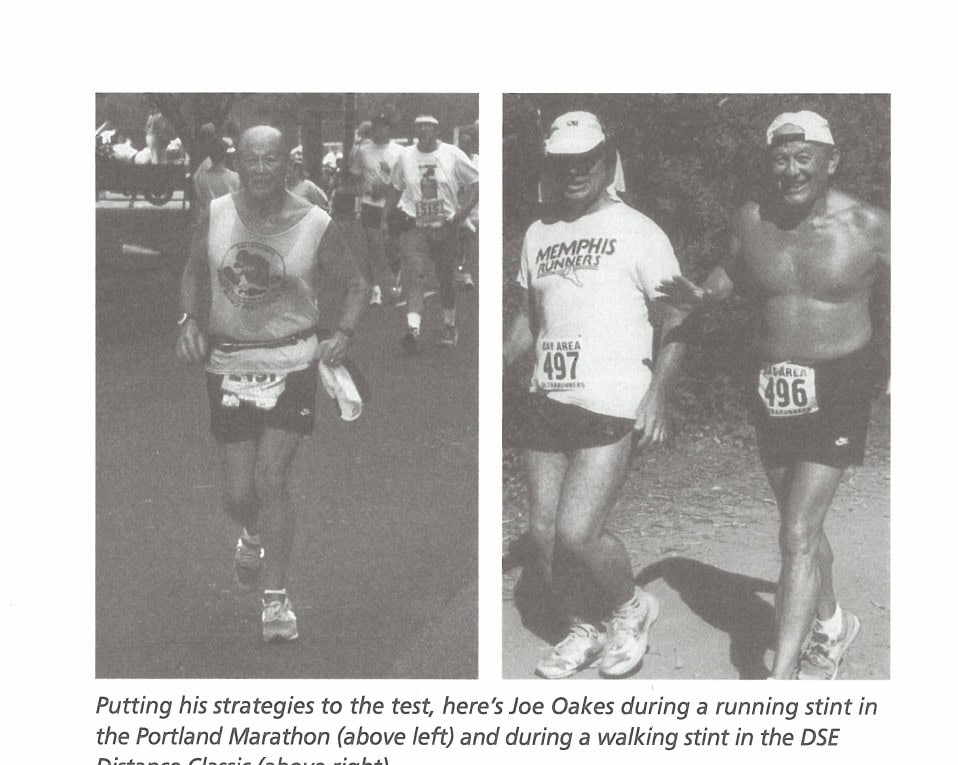
During the 1995 Portland Marathon, which Jeff was using as his qualifying run for the 1996 Boston Marathon, he hooked up with a slower friend, walking a minute at each mile marker while chatting away the miles. At 20 miles, he checked his watch and . . . whoops! He was seven minutes behind his qualifying schedule with just over six miles to go. But not to panic. Because of his relaxed pace and the walking breaks, Jeff says, “My legs were so resilient I was able to cruise on in with time to spare.”
Tom Osler is also flexible about the details. He has three plans for a 24-hour track race. Plan one consists of running seven laps and walking one. Later he goes to plan two, which is running three laps and walking one. Later still, in plan three, he runs one lap and walks one lap. This shifting and increasing amount of walking takes into account the changing needs of his body as fatigue sets in during the late phases of an arduous race.
Joe Henderson, Runner’s World editor from 1970 to 1977 and the current West Coast editor, and one of my longtime heroes, puts it this way: “I was a purist once, as most runners were in the Dark Ages. We thought if we ever took so much as one walking step, the gods of running would throw down a bolt of lightning and strike us dead.” Joe cites German ubercoach Ernst Van Aaken, British madman ultrarunner Ken Crutchlow, and Tom Osler as contributing to his conversion. Now, Henderson says, “I wouldn’t dare attempt the full [marathon] distance without the walks. They never let me down. I wouldn’t be finishing them at any pace without the walks.”
Henderson’s personal formula has evolved to a 10-minute run/1-minute walk pattern, which, he says, is quite similar to what Jeff Galloway espouses. “Simply put,” says Joe, “I think that the walking break is the most significant development in the 1990s marathon boom.”
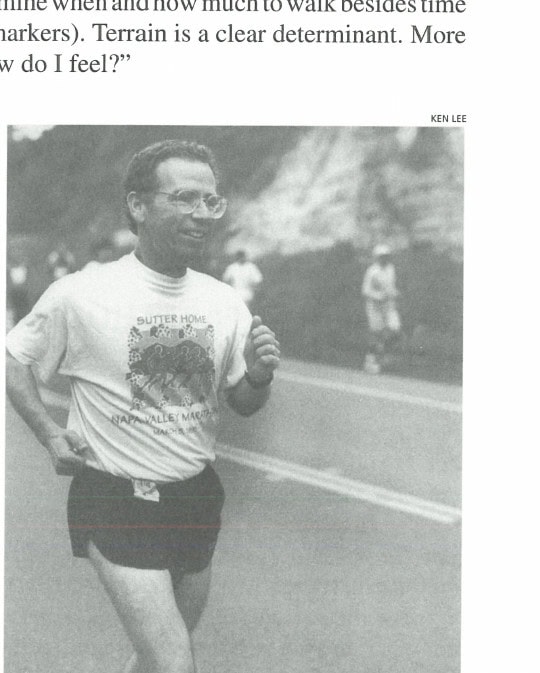
There are other ways to determine when and how much to walk besides time (the clock) and distance (mile markers). Terrain is a clear determinant. More about that later. Another is “How do I feel?”
Stick with the Plan
As dearly as I love and enjoy reading the philosophy of George Sheehan, I find a weakness in his oft-quoted “Listen to your body,” especially as it applies to long races. The simple fact is that if you are “listening to your body,” you are listening to history, and it may be getting too late to do much about the little things it is telling you. Your body tells you how it feels now, based on what has already happened to it. It cannot tell you how it will feel in another hour. Only your analytical brain can do that by drawing on your accumulated experience. You must anticipate the need, plan the walks ahead of time, and stick with your plan. The idea is to stay inside the envelope and never have to support the weight of the fatigue buzzards as they descend upon your lactic acid-wasted corpse.
There is another, more high-tech approach to listening to your body that may be worth using as a “when to walk” indicator. You might consider using a heart rate monitor. It makes sense to use such a device during the running phase of a cycle to keep the horses reined in, then use it again during the walks to reassure yourself that your body is, indeed, undergoing a recovery.
Of course, it makes no sense to strap on a heart rate monitor the morning of your marathon without having used it in training. A few weeks of heart monitor training should be sufficient to acquaint you with its potential, to correlate what the readings say with how well—or badly—you are doing in training. Once you have calibrated yourself against the monitor, you can use it as your tachometer. (It is still up to you to make decisions about how fast or slow to travel, however; never allow the monitor to control you.)
From my personal experiences, it is always reassuring to have “another opinion” on which to base pace decisions. A heart rate monitor can provide that opinion. It is even more reassuring to watch the numbers rapidly drop from your target pace rate to the two-digit numbers that indicate your body is taking its little rest.
How Fast Should I Go Slowly?
There is also this question: At what rate of speed should I be walking during the walking breaks? (And are they really breaks if you’re still plugging along?) Fortunately, there does seem to be a consensus here: Don’t dawdle, don’t crawl, don’t stroll. Move it along, fast, but not at a hurried race-walker’s pace. You are not a race-walker, and this is a rest period.
The descriptive word I’ve seen used most often is brisk. How do you convert “brisk” into a pace? Tom Osler, a math professor by trade, feels that 3.5 mph is in the range. That converts to just over 17 minutes per mile. Ron Kovacs agrees with that number. If mathematicians and engineers agree, who am I to argue? I remember many decades ago reading in The Boy Scout Handbook that four miles per hour is a fast walking pace. But the Boy Scouts were hiking five miles, not doing a marathon or more.
If you are going to use walk breaks in your races, it is important that they be part of your training program as well. How does 3.5 mph feel? Try it on your local quarter-mile track. It should take you roughly 4:15 to 4:20 to briskly walk one lap of the track.
Rather than aiming for that specific time, do what feels like a good brisk recovery pace, and time yourself (or don’t). You may find your natural pace to be a bit higher or lower. Practice, practice, practice. And use your head when you’re practicing. Monitor your walking pace, learn your potential. Nike may
be just fine with its “Just do it” philosophy, but with a bit more attention to planning and detail and numbers, you will be in a better position to reap the results you work so hard to achieve.
Since the walking phase of your runs will take about 10 percent of your overall time, it is obviously worth at least that much of your planning and thought. Put another way, if you go too slowly, you will lose precious time; if you go too fast, you may not be getting the rest you want and need.
A WALK ON THE WILD SIDE
In June I attended what was a potentially somber service for half a dozen heroic souls who were about to march into the gaping maw of impending doom: the Western States 100 Mile Trail Run. This was a last rites service, so to speak. These gallant footsoldiers were uniformly virgin to the Western States 100 challenge, but they were all experienced and hardened runners, as you must be before your entry is accepted into this rather elite and highly-hyped event.
This backyard barbecue turned out to be not so much a “last supper” as it was a light-hearted yet serious celebratory send-off, a bon voyage get-together as the troops prepared to march off into the fray.
Also present were the graybeards, a dozen battle-scarred veterans, each of whom had already savored the bittersweet taste of the Western States finish line on the Auburn High School track.
One kernel of knowledge was very clearly and freely given to the virgins: You will walk, a great deal. This race is all hills. The steep uphills are unquestionably walk-ups, most especially in the very hot middle portion of the race, which just happens to coincide with the middle of the day. Moderate uphills, of which there are few, can be jogged/walked. And never waste a good downhill. Descend as fast as you can without hurting yourself. If you can manage an overall average pace of just over four miles per hour (Boy Scout pace) for just under 24 hours, the silver belt buckle is yours. (Normally only 25 percent of participants earn a silver buckle.)
A bit more on trail runs. Dick Collins fancies himself, correctly, as a trail runner. He is one of the very few who sports the coveted Western States Thousand Mile Buckle, awarded to those who’ve finished the race 10 times. Ron Kovacs is also a very fine trail runner. Both advocate extensive walking during long trail races. Walk the uphills, run the downhills, mix it up on any flats you encounter. It’s a good idea to study the course altitude profile. Better yet, train on the course so you can gauge where and when to insert the walking breaks. Think of a trail run as a long walk in the woods broken by the occasional running breaks. Track runs, road runs, trail runs. Marathons, ultramarathons, multi-day races. Training and racing. In all of them, you’ve got to walk a bit and run a bit.
Ron Kovacs, like many experienced longer distance runners, has developed a running philosophy built upon what he can draw from the three wells of body, mind, and spirit. Ron feels that of these three, the body is the least important. The body is merely the physical, the visible, the muscles and bones and blood; it is through this physical entity that Ron propels himself through those endless training and racing miles. He plays with his body, teaches it to love to play. He plays with glycogen, oxygen, food, and time. He trains his corpus vivendi long and well, but when, at some point, that physical creature goes into the complaint mode, he switches over to the second well, the mind.
It is this mental side, says Kovacs, that controls, cajoles, and masters the flagging and whining body, pushes it beyond the fun part, into exhaustion and past the plea of “Please stop, I’ve had enough!”
The mind extracts performances from the body in several ways. Some of the best tricks involve offering creature comforts in limited amounts, giving the body that which it most hungers for: drink, food, drugs, and yes, rest—those planned, promised, and much anticipated walking breaks.
Eventually, on a tough ultra there comes a time when the mind, too, begins to shred. It is then time to call upon the third and deepest well of all, the spirit. It is from the depths of this spiritual realm that the void of the depleted physical and mental reservoirs can draw up its last source of sustenance. But, says Kovacs, you cannot go to that well too often, because refilling the deep spiritual reservoir is a long, slow process. In his racing, Kovacs will only go really deep when the prize is worth the price of a long downtime.
There, then, is the crux of Ron Kovacs’s running life: train the body with a lot of restful walking.
THESE FEET WERE MADE FOR WALKING
As upright, gravity-defying creatures, we were designed to walk and to run. But how far? Jeff Galloway sums it up most succinctly: “It is my belief that we were not designed to run very long distances continuously, but we were designed to go almost indefinitely by running and walking when we put the walking breaks in early and often.”
In addition to the goal of arriving at a faraway destination in a reasonable period of time (or at all), Jeff reminds us of several added advantages of walking breaks: they speed up recovery and decrease our proclivity toward serious injury and that ego-gratifying feeling of passing more talented but less wise runners in the later stages of the race. You know, those who never walk.
THE RACE EFFORT STRATEGY
Unless you are a race-walker, it is a given that you walk a mite slower than you run. But just how much is your overall race performance going to be affected by interspersing walking breaks between your periods of running? After all, when you are walking, you are still moving in the direction of the finish line.
The numbers are easy enough to calculate.
Table 1 presents a wide variety of run-to-walk ratios, from 6:1 to 1:1 (the ratio of minutes running to minutes walking), cross-referenced against running speeds from 5:00 to 15:00 minutes per mile, the actual speed while running. That range should pretty much cover everyone reading this article. The body of the table contains calculated values of average overall paces that will result from the various mixes of running and walking.
A study of Table 1 presents some interesting conclusions.
For the very fast runner (5:00 per mile pace, which would result in a 2:11 marathon), a lot of walking at 3.5 mph (17:09 per mile) will take a heavy toll overall. With a ratio of 5:1, the average pace will fall from 12 mph to 10.58 mph, a 12 percent decrease (1-[10.58/12.00]). Yet a runner capable of running 12 mph in spurts is still going to run a 2:28 marathon when walking one minute for each five running minutes (26.2 miles divided by 10.58 mph = 2.476 hours or 2:28:35).
| Pace per mile while running | Average pace overall in mph at various minutes running to minutes walking | ||||||
|---|---|---|---|---|---|---|---|
| min/mi | mph | 6:1 | 5:1 | 4:1 | 3:1 | 2:1 | 1:1 |
| 15:00 | 4.0 | 3.93 | 3.92 | 3.90 | 3.88 | 3.83 | 3.75 |
| 13:20 | 4.5 | 4.36 | 4.33 | 4.30 | 4.25 | 4.17 | 4.00 |
| 12:00 | 5.0 | 4.79 | 4.75 | 4.70 | 4.63 | 4.50 | 4.25 |
| 10:55 | 5.5 | 5.21 | 5.17 | 5.10 | 5.00 | 4.83 | 4.50 |
| 10:00 | 6.0 | 5.64 | 5.58 | 5.50 | 5.38 | 5.17 | 4.75 |
| 9:14 | 6.5 | 6.07 | 6.00 | 5.90 | 5.75 | 5.50 | 5.00 |
| 8:34 | 7.0 | 6.50 | 6.42 | 6.30 | 6.13 | 5.83 | 5.25 |
| 8:00 | 7.5 | 6.93 | 6.83 | 6.70 | 6.50 | 6.12 | 5.50 |
| 7:30 | 8.0 | 7.36 | 7.25 | 7.10 | 6.88 | 6.50 | 5.75 |
| 6:40 | 9.0 | 8.21 | 8.08 | 7.90 | 7.63 | 7.17 | 6.25 |
| 6:00 | 10.0 | 9.07 | 8.92 | 8.70 | 8.38 | 7.83 | 6.75 |
| 5:00 | 12.0 | 10.79 | 10.58 | 10.30 | 9.88 | 9.17 | 7.75 |
Notes: (1) This chart assumes a brisk walking pace of 3.5 mph, or 17:09 min/mile. (2) For a given ratio of minutes running to minutes walking, there is a whole family of possibilities, and this table is valid for any member of that family. For example, a ratio of 5:1 is the same as that for 25:5, or 10:2, or 20:4.
A back-of-the-packer, on the other hand, will not suffer serious time penalties by salting a marathon with judicious doses of walking. A runner with a 10:00 pace who walks five minutes out of every half-hour (5:1) will post a 4:42 marathon (26.2 miles divided by 5.58 mph = 4.695 hours or 4:41:43). If that runner didn’t walk at all but held the 10:00 per mile running pace, the time would be about 4:22 (26.2 miles divided by 6 mph = 4:22). The difference is only about seven percent, but the effort is significantly less. I’m willing to wager that a runner will feel a bunch better at the finish line and during the week following the race if the walking breaks are included.
Let’s consider this numbers business from another direction. Suppose you have a specific time goal that you want or need to meet. Let’s say you’ve decided on a 4:00 marathon. Your average pace would need to be 26.2 miles divided by four hours, or 6.55 mph, which is roughly a 9:10 pace.
Consult Table 1 again. Any average overall pace of 6.55 mph or greater will get you to the finish line in four hours or less. One way to do it is with a 6:1 ratio and a speed when running of 7 mph, for an average speed of 6.5 mph (Starting the top at 6:1, go vertically down the column until you hit 6.50. Your running pace must be just a wee bit better than 8:34 minutes per mile or 7 mph). You may achieve the same results with an 8:00 pace, walking one fourth of the time (3:1, which can be accomplished at 24/8, 15/5, or 6/2).
WALK A MILE IN MY SHOES
As I write this, I have two “races” on my drawing board. On September 29, 1996, I plan to run/walk the Portland (Ore.) Marathon. The following week I will participate in the Dolphin South End Distance Classic 12-Hour Run in San Francisco. (See “The Grand Experiment” for my run/walk strategies for both events.)
I plan to do the marathon as a training run, my last long workout before the DSE 12-Hour. I will not, I must continually emphasize to myself, run Portland as a race, but rather as what we used to call a “depletion run.” That term seems a bit out of touch, especially in the context of running with walking.
Although I’ve been reduced to walking in races more than I’d care to admit, I have not previously planned or used a run/walk strategy for a race. I am planning to do so for these two events. I know myself. I am susceptible to the excitement generated by a crowd. I must keep myself under control. My mantra will be “Piano. Piano. Don’t get crazy.” I plan to finish feeling good, feeling ready for the DSE 12-Hour seven days later. I imagine that holding back will be quite difficult during those closing miles. I’ve run a
The Grand Experiment
STRATEGY FOR THE PORTLAND MARATHON
This marathon on September 29, 1996 is the final long training run for the Dolphin South End Distance Classic 12-Hour Run, one week later. Here’s my plan:
- Keep the pace at 5.5 to 6.0 mph. I can monitor that pace by keeping my heart rate monitor at 115 to 120 beats per minute.
- Use mile markers as a walk cue, then walk for one minute, running the rest of the next mile. Each mile should take me about 10.5 minutes.
- Walk the big hill. Allow five minutes. Also allow a total of six minutes for potty breaks.
How long will it take me to finish the marathon? 26.2 miles x 10.5 minutes/mile + 11 minutes of breaks = 286 minutes or 4:46. Slow, but not for a training run.
STRATEGY FOR THE DSE DISTANCE CLASSIC 12-HOUR RUN
I will run the DSE Distance Classic on a three-quarter-mile dirt loop one week following the Portland Marathon. Here’s the race pace and distance with varying pace and run/walk ratios I plan to follow:
| Hours | Cycle | Miles covered |
|---|---|---|
| 1 to 6 | Run 2.75 laps at 6 mph Walk .25 lap at 3.5 mph |
34 miles |
| 7 to 9 | Run 2.75 laps at 5.5 mph Walk .25 lap at 3.5 mph |
15.8 miles |
| 10 to 12 | Run 1.75 laps at 5.5 mph Walk .25 lap at 3.5 mph |
13.5 miles |
Total miles in 12 hours = 63.3 miles
Editor’s note: Joe Oakes wrote this feature and cooked up this race strategy in July of 1996. His actual performance at the Portland Marathon was 4:44. The following week, he covered a bit more than 45 miles in 12 hours at the DSE Distance Classic (see “Results of My Experiment” on page 41 for more details).
boatload of marathons, and I know only too well that the smell of the barn is strong and appealing.
The DSE 12-Hour Run is another story. I would dearly love to conjure up 100 kilometers during that half-day.
In the meantime, my training is an amalgam of Galloway, Kovacs, Collins, and the realities of my training course. I’m using a heart rate monitor for my long Wednesday runs, which have been getting slowly and steadily longer. The monitor helps me keep my pace even. It also gives me a better feel for the relationship between my own heart rate versus pace over a period of hours and weeks. I schedule four walk breaks per six-mile circuit of my favorite running loop, two of the breaks occurring at water/toilet facilities. I always carry water.
I’m running five or six days a week, two of them very short and easy. On Sunday I do a short, fast run (but not all out) of about five miles with my club, the San Francisco DSE Runners. I swim three or four days a week for about 45 minutes or so, and I do a light weight workout twice a week.
We shall see how all of this works out for me. If the walking breaks are as effective as they are touted to be by the experts I interviewed, and as good as I hope them to be, then get out of the way, Quasimodo, for I’m headed to the bell tower to shout to the world the joys of mixing walking with running.
Results of My Experiment
Editor’s note: What follows is the updated report from Joe Oakes on his Portland Marathon and DSE 12-hour attempt.
THE PORTLAND MARATHON
All went well at the Portland Marathon. Boring, but well. Keeping to a strict run/walk program made the marathon physically easy, and I went home with minimal postmarathon boo-boos. I hit the finish line two minutes ahead of my predicted time. My problem was psychological. The strict time format left little room for “self expression” in the physical sense. It just wasn’t fun, although my strategy did work as predicted.
DSE DISTANCE CLASSIC
The San Francisco DSE Distance Classic, which circles the Golden Gate Park polo field, came six days of healing rest after Portland. All began well enough. I went out at a conservative pace with only a slight chance of hitting my 100K goal, 100K being 62 miles, and I being 62 years old.
After passing through the marathon distance a bit slower than planned, running and walking, walking and running, bored to tears, I had an idea. I took off my shoes so I could think and walk about a mile. My logic? My ancestors were European, and Europeans don’t know miles. They speak metric. It seemed only just and fitting that I should dedicate this day to my ancestors (from whom I inherited these great legs) and run my age in kilometers. After wrestling with the problem of how many 0.7881 mile-long laps there might be in 62 kilometers, I had a new, doable target.
I ended the day at something over 45 miles, put my feet up, and watched both the male and female records get shattered on one of the hottest days in San Francisco history. The winner, Robert Montouri, took two 5-minute walking breaks in 12 hours. “They were better than a massage,” he said after the race. Montouri covered 76.4 miles. What can I tell you? —J.O.
This article originally appeared in Marathon & Beyond, Vol. 1, No. 1 (1997).
← Browse the full M&B ArchiveMore like this
1,000+ stories from 19 years of Marathon & Beyond
The complete archive of the legendary long-distance journal — digitized and free to read.
