

Warrior Queen In Death Valley
“Seek the very best in everything. If you bow your head, let it be to a great mountain.” —New Zealand Ma–ori proverb
Mount Taranaki was covered in winter snow when Lisa took her last training run in New Plymouth in early July. It was 38 degrees Fahrenheit, and the wind blew cold and moist off the white peak of the mountain. Two days later her next run was in Las Vegas, where the mountains are all fake, the temperature was a bone-dry 108 degrees, and the New Zealand winter was a world away. Lisa and her crew stayed in the Luxor, a replica of the original pyramid built in the Egyptian desert by the labor of slaves condemned to toil remorselessly up steep slopes under a blazing sun until they dropped dead of exhaustion—good preparation for the Badwater 135 Ultramarathon.
The transition from running a handcrafted jewelry store in a seaport town in New Zealand’s damp and cloudy midwinter to running a high summer 135-mile race across a desert and up a mountain in the hottest and driest place on earth was only one of the adjustments Lisa Tamati has had to make. Hers is a life of adaptation and survival, endeavor and adventure. In the first place, she is Ma–ori (pronounced “Maow-ree” by the way, never “May-OR-ree”), and the indigenous Ma–ori of New Zealand are a seashore people with Polynesian bodies, apt for explosive strength sports like rugby or softball, not extreme distance events. And their culture is one that values communal support and group accomplishment, not solo achievement and individual fulfillment.
So Lisa became the first New Zealand woman, the first Ma–ori of either sex, and the first person from New Plymouth (which is important) to run Badwater. She had to survive physical and emotional crises even to get there. She had to raise more money than she had seen before in her life. She found support from her Ma–ori family and New Plymouth’s business community. It’s a good story.
Ultra relations come unraveled The story started as a nearly tragic adventure, when her first serious boyfriend dumped her halfway across the Libyan Desert. Literally deserted her there, in the middle of a 10-day trek across a banned military zone, after four years together, and walked away. He had introduced her to such adventure expeditions and set such high standards that she says, “It was like boot camp. I was never good enough.” So after some depressed years of being “virtually a sack of potatoes,” Lisa finally picked herself up and moved to Austria to focus on ultras. Nothing could deprive her of the reward of meeting the challenge of that addictive sport again. Her commitment increased when she met elite Austrian ultrarunner Gerhard Lusskandl, who encouraged and trained her. They married in 2003 and traveled the world, running ultras, speaking German together. But loyalties torn between Austria and New Zealand created tensions and eventually ended the union—this time a week before Lisa raced a 200-mile ultra in the Sahara Desert in Niger while suffering from food poisoning. (She finished.)
Lisa went home again to New Plymouth, on the west coast of New Zealand’s North Island, a town dominated by a mountain that is a perfect symmetrical cone, almost a twin for Mount Fuji. And it has similar spiritual significance to Japan’s holy mountain. Ma–ori proverbs and myths are full of references to mountains. Their names are evocative: Mount Cook is Aorangi, the Sky-Piercer, and Taranaki means “Treeless Mountain” (it’s volcanic, like most New Zealand peaks, so an eruption must have wiped off the forest). The whole country is Aotearoa—Land of the Long White Cloud.
The full story in Ma–ori myth is that Mount Taranaki used to be a bit of a lad. He lived and played among the other great mountains in the middle of the North Island but made a seductive pass at the mountain wife of the fiercely volcanic Mount Tongariro. The angry husband erupted in fiery rage and drove his impertinent rival 100 miles away to the edge of the ocean, gouging the winding gorges of the Whanganui River as he went. There to this day on his swampy promontory by the Tasman Sea, Mount Taranaki sits, a solitary peak, often hidden by sorrowful clouds or weeping mistily in his loneliness. But away to the east he sees the warning smoke, flame, and hot ash that the watchful husband still sometimes throws high into the sky—sometimes even closing the ski slopes.
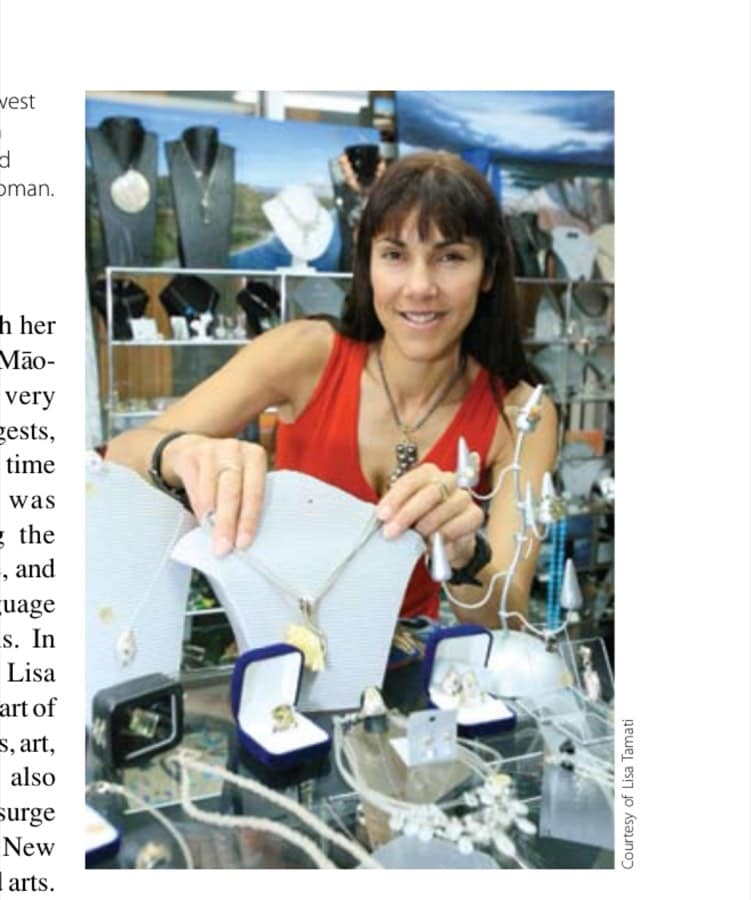
Lisa Tamati did her share of weeping, too. But she also focused on work, family, and running, and reclaimed her life. Her mother, Isabel Tamati, a New Zealander of British descent, set up Black Rock Designer Art and Jewelry, a manufacturing and retail business that the two women share. “I wanted Lisa to have a reliable income and work,” Isabel said when we all met in Auckland for coffee after Lisa returned from Badwater. Lisa became a skilled jewelry designer and craftswoman. Necklaces and bracelets that celebrate running are among her most popular items.
She made contact with her extended family on her Ma–ori father’s side. As his very English name, Cyril, suggests, Lisa’s dad grew up in a time when the philosophy was assimilation, absorbing the Ma–ori into British culture, and speaking the Ma–ori language was forbidden in schools. In a more enlightened era, Lisa could openly accept that part of her heritage, with its values, art, and language. She could also benefit from the recent upsurge of success by Ma–ori in New Zealand’s professions and arts. She found a whole network of what Ma–ori people humorously call “cuzzibros” (cousins, brothers, and endless other relatives). “
Are you for real?” they asked to begin with. When they found she was for real, and then some, they accepted and supported her. When she needed publicity, members of the “whanau” (family) who work in the media were able to supply it, featuring her seven times so far on the Ma–ori TV channel. They have never had a globe-trotting, good-looking, German-speaking, ultrarunning, death-defying cuzzy before, and they are proud of her.
Long-distance accomplishments at home Lisa ran every available marathon and ultra, placing second in the 2007 New Zealand 100K championship and third in the big 150K Round the Mountain race that circles the central range of peaks. She befriended Sandy Barwick, New Zealand’s world-record-breaking “Ultrarunner of the 20th Century,” who was a world figure in the early 1990s. Then she began looking for a big challenge to focus on as she approached 40. She thought of her people’s proverb: “Seek the very best in everything. If you bow your head, let it be to a great mountain.” The
Courtesy of Lisa Tamati
▲
In New Plymouth on the west coast of New Zealand’s North Island, Lisa is an accomplished jewelry designer and craftswoman.
▲
Lisa was the first New Zealand woman—and the first Māori of either sex— to run Badwater.
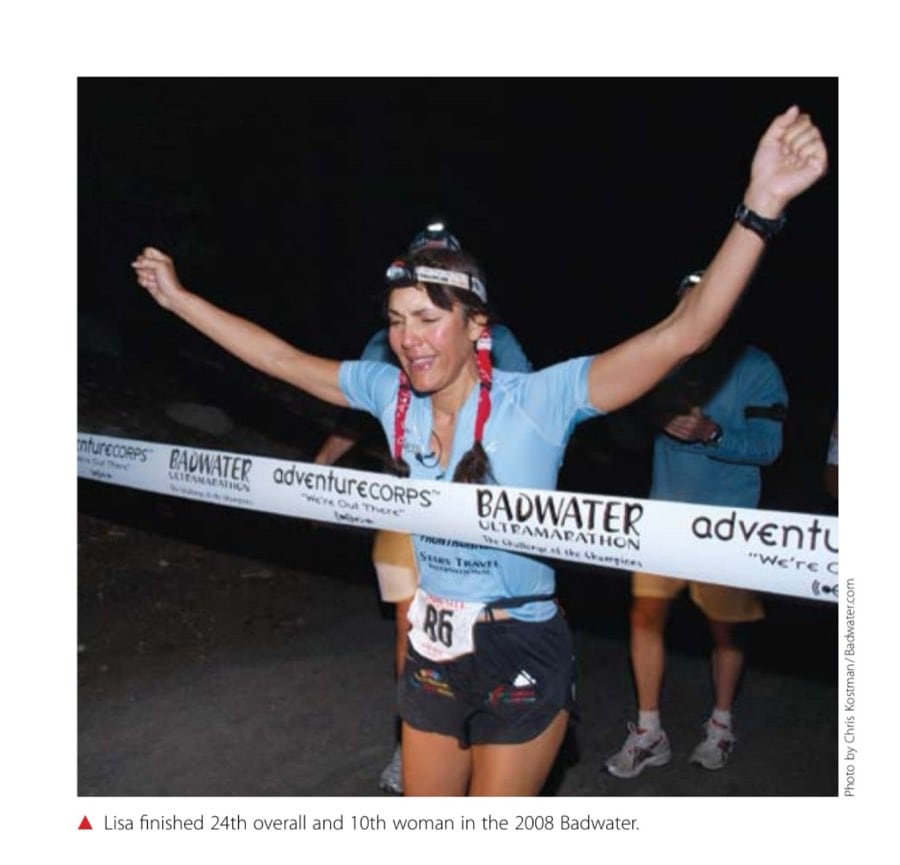
Photo by Chris Kostman / Badwater.com
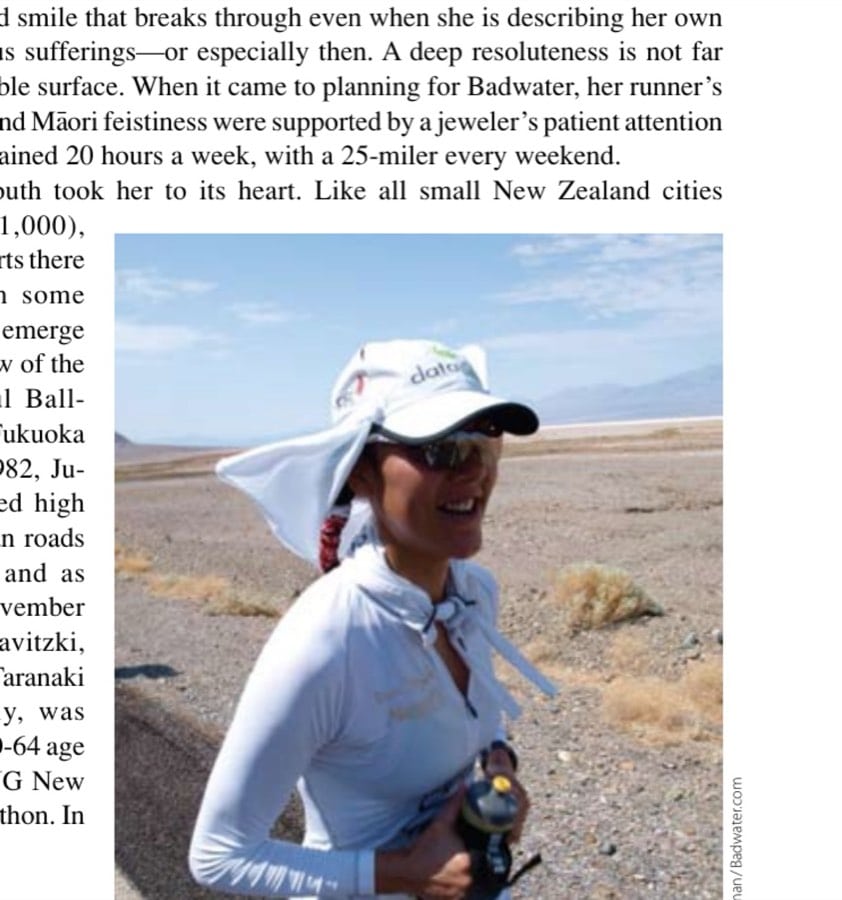
best challenge and greatest mountain she knew of in the world of ultras was Death Valley. She began to plan to run Badwater. That’s not an easy project when you live in New Zealand and don’t have much money or any sponsorship. But Lisa Tamati is a very interesting mix, and she can make things happen. Tall, dark, beautiful, strong—those are the first impressions. Then there is the stylish way she dresses, and the jewelry, of course. She could play the beauteous warrior queen in a South Seas historical romance movie. This is a woman who can look strong and sexy even in coverup, sweat-wicking, white pajamas, an ice collar, and a floppy Arab headdress, which is how she appeared on the start line at Badwater. The miner’s lamp she wore at night just added to the image. You soon learn she is also friendly, kind, gracious, and comical, with a good-humored smile that breaks through even when she is describing her own most horrendous sufferings—or especially then. A deep resoluteness is not far below the amiable surface. When it came to planning for Badwater, her runner’s determination and Ma–ori feistiness were supported by a jeweler’s patient attention to detail. She trained 20 hours a week, with a 25-miler every weekend.
New Plymouth took her to its heart. Like all small New Zealand cities (population 51,000), people love sports there and have seen some classy runners emerge from the shadow of the mountain. Paul Ballinger won the Fukuoka Marathon in 1982, Judith Hine placed high on the American roads in the 1980s, and as recently as November 2007, Max Dravitzki, one of a famed Taranaki running family, was second in the 60-64 age group at the ING New York City Marathon. In
the 1980s, the top Japanese marathoners under coach Kiyoshi Nakamura used to come here to train. The quiet roads and the towering mountain made it a perfect environment for their spiritual approach to running. New Zealand Runner magazine published one of the all-time great running photos (by Tim Chamberlain) with Toshihiko Seko, the Soh twins, and others running against the background of soaring, snow-capped Mount Taranaki.
Lisa found a secret weapon, too: Andrea Needham, another extraordinary woman, a Kiwi (New Zealander) who has lived in the USA and picked up American entrepreneurial energy. She was a leading activist against repression in East Timor, among other things. Andrea’s way of coping with life-threatening illness (a double lung transplant) was to throw herself into fund-raising for Lisa as well as writing two books about ethical conduct in the workplace.
How support was raised “Soon the whole town was supportive,” Lisa said. “Andrea set up business sponsors and a fund for small-scale donations. The main sponsors were both local—Van Dycke’s Fine Foods and Marcel’s Pancakes. The mayor got in behind us, and the gym, the Front Runner running store, and the radio station. A local café sold the Lisa Tamati Sandwich (salmon and cottage cheese) with a dollar from each going to our fund; the mayor promoted a scheme called the Lisa Tamati Effect, about living your dream and going for your goals; a businesswomen’s group raised $6,000; there was an Endurance Day, when one lawyer did seven hours on her bike to raise money; and Kathrine Switzer came to town to launch her book, Marathon Woman, and put the sales plus a donation to my Badwater fund. “
It became mainly a way of inspiring women to exercise and take control of their health. I took clinics that got them through the hard first two months, and now some are even ready to do a half-marathon. Because I’m just a local girl— two brothers, did a bit of surfing, half-Ma–ori, nothing special—it helped them to see that they too could run a bit, and maybe achieve something. “
Because of Andrea’s condition—her new lungs are in the process of rejection —we also raised money and awareness for Organ Donation New Zealand. For me that was another challenge, as the whole business of organ donation is against traditional Ma–ori beliefs. So I’m trying to change a whole set of ancient cultural perceptions, as well as modern women’s perceptions of their limitations. Running gets you into some interesting things, all right.”
They raised $45,000 (New Zealand dollars) for Lisa, enough, just, to fund a crew of four, a vehicle, travel and hotel costs, and all the gear that Badwater demands. It was the kind of ingenious, low-budget, high-quality job that Kiwis excel at. (Think of the early Peter Jackson movies, or Arthur Lydiard’s jogging groups.) The crew, like Andrea, gave their time and skills. The team was Sandy
Barwick, 60 this year and still in good enough shape to have run a charity 100K in 2007; two personal trainers who worked with Lisa, Neil Wagstaff and Chris Cruikshank; and ex-husband Gerhard Lusskandl. “
Gerhard did all the logistics—all that water, ice, food, special clothing, the vehicle, everything. He designed this ice collar for me, made from a rolled-up headband, and they kept spraying me, too. The key to Death Valley is not getting heat stroke. My crew was wonderful. And it’s harder for them than the runners, 38 hours of nonstop work, endlessly stopping and starting.”
Knowing about Sandy and Gerhard, I asked if Neil and Chris were also ultrarunners. “They are now,” Lisa said, with her slightly wicked laugh. They decorated the vehicle with New Zealand flags—the official blue-and-red one with stars of the Southern Cross and the familiar one used for sports, black with a silver fern. The colors stood out against the uniform brown-gray of the Death Valley landscape.
The heat in Death Valley is too well known to linger over. Enough to say that the Television New Zealand coverage of Lisa’s run included a sequence when they really did fry an egg on the road and toast a bagel on the trunk of a car. New Zealanders in their hundreds switched to cold cereals the next morning. “
Because I had the TV crew following me, I had to start with the elites, the third wave, at 10:00 a.m. Usually rookies like me go off at 6:00 a.m., when it’s a bit cooler. So I went off with the big guns: Jorge Pacheco, who won it, Dean Karnazes, Jamie Donaldson—she’s incredible, third overall, she beat Karnazes. My old friend and idol Jack Dennis was in it, too. ‘Death Valley Jack’ they call him; he’s 73 and has run it 14 times. They are wonderful eccentrics, some of the ultrarunners.”
Courtesy of Lisa Tamati
▲
Lisa with ultrarunning legend Dean Karnazes, who also ran Badwater in 2008.
Storm clouds over the course “There was a big storm the day before,” she continued. “The clouds over the mountains were incredible. At the start it was humid, but not too hot—only 112 degrees (that roguish laugh again). The first 45 miles are the worst for temperature, and you’re not allowed a pacer for the first 18 miles. “

I went out pretty fast—I’d waited a long time to be there. We still didn’t know what the course would be, because there had been flooding and massive slips, and no one knew if the road would be open all the way. So we might have got turned back to complete the distance by running back and forth without climbing Mount Whitney. Eventually we did the full course, but it was all uncertain and I heard that at least one top runner, Dave Goggins, pulled out because of it. “
Gerhard and Neil started to run with me when a pacer was allowed, but Neil only lasted 40 minutes. His heart rate went dangerously high, and they had to cool him off in the van.” I asked about Lisa’s supplies and equipment. “
The best thing I did was use a New Zealand electrolyte drink called Red 8, plus good old Sustagen. It’s the first time I ever did an ultra without throwing up. And Injinji socks were brilliant—no blisters!” In the Auckland coffee shop, she slipped off her fashion boot and showed us the white socks with separated toes.
ad
© Luis Escobar
▲ Gerhard keeps Lisa cool while on the run.
My wife, Kathrine, then asked the question that I couldn’t. “Unlike most women distance runners, Lisa, you’ve got good breasts. What did you wear for a bra?” I went off to order another coffee. The answer was, I believe, CWX by Bendon. I resurfaced into the conversation as Lisa was describing the chafing she got from the bra and her heart rate monitor.
Greater problems lay not far ahead. “The first drama was the car got stuck in sand and got a flat tire at the same time. The boys had a major battle getting the spare tire out from under the van—it was blazing hot. And then the jack kept sinking in the hot tar-seal. I was freaking out. It looked like I would have no van and no crew. “
They loaded Gerhard with drinks and ice to get me through a few miles. I’d planned a wee stop in Lone Pine, but the crew wasn’t available. I did eventually manage a wee rest, about 20 minutes.” (New Zealanders say “wee” for “small.” It’s the Scottish influence.) “
Through the night, you go over two passes. I began to suffer. Gerhard said I was going too slow. He said, ‘You must run faster!’” (“Du muss schneller laufen!”
German is such an emphatic language. But Gerhard is a policeman in Austria, which could explain it. “And he’s a bloody good policeman,” says Lisa.) “I got panic attacks, hyperventilating. I imagined bears were following me. I was struggling, in the zone. There’s a 45-mile stretch where you can see Mount Whitney all the way. But it’s still so far away. Then one of my crew who was running close, trying to help, tripped me, and I crashed, and had the next panic attack. That time I was crying for three-quarters of an hour. “
I had pain in all areas. And I was sleepwalking—the mind just blips off. Finally, I got to Lone Pine, and Mum got us there on the cell phone from New Zealand. I had another crying session.”
Why mum stays home “I don’t go along to her races because I’d feel too sorry for her and tell her to stop,” said Isabel. “When she started crying on the phone, since I couldn’t see how bad she was, I just told her to toughen up.” She did. “I wanted to rest, but the crew were looking so desperately tired that I thought, No, no, no, they’re going to shoot me if they have to wait another hour. So I pushed on. Then at a control point, I met Jack Dennis, and we had a big hug. He had happy tears in his eyes. It was great. The last race we were at, we were both suffering.
ad
“I had to keep moving. So many people had helped me get this far. Everybody at home with their cell phones knew exactly where I was. They were waiting.” “Forever,” said Isabel quietly. “The last 13 miles you’re climbing the Portal Road. I was so stoked. I knew now I was going to make it. The goal had been 48 hours, which is the cutoff to win a belt buckle. But I was well under that. So now Gerhard set a target of 38 hours. Push-push-push up Mount Whitney—I was on one of those highs. I was dancing about for the TV camera. “
So of course I shot all my energy reserves. I didn’t realize how steep it is. All of a sudden, it went really steep and I just crashed. I started crying again. I was in dire straits. I was hardly walking, my back was agony, and I was getting these hallucinations of bears. (Usually I see penguins; don’t know why.) A black shadow was following me. I saw people peeing on my feet. I was losing the plot. “
The crew would not let me take a break. But it was so steep! I was desperate. Then a mile from the end, this lady came running past from behind me; she just flew by. And I was, like, bugger!” It still wasn’t over. “
Gerhard was telling me, ‘Just one bend to go, and you’re there.’ Then one of the crew came running back from the finish and called out, trying to encourage me, ‘Only three more bends’! I just put my head between my knees and said, ‘I’m not going on.’ I was really performing and hyperventilating. But it was only 300 to go, just one bend with three curves in it, and I saw the finish line. All was forgiven! It was a very emotional finish, I was so happy and relieved, I cried again, had a big bawling session on camera. I was just so happy I could sit down! “
Then it was photos, and I got that wonderful medal and buckle. I did two hours of interviews after a shower, I was so stoked. A couple of hours’ sleep and it was the prize giving, talking with all the runners. That’s the fun part; they are the best. “
The crew just wanted to go out on the booze—no way did they want to go to bed. But they’d earned it. They never complained. Chris was the jester. Gerhard ran nearly 100 miles with me.”
The final accounting Lisa Tamati, 39, placed 24th of 80 starters, 10th out of 21 women, at the 2008 Badwater, in 38:24:43. The winner was Jorge Pacheco, 40, a Mexican from Los Angeles, in 23:20:16, and first woman was Jamie Donaldson, 33, of Littleton, Colorado, in 26:51:33. Now Lisa is back in New Zealand, making and selling jewelry, giving more interviews, waiting to turn 40—“That’s really scary.” She hopes for a career in motivational speaking. After coffee with us in Auckland, she was off to do a
Photo by Chris Kostman / Badwater.com
▲ Lisa finished 24th overall and 10th woman in the 2008 Badwater.
photo shoot with Woman’s Day magazine—the first time that domestic-oriented publication has featured an ultrarunner. The times are changing. Lisa Tamati is helping to change them. For ultrarunning, she is part of the rising wave of women who took five of the top 10 and 11 of the top 30 places at Badwater 2008. For TV and magazines, she is proof that someone who succeeds in one of the toughest and least glamorous sporting events on earth can also be an attractive, natural, personable, and multitalented woman. For mainstream New Zealand, she is proof that a Ma–ori can endure and succeed under one of the greatest extremes of suffering it’s possible to voluntarily inflict on yourself. For Ma–ori New Zealanders, she is opening doors to a reassessment of old beliefs about medicine and health and is a role model in a wholly new sport. For the women of New Plymouth, she is an inspiration. For the rest of New Plymouth, she is their Lisa. She lived up to their hopes. She succeeded in the big event overseas. Kiwis like
to do that, in their modest, no-fuss way. (“We knocked the bastard off,” said Ed Hillary after conquering Everest.) What great mountain lies ahead? No hesitation on that one. The Commonwealth Games has announced that a 24-hour and a 100K race will be included at the 2010 Games in New Delhi. Lisa is aiming for the 24 hours, “but the qualifying will be tough for me. I need to do 200K in 24 hours.” The Commonwealth Games are a big event for little New Zealand, in an era when Olympic medals are almost beyond the national budget. Lisa Tamati might even qualify for the first time to receive support from government funds, at last meeting the criteria of the prevailing management-heavy structure of state-financed sports sponsorship.
The Commonwealth Games are the first international games to recognize ultrarunning, which is big news for readers of Marathon & Beyond. It is a significant decision that could even lead to inclusion in the Olympics and transform the sport. Among much else, it will bring Kenyans into ultrarunning. Whether Lisa Tamati succeeds in gaining selection for New Zealand, she and other dedicated ultrarunners from Commonwealth nations deserve some credit for the new opportunity. She will be at Badwater again in 2009, still seeking the best, still refusing to bow her head, except to the greatest mountain. The 15-minute Television New Zealand coverage of Lisa’s Death Valley run can be seen on http://tvnz.co.nz/view/video_popup_windows_skin/2003723.
© Mike Scott
▲
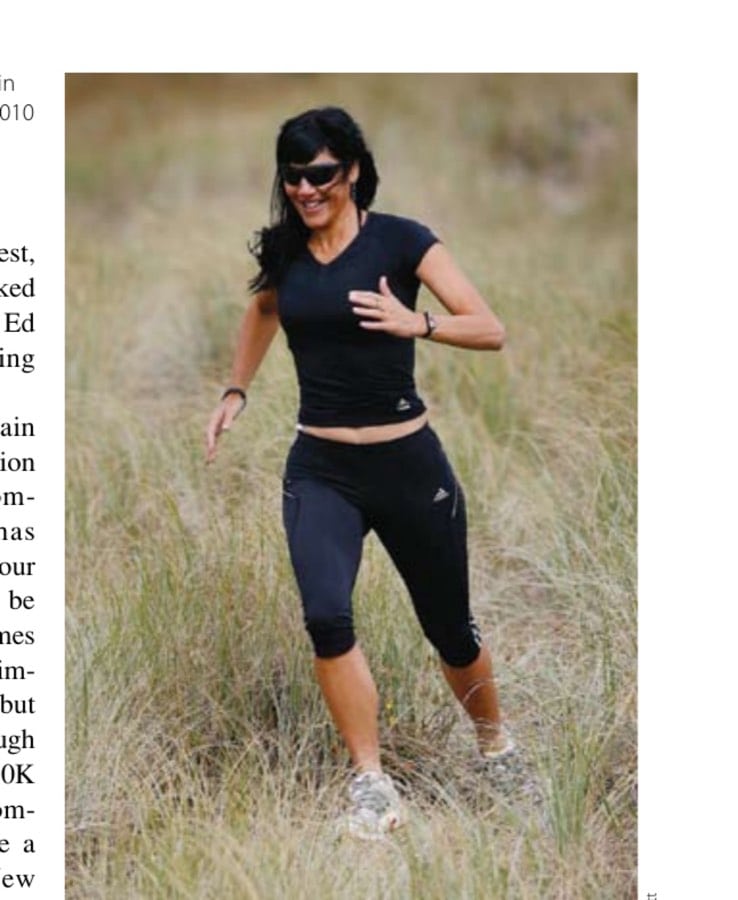
Lisa hopes to compete in the 24-hour event at the 2010 Commonwealth Games.
This article originally appeared in Marathon & Beyond, Vol. 13, No. 4 (2009).
← Browse the full M&B ArchiveMore like this
1,000+ stories from 19 years of Marathon & Beyond
The complete archive of the legendary long-distance journal — digitized and free to read.
