

Warrior Tactics for Distance Runners
THE PLAYFUL voice at the other end of the workout room stirs me out of a zombie-like trance.
Around me the students in the class let out a collective giggle while struggling to maintain control over their bodies. We have been crouching in “neutral horse” stance. We’re doing this in a small, cinder-blocked room in the basement of a Chinese community center in Toronto. My thighs are burning, and the last thing I can think to do is laugh at the latest joke to make the rounds in the training hall.
It’s not quite mile 23 of the marathon, but it sure feels like it should be. It is the middle of a class put on by the Jing Mo Kung Fu Club, and instructor Glen Doyle is at center stage. Doyle may be a three-time Canadian kung fu champion, but right now he’s doing what he does best: goofing around with his students, getting them to laugh, to open up, so that the serious work doesn’t feel so darn, well, serious.
I’m a dedicated marathoner and recreational martial artist from Boston, and I’ve come to Toronto to discover what all the fuss is about this guy Doyle. He’s a cross-training expert with an extraordinary talent for getting his point across to his athletes—and he has a track record that would make any coach envious. He has trained members of the Oakville (Ontario, Canada) Athlétiques, track club of 1996 Olympic 100-meter gold medalist Donovan Bailey; the Philadelphia Bulldogs pro roller-hockey team; and, most notably, three-time world figure skating champion Elvis Stojko, who has been working with Doyle for the last decade. Doyle even has marathoning in his family tree: his father Greg raced the distance for Canada back in the 1950s.
But I’m not here because of Doyle’s impressive credentials for helping elite athletes to reach new heights. I’m here because I’m hungry for a marathon PR in 2000, and after 14 years of running, countless miles on the roads, and more than a few injuries, I need something new to fire up my training routine. When the opportunity arose to train in an entirely new way with one of the top martial artists in North America, how could I resist? One call to Air Canada later, I was booked on a flight to Toronto to train with Glen Doyle.
In this article I’ll introduce you to some of the concepts I learned in Toronto. What I discovered will make your old training log look like a boring mathematical tome. Six by 800 track repeats? Tempo runs with five-minute surges bookended by one minute of easy running each? Try the following workout on for size: “Dynamic tension, five minutes horse, five minutes side horse (each side), 20 reps frog walking.” Now there’s a new entry for your training log!
UNDERSTANDING CHI: THE ENERGY FLOW THAT MOVES US
Doyle’s training regimen depends heavily on the athlete’s understanding of the energy known as chi in the parlance of both the Chinese martial and healing arts. Chi isn’t just any old energy. It is literally the life force that circulates within us. The science of acupuncture, gaining increasing respect in Western medicine for its healing and restorative properties, is based on the concept of manipulating the flow of chi through the body.
John Rivers, one of Doyle’s co-instructors at Jing Mo, explains the importance of this concept. “Everyone is born with chi. It’s just a matter of finding it and developing it. Once you find it, you have to develop it and nurture it; . . . it is [based on] breathing or circulation. The Chinese . . . believe [body parts] are just like parts on a car. If you always run your engine 150 miles an hour, parts wear out, and your car’s not going to last. The Chinese think the same way about the body.”
Doyle designed his training program taking chi into consideration. His regimen for distance runners is built on three basic concepts: physical training to strengthen the body, breathing exercises to work the internal organs and increase the athlete’s energy and focus, and psychological training to condition the mind for the long haul. Sound intriguing? Time to get down to the specifics.
PHYSICAL TRAINING: MINDING YOUR MUSCLES
Doyle’s prescription for building leg strength for distance running includes the use of kung fu stances: strong, rooted leg positions performed for several
minutes at a time to develop control and power in the lower body. While working out in class, we would hold these stances while throwing punches, blocks, and jabs. When we moved outside to work on specific cross-training exercises for distance runners, we simply held the stances for as long as we comfortably could.
Doyle explains the importance of these stances for runners: “Muscles and nerves get desensitized to a movement if you do it long enough. [Stances] are good for two reasons. One, they stimulate everything from the waist down, and two, it’s an isometric exercise. And when you run, the muscles are used to exploding, using energy, then relaxing. What the horse stance does for runners is to make the muscles more energy efficient by forcing them to perform a constant explosion.”
In other words, as your legs adapt to the challenge of holding the stances, your efficiency in running increases, resulting in a swifter pace with less effort.
Bruce Burton, head coach of the Oakville Athlétiques, is familiar with these concepts. Doyle has worked with many of his athletes, giving him a unique perspective as a track coach to see the value of this style of cross-training for runners. “Glen’s exercises enable athletes to actually focus on something, to focus on one explosion, getting everything down to a nanosecond,” Burton observes. The importance for distance runners cannot be underestimated. “In the last six miles of the marathon [instead of tiring out], you can just focus on something—’extend, pull in, extend, pull in,’ keeping the legs moving in full stride.”
THE STANCES
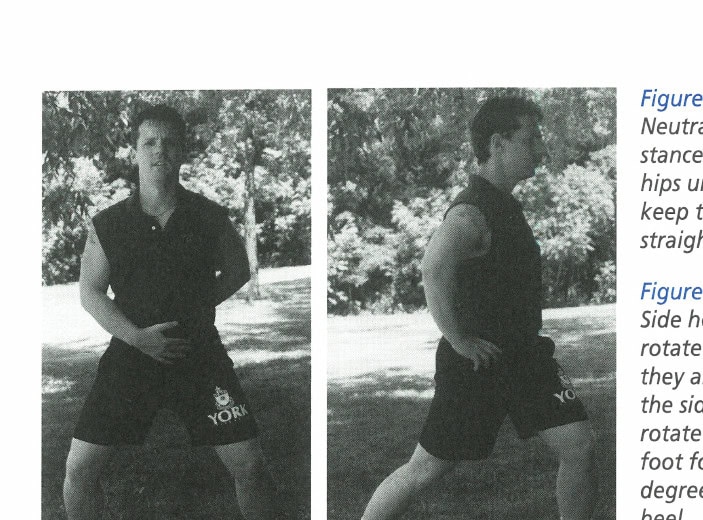
The basic stance is called the “neutral horse” (see figure 1). To get into the stance position, simply separate your feet so that they are just a bit wider than shoulder width, with feet parallel. Next, bend your knees deep enough so that you cannot see your toes, and make sure that your knees are pushed outward. Finally, tuck your hips underneath you. Place your hands on your hips, and bring your chest forward and your shoulder blades back to create a strong upper body position. This is an especially super strengthener for the outer legs—a traditional weak spot for many runners.
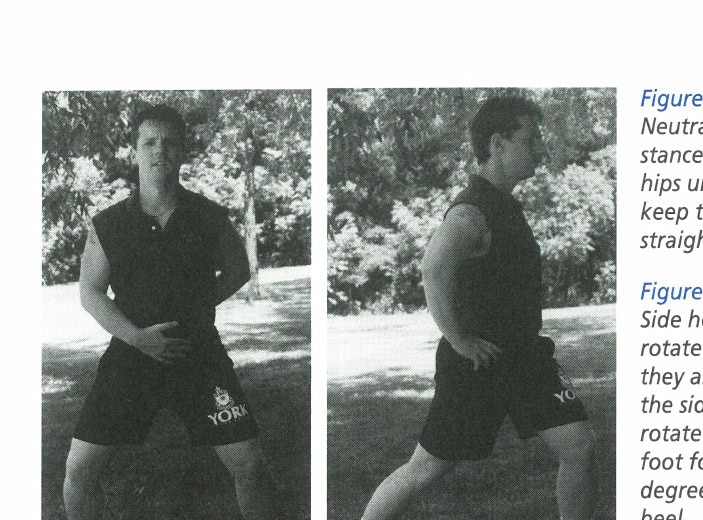
The next step up in intensity is called the “side horse.” A side horse stance is simply a neutral horse rotated to the side. Start in neutral horse position. To perform a side horse to the left, rotate your right foot on its heel about 45 degrees to the left and your torso 90 degrees to the left. In the correct position, your hips should be square to the left and your right knee should be slightly bent. Lean forward enough so that 60 to 70 percent of your body weight is balanced on your left leg (see figure 2). To perform a right side horse, simply reverse the position of your feet and turn your hips so that they are square to the right. It may feel a bit awkward at first, but the stance strengthens muscle groups in a different way than running does, resulting in greater muscular endurance over time.
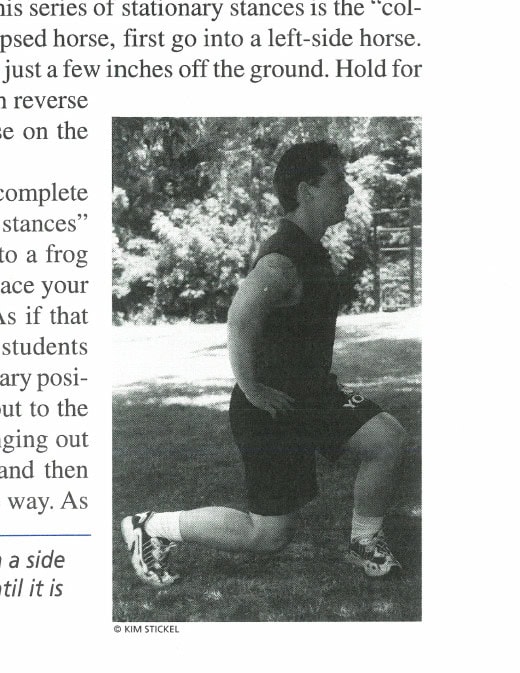
The final step up in intensity in this series of stationary stances is the “collapsed horse.” To go into a left collapsed horse, first go into a left-side horse. Now, lower your right knee until it is just a few inches off the ground. Hold for as long as you comfortably can, then reverse the positions to do a collapsed horse on the other side (see figure 3).
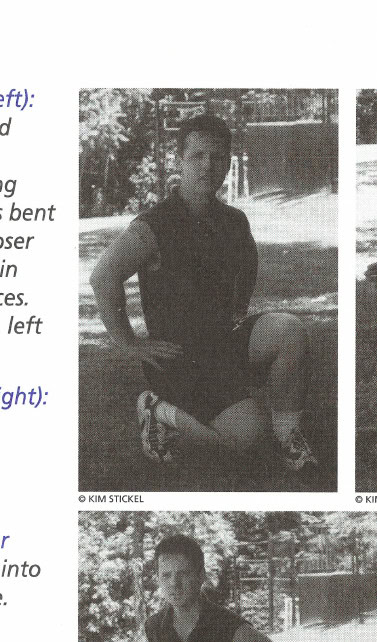
No workout with Glen Doyle is complete without a round of his patented “frog stances” (see figures 4 through 8). To get into a frog stance, bend your knees deep and place your feet as close together as possible. As if that weren’t difficult enough, Doyle’s students don’t just hold this stance in a stationary position; they “walk” by taking a step out to the right at a 45-degree angle, then bringing out their left foot in behind the right, and then taking a step out to the left the same way. As soon as you do it, you’ll realize how powerful an exercise it is for building leg strength and endurance. Try it on a track, on grass, or on a gym floor. This is a super exercise for building leg strength as well as waking your legs up a half-hour or so before a big race.
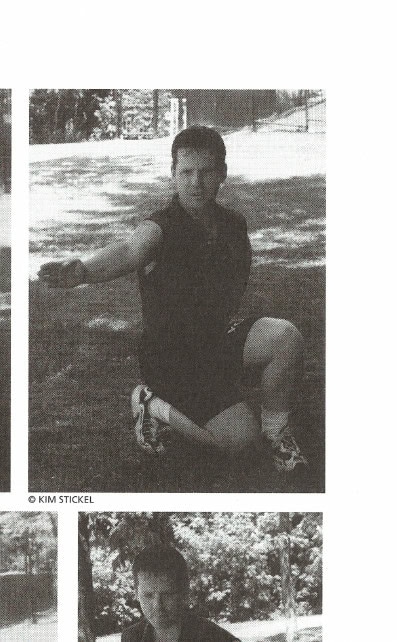
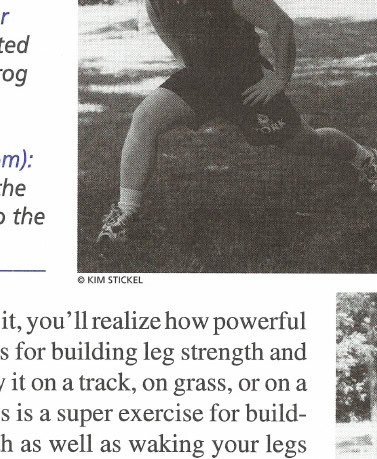
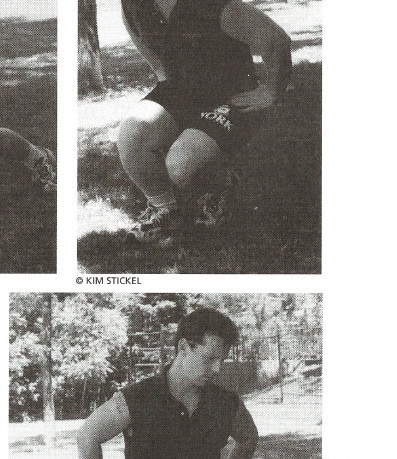
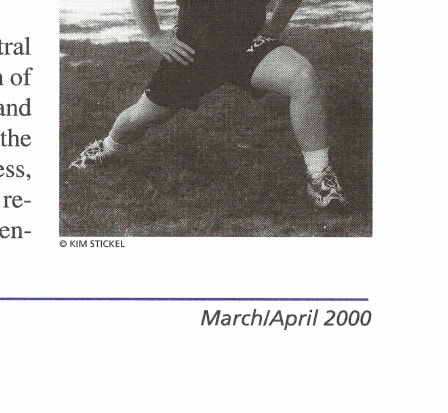
For a first workout, try holding the neutral horse position for five minutes, then each of the side variations (side horse to the left and the right, collapsed horse to the left and the right) for two minutes each. As you progress, you’ll be able to hold the stances longer, resulting in more muscular endurance and energy. Finally, try a round of 20 steps of frog stances. You’ll be hauling yourself off the floor afterwards, but amazed at how much more energy you have during your weekend long runs.
ENERGY WORK: FOCUSING ON THE BREATH
A key part of Doyle’s workouts for runners involves exercising the internal organs through the use of the Chinese art of chi kung. The term translates from the Chinese as “energy work,” and the exercises work the internal organs and the breath. Among the exercises Doyle prescribes for runners is a series based on dynamic tension. In his book, The Martial Artist’s Way: Achieve Your Peak Performance, Doyle describes dynamic tension as “a set of exercises that uses muscle against muscle to create an isometric environment.” The dynamic tension exercise known as the “Eight Bridges” can be used to fire up your energy before heading out on the road.
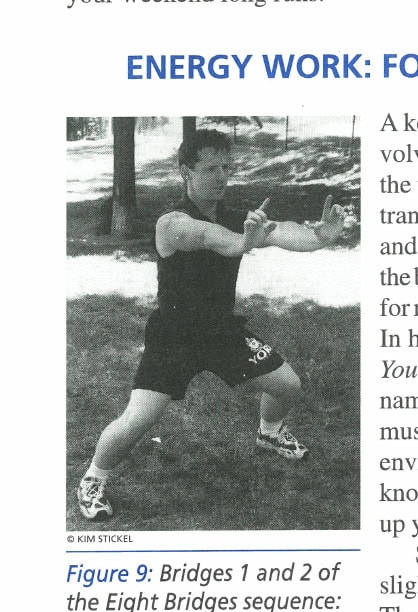
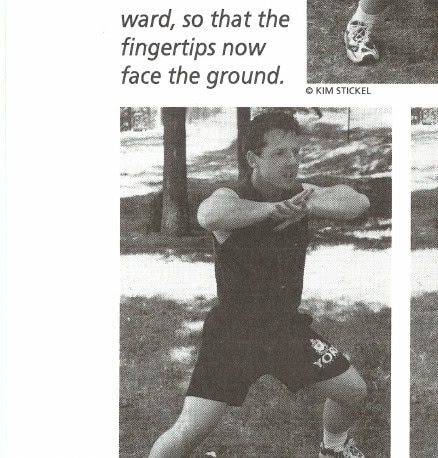
Start in a neutral horse stance, but with feet slightly wider than in the usual horse position. The exercise consists of four separate movements, each of which constitutes two “bridges.” To perform bridges 1 and 2, press your arms out in front of your body, palms facing away from you, keeping your arms at shoulder height and parallel to the floor. Resist the movement as much as possible, as though you are pressing against a heavy object (see figure 9).
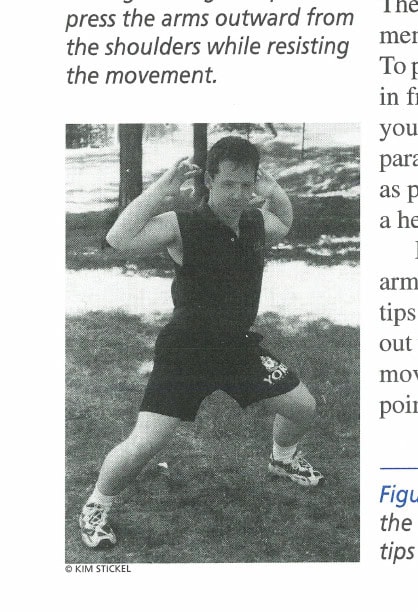
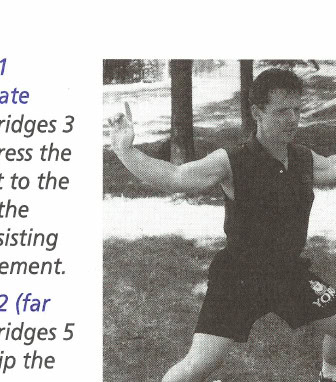
Bridges 3 and 4 consist of bringing your arms in to your body, your fingers brushing the tips of your ears, and then pressing your palms out to the sides of your body, while resisting the movement, arms parallel to the floor, and fingers pointing towards the sky (see figures 10 and 11).
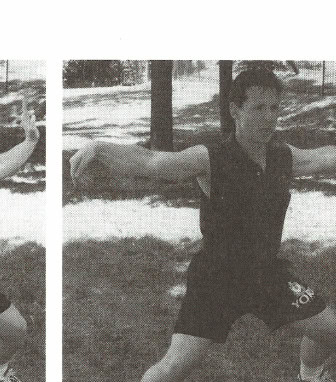
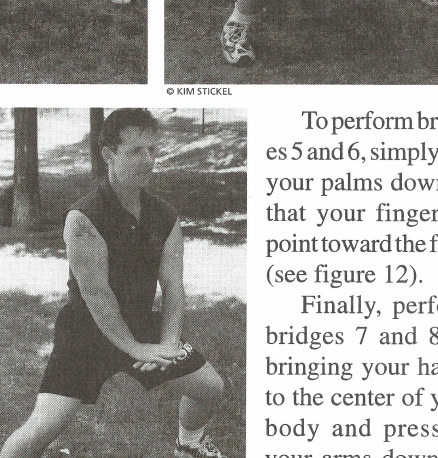
To perform bridges 5 and 6, simply flip your palms down so that your fingertips point toward the floor (see figure 12).
Finally, perform bridges 7 and 8 by bringing your hands to the center of your body and pressing your arms down toward the floor, palms facing the ground, again resisting the movement as much as possible (see figures 13 and 14).
Mental Strength: The Mind as a Power Source
Doug Antoine is a professional power skating coach in Ontario who has brought Glen Doyle in to work with many of his athletes. Of Doyle’s work, he notes, “If [my athletes] ever had any doubts when they went in, they had no doubts when they were finished about how good they could be. That’s just the way Glen works with people: they come out feeling phenomenal about themselves.” Antoine picks up on a key component of athletic success: the power of the mind. Our bodies require conditioning for racing. Our spirits require attention through attending to our breath and energy flow. Yet our minds demand training as well, for marathoning and ultrarunning are tests not only of physical skill but also of boundless mental energy, focus, and patience.
Doyle pays particular attention to training the mind of the athlete, whether it means telling a zany story to lighten the moment, or simply shrugging his shoulders and saying matter-of-factly with a smile, “If you don’t beat your best time, eventually, somebody else will!” In Doyle’s parlance, it’s all about adopting the mindset of a warrior. Developing “fighting spirit” isn’t about beating up on anyone or separating people into groups of winners and losers. It’s about yourself: embracing your talents, developing the best of yourself, tending to your weaknesses, and ultimately, becoming a better human being through the lens of your chosen sport. “Fighting spirit is the will to challenge oneself,” Doyle explains. “There’s a drive in you to get things done that you wouldn’t naturally think you might do, but when you’re put into a situation, you do them . . . there’s [also] an honor to a fighting spirit.” Doyle’s techniques for mental training are designed to bring this spirit out in every athlete he trains, all with the goal of making the athlete feel “10 feet tall and bulletproof.” It’s a catchy phrase with simple meaning: whether you’re an elite or recreational athlete, you want to come out of your training feeling as though you can handle any challenge dealt to you.
Storytelling
By finding inspiring stories that remind you of your goals, you can use these stories when you’re experiencing a difficult moment during long runs or races. To one student, an elite athlete and history buff with an eye toward making some history of his own, Doyle shared the story behind Genghis Khan’s statement that “the merit in an action lies in finishing it to the end.” The great 13th-century warrior once ordered his troops to dismantle a conquered city, brick by brick, until no trace of it remained. Soon after hearing this story from Doyle, the student went out and won a national championship.
To young hockey players, Doyle might describe Wayne Gretzky’s “low panic point.” Doyle explains: “It means that [Gretzky] holds onto the puck until the last moment before he passes it, because he’s not nervous that someone’s coming in to check him. And as soon as I say that, I see the little switch go on in their heads: ‘Oh! I know why we’re doing this exercise: so we can pass the puck better!'” And they do, without long-winded explanations about technique.
It’s all about feeding your mind with positive thoughts while focusing on the task at hand. During a difficult moment in a race or training run, think of Alberto Salazar’s miraculous win at the Comrades Marathon in South Africa, or Louise Sauvage’s amazing come-from-behind triumph over Jean Driscoll in the women’s wheelchair division of the 1998 Boston Marathon, or Bob Kempainen placing first in the 1996 Olympic Trials Marathon despite vomiting three times in the final miles. Any story that inspires you to keep moving forward is a good one for you.
Visualization and Breathing
It never occurred to me that I sometimes felt fear when I began to tire during races or long workouts. But it’s true: fear is an emotion that we all deal with. When we become fearful of our ability to complete a workout, our form becomes sloppy, our stride shortens, and we slow down. It’s too much. I can’t do it. How often do we hear such thoughts in our minds—at precisely the time when mental strength may give us the edge to bring out a personal-best performance? Doyle shared with me the idea of combining visualization with deep breathing to combat fear while training or racing. Visualize breathing in fresh, clean breaths of courage with every inhale, and then visualize yourself exhaling fear in the form of dirty air. Picture it leaving your body as you prepare for the next inhalation. I tried this exercise during a recent long run and was amazed at the strength it gave me to finish the workout in high spirits.
Physical Rejuvenation
Glen showed me a nifty trick he prescribed for one distance runner who had trouble getting beyond the 20-mile “wall” during races. The trick involved rejuvenating the chi in his body by shooting out his fingertips for 20 to 50 strides during a race. The goal is to be able to recirculate chi when the body has already gone through a monumental level of stress, as at the 20-mile mark in the marathon. To perform this exercise, flick your fingertips out as your foot hits the ground. Do this every other stride for a total of 20 to 50 “flicks.” It’s a simple exercise but really helps to re-energize the body during those last few miles.
Putting It All Together
Since I’m currently training for a marathon, I use the strengthening exercises, such as the stances and frog walking, as supplementary exercises. I do frog walks on the same day as my speed sessions on the track, since they stress the muscles similarly and give me a few days to recover in time for my weekend long run. I do the dynamic tension exercises every day when I first wake up, as well as before my workout. The mental preparation is a constant in my training life. I’m always on the lookout for mental triggers that will enable me to turn on my mind and body to the notion of setting a personal record this year.
During the off-season I’ll spend more time strengthening my legs with frog walking. I plan to work up to 100 reps (in sets of 20 steps each). I’ll also continue to use the dynamic tension exercises and stances to further strengthen my legs and increase my endurance.
Final Thoughts
No matter what our chosen distance—the marathon, 100-miler, or somewhere in between—we all search for that perfect performance. The day when years of preparation and hard work finally pay off. That ultimate race where our intent matches our output, stride for stride. No matter whether we’re Olympic-caliber or just Olympic-inspired, we dream of a level of achievement in our sport that reflects our true abilities. Reaching this level demands that we keep our minds open to new training methods and devices, keeping our minds and hearts open, willing to move to a new level of achievement in our sport.
Julie Kristof, a runner, all-around athlete, and longtime member of Jing Mo, puts it all into perspective:
[Martial arts] has helped me in all the sports that I do because of the focus that you get and your ability to be aware of more than just the physical aspect. You’re aware of your breathing, you’re aware of your surroundings, you’re aware of how your muscles are behaving as they explode. You learn how to get over barriers. It’s a very intelligent form of exercise, because everything you do has a purpose. Every two motions that you do run into one another, and if they don’t, you’re not doing it properly, because it’s all circular.
Julie smiles, laughs at the members of Jing Mo in the background, clowning around after class as they prepare to go home, then adds one last thought before taking off for the night: “Eventually, you start seeing your life that way.”
THEY CAME with their camel backs, fanny packs, vitamin supplements, altimeter watches, and fluorescent Spandex. They came from all over the world: the United States, England, South Africa, Japan, China, France, and Switzerland. And they came with lots of experience.
The athletes who gathered on the shores of northern Mongolia’s Lake Hovsgol for that country’s first ultramarathon had cumulatively run thousands of kilometers training in dozens of countries. Some had even won big-time races. Klaus Muttke, for instance, had won the Leadville Trail 100, a grueling century race in Colorado run entirely above 10,000 feet altitude. Another runner was a champion of the Hong Kong 64K ultra. Mary Ritz and Kristina Irvin were both experienced runners from the United States; Ritz is trying to be the first woman to run an ultra on all seven continents of the world, whereas Irvin has completed more than 70 ultras.
But at the end of the day on July 8, 1999, at the conclusion of Mongolia’s first ultrafest (the 100K and a companion marathon), it was the Mongolian runners who won. But the word “won” doesn’t do justice to the performances of these fine and unheralded athletes. “Dominated” or “obliterated” would be more appropriate.
The Mongolians—in their torn shoes, floppy backpacks, and old cotton track suits—stormed out of nowhere to finish in remarkable times over the wet and often treacherous terrain, setting the pace from start to finish.
“I am surprised they finished with these times,” observed race organizer Tyler Pike, who created the course. “I didn’t expect anyone to run it so quickly.”
The Mongolians surprised even themselves. None had ever run 100 kilometers before; they were noticeably ill-equipped for such a race, and they were tired. Nearly all of them had driven for three days over bone-jarring roads from the capital Ulaanbaatar, while the foreign runners had been shuttled directly to the start area several days earlier in helicopters.
“This shows that Mongolians are able to face difficulties and challenges; it is one of their better qualities,” said 100K winner N. Tsogtbaatar, who finished in 12 hours and 22 minutes. “No one knew what to expect. We had never seen anything like this. Winning an ultramarathon never crossed our minds. We just wanted to finish.” Certainly Tsogtbaatar’s long and lanky frame, ideal for running distances, proved the most enduring of the day.
But it was another Mongolian, Ch. Biambadorj, who shone in the marathon segment. His time of 4 hours and 45 minutes easily eclipsed Tsogtbaatar’s split time of 5:15. A guard at one of Ulaanbaatar’s Soviet-era coal-fired power plants, Biambadorj won from years of experience and strength. The 32-year-old, with his rough country-boy face and compact muscular body, is a Mongolian sports champion who has collected dozens of medals from local competitions.
“This was a difficult course, running up and down mountainsides, across rivers, and through the marsh. But that was what made it fun,” Biambadorj said. “It was more challenging and exciting than normal road races.”
JAPAN POWER
But the Mongolians didn’t steal the show entirely. Some of the glory was snagged by an unassuming Japanese woman named Mari Takemura. The 30-year-old office worker ran the 100K in 13 hours flat, a mere 38 minutes behind the open winner, and 19 minutes ahead of the third-place finisher. The shy and demur Takemura trotted across the finish line to the cheers of locals and visiting runners. She appeared unfazed, as if running 100K were merely a jog in the park.
She suddenly found herself the center of attention. The press wanted interviews and pictures, while everyone else pressed forward to offer congratulations.
“I didn’t really expect that, but it was nice,” the Nagano native said. She surprised everyone again when she ran an additional 5K in order to accompany her sister, Nobu, to the finish. Nobu finished in 17:50.
Rounding out the rest of the top finishers in the 100K were 3. B. Erdenebayar, Mongolia, 13:19; 4. Klaus Dieter Muttke, Germany, 13:27; 5. Gerard Verdenet, France, 14:00; 6. T. Gurragchaa, Mongolia, 14:23; 7. Dieter Jung, Germany, 14:30; 8. B. Dorjbat, Mongolia, 14:38; 9. Tyler Pike, USA, 15:39; 10. Yoshimi Tsugawa, Japan, 15:39.
After Biambadorj, the top finishers in the marathon distance were 2. L. Battsengel, Mongolia, 5:15; 3. Chris Hazen, USA, 5:48; 4. Mark Progin, France, 6:04; 5. David Mills, South Africa, 6:06.

This article originally appeared in Marathon & Beyond, Vol. 4, No. 2 (2000).
← Browse the full M&B Archive1,000+ stories from 19 years of Marathon & Beyond
The complete archive of the legendary long-distance journal — digitized and free to read.
