

We Are Cardiac Athletes
In mid-November 2010, I traveled from Eugene, Oregon, to Harrisburg, Pennsylvania, for the Select Medical Harrisburg Marathon and Relay. I wouldn’t ordinarily travel 2,300 miles just for a marathon, but this one was special.
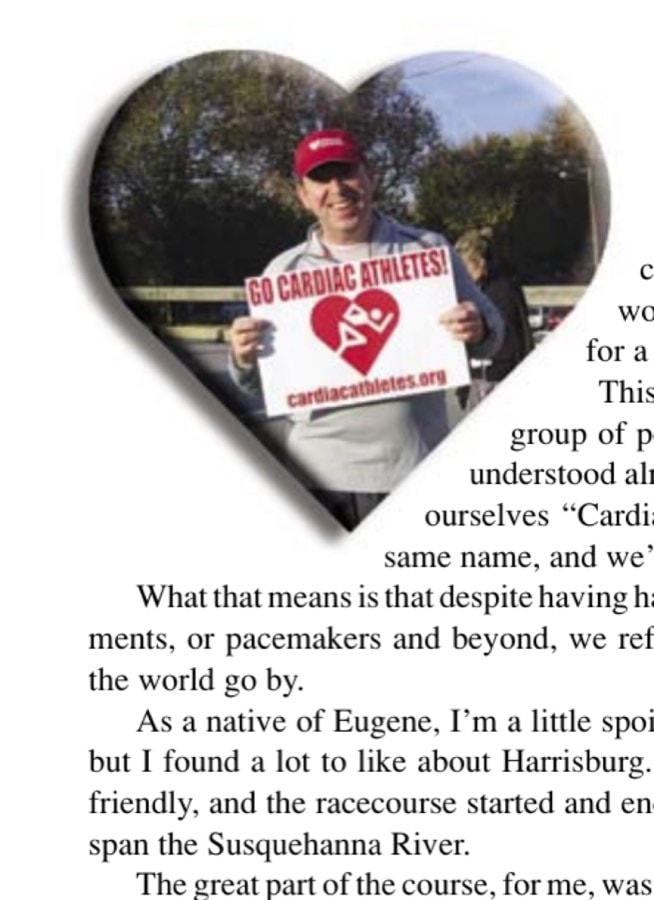
This one was a reunion of sorts with a group of people I had never met personally yet understood almost as much as I did myself. We call ourselves “Cardiac Athletes” after the website of the same name, and we’re pioneers in cardiac recovery.
What that means is that despite having had open-heart surgeries, valve replacements, or pacemakers and beyond, we refuse to sit on the sidelines and watch the world go by. As a native of Eugene, I’m a little spoiled when it comes to running events, but I found a lot to like about Harrisburg. The city was clean, the people were friendly, and the racecourse started and ended on one of the arched bridges that span the Susquehanna River.
The great part of the course, for me, was that it paralleled the river after several miles through the nearby city streets and neighborhoods and then crossed back and forth over two bridges for the relay exchange. We have rivers in Eugene, and I felt right at home running next to the water.
Harrisburg is the capital of Pennsylvania, and I found the brick and stone architecture a pleasant distraction during the race. We don’t have many front stoops back home, but Harrisburg seemed filled with them. Many display the flags of favorite college teams like Penn State and Ohio State. I found out later it was their weekend to play each other in college football.
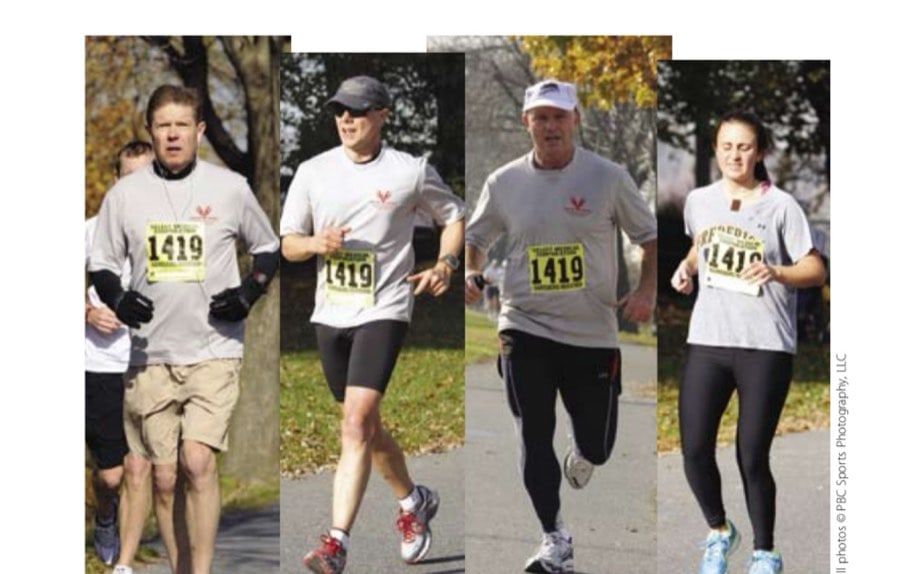
All photos © PBC Sports Photography, LLC
The water and aid stations were well stocked and the volunteers friendly. The trees still held a hint of the reds and golds of autumn splendor. I recommend this race to anyone. Another plus for this location is its proximity to Hershey, Pennsylvania, and to Gettysburg. In my opinion, there is nothing like the hallowed ground of a battlefield to give you reason to pause and give thanks for life.
Cardiac Athletes was founded by Lars Andrews, a chief cardiac physiologist who saw the value of the cardiac-rehabilitation program at Conquest Hospital, Hastings, United Kingdom. One day, Lars overheard two staff members referring to a patient as a “cardiac cripple.” Having recovered from a broken neck suffered in a rugby match in the early 1980s, Lars had great respect for anyone overcoming an illness or disability. He didn’t agree with these doctors that some people are just hopeless cases and asked himself, What would be the polar opposite of a “cardiac cripple”? The answer: a cardiac athlete.
I had open-heart surgery in 2005 and ran the Seattle Marathon seven months later. I chronicled my story in an article I wrote for the September/October 2007 edition of Marathon & Beyond titled “Running for My Life.”
▲ Members of a Cardiac Athletes relay team. Author Jeff Hardisty is second from left. Tony, second from right, came all the way from Australia to participate.
I was elated to complete such an event. The cardiac-rehab team at the Oregon Heart and Vascular Institute, where I rehabbed, had not heard of anyone doing such a thing so soon after surgery. I hoped that I could use my situation to educate the public on heart disease and to motivate people to lead healthier lives. I felt alone in my quest and wondered how one person could reach across the country. Enter cardiac athletes.
We used the setting of the Harrisburg Marathon as the site of the annual “Heart Patient Race,” as we called it, an annual gathering that has grown in the number of participants since the first one in 2006 at the Vermont City Marathon. During our group meeting Saturday night, we donated an AED (automated external defibrillator) to the New Cumberland Fire Department and Volunteer EMS. The next day, that very AED was out there on the course, ready to assist a runner near the finish line. It was comforting to know that we had contributed in such a positive way.
Heart disease knows no borders and can reach across the oceans, and so can we. From Tony and Bellthorpe in Australia, to Gary in Ohio, to Richard in Florida, and all the way to Venkat in India, we share heart-health information and post our ups and downs on the www.cardiacathletes.org website. Some of us led active lives before our cardiac wake-up call and some, in order to stave off future cardiac events, began daily training and eating as if our lives depended on it. Competing in sporting or endurance events is different after open-heart surgery than after, say, appendix removal. Sportscasters always comment on the “heart of a champion,” but you never hear them say, “That team played with a lot of spleen today.” Not a training session goes by that I’m not keenly aware of my heart rate and thankful that it’s still there to monitor.
There is a line in a Foo Fighters song that speaks to me: “There goes my hero, he’s ordinary.” I couldn’t put my philosophy any better than that. We are pioneers saving lives. We are cardiac athletes.
This article originally appeared in Marathon & Beyond, Vol. 15, No. 6 (2011).
← Browse the full M&B ArchiveMore like this
1,000+ stories from 19 years of Marathon & Beyond
The complete archive of the legendary long-distance journal — digitized and free to read.
