

Weightlifting For Marathoners
WELCOME TO Part II of our Weightlifting for Runners program. In Part I in the January/February issue, we talked about the basics of weight training, what it will do for your body, and how it will help your running. Now, in Part II, we’re going to get down to the nuts and bolts. We’ll talk about the details of our workout—the specific exercises and how to do them correctly and safely. But first, let’s spend a moment reviewing the general concepts we covered in Part I (and feel free to sing along if you remember the words!).
In Part I, we explained how running is a total-body movement and because of that, can contribute to strength imbalances, which can lead to pain, strain, and injuries. Strength training helps correct this, with an addition to your weekly workout time of as little as two 30-minute sessions, done on non-consecutive days. We also talked about the need for a quick warm-up before the workout and stretching. Your strength training workouts should be comprised of sets that work all the major muscle groups of the body in an alternating sequence. This way, you can exercise nearly nonstop but without working the same muscle groups two sets in a row. We also talked about proper lifting form, which should involve slow, controlled movements and continuous breathing. Keep all of these concepts in mind as you read the following pages, and refer back to Part I when you feel you’re losing sight of the forest for all the trees.
Okay, let’s get right to it!
FINALLY—THE EXERCISES!
If you’ve finished reading Part I of our program, congratulations. You’ve come a long way. Believe it or not, you now know more about weightlifting theory than most people in a busy gym on a Monday night. You certainly know enough to design your own workout. But don’t get nervous; I’m not abandoning you.
This section will introduce you to the specific exercises I recommend. It will also explain how to choose which ones to do, and in what order.
The exercises listed here are arranged according to the major muscle groups that they work. Each of these groupings is numbered, and within each group are machine, bodyweight, and free-weight exercises. Begin your workout by choosing one exercise from each of these groups and perform them in order. This will comprise your first circuit.
After you complete one circuit of these exercises, repeat them, increasing the resistance (or the number of repetitions, for bodyweight exercises), as we discussed earlier. For your third circuit of sets, choose a different exercise from each group, and perform these exercises at a high resistance level, as we also discussed. Finally, perform one last circuit of these exercises at a lower-resistance level, as indicated earlier. Good work—you’ve completed your workout!
As you go through the exercises on the following list, note that while our workout calls for you to do only two different exercises for every major muscle group, I’ve listed more than two exercises for each group. This enables you to choose different combinations of exercises each time you work out. This also prevents boredom and encourages more complete strength gains since each different exercise works the muscles in a slightly different way.
GROUP 1: CHEST
Dumbbell Press. Lay flat on the bench and hold the dumbbells at shoulder level, a little wider than your body. As you push the dumbbells up above you, bring them together slowly, until they lightly touch at the top of the movement.
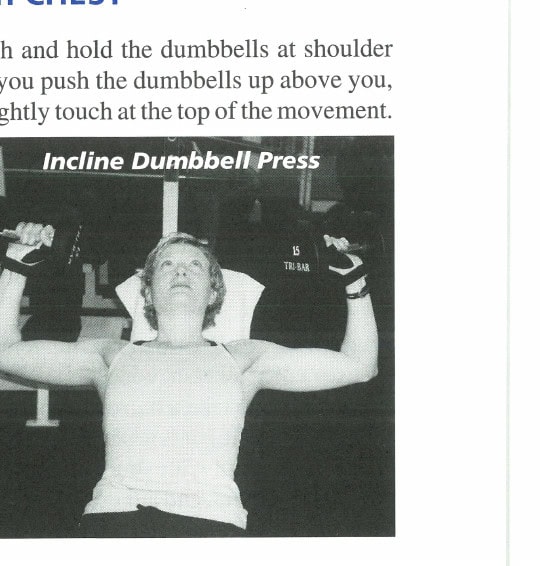
Incline Dumbbell Press. This exercise targets the muscle fibers of the upper chest. You can perform this exercise if you have an adjustable bench or an incline bench. Set the bench at about a 30-degree incline and perform the dumbbell presses as described above.
Chest Press. The seat on the machine is at the proper height for you if you are driving the handles straight away from your shoulders. Bring the handles toward you until you feel a slight pull across your chest, then slowly push the handles away from you.
Push-Up. Lower yourself until your nose is almost touching the floor. The key here is to keep your body straight and rigid—don’t let your backside point up in the air! This ensures that you don’t strain your lower back and will also involve and strengthen both your lower back and your abdominal muscles. If you have trouble doing this exercise from your toes, do it with your knees on the floor.
Decline Push-Up. This exercise is a bit more advanced, so don’t try it until you feel comfortable doing regular push-ups. These push-ups will recruit more of the muscle fibers in your lower chest area. You perform them by putting your feet up on a chair while keeping your hands on the floor.
GROUP 2: UPPER BACK
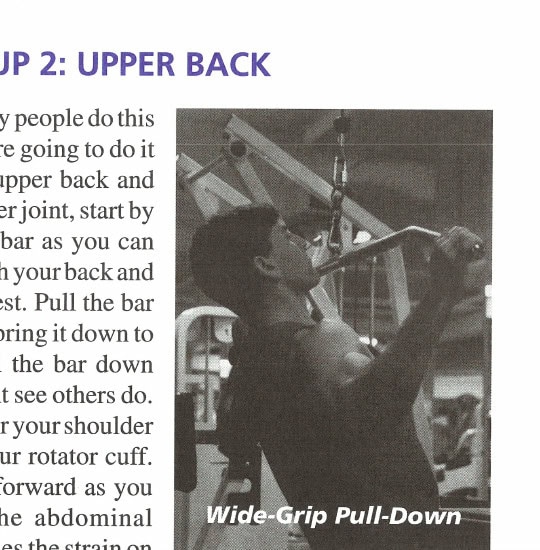
Wide-Grip Pull-Down. Many people do this exercise incorrectly, but you’re going to do it right. To properly work the upper back and minimize strain on the shoulder joint, start by taking as wide a grip on the bar as you can handle comfortably. Next, arch your back and lift up your chin and your chest. Pull the bar down just past your nose and bring it down to your collarbone. Do not pull the bar down behind your neck as you might see others do. This is an awkward position for your shoulder and can result in injury to your rotator cuff. Also, don’t bend your body forward as you pull down. This recruits the abdominal muscles to help out, which eases the strain on your upper back and minimizes the effectiveness of the exercise. Again, the thing to remember is to use an appropriate level of resistance and to use proper form.
Triangle Bar Pull-Down. This movement is similar to the wide-grip pull-down but uses a different bar, which, predictably enough, is in the shape of a triangle. It allows you to take a narrow grip, with the palms of your hands facing each other. If a triangle bar is unavailable, use the wide bar, but grip the bar with your palms facing you, with your hands just a few inches apart. Lean back slightly for this movement, and although you still want to arch your back and keep your chest up, aim to bring the bar down to the lower part of your breastbone.
Row. Choose a machine with a pad to lean forward against, and keep your body planted against it. This prevents you from risking injury to your lower back by engaging it while leaning backward. Pull the handles until your hands are close to your rib cage. If you choose to use a cable machine, which likely has no pad to lean against, make sure that the only parts of your body that are moving are your arms; keep your back in a single position.
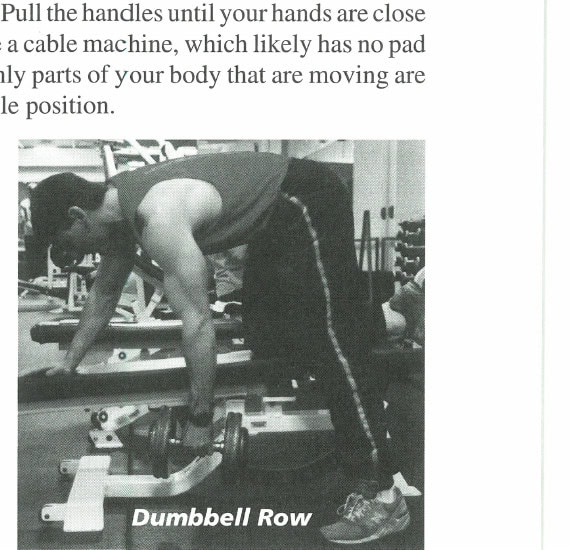
Dumbbell Row. Place one knee on the bench and lean forward, with your hand placed forward on the bench for support. Place your hand far enough forward so that your upper body is close to parallel to the floor. Make sure that the hand on the bench is on the same side as the knee on the bench. Your other foot should be out to the side on the floor for stability and support. Grip the dumbbell with your free hand and pull it up to your lower ribs. As soon as you’re finished on one side, continue the set on the other side.
Wide-Grip Pull-Up. This exercise is the bodyweight equivalent of the pull-down. Proper form for this movement is essentially the same as for the pull-down. Keep your back arched and your chest up.
Narrow-Grip Pull-Up. Here’s the bodyweight equivalent of the triangle bar pull-down. Perform these pull-ups with your palms facing you and your hands about 12 inches apart. Again, remember to arch your back and keep your chest up.
GROUP 3: SHOULDERS
Shoulder Press. When using the shoulder press machine, be sure to keep your back firmly against the pad. During the exercise, lower the handles to eye-level and remember not to lock your elbows at the top of the movement.
Front Raise. This exercise works the front of the deltoid muscle group. Start out with light dumbbells held next to your hips, in front of your body. Keeping your back straight, alternately raise and lower your right and left arms straight out in front of you until the dumbbell is at eye-level. Make sure that you are not swaying or arching your back while performing this exercise.
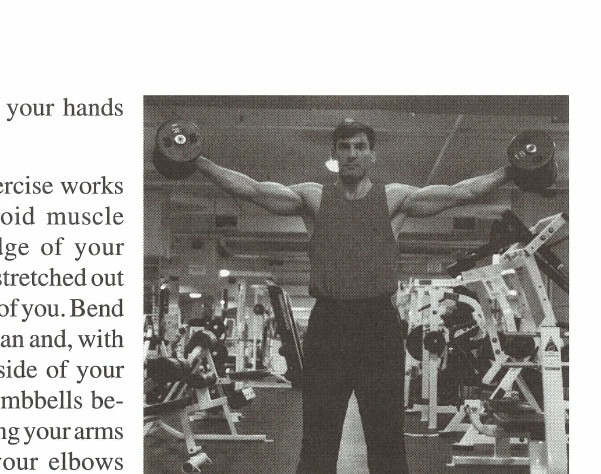
Lateral Raise. This exercise works the middle of the deltoid muscle group. Using light dumbbells and keeping your arms straight, raise your arms outward
from your sides until your hands are at eye-level.
Reverse Fly. This exercise works the back of the deltoid muscle group. Sit on the edge of your bench, with your legs stretched out nearly straight in front of you. Bend forward as far as you can and, with your arms on the outside of your legs, grip a pair of dumbbells beneath your legs. Keeping your arms nearly straight and your elbows facing up toward the ceiling, lift your arms up on either side, like a bird flapping its wings. This exercise might feel awkward at first, and you might not be able to lift much weight, but stick with it. It’s a good exercise, and you’ll be comfortable with it soon enough.
Shrugs. This exercise works the trapezius muscle, which is a big, diamond-shaped muscle that runs from the back of your neck, out to your shoulder blades, and down to the lower part of your spine. Holding heavy dumbbells, keep your arms straight and shrug your shoulders up as high as you can go.
GROUP 4: LEGS
Leg Press. The leg press is a wonderful movement because it works so many muscle groups at the same time. You name it, this exercise works it: the quadriceps on the front of the leg, the hamstrings on the back, the abductors on the outside of the leg, and the adductors on the inside. To do this properly, you must be careful not to allow your knee to bend too much. Aim for a 90-degree angle, and remember not to lock out your knees at the top of the movement.
Lunges. This is a bodyweight exercise that works the leg much the same way as the leg press. Step forward, plant one foot in front of you, and keep it there. Keeping your front knee aligned with the ankle, bend your front knee and lower yourself forward until your back knee is almost touching the floor, then straighten your front leg until you return to the starting position. To avoid risking injury to the lower back, be sure to keep your body upright throughout this movement.
Kickbacks. This is another bodyweight exercise, but it focuses on the hamstrings and the glutes—that is, your rear end. Get down on all fours and kick one leg back slowly until it is fully extended behind you, as high as you can possibly raise it. Return your leg to the starting position, and repeat. When you’re finished with that leg, start working the other leg.
Calf Raises. Stand backward on some stairs, with your forefoot on the edge of a step. Slowly lower your heels as far as possible, then raise your heels until you are standing as high as you can on tiptoe. If you are strong enough, try standing on only one foot when performing this exercise.
GROUP 5: THE MIDSECTION
Crunches. This exercise works the upper abdominal muscles. There are two key points to remember about this exercise: first, keep your lower back against the floor throughout the movement. We don’t do the old-fashioned sit-ups that they used to teach us in school. Those sit-ups recruited muscles other than the upper abs and could also cause an injury to the lower back. The second point to remember is that you should cross your hands over your chest or hold your fingers lightly against the sides of your head. Do not interlock your fingers behind your head and pull. This lightens the load on the abs by getting your arms involved and also may lead to a neck strain. Look up toward the ceiling at all times during this exercise; this will ensure good spinal posture. Slowly lift the shoulders up and forward until your shoulder blades are off the ground. Hold this position for a few seconds, then slowly lower yourself back down. For added difficulty, raise your legs straight up in the air and keep them there throughout the set. By doing crunches this way, you’ll get a two-for-one deal because, in addition to working the upper abs, you’ll be recruiting the muscles of the lower abs isometrically, which means contracting without moving.
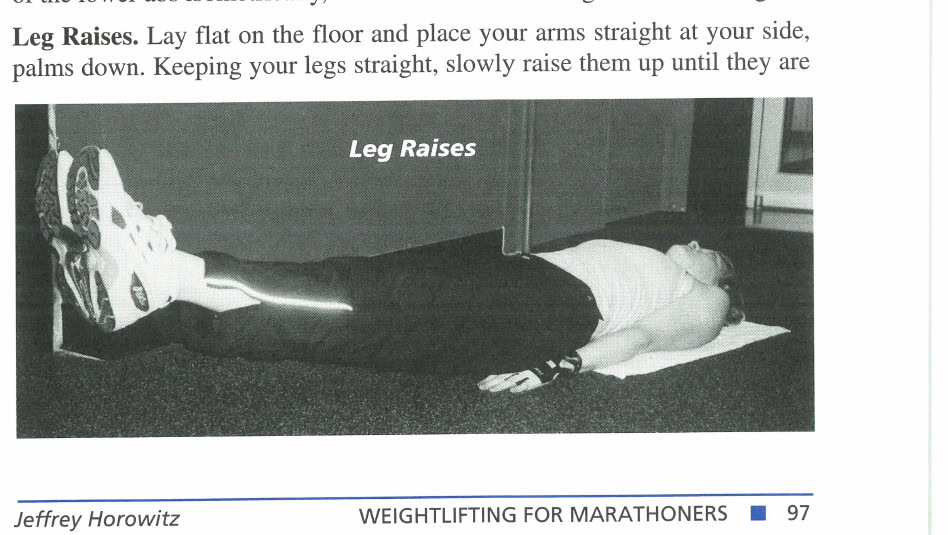
Leg Raises. Lay flat on the floor and place your arms straight at your side, palms down. Keeping your legs straight, slowly raise them up until they are perpendicular to the floor. If you have trouble holding your upper body on the ground during this exercise, wedge the sides of your hands under your buns to gain leverage.
Cross-Over Crunches. This exercise works your obliques, also known as love handles. Lay down on your back with your right elbow on the floor by your side and your right hand on your stomach. Keep your left foot on the floor, and place your right ankle on your left knee. Finally, place your left hand lightly against your head. Now you’re ready for the exercise! Keeping your right side on the ground, raise your left shoulder up and move it diagonally across your body, toward your right knee. If you come straight up, you’ll only be performing a modified crunch, which is not bad, since it works the upper abs, but we want to focus here on the obliques. When you’ve completed your set, reverse your position and do a set for the other side of your body.
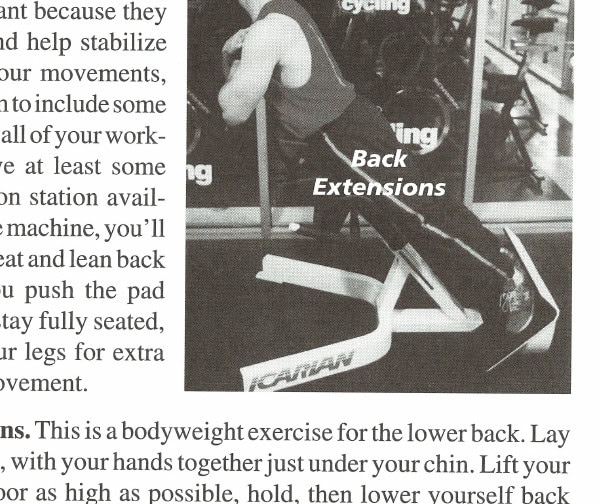
Back Extensions. This exercise, as well as the next one, works the erector spinae muscles of the lower back. These are especially important because they support your body and help stabilize you throughout all your movements, including running. Aim to include some lower back exercise in all of your workouts. Most gyms have at least some form of back extension station available. If it is a resistance machine, you’ll likely have to sit in a seat and lean back against a pad. As you push the pad backward, be sure to stay fully seated, and try not to use your legs for extra support during the movement.
Prone Back Extensions. This is a bodyweight exercise for the lower back. Lay on the floor face down, with your hands together just under your chin. Lift your upper body off the floor as high as possible, hold, then lower yourself back down. As you get stronger in this movement, try to lift both of your legs off the floor as you lift your upper body. Be sure to keep your legs as straight as possible. And when you get really good at this exercise, you can try what I call “supermans,” which involve performing the exercise with your arms stretched out in front of you, as if you were flying through the skies of Metropolis. This maneuver moves weight away from your center of gravity and reduces your leverage, which makes the exercise more difficult to perform.
BORED? MAKE A CHANGE!
After you’ve been using this program for several months, a time may come when you feel that something is wrong. You’ve become stronger and leaner than you’ve ever been before, but you’ve stopped having fun exercising, and you don’t seem to be making any more progress. What could be wrong?
Don’t worry; nothing’s wrong. Fitness gains don’t come smoothly and exponentially; instead, they come in fits and starts. Eventually, everyone hits a plateau. Remember our workout plan is based on the principle that your body will react to changing demands placed upon it by improving muscle strength and endurance. When you’ve stopped making gains and feel bored with your routine, it’s just a signal that your body has adapted to the new demands and might need a more significant change than usual. Often, it won’t take much of a change to move you off this dry patch; a change for one or two workouts will shake things up enough for you to return to your regular routine and make progress. Here, then, are some suggestions for ways to get off that plateau.
Decrease Weight, Increase Repetitions. Go through your regular sequence of exercises but set the weight low enough to enable you to do 20 to 25 repetitions of each set. Each exercise will seem easy at first, but you’ll soon discover that less weight doesn’t necessarily mean less effort.
Increase Weight, Decrease Repetitions. Spend a workout going for power. Using proper form, as always, set the weight at a level at which you can only do six to eight repetitions. Normally, as indicated earlier, this kind of workout, performed on a regular basis, leads to gains in strength and muscle size. Performed sporadically, however, it provides variety without changing your emphasis on building muscle tone and endurance.
Stick With Just a Few Exercises. Instead of choosing two different exercises from each group, stick with one, but do four sets of that exercise. Start with the warm-up set, as usual, then go heavy on the next set, and lower the weight incrementally over the last two sets.
Do More Exercises, But Fewer Sets of Each. You could probably guess what I’ll say here. Instead of doing four sets over two exercises, do one set each of four exercises from each group. The resistance profile remains the same, however: start out light on the first set, go heavier on the next, stay heavy on the third, and then go lighter on the fourth.
Go Slooooooooow. This variation is especially well-suited to bodyweight exercises. Instead of spending 2 or 3 seconds doing the positive and the negative phase of each repetition, spend 10 seconds on each. To do this, you may need to lower the resistance or the number of repetitions. For some bodyweight exercises, such as crunches and prone back extensions, you can even hold still at the top of the movement for 5 to 10 seconds. Every now and then I’ll do a set
of crunches that consists of just a single crunch. Sound easy? Not if you’re holding this position for several minutes!
Do Supersets. A superset is really two sets in one. It consists of two related but different movements performed back-to-back without a break. For example, you can do 14 repetitions of lateral raises and follow them immediately with 14 repetitions of front raises. Both exercises work the deltoid muscles but in slightly different ways. Performing them together will constitute just one set, but, as you can imagine, it will be a very tiring set! The benefit of doing this kind of movement is that it is mentally easier to work through a very high-repetition set—which is what a superset amounts to—if you can break it down into segments. As marathon runners, this type of mental gymnastics is something at which we all excel.
Do Breakdowns. Also referred to as drop sets, this exercise involves working to temporary muscle failure in a particular exercise, then quickly breaking down, or dropping, the weight to a lower level to squeeze out a few more repetitions. This can be a very tiring exercise and cannot be performed all the time, but it will push you further than a regular set will.
HAVE FUN!
You began reading our two-part article to learn how to use strength training to supplement your running, and by now you should know enough to go out there and lift yourself silly. But I hope that you will find, as many of us have, that instead of just being a necessary chore performed in support of health and better running, strength training becomes one of your passions. It can make your body feel alive in a completely new and exciting way, and, believe it or not, it can be lots of fun. And that should really be the best motivation for beginning any new exercise program. Have fun and good luck!
This article originally appeared in Marathon & Beyond, Vol. 5, No. 2 (2001).
← Browse the full M&B Archive1,000+ stories from 19 years of Marathon & Beyond
The complete archive of the legendary long-distance journal — digitized and free to read.
