

Whatto Keep Packed
Traveling to races is fun. Packing for them is not. In fact, packing can be a chore almost as stressful as running a marathon—without the medal at the finish line. As a veteran traveler who has completed marathons in 10 countries and every U.S. state, I admit to making plenty of mistakes in packing. I have forgotten a number of critical items and experienced much anxiety as a result. After these frustrating experiences, I have finally devised a solution to the packing conundrum. Now I can easily “pack and go” for a weekend or longer without suffering too much angst. After all, the whole point of travel is to have fun, enjoy the change of scenery, and revel in the completion of another good race.
Make a few lists—and check them at least twice (or more) In desperation, I created several lists and refer to them several times before each trip. My basic list involves the barest minimum of items necessary to travel to a destination, complete a race, and return home. Of course, there are many variations to this list, depending on the type of race, means of transportation, duration of trip, weather conditions at the race locale, and whether the race is domestic or international. In addition, I have a list of personal items I simply must take with me, along with a list of things that are not essential but nice to have if there is room.
Just following a list is not sufficient, though. I never zip a suitcase or completely close a travel bag without first double-checking that I actually have put the necessary items inside. Since I change bags and suitcases depending on where I am going and whether I am flying or driving, this is essential. Sometimes I leave an important item in one bag, all packed and ready to go, and then decide to take a different bag without checking to see whether that critical thing I need has been moved to the new suitcase. Over the years, I have forgotten such disparate but important items as Bodyglide, my sports bra, and Band-Aids. Reviewing my lists at least twice and double-checking that everything crucial ends up in the
correct suitcase helps prevent this. I highlight in yellow those last-minute items that can’t be packed until race-day morning (eyeglasses, retainer, keys, and wallet, for example).
What to take depends on many factors The type of race will often dictate what you pack. Road races are fairly simple; your race-day outfit, running shoes, socks, underwear (including that sports bra if you are female), cap, and sunglasses are all pretty straightforward. But if you are doing a trail race, you might also need gaiters, a water bottle or hydration system, and bug spray. Ultras and multiday races require even more thought and precision when packing. When I do any race longer than a 50K, I bring a drop bag with extra shoes, clothes, and supplies like headlamps and extra batteries.
Of course, if you are driving to your destination race, packing and planning become much easier but are no less fraught with worry if you forget important items. However, with a car it is always possible, though not necessarily convenient, to drive to a nearby store to purchase any missing things you need. For car trips, I use a large covered plastic bin to house all my ultra supplies. I also use extra suitcases to hold clothes and shoes just in case I might need them. It’s a real luxury to do so, but even then, it becomes hard to find what you might need if there is too much stuff. Planning is still essential, and packing exactly what you need is still important.
Traveling by air is a real challenge, especially these days. For short two- to three-night trips (my usual practice), I take a small rolling suitcase that I never have to check (it actually fits in those check-your-suitcase bins at airport gates). Everything I need for a race and for sleeping fits inside. I never let it out of my sight. Into a smaller bag go all my toiletries and personal essential items. This bag has a shoulder strap and is large enough to carry my 3-1-1 bag, noise-canceling headphones, food, calendar, keys, pens, iPhone, and so forth but will still fit easily under the seat in front of me. I have several in different sizes depending on whether I want to use it as a pocketbook when I arrive at a foreign destination (when I prefer a smaller size) or if I just want to use it as an extra bag. Instead of my small-wheeled suitcase, I will opt for a large backpack that can be easily toted if I decide to check an additional bag. For longer trips, I usually check one midsized suitcase and fill it with extra running shoes, extra clothes, and a nylon drop bag for ultras, always leaving a little room for souvenirs and items I might buy at the expo. But I still keep my race-day outfit and shoes in my carry-on luggage.
Another factor to consider when packing is race-day weather at your chosen locale. Depending on the place and time of year, you might encounter rain, snow, heat, or humidity and this may be extremely different from the weather in your hometown. It is important to check the forecast before you leave but also critical
to pack a few items that might be useful if the forecast unexpectedly changes. If I have room, I usually pack a rain jacket, gloves or mittens, and hand warmers, just in case. For domestic travel, all you really need is your driver’s license or ID and your credit cards. International travel (even to Canada) requires a passport and in some cases a visa. It’s a good idea to notify your credit-card issuer and phone company of your overseas plans and to obtain at least a small amount of foreign currency ahead of departure. Since most overseas races require a substantial amount of planning ahead, the bulk of this packing information will apply more to shorter domestic jaunts.
Streamlining your packing I am fortunate to have an extra bedroom as my race headquarters. That’s where I keep all my running shirts, shorts, socks, suitcases, and travel bags. I have to clean the room of running paraphernalia only a few times a year when my son and his family visit. This means that I can lay out the desired items for a particular trip on the bed and review my lists to make sure I haven’t forgotten anything. My personal essentials are always kept in or near my under-the-seat bags. This includes my 3-1-1 bag of liquids and gels. I also keep a clear plastic gallon-sized bag packed with several of the items in the personal-essentials list: toothbrush and dental floss, comb, small baggie with medications, tiny box with assorted earrings—all ready to insert in my chosen traveling bag. For those with more limited space, a corner of a room or even a closet can serve as a holding area for these necessary items. Extra toothbrushes, combs, and other essentials are inexpensive, and when they go on sale, I stock up.
The following lists are suggestions based on what I use; they should be tailored to your specific needs.
Race essentials • Running outfit (I wear capris, singlet or long-sleeve shirt, and a mesh vest with pocket for phone and sunglasses) • Socks (Injinji; I pack two pairs just in case) • Running shoes • Underwear (including sports bra) • Cap with brim or visor or sweatband • Light jacket with hood and extra pockets • S-caps and/or salty snacks • Energy bars/gels • Fuel belt (if you use one)
© J. Darcy White
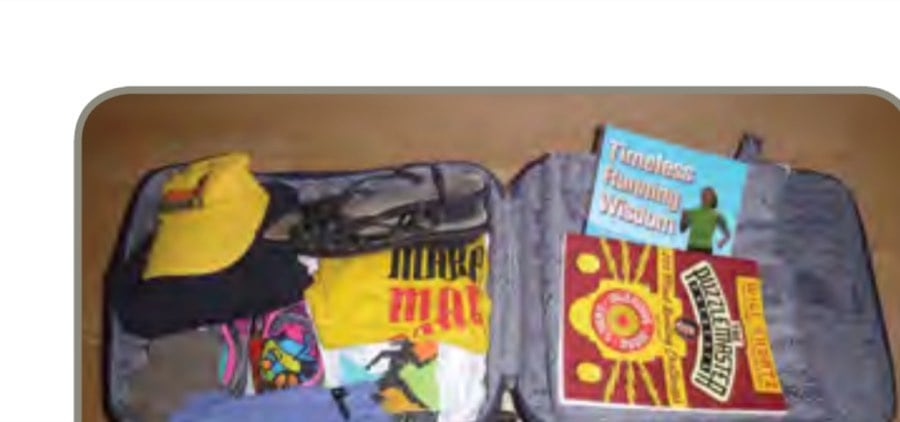
▲ My roller board packed with all my running essentials (except for toiletries and personal items).
Race essentials (if cold or snowy weather) • Gloves/mittens • Hand warmers (I always have cold extremities) • Long pants or tights • Warm cap • Throwaway jacket or sweatshirt (I scour garage sales for these) • Rain jacket •
A warm jacket (since this can be bulky and take up lots of luggage space, carry or wear it and use it as a blanket while traveling) Critical items (these don’t take up much space but they are important) •
Wallet with driver’s license/ID/passport • Cash and credit/debit cards • Keys • Phone with charger • Health-insurance card • AAA card/car-insurance information (if driving) • Boarding passes (if flying) Personal essentials •
Toiletries (soap, shampoo, toothpaste, sunscreen, makeup, Vaseline/Bodyglide, hand wipes/hand sanitizer, deodorant, razor, nail scissors/clippers, feminine products)
• Toothbrush and dental floss • Comb and brush • Medication (prescription and over-the-counter drugs, including sleeping pills, allergy meds, pain relievers, antacids and anti-diarrheal pills, analgesic
creams like Biofreeze and Bengay) • First-aid kit (Band-Aids, Neosporin, moleskin) • Tissues • Glasses and sunglasses (or contact lenses with solution if you use them) • Itinerary (race confirmation, hotel and airline info or driving directions,
maps); I have a folder for each race I do and carry this folder with me • Books and magazines (or Kindle, Nook, or tablet) • Camera with extra batteries/charger • iPod (even if not allowed in race, it can be helpful on planes and in noisy hotel rooms) •
Noise-canceling headphones and eye mask • Snacks (granola bars and food for prerace breakfast) • Watch or GPS/heart monitor • Sleepwear (I wear a comfy pair of cotton cargo pants and a T-shirt; that way I can go from bed to breakfast without needing to change clothes)
© J. Darcy White
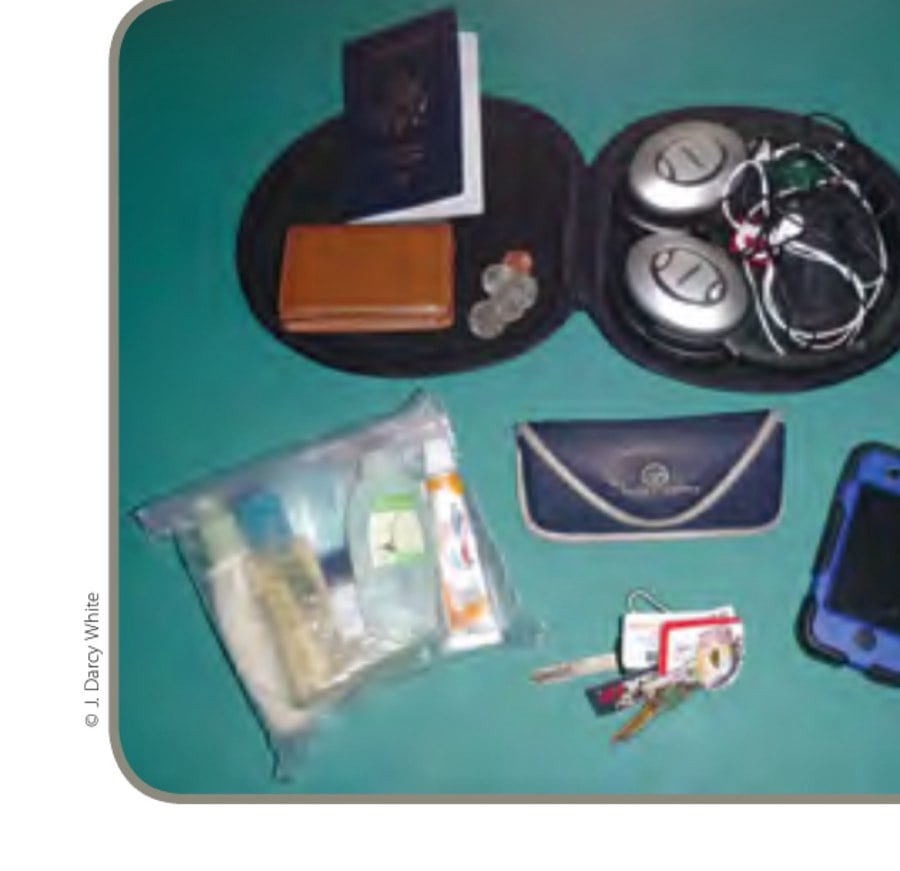
▲
These are toiletries and personal items I don’t want to forget. I carry them on my person or in my under-theseat bag.
ad
• Sandals/slippers/flip-flops for lounging • Compression gear (if you use it) • Safety pins • Jewelry (I wear only earrings on trips so I pack a couple of pairs)
Nice to have (if there’s room) • Extra clothes for variety and warmth (shirts/sweater/pants/shorts) • Additional running shoes and socks • Plastic bags (various sizes for food and clothes) • Garbage bag (to wear and/or sit on) • Foam roller/The Stick/ice pack Trail races • Trail shoes • Gaiters • Handheld water bottle or CamelBak • Preferred electrolyte drink (powdered is most convenient) • Bug spray
Ultras/multiday races • Drop bag(s) • Trail shoes • Gaiters • Handheld water bottle or CamelBak • Reflective vest or tape • Folding chair/canopy/tarp/blankets • Headlamp or flashlights with extra batteries • Cooler with ice/food (fill at destination) • Extra clothes for warmth and in case of wet weather • Extra running shoes (I bring comfortable shoes a size larger and sometimes wider to account for swelling after long hours of racing) International races—in addition to race and personal essentials, don’t forget: • Adapter plug and voltage converter for chargers—check specific country requirements • Foreign currency in various denominations • Passport (and visa, if needed)
Some packing tips 1. Start early if you can, preferably several days before the race. 2. Stock up on multiples of certain frequently used items (small tubes of toothpaste, extra toothbrushes, toiletries); I keep these in a special drawer
for easy access. 3. After each trip, check to make sure there are enough of each item to get you through another race—if not, then restock your 3-1-1 bag with needed items (and do this right away). 4. Save holey socks and worn-out underwear; they are great to pack and wear
one more time and then throw away. Same with stretched-out T-shirts or stained sweatshirts. These make great warm-up togs that you can wear before a race and then discard. 5. Stuff rolled-up socks and panties into your packed racing shoes; this fills
up empty spaces with useful items. 6. Wear the same traveling outfit coming and going (changing underwear and socks, of course). For two- to three-night trips, this minimizes the need for additional clothes. I often wear the race shirt on the trip home over another shirt.
▲
I am ready to go! Note the multipocket vest with wallet, passport, glasses, and so on.
7. Layer your clothes; wear a short-sleeve T-shirt over a longsleeve shirt or a sweatshirt over a T-shirt; wear or carry a jacket.
9. For trips that include multiple races (Disney’s Goofy or Dopey, challenges that include half-marathons on Saturday and full marathons on Sunday, or series races like the Savage Seven), plan on wearing and rinsing out quick-dry shirts, shorts, and socks each evening. Bring another complete outfit just in case clothes don’t dry in time for the next day’s race. I bring at least two pairs of
running shoes and alternate them to minimize blisters and sore feet. 10. For international trips or very long domestic flights, I wear a multipocket vest that has pockets for everything—my passport, keys, phone, granola
bar, wallet, checkbook, boarding passes, and iPod. It adds about 10 pounds to my frame but so far at least airlines don’t weigh passengers, so it really serves as an extra suitcase and frees my hands for other bags and parapher
nalia. I also carry a brown accordion folder in which I place my race folder, calendar/notebook, magazines, newspapers, and books. Airlines don’t count reading material against the two-item carry-on rule, so that makes for more
space in my bags for other items. 11. Don’t forget something for breakfast the morning of the race. Most hotel breakfasts are served too late for early race starts. Unless I am sure there is a nearby place to get bagels or toast, I bring along my customary breakfast
of bread and peanut butter, squirreled away in my under-the-seat bag.
© J. Darcy White
8. For truly last-minute races, wear your racing outfit on the plane, including your shoes. Bring along a T-shirt and comfortable shorts or sweatpants for sleepwear and the trip home.
12. Before you leave, arrange for your mail and newspaper to be stopped or picked up by a neighbor or friend. As you leave the house, make sure doors are locked (and you have the key in your hand or pocket), appliances unplugged, and timers or security system set. Planning my trips around marathons and ultras gives a meaningful focus to my love of travel. Having a streamlined method of packing gives me the luxury to go at a moment’s notice and makes travel much easier. I can indulge in one of my favorite pastimes—racing—without worrying about whether I remembered my shoes.
Sources for traveling accessories There are a number of stores that specialize in useful items and clothing for packing and traveling. Some of my favorites include: • L.L. Bean—my favorite source for running clothes, travel vests, luggage, backpacks, hand warmers, and jackets; high-quality items with quick and efficient service and free shipping (http://www.llbean.com) • Magellan’s—everything from wallets, travel jackets and vests, quick-dry shirts and pants, disposable underwear, to current adapters and sleep masks (http://www.magellans.com/) • Eddie Bauer—a good selection of quick-dry and moisture-wicking items, including breathable cotton shirts (http://www.eddiebauer.com)
Resources for travelers • Trusted-traveler programs like TSA PreCheck, for domestic travelers, and Global Entry for both domestic and international travelers. It costs money to join these programs ($85 for TSA PreCheck and $100 for Global Entry,
which includes PreCheck), but if you travel a lot, these can save you time and aggravation. (http://www.dhs.gov/trusted-traveler-programs) • ITA. Check for the lowest airfares to particular destinations. You cannot
book flights here (to do that, you must visit the airline or a third-party site), but you can see which airlines offer the best deals. (http://matrix.itasoftware. com) • FlightStats. Get the latest information on flight delays, alternate flights,
airport information, and impact of weather on your travel plans. (http:// www.flightstats.com)
This article originally appeared in Marathon & Beyond, Vol. 19, No. 2 (2015).
← Browse the full M&B ArchiveMore like this
1,000+ stories from 19 years of Marathon & Beyond
The complete archive of the legendary long-distance journal — digitized and free to read.
