

When Atrail God Falls, “Love Endures”
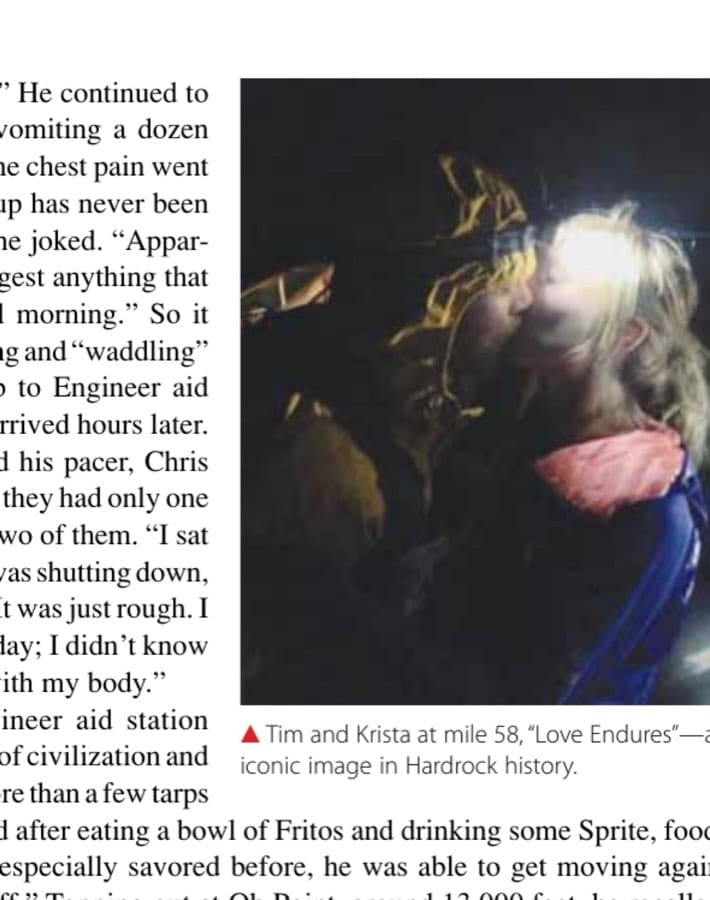
If you were like me during this year’s Hardrock 100-mile endurance run, you got online at 4:00 a.m. Saturday to find out what was happening at the front of the race. With new star entrants like Kilian Jornet, fresh off a record ascent of Denali, and Timothy Olson, who holds the Western States 100 record, the men’s field was stacked, and there was sure to be high drama. Indeed, Jornet handily obliterated an impossibly stiff course record, winning in 22 hours, 41 minutes. But as I scrolled through irunfar.com’s live feed to replay what had been happening all night while most of us were snuggled in bed, I came across an iconic photograph taken and tweeted by Dominic Grossman: illuminated by his headlamp in the black of night, Timothy Olson passionately kisses his wife, Krista, their eyes closed, absorbed for a moment in their own sweet intimacy. Grossman captioned, “In the middle of a storm, in the San Juan backcountry at mi58 of #HR100 . . . LOVE ENDURES.”
The image was taken in the high country near Silverton, Colorado, at Grouse Gulch aid station around 10:00 p.m., and by then Olson had fallen off the back of the leading posse, much to everyone’s surprise. As his friend and fellow competitor Dylan Bowman has noted, Olson is capable of transforming himself into “his trademark ‘animal mode’” and entering “the pain cave.” But even a trail god such as Olson—who has won Western States twice and other prestigious, fast races like the Bandera 100K and Waldo 100K and who actually resembles the Norse god Thor, with long golden locks, tattoos, and a buff build—can be ill-fated, or in this case, just ill.
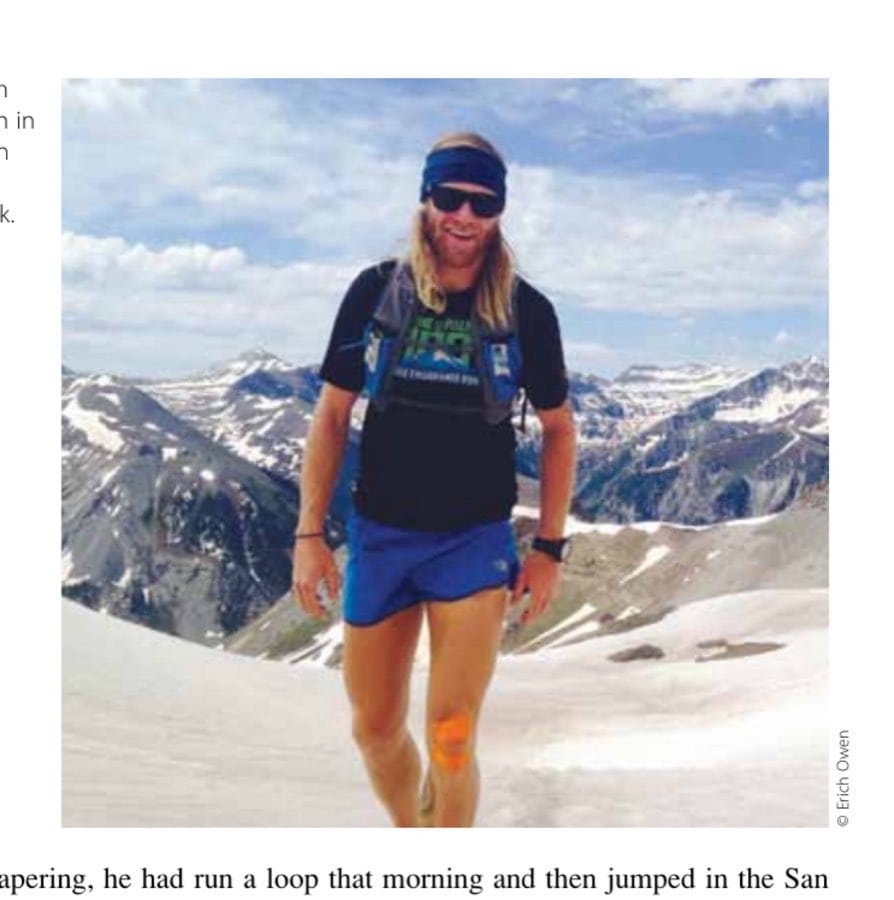
When I interviewed Olson shortly before Hardrock, he and his family were staying outside of Telluride with ultrarunner Erich Owen, whom they had met at the Bryce Canyon races last spring where Krista ran her first 50-miler. Alone, sautéing some green vegetables in the kitchen, Olson exuded a calm, contented demeanor. All was right in his world: coming off a 30-plus-hour week of training
© Erich Owen
▲
Tim Olson training high in the San Juan Mountains, pre-Hardrock.
and now tapering, he had run a loop that morning and then jumped in the San Miguel River to cool down. “You can’t ask for anything better than that,” he told me. Krista and Tristan, their 2-year-old son, were napping. With seven sponsors, including The North Face, EPIC Bars, and PocketFuel, the 31-year-old Olson no longer has to hold down three jobs as he once did in Ashland, Oregon, as a freelance writer, masseur, and running-store employee, so he’s free to compete all over the world—this year in the Canary Islands and French Alps and on an island off Madagascar—and bring along his family. He had vied for four years to get one of the coveted 140 entries to the Hardrock, and with a deepening love for mountain running, he was now going to get the full Rocky Mountain highelevation experience. “Running Hardrock has been a dream of mine ever since I got into ultrarunning,” he said.
The pre-Hardrock training With a focus on this event, he had raced less and trained hard—5,000 vertical feet per day while based this winter in SoCal and nights in a Hypoxico altitudesimulating tent, sleeping between 10,000 and 12,000 feet—and had reconnoitered much of the course in the San Juan Mountains of Southern Colorado, where the Hardrock takes place. “I’ve been doing a lot of steep running for Hardrock, but
© Rhonda Claridge
▲
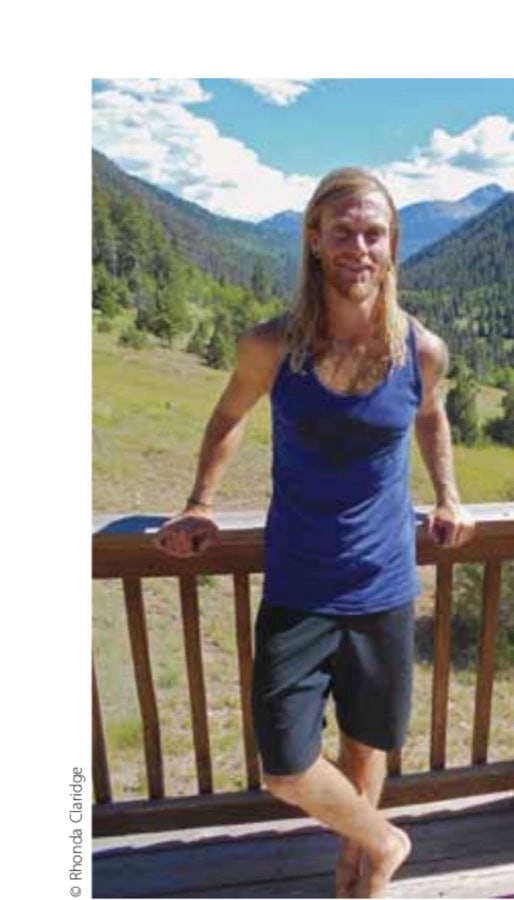
Tim Olson relaxes outside of Telluride during his pre-Hardrock taper.
also it’s just what I love to do: running to the top of a mountain and coming back down.” He had been alternating days of long runs of five to eight hours with days of five-hour hikes, carrying Tristan on his back. For
cross-training he uses Tristan as a kettlebell: “He likes being thrown. You’re always doing core work holding a kid.” Nonetheless, he said, because the course elevation averages more than 11,000 feet and de
mands 33,992 feet of climbing, “You can’t prepare for what’s going to happen to you out there. This race is so much more than your physical abilities. That will only bring you halfway. It’s just got so many variables of challenges.” The other
half, he reckoned, would depend on his mental strength. Before races, he meditates, going into his body and becoming more self-aware. “I try to be still within. It helps me for races, when things are hurting and there’s chaos all around going
through aid stations. I focus on my breath and connecting with the earth. It helps me be at peace no matter what happens.” During a race, he keeps tabs on other racers who are within striking distance: “
I like to know if people are within 20 or 30 minutes, because you’re definitely inspired by people rocking the course; if they’re close, that’s incentive to catch them and be there next to them, or if someone’s chasing me, that definitely gets
the blood going, but if someone’s an hour ahead that doesn’t concern me, because in this race, a couple of hours’ lead doesn’t mean anything.” He doesn’t check his watch while racing, however, because he doesn’t find it
to be important or helpful. “I’ve never cared about time. I don’t know my splits. . . . I don’t worry about those things because it’s not in my control. I’ll pick up some minutes here, and that’s not going to excite me any more than it discourages me if
I’m back a few minutes in places.” In his 2012 Western States 100 performance, Olson didn’t know he was breaking the course record until he hit Highway 49, about
▲
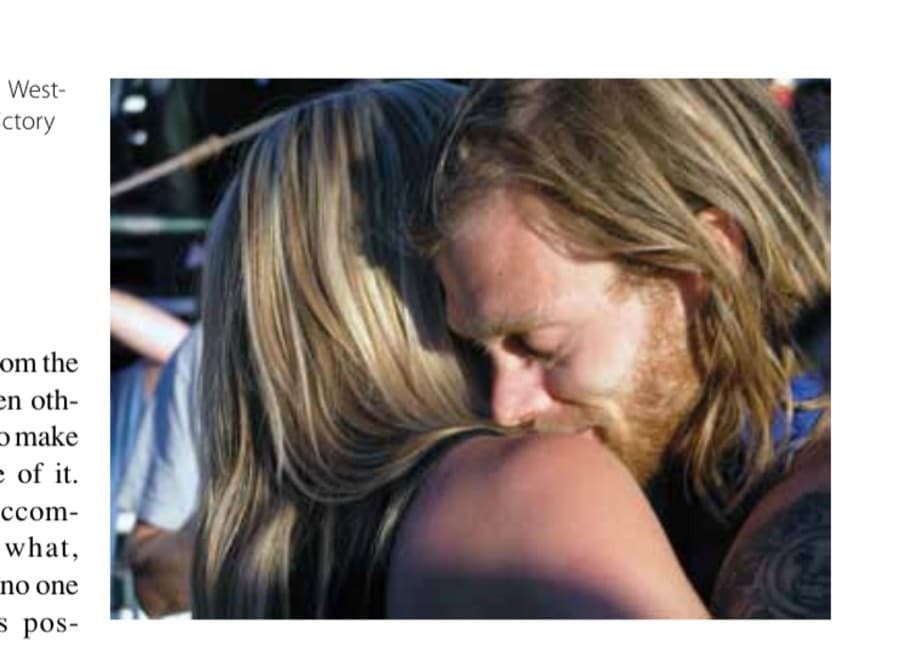
Sharing a Western States victory with Krista.
10 miles from the finish, when others began to make him aware of it. He was accomplishing what, until then, no one knew was possible, but that is one of the inspiring aspects of the sport and about Olson too: not accepting limitations.
Originally from Amherst, a small town in central Wisconsin, Olson grew up racing through cornfields and took up cross-country in high school mainly because he identified with the other runners, but as an adult he lost focus and found himself adrift, a college dropout experimenting with drugs. As he explained in a 2012 interview for Competitor magazine: “‘. . . I used drugs every day, multiple kinds, to mask the feeling of being lost.’” He witnessed the destruction of friends—one “‘ended up in prison, another committed suicide, and a few others I knew died from drug overdose’”—and found the strength and courage to change. “‘I suddenly wanted to be sober. And alive.’” He met Krista in 2007 and they got married a year later, choosing to settle in Ashland, Oregon, for its natural beauty and finding a family of elite ultrarunners there who encouraged and informally coached Olson while crushing him on the trails.
Doing the impossible at Western I asked Olson how he could account for the fact that, after years of attempts by so many others, including some of his fellow Ashland runners, he was able to smash the Western States record by 20 minutes. “That was a special day,” he said. “More than anything, I was really excited to be a dad. That feeling drove me. Krista had a good-sized belly then, and that really inspired me, just realizing that life was changing all around me and having these intentions years prior of hoping to meet someone who loves me and to share a life with and maybe have a kid with someday—that all coming to fruition, all those things were falling into place—that win was just icing on the cake.”
A few months later, during the inaugural Run Rabbit Run 100 in Steamboat Springs, Colorado, after bottle-feeding his baby boy in the middle of the night, he was too tired to give his best effort in the race. “I was really dumb for a few
months.” Since then, his perspective has continued to change. “Now I’m trying to be a good dad. I train hard but also try not to worry about it too much and just let things fall into place. “My number one priority is my family. They come first, and I try to make the
running go around it. I love hanging with them. Having a young kid, you only get those years once, so it’s really awesome to watch him grow up.” Krista is his crew chief, making spreadsheets and charts to organize his races
and optimize his efforts. “She’s a huge inspiration for me on race day, or all the time.” In addition, Krista’s parents generally attend all of Olson’s 100-mile races, babysitting Tristan and serving as backup crew. “They geek out at all the maps
and go to all the race meetings. It’s really special to have in-laws get into a sport like this and support me,” he says. Fast-forward to Friday, July 11, 2014, day one of the Hardrock 100: Olson was experiencing one of the worst races in his life. Less than halfway around the
course, he was overcome with nausea, vomiting, and shortness of breath. As he later recounted frankly and humorously in a phone interview, it took him an hour and a half to travel a mile and a half outside of the town of Ouray. “Flopping all
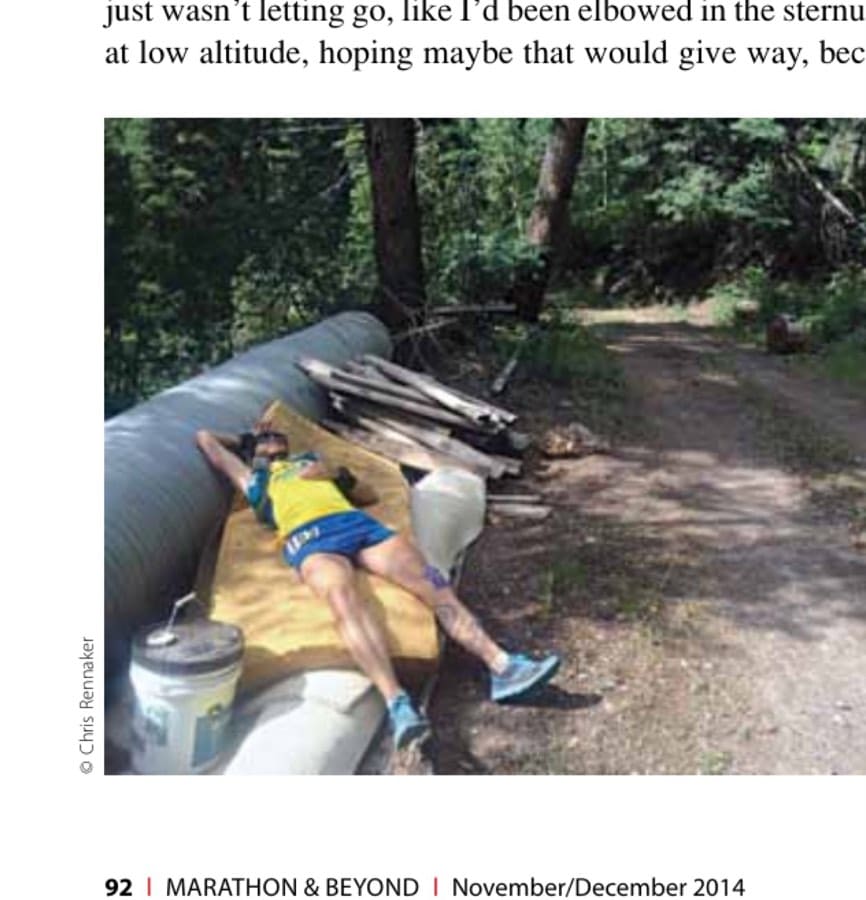
over the place,” he eventually surrendered, collapsing for about 30 minutes on “a nasty, pee-stained mattress” lying in a junk pile trailside. “Something in my lungs just wasn’t letting go, like I’d been elbowed in the sternum, so I just tried to relax
at low altitude, hoping maybe that would give way, because while I was hiking
© Chris Rennaker
▲
Tim Olson prone on the infamous mattress, unable to breathe during his epic 2014 Hardrock.
The bed-and-breakfast version of Hardrock At just mile 58, after seeing his chances of winning the Hardrock slip away, experiencing physical disorders of epic proportions, and escaping with his life through a battlefield of lightning strikes, Olson wasn’t keen to set out on the next leg of the course, which takes runners over the highest point, Handies Peak, above 14,000 feet elevation, in the cold, stormy night. But Krista was of a different mind: “I thought she might want me to quit because there was so much lightning,
© Dominic Grossman
I couldn’t breathe.” He continued to slog up the trail, vomiting a dozen times more, until the chest pain went away. “Throwing up has never been a benefit before,” he joked. “Apparently, I couldn’t digest anything that I’d been eating all morning.” So it went, more vomiting and “waddling” through that climb to Engineer aid station, where he arrived hours later. Meanwhile, he and his pacer, Chris Rennaker, realized they had only one light between the two of them. “I sat by a fire; my body was shutting down, freezing, shaking. It was just rough. I wanted to call it a day; I didn’t know what was wrong with my body.”
However, Engineer aid station ▲ Tim and Krista at mile 58, “Love Endures”—an isn’t near any kind of civilization and iconic image in Hardrock history. consists of little more than a few tarps at the tree line. And after eating a bowl of Fritos and drinking some Sprite, foods that he had never especially savored before, he was able to get moving again. “Four of us took off.” Topping out at Oh Point, around 13,000 feet, he recalled, “We saw the most beautiful and peaceful sunset, and then in the other direction: storm clouds, rain, and lightning hitting rocks up there, a complete yin-yang.” By then, Olson just wanted to get down to the next aid station, Grouse Gulch, and crawl into a tent. “Lightning was so close that I hit the ground a few times. . . . I forgot I was racing or how crappy I felt; I was in survival mode and started running down that pass as fast as I could.” He guessed he was clocking six-minute miles. “When I got to Grouse, it was amazing to be there. I saw my family, I hugged and kissed my wife, and I thought, I’m alive.” This was the moment Dominic Grossman’s photo captures.
and she told me to keep going on.” For 45 minutes he sat in a car, changed into new clothes including a puffy jacket and a rain jacket that he wore until the next morning, and contemplated how to articulate his feelings about dropping. He ate a few EPIC bars with bison bacon and cranberries, feeling “normal, but altitude drunk, when you’re cracking jokes because you’re in such a pathetic state,” and then went back out into the dark mountains. “I decided from there that I was going to finish the race.” At Sherman aid station, for the first time in any race, he sat down to enjoy a breakfast of bacon and eggs and green tea and talked with the aid station people and thanked them. “
Basically, the goal of the day was just to accept what was, and mentally that was challenging,” he recalled. “I was enjoying the views, but breathing was hard and everything hurt. It was one of the more miserable runs but also one of the more memorable ones because I made it through all that adversity.” He fell a few times in slow motion while descending to Cunningham aid station and laughed at himself. “Every moment seemed like a new blooper. I couldn’t see straight.”
At Cunningham, early Saturday morning, he asked Krista to pace him for the last nine miles over Little Giant pass to the finish. “It wasn’t planned, but I got there and I just really wanted to spend some time with my wife. I told her, ‘Pretend we just woke up and we’re going for a little run together,’ and it was a new day and a beautiful day and I wanted to make the best of the last few miles, so we hiked and talked and got to the top, took a couple of pictures together . . . and made our way back down to Silverton.” Despite all of his hardships and despite having stopped racing once his plans went wildly awry, Olson still took 13th place, kissing the finish line rock in a very respectable time of 30 hours, 18 minutes. “There were a lot of emotions; I was in disbelief that I made it there and got it done. It was a totally different scenario than I’d imagined but an incredible experience; I got to finish Hardrock and I feel really proud of that. I’m humbled by the mountains and the course, but I can’t wait to get back and try it again.”
He admits that maybe he’s “weird” for loving a sport that puts him in lightning storms and supine on a pee-stained mattress, but he gets at the reason we all sign up for endurance events. “Those uncomfortable situations make you stronger and bring out the truth of what’s inside of you. When I have those feelings in racing, it’s cool to see what comes up.” Olson, whose life has metamorphosed in ways that he could once only hope for, runs with a heart full of gratitude for being loved and for being alive. “I don’t think about winning toward the ends of races; I think about my family and all these things that make me happy. Back in the day, having struggles in life, when I’d go for a run I’d use anger as more of a motivation, dealing with demons, but now I feel like it’s more from a sense of peace and love, and running an ultra, that’s going to help you so much more. What’s motivated me the most has been my family, and I don’t feel like I’ve lost an edge having a family. I feel like it’s made me stronger.”
Running the 292-Mile Badwater Double Lessons learned. BY KENNETH A. POSNER
ISummertime temperatures in Death Valley commonly exceed 120 degrees F. Visitors beware. ▲
© Laura Casner
n 1977, Al Arnold became the first person to run the 146 miles from the Badwater Basin in Death Valley (which, at 282 feet below sea level, is the lowest point in the Western Hemisphere) to the summit of Mount Whitney (which, at 14,505 feet, is the highest point in the continental USA). In 1989, Tom Crawford and Rich Benyo conceived the idea of doubling this feat and became the first people to complete the 292-mile round trip, which is referred to as a “double” (Benyo 1991). In 2001, Marshall Ulrich set a record for the double of 96:07 as part of his celebrated “quad” crossing (Ulrich 2004). I set out on July 1, 2014, with the goal of completing the double and—if all went perfectly according to plan—of improving on the record. If successful, I would contribute in a small way to the tradition that Tom, Rich, and Marshall established of seeking out extreme challenge in the beautiful but unforgiving environment of Death Valley and the High Sierra—and then raising the bar. After the experience was over, my crew and I identified several
lessons learned that we thought might aid other Badwater runners in such areas as planning, crew leadership, pacing, nutrition, and footgear. We offer these ideas with the goal of inspiring others to take
on the Badwater course and to further improve the times for single, double, and other crossings. But first, here’s what happened.
This article originally appeared in Marathon & Beyond, Vol. 18, No. 6 (2014).
← Browse the full M&B ArchiveMore like this
1,000+ stories from 19 years of Marathon & Beyond
The complete archive of the legendary long-distance journal — digitized and free to read.
