

When The Phoenix Arises
Six months after she won the Boston Marathon masters title and had her name literally etched in stone in its Centennial Monument alongside the likes of Bill Rodgers, Joan Benoit Samuelson, and Johnny Miles, Denise Robson could barely summon enough energy to move out of her bed in the intensive-care unit.
Robson, a Canadian single mother of three, lost two days of her life while being treated for severe blood clots and a collapsed lung. The frightening trip from running a 6:13-mile pace at the 2010 Boston to spending several weeks in the hospital that same year was as surreal as it was unpredictable. At age 41, she was in the best shape of her late-blooming athletic career. But while training to defend her Boston masters title, she experienced some difficulty at the 2010 Canadian National 10K Championships in Toronto, where she was expected to defend her national masters title. “
But as soon as I started—I’m talking 400 to 800 meters in—I was breathing way too rapidly and couldn’t suck it in to take any deep breaths. My first mile, I was out of breath!” Robson slowed her pace in the hope that the pain would subside, but halfway through the 10K, it was becoming unbearable. “
By mile three, I wanted to drop out,” she said. “Those last three miles were the toughest miles I have ever run. I was nauseated, and the chest pain was so intense. I finished, but I had such a terrible race.”
The previous year, Robson ran 34:58.5 as the first master and third woman. But this time, she struggled to a 37:17.1 and was the second master and 12th woman. “I still felt very nauseated after the race. And in the hotel, as I look back on it, when I went to bed I actually had to raise my pillows up to get comfortable, which I’ve never done before,” she said. “I never thought anything of it at the time.”
Life-threatening
Photo by Paul Clerici
That discomfort continued—and worsened—on the 90-minute flight home to Nova Scotia. She felt something was not right. There is always some level of pain for an elite athlete, but this was a different kind of sensation. Half a year earlier she was on top of the running world with a $10,000 Boston Marathon masters title, and now she had to deal with something that forced her to contemplate quitting a 10K!
When she landed, she immediately went to a hospital emergency room. “I was diagnosed with four pulmonary emboli—three in my left lung and one larger one in my right lung,” she said. “The term they used was ‘life-threatening blood clots,’ and they said I had a 25 percent chance of instant death by flying [home after the 10K].”
Robson’s initial 10-day hospital stay was extended to three weeks when it was discovered that her right lung had collapsed. More than 2 liters of fluid had built up in her lung, which had to be drained.
When Robson returned home to recoup and rehab, she was extremely weak. From having a toned body recently fit enough to run a 2:41:12 marathon, she strained to walk from the couch to the bathroom. “I was already at a low body race weight of 108—as I was only 3 1/2 weeks from my fall marathon—and I went down to 98 pounds,” she said. “That in itself
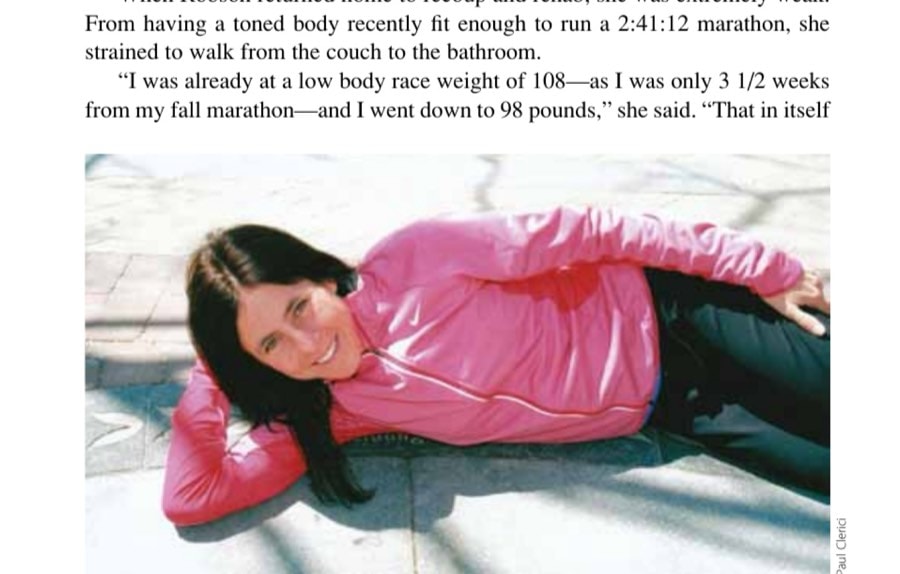
▲ As the 2010 women’s masters champion, Denise Robson has her name, country, and time (visible below her right elbow) etched in stone at the Boston Marathon Centennial Monument at Copley Square. She is shown here in 2012 when the Canadian ran Boston after an 18-month break from racing due to her health issues.
was really scary because I looked really frail and sickly. My cheeks were sunk in; every one of my ribs you could see. I cried when I saw myself—it was that devastating.” With a new goal of running the 2011 Boston in about six months, she had on occasion in the hospital walked 50 meters. At home, she was ecstatic when her doctor gave her the green light to exercise. But much to her chagrin, that exercise consisted of short walks and four months later perhaps some light jogging. As she took these baby steps, other athletic goals—such as continuing several roadrace win streaks—flew by without her. She even suffered an eight-week setback when her legs swelled up from blood-clot damage. She was despondent, but she was still resolved to overcome and to run fast once again.
2012 Boston After she had missed several more goals, Robson was determined to run the Boston Marathon in 2012. But she didn’t set that objective until late in 2011, a year after her hospital admittance. She realized that her body would not be at 100 percent by April but felt this was a target she had to make. “
It was worse than starting over. It was taking me so long to even get anywhere near where I wanted to be,” she said. “What was painful was taking in a deep, deep breath. I feel it all down my right side where the scar tissue is from the [surgical] puncture. When I expand my lung, it’s all that scar tissue that’s kind of stopping it. It’s very sore. And the blood clots are still in there now. They haven’t even shrunk. The doctors told me after a year, if they still remain there, chances are I’m going to be stuck with them.”
When she toed the line at Boston on April 16, 2012, it had been two years since her last marathon and 18 months since a race of any kind. She was nervous, excited, and hot. It just so happened that temperatures for the sun-soaked 116th Boston ranged between 80 and 90 degrees. “
I was worried about that,” she said. “My coach advised me to go out very slow and cautious.” But caught up in the excitement, Robson went out too fast. She pushed about a 6:20 average pace through 15K and slowed to about a 6:27 pace at the half. With no recent marathon races, serious track work, or hill work, and recovering from so much trauma, the pace was setting her up for a disaster. “
I went out way too fast, like, almost 25 seconds per mile faster then I wanted to and should have,” she said. “At mile eight, I had cold sweats. By mile 10, I was nauseated.” Robson steadily slowed throughout the second half. “
Let’s just say it was a long day to be suffering from mile 10 and feeling like I am in survival mode for 16.2 miles,” she said.
She finished in 2:59:43, a 6:52 pace for sixth place in her division and 24th woman. “Of course, I was not happy with the results,” she said. “But I have to remember where I was in January 2011 and not being able to jog one mile!”
That first run Unlike most elites who are groomed from a young age, Robson started running again in 2004 after a 15-year layoff from the sport. After many years of marriage, she became a newly divorced working mother of three that summer and by the fall was among hundreds of runners at the start of her first marathon.
It all began when a colleague invited her to a short lunchtime run with some friends at work. She was hesitant at first, but she had run competitively in high school and for a year in college, so she soon acquiesced.
The following day, Robson laced them up and ran three miles with her friends. After a decade and a half of no running, she felt every step. “It hurt,” she said. “I thought I was in relatively OK shape—I did a lot of walking with my children, taught aerobics for years and years. No way, it hurt! But it still felt good.”
Surviving divorce Running also helped her deal with the drastic life changes that affected her and the three girls, then ages 4, 6, and 8. Robson was no longer married to the man she had known since her teens, and the kids no longer had their father around the house. It was a difficult time of transition. “
Those long runs—you could think and just clear your head like it was just my time,” she said. “Maybe that’s why it became so addictive. I just thoroughly loved being out there.” Robson said her husband had lost his job and would often be away for days at a time. “
I guess it was tough on him, and he just started drinking more and more,” she said. “I probably stayed two years too long to begin with, but trying. We had a lot invested—a 20-year relationship; we were high school sweethearts; three beautiful girls. I didn’t want to end this. I tried. I’ve said [that] somebody was watching and threw this running at me because it was definitely my savior.”
Two months after she began running, someone suggested that she run a marathon. “At that point, I’m still only able to get a grunt or a groan in [while running],” she said. “A marathon? Are you kidding me? Shouldn’t we be doing a 5K or a 10K? I said no.”
Photo by Paul Clerici
▲
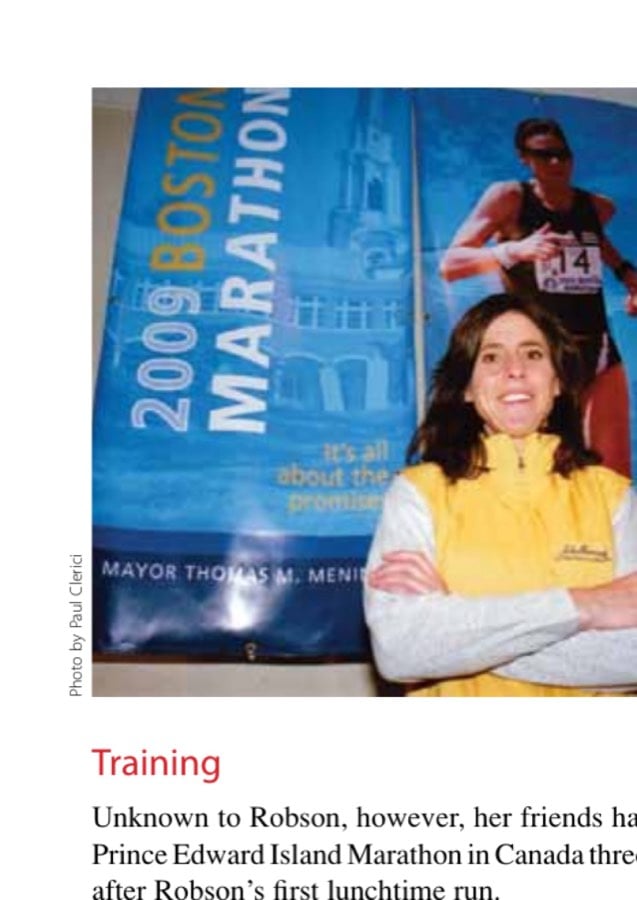
Denise Robson stands in front of a 2009 Boston Marathon banner that bears her picture during the 2008 running when she was the 307th overall and 11th in the open division in a time of 2:45:54.
Training Unknown to Robson, however, her friends had already selected their goal—the Prince Edward Island Marathon in Canada three months later and only five months after Robson’s first lunchtime run.
First-timers all of them, they chose a training program designed for the novice runner, Robson included. “We started the program, and we followed it to a T,” Robson said. “We didn’t miss a beat. And I loved it. It was nice to have a goal, something to strive for. I
fell right into it. The training was tough. They had been running for about a year, and I was just newly into it. And it hurt! But it was great motivation training with them. And we ran together.” The camaraderie carried Robson. Her friends provided the inspiration, the
motivation, and the company she desired. But she soon found herself without those comforts when one friend stopped due to an injury and the other could not get in enough long runs for the marathon. The impetus that had pulled Robson
back to running was now gone, but she decided to continue on her own. “I found it harder to get motivated to go out because I was by myself,” she said. “But I got through it.”
Doubts In mid-October 2004, at Prince Edward Island (P.E.I.) National Park, Robson felt lonely despite being among nearly 700 runners at the combined marathon
/half-marathon start. At 36 years old, she was in a whole new world as a divorced single mother running her first marathon with no support at the race. And as a rookie, she began to overthink the situation. “
I looked at all the runners, and they looked so high tech,” she said. “I’m looking at them, and they’re runners! They’re real runners! What am I doing here? I have no idea what I’m doing here.” She was doubting her decision, her training, her commitment—everything. “
I had done two 18-mile runs and one 20-mile run, and if you could see what I looked liked when I finished that,” she said with a laugh. “I could hardly walk—I could hardly move—the next day. I was saying to myself that there is no way I can do six more miles on top of this.”
In addition to the negativity, Robson went with cotton. “First mistake was all the negative thinking I was doing,” she said. “And the second mistake was I wore cotton shorts and a cotton T-shirt—a big, baggy sail of a cotton T-shirt. So that either hindered or helped, depending on which way the wind was blowing.”
An awakening Within the first few miles of P.E.I., Robson began to match strides with a pair of male runners. She enjoyed the connection but wondered whether they might object to her running with them. “
And they said, ‘No, absolutely not. It’s going to get so lonely out there. The more company, the better.’ These guys were instrumental in this marathon for me.” Robson had her company and conversation, and she learned a great deal. She noticed that each runner’s watch would beep at certain intervals and asked one runner about it. “
He said both of them want to qualify for Boston, and they have to run 3 hours, 15 minutes, so it’s clocking off the pace each mile,” she said. Once again, doubt and negativity enveloped Robson. “I’m like, 3 hours, 15 minutes! What have I done? I can’t do that. I sabotaged my race right there,” she said with a laugh. “And he said, ‘Relax. Relax. You’re running comfortably. Your form looks good. You’re breathing fine. You look great. Don’t drop back. Stay with us. If you drop back, you’re finished.’ He really encouraged me.”
When they asked about her goal, and she replied “to finish,” they were even more supportive. This was what was missing from her training and at the race start where her running friends were not with her as originally planned.
At the halfway point, Robson clocked 1:36:05. But she soon found herself alone again when the two men informed her of an impending pit stop before entering Confederation Trail, an old railroad track where there were no facilities
for approximately eight miles of off-road running on a trail of fine gravel. But she decided to continue, for fear of cramping muscles if she stopped. “They said they’d catch up to me, so I carried on. First mile went by—didn’t hear them. I was hoping I was still on pace,” she said. “Totally lonely. Could see nobody in front of you, nobody in back. Eight miles on the trail, there were no spectators. Nobody. And then it got really lonely.”
Robson wondered whether she had taken a wrong turn but soon realized there were no turns on the trail. After eight solo miles, she finally reached the end of the trail with about five miles remaining. “
I hear cheering at the end of this ‘tunnel,’ I called it, and it brought me back to life,” she said. “I had stopped looking at the mile markers and had no idea [of time]. And one of the [cheering] women was screaming, ‘Here’s the first woman!’ And then I realized, ‘Oh, yeah, where are the women?’ Then I thought that I’m going to be disqualified. I must have taken a wrong turn or something.”
It also occurred to Robson that she was now in uncharted mileage territory, as she had never run this far before. Twenty was her peak—once. And she was almost certain that the “real” female runners would soon pass her by.
First With two to three miles left, Robson was tiring but nevertheless persevering. The cheers and impending finish lifted her spirits, but as she approached the finish line, she noticed some sort of rope or twine in the way.
Not only had she trained hard for several months, uprooted her comfortable lifestyle, and inconvenienced her daughters, but now it appeared that the race organizers had added a further obstacle. She thought, You’ve got to be kidding me! I cannot run through that. I am going to fall down.
However, surrounded by cheers, it dawned on Robson that she had not taken a wrong turn and that she was the first female finisher. And that finish line tape? “They dropped it before I got there,” she recalled with a laugh.
At 3:13:27, Robson came in ninth overall with a 7:23-mile pace as the first woman. “Wow! That was a huge surprise to me and everybody else,” she said. She had also unknowingly qualified for the 2005 Boston, a fact that was brought to her attention after she won.
Boston Her next goal was Boston, six months away, so she increased her miles and track work. She also now possessed some experience: she had raced 26.2 miles and won.
But at P.E.I. that October morning, Robson was one of only 241 marathoners. At Boston, she would be among more than 20,000 entrants. “I had a sense of what that daunting distance was and had done more 20-milers, so I had a little bit more confidence,” she said. “But I was still as nervous as could be. It was Boston! I was nervous.”
Boston 2005 was unlike anything she had experienced before—thousands of runners and spectators; the presence of past winners and legends, politicians and town officials; constant music and race announcements; the aroma of heat rubs and fried dough; the overhead chops of helicopters; large areas of media and cameras; warm weather; and the electric excitement that is part of every Boston Marathon. “
Everyone kept telling me that the crowds were just incredible. And I’m thinking that there are probably going to be some here, and then a little bit dispersed,” she said. “So my total surprise doing Boston was [that] from mile zero to 26.2 [there were] thousands and thousands of people cheering you on. And I love that.”
After overcoming a crowded first few miles, she was fueled by everything from the banners and signs along the way to the constant yells of support from the throngs of spectators. When she reached the halfway point in Wellesley, Robson was told she was the first nonelite woman from the mass start to reach the 13.1-mile mark—in 1:20! “
I got carried away with it all,” she admitted. “I wasn’t on pace for a 2:40 marathon, so I had no business being at the halfway mark at an hour and 20 minutes. So I sabotaged my own race.” Robson reached her goal of beating her previous time and turned in a 3:05:28 for 1,119th overall and 73rd woman. And after she crossed the finish line, Robson was approached by medical personnel who offered her a wheelchair. Chagrined at the thought, she told them she did not want to enter the VIP tent in a wheelchair, so she slowly walked in with her arm around a volunteer. “
I was so excited at my first Boston that I bought the video of myself running. When I watched it, the legs were so wobbly, now I know why they asked if I wanted a wheelchair,” Robson said with a laugh. “It’s a wonder I stood up.”
At the 2006 Boston, she improved to 2:55:10, 640th overall and 30th female finisher, despite repeating some of the same mistakes. Robson again went out too fast, hit the half at 1:20, and fell apart in the latter stages. “
I think I could have walked faster than I was trying to run,” she said. “I thought I was not going to make it. It was fatigue. I didn’t know anything about proper fueling.”
The next level Robson was introduced to coach Cliff Matthews by Rami Bardeesy, one of the top male marathoners in the Atlantic provinces of Canada, whom she happened to
Photo by Paul Clerici
briefly meet at Boston. It turned out that they both worked for Manulife Financial in the same building in Canada, and their paces were in the same neighborhood. Robson and Bardeesy embarked on group lunch-hour runs at work and afterward for longer distances. He was faster than Robson, but Bardeesy soon discovered that she was able to stay with him the more they ran together. She was improving. “
It was over the course of these weekly and weekend runs that I realized she had a special talent. She displayed the ability from day one,” he said, “but I had to learn more about running before I understood how much ability she had.”
Bardeesy recognized that Robson could benefit from his coach’s instruction, because Matthews “is as attentive to form and efficiency as he is to achieving target times/pacing, [and] to proper rest and recovery as to hard work. He helps us to set high goals and gives us the confidence and programs we need to achieve them. He directed me to do targeted training and interval training of varying distances and paces—not just running a specific pace for as long as I could.”
This was precisely the kind of structured training Robson required. “That’s when it really started happening with me,” she said. “With working with my coach and adding some speed work twice a week, that was what really helped me.” She decided to run the 2006 Chicago Marathon, the first time Robson would run two marathons in one year. Her improvement was immediate, as she shaved off 11 minutes from her 2006 Boston with a 2:44:36 for 25th overall.
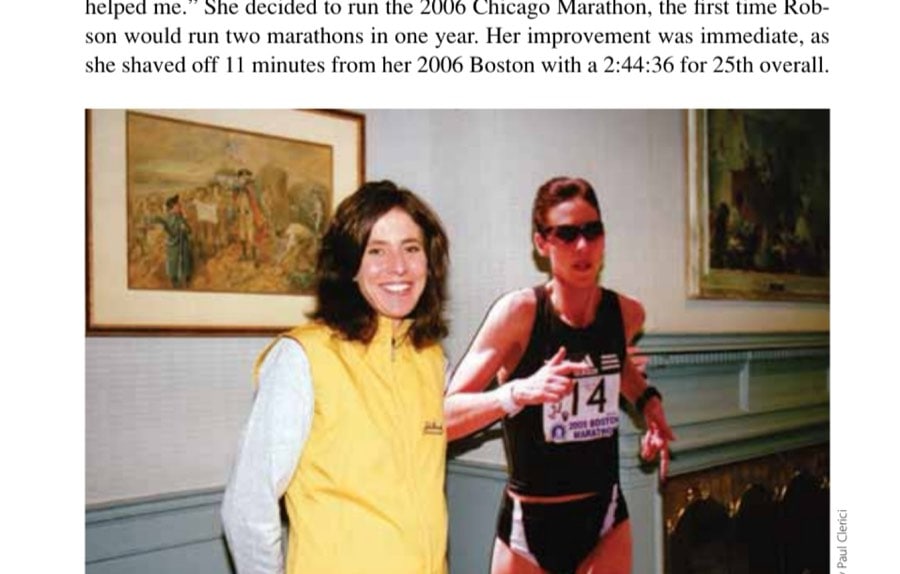
▲ Located inside the old John Hancock Elite Athlete Village, Denise Robson of Canada stands near a life-size cutout of herself from when she ran in the 2008 Boston Marathon.
“I was really excited,” she said. “I wanted to really work hard and see where this would take me. Not having beaten my legs up from years of running, and having fresh legs, I thought—no pun intended—I wanted to run with this as far as I could.”
Disappointment Her return to Boston in 2007 was going as planned, but during taper mode close to the race, she decided to take in a nice Canadian trail run on a beautiful spring day, something she had never done before. “
Where I had trained on the pavements all winter long and switched to a soft surface, I woke up the next day with this huge charley horse in my calf, and it wouldn’t go away. It was like a big ball in there,” she said. “One day I could run, the next day I couldn’t. And this was nine days before Boston!”
She stopped running and received several treatments before departing from Canada for Massachusetts. She tried running again in Boston, but while she could jog, she was unable to push off. It was the first marathon with her coach, her first one as an elite athlete. “
I could jog and probably could’ve got through it, but I couldn’t race. I literally was crying,” she said. “You train all winter long for it. I was really excited, and it was my debut with the elite women because I had qualified from Chicago. It was so, so tough.”
Tougher for her was the call the night before the race to her daughters in Nova Scotia to tell them she wouldn’t run. She had given them permission to stay home from school to see their mother compete on television. “
And my youngest says to me, ‘Does that mean we have to go to school tomorrow?’” Robson laughs. “I said, ‘Yes, you do.’ I think they were more upset that they had to go to school.”
Turnaround Recovered, and with Boston still on her radar for 2008, Robson traveled to the Berlin Marathon in September 2007. Wearing bib number F26 among the elites, she finally put together an all-around performance for a personal best of 2:44:28 as the 17th woman overall and sixth in her age group. Other than her P.E.I. debut, this was her best finish. The difference was that this was a big-city marathon with more than 32,000 runners. “
I felt really good. It was a nice flat course, so you had no hills to deal with, so I was able to do a nice, comfortable, even pace the whole way,” she said. On the heels of a pair of 2:44 finishes, Robson entered the 2008 Boston with more confidence and more strength, and she was once again among the elites, with bib number F14. In her third run in four years at Boston, it was also her first one
there with a coach. She was ready, she was thrilled, and she came in 11th. Robson slashed 10 minutes off her previous Boston best with 2:45:54 at the 112th running. “My coach kept drilling into my head that I have got to slow down [at the beginning]. That was big,” she said. “It was tough. And I still didn’t do it, even though I was consciously trying to do it. I still came in that half at 1:20. He said a 1:23 is where we would like to be at, and I tried, but I still came in 1:20.”
Robson was among a second group of about eight to 10 runners when she noticed two women ahead of her break away. One was masters runner Firaya Sultanova-Zhdanova of Russia (F101), and the other was open-division runner Eliza Mayger of Austria (F15). “
I thought that bib F15 must be around the same time as me,” she said. “Feeling so good, I was wondering if I should go with her. Then I thought [about] what my coach said to me—‘Run your own race!’ So I didn’t go. And it was the best choice I made.”
The pack soon faded. “The pace didn’t get faster, but they just all started dropping back,” Robson said. “I wanted to be in a pack. I didn’t want to be by myself there. And I was.” By mile 15, Robson could see Mayger. And she passed her. By mile 22, there was Sultanova-Zhdanova. And she passed her as well. “She was suffering, and she didn’t respond at all when I went by her,” Robson said.
Sultanova-Zhdanova won the 40-49 division at 2:47:17. Robson, who was 39 at the time, finished ahead of her in 2:45:54. “It was 10 grand, the purse! And it was only, like, what, seven months away when I would have turned 40,” she said with a laugh.
Three runners fought it out for the final top-10 spot for women: Magdaline Chemjor of Kenya, Robson, and Stephanie Hood of Illinois by way of Canada. Around 40K, Robson was passed by Hood, who would eventually take the 10th position. And near the Hereford Street turn onto the final stretch of Boylston Street, Robson eyed Chemjor. “
When I got passed just before 40K, I didn’t slow down, but I just didn’t have that other gear to go with her,” Robson said. “And she was Canadian! That hurt. But I found a little bit more motivation when I saw Magdaline. A Kenyan! And she was struggling. Boy, did I ever get a boost from seeing a Kenyan runner. I found some drive to come down the homestretch.”
And this time, her daughters were able to stay home from school and watch their mother near the lead pack for quite a few miles in the beginning before she settled down in her race. “I wanted to make sure they could try and catch a glimpse of me, so I went right up there and I toed the line,” she said. “And it was a big glimpse that they caught of me because I called them that night and one of my daughters said, ‘Mommy, we got to see you on TV so much. But why didn’t you stay with the front group [longer] because then we would have seen you all kinds [of time] on TV.”
Laughing, Robson tried to explain, “I said, ‘My dear, if I stayed with the front group, I wouldn’t have finished.’ And she said, ‘All you had to do was run with that first group and we would have seen you the whole time.’”
Yet another level Robson chose the 2008 California International Marathon (CIM) in Sacramento because of its flat, fast course with a downhill second half. The elite women were also averaging 2:32-2:35, so that would bode well for her to have runners to chase and to push her along. And with her coach, she also focused more on her speed work. “
I went in there with lots of confidence,” she said. “I’d run some local 5Ks and 10Ks through the summer so we could focus on the speed work all through the summer and not have to worry about the distance, because it was a late marathon in December.” Eighteen days before CIM, Robson turned 40 and moved into the masters division. That was not the reason she had chosen CIM, but it was fortunate. This was to be her breakthrough marathon. “
I paced it perfectly. I had a goal time of 2:41,” she said. “Ten women just blew by me at five miles in and, again, I had the panic set in. I counted them because I knew the top five had nice prize money, and the top masters [too]. But I just said to myself what my coach said—‘Run your own race. Forget about it.’ And I did.”
Robson remained patient and stuck to her plan. And unlike previous marathons where a 1:20 half was disastrous, she turned in a 1:20:19 split and continued at a steady pace. A male runner later joined Robson, who welcomed the company. He said that she was running about seventh and that the women who went out fast would eventually come back. “
He said they all go after the 10 grand and they’re all gonna die, so we just sort of ran together side by side,” she said. “And let me tell you, by mile 19, I was feeling fresh as a daisy. And then he says to me, ‘There’s our first woman, Denise.’ My head was down and I hadn’t even noticed. But sure enough, at mile 19 she was coming back. We didn’t change our pace or anything.”
Robson was now the sixth woman. Then she had to work to reel in number five, which she did at mile 24. But it was an up-close battle, because the two of them, despite running on a four-lane roadway, were shoulder to shoulder. “
She was right on me—there were elbows. I wasn’t used to that,” Robson said. “I’m thinking, Do I have to run two more miles like this and duke it out? But she did fall off half a mile later.” Now Robson was fifth, or so she thought. Someone soon yelled out that she was the fourth woman. Then, with less than two miles remaining, her running buddy pointed out yet another female runner ahead.
Robson was comfortable at their current pace. “He says, ‘Top three at an international marathon. You want this.’ He was awesome. And I did want this. So he says to me that I have to go now because we were running out of road.”
Champ at 40 With less than a mile left, Robson broke out of her usual survival mode and gutted it out. Closing in on 200 yards, she was on that woman’s heels, hoping to sneak up from behind and grab the third spot, but a spectator yelled, “She’s right
behind you! Move it!” She beat Robson by two seconds. “I swear she had three gears,” Robson said, “and I had maybe one gear because I took the two gears to catch her.” But the woman she was hunting turned out to be a relay runner. The actual
third-place woman finished 2:09 ahead of Robson, who remained in fourth. Waiting for her at the finish line was Bardeesy, who came in 17th at 2:28:01. “Rami just ran a PB, and he knew I had run a PB, and he was there ready to
hug me,” said Robson, “and I threw up like crazy.” Robson finished 56th overall at 2:41:12. It was thought at the time that she had broken the 17-year-old Canadian masters record of 2:44:33 held by Laura
Lynn. But it turned out that Danuta Bartoszek had run a late-recorded 2:39:35 in 2002. Nevertheless, Robson not only took fourth place at CIM but also won the masters division. And this was less than three weeks into her 40s and just four years into her marathon career.
Photo by Paul Clerici
▲
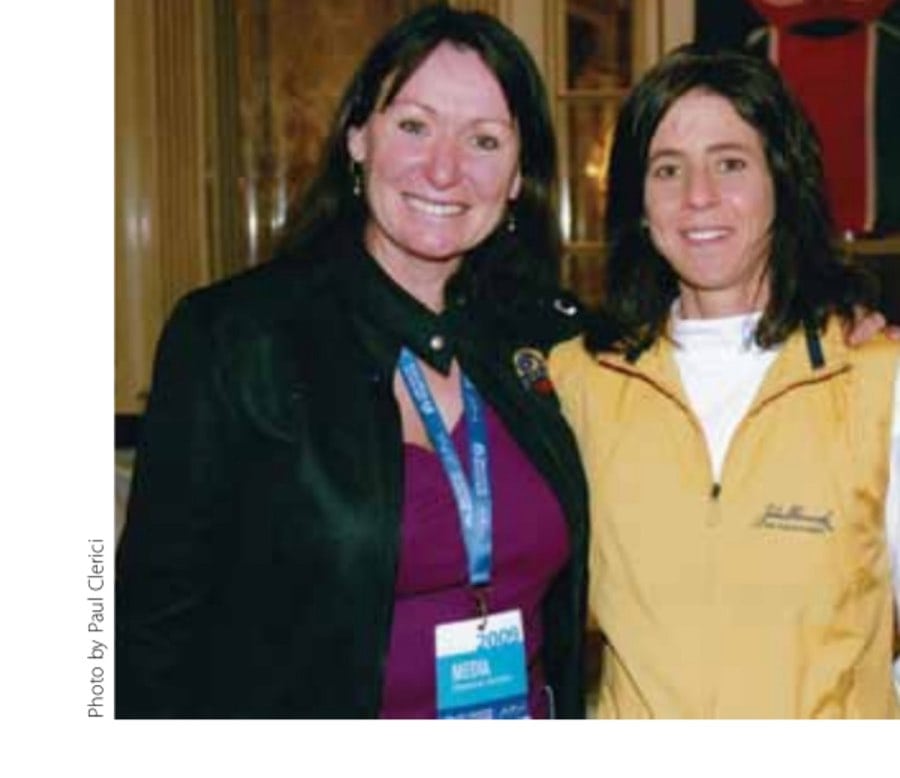
At one of the many Boston Marathon press conferences attended by former, current, and future champions, Denise Robson meets Lorraine Moller of New Zealand, only the second woman to win both the women’s open (1984) and women’s masters (1996) titles at Boston.
“I was happy I ended up being a fourth-place finish and I was the top masters woman,” she said. “And those two women I passed at the end were both masters women, so I was on cloud nine just on that alone.”
Balancing family As her running career soared with greater possibilities, the time it demanded was increasing. While running may seem to be a solitary act, Robson is fully aware that it takes many people and many sacrifices for her to reach her goals. She is the first to say that she cannot do it all by herself. “
There’s no question it’s a tough balancing act,” she said. “There’s no way I could do any of this without the support from my folks. They live about two minutes away from me, and my mom basically moves into my house when I’m away racing.”
With only one parent at home, Robson’s three daughters—Autumn, Ashley, and Alyssa (now 12, 14, and 16)—struggled to understand their mother’s absences. “The earliest memories I have about my mother’s running is that she was always training,” said the oldest daughter, Alyssa, when she was 14. “I could never understand why Mom wanted to run so much. But now that I am older, I know she has to train to be the best she can be. I’m proud of her for following her dream.”
Added middle daughter Ashley, when she was 12, “The earliest memories I have about my mom’s running is she would always miss our morning breakfast on the weekends because she was running.” To reduce the time away from her family, Robson runs to and from work and during her lunch hour and endeavors to spend as much time as she can with her daughters. The girls may accompany their mother to the gym when she does her treadmill workouts or swim while she does pool running. “
I really try not to take too much time away from the girls because I don’t want them to not like Mommy running, and it’s taking time away from them,” said Robson. Autumn, however, seems to take to those training sessions with her mother and coach. “
When she goes training at the track, I sometimes get to go with her,” said Autumn, when she was 10. “And her coach will teach me when he is not teaching my mom. He tells me how to run properly. Also, I like it when my mom brings home her trophies and medals from her races. I really like them. It made me want to get some for me.”
A side benefit of including her daughters in her running is that all three have taken up athletics. All three play basketball, and while Alyssa has exercise-induced asthma, Ashley and Autumn both enjoy running. “
I love to run because it is fun and it is good exercise,” said Autumn.
Added Ashley, “I like to run because exercise is good for you. I started running when I was 7. I like to run the longer distance races.”
It can be done Robson knows that, with hard work and determination, it’s possible to go from being a working married mother to a two-career single mother. “It is challenging, but it can be done,” she said. “And when you’re passionate about something and enjoy it so much, you find the time to make it work.”
But it all took planning. When she realized that she had talent worth pursuing, Robson sat down with her parents and family to discuss the inevitable sacrifices and consumption of time. It was not just Robson who would be making concessions, but her parents and her children as well. And she knew that. “
My folks saw that it was making me happy and I was enjoying this because, like I said, it had come at a time I was going through my separation. They are behind me 100 percent and are so proud,” she said.
As her daughters grow older, they begin to better understand and appreciate the sacrifices and the results. While they always miss their mother when she is away at a race, they know they are not far from her thoughts, thanks to regular phone calls and gifts. “
She gets to go all around the world and she brings us back some cool stuff,” said Autumn. Ashley agreed: “She gets good stuff.” The one who appears to benefit the most is Alyssa, who especially likes Mom’s athletic sponsor, “because they send her lots of clothes and cool running sneakers,” she said. “And I’m her size!”
Continued success After a fourth place in 2009, Robson finally won the 40-44 division title at the 2010 Boston with her course PR 2:43:16. She has also set several Canadian records, including three separate legs of the 185-mile, 17-stage Cabot Trail Relay in Nova Scotia; the Nova Scotia five-mile record; and the six-mile Dartmouth Natal Day Road Race. She also carried the Olympic torch in her hometown of Dartmouth, Nova Scotia, when it was en route to the 2010 Winter Olympic Games in Vancouver.
At the fall 2009 Athletics Canada National 10K Championships in Toronto, Robson earned bronze in 34:58. Her top showing at the nationals qualified her for a trip to Japan as a Canadian team member at the International Chiba Ekiden road race relay, in which her nation came in eighth. And she was honored in 2009 by Canadian Running magazine’s First Annual Golden Shoe Awards with the Master of Masters Award. “
Even if I didn’t run this fast, there’s no question running would be a huge part of my life because it really is my time,” said Robson. “I just think it’s a good, healthy addiction.”
This article originally appeared in Marathon & Beyond, Vol. 17, No. 1 (2013).
← Browse the full M&B ArchiveMore like this
1,000+ stories from 19 years of Marathon & Beyond
The complete archive of the legendary long-distance journal — digitized and free to read.
