

When Watching Ultras Was All The Rage
While the crowds attending most ultra events today are, as they say, small but enthusiastic, in the second half of the 19th century, long-distance footraces were all the rage in the United States. In the 1870s and 1880s, thousands of fans filled arenas to watch “pedestrians” race around tiny dirt tracks for as long as six days at a time.
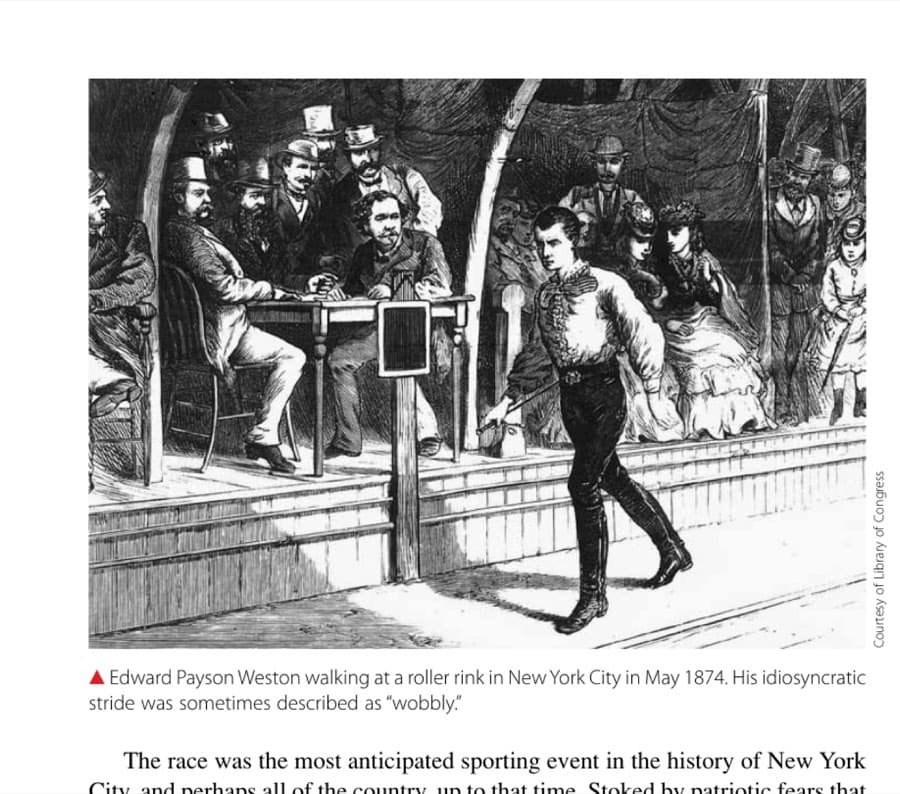
The sport was known as pedestrianism, and its roots dated back to 1861, when a door-to-door bookseller named Edward Payson Weston lost a bet that required him to walk from Boston to Washington in 10 days to witness Lincoln’s first inauguration. This made Weston so famous that, after the Civil War, he began touring the country, performing walking exhibitions inside roller rinks. He charged up to 50 cents for the pleasure of watching him circumambulate for hours—and thousands gladly paid. Weston usually walked against time, such as attempting to cover 100 miles in 24 hours.
Inevitably, competitors rose to challenge Weston. The most famous was Daniel O’Leary, an Irish immigrant from Chicago who set a record when he walked 116 miles in 24 hours. In 1876, Weston and O’Leary met in a 500-mile walking match in Chicago, which O’Leary won. The popularity of the event proved pedestrianism was a profitable business enterprise. Soon, six-day matches (longer races were prohibited by blue laws banning “public amusements” on Sundays) were all the rage.
The pinnacle of pedestrianism occurred in March 1879, when a six-day race at Gilmore’s Garden (soon to be renamed Madison Square Garden) attracted four of the finest pedestrians from both sides of the Atlantic. The contestants were Dan O’Leary, winner of the 500-mile race against Weston three years earlier; Charles Rowell, a former Cambridge rower regarded as England’s finest pedestrian; John Ennis, a 36-year-old Irish immigrant from Chicago best known for his feats of endurance ice skating; and Charles Harriman, a long-limbed 26-year-old prodigy from Maine.
Courtesy of Library of Congress
▲ Edward Payson Weston walking at a roller rink in New York City in May 1874. His idiosyncratic stride was sometimes described as “wobbly.”
The race was the most anticipated sporting event in the history of New York City, and perhaps all of the country, up to that time. Stoked by patriotic fears that the Americans might lose to the Englishman Rowell, the race was as hyped as a Super Bowl is today. “Such general interest in a match of this kind has never been excited in this or any other city,” reported the New York Times.
In the days leading up to the race, papers nationwide were filled with reports on the preparations for the “Great Walking Match” at Gilmore’s Garden. (Although running would be permitted in the race, colloquially such races were still called walking matches.) A single 10-foot-wide, 1/8-mile-long track was laid on the floor of the arena. It would be shared by all four competitors.
Four tents were erected inside the track for the competitors, one at each corner of the oval. Teams of judges and scorekeepers were recruited from the sporting papers and the city’s various athletic clubs to work in six-hour shifts around the clock throughout the race.
A rapidly filling arena The doors to the Garden opened on the evening of Sunday, March 9, 1879. By 10:00 p.m., three hours before the match was scheduled to begin, more than a thousand
© Islington Local History Centre
▲
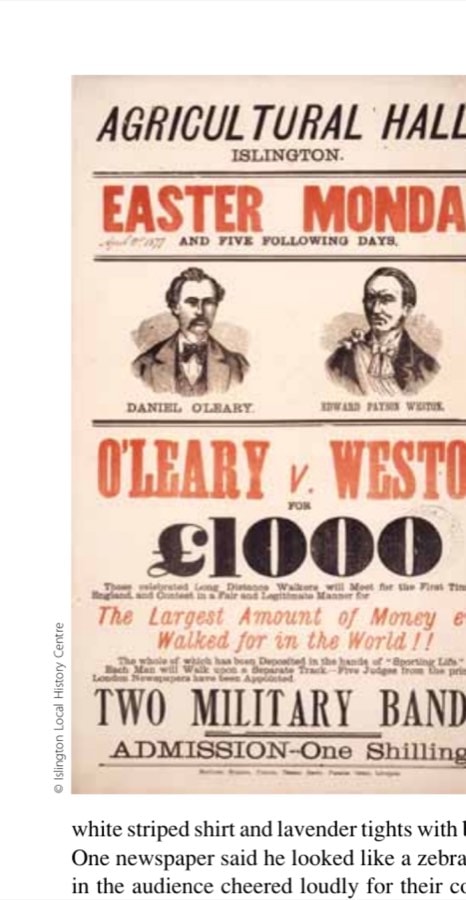
A broadside advertising a six-day race between Edward Payson Weston and Daniel O’Leary in London, 1877.
spectators were already inside the arena. A band entertained the growing crowd by playing sacred music until midnight, when the Sabbath ended and it switched to livelier tunes, such as “Baby Mine,” which
was loudly encored. By now between 4,000 and 5,000 were in attendance, including “many distinguished citizens . . . judges, lawyers, and politicians.” Thick clouds of cigar smoke swirled in the dim gaslight.
After midnight, the competitors, who had spent Sunday resting at their respective hotels, began to enter the arena. Rowell was the first to arrive. He wore a blue-andwhite striped shirt and lavender tights with blue trim. It was a distinctive costume.
One newspaper said he looked like a zebra. A small contingent of British expats in the audience cheered loudly for their countryman as he made his way to his tent. The rest of the crowd was more subdued. After all, Rowell was the enemy.
Dan O’Leary, on the other hand, embodied nothing less than the American Dream. He was the archetypal immigrant who, by dint of hard work, pulls himself up by his bootstraps and finds fame and fortune in the Land of Opportunity. That
he was a naturalized citizen and not, as the Constitution puts it, “natural born,” seemed not to matter—as long as he was winning, anyway. It was on O’Leary that the audience—and all of the country, really—was pinning its hopes of keeping
Rowell from winning the race. As the starting time of 1:00 a.m. drew closer, the arena continued to fill until its capacity of 10,000 was reached and, by some accounts, exceeded. “The jam was growing worse and worse every minute,” the New York Herald reported, “
and with the fresh accession of hundreds, the bookmakers shouted their odds in
louder tones.” The bookies had made O’Leary the favorite to win at odds of 1.5 to 1. Rowell was at 2 to 1. Harriman and Ennis were the decided underdogs at 5 to 1 and 12 to 1, respectively. Outside the arena, an entirely different spectacle was unfolding. Thousands of fans were still waiting in long lines, frantic to purchase their 50-cent tickets and get inside the building in time to see the start of the race. But the ticket sellers couldn’t work fast enough, and as the minutes ticked by, the crowd grew impatient and agitated and began pressing closer to the ticket windows en masse.
At 12:45 a.m., a worried police captain named Alexander Williams ordered the doors to the Garden locked and the box office closed. “This infuriated those who were thus excluded,” the New York Times reported the next day, “and their numbers being constantly augmented by fresh arrivals, who, not comprehending the situation, pressed forward until those nearest the building were in danger of being crushed.” Seemingly in an instant, the crowd outside the arena had become an angry mob, surging toward the locked doors on Madison Avenue. Fearful screams filled the air. “Bitter curses and yells of pain were heard from every part of the struggling mass of humanity,” said the Times.
Inside the arena, however, all were oblivious of the panic on Madison Avenue. Precisely when the hands on the big Garden clock reached one o’clock, the match referee, William B. Curtis of the New York Athletic Club, sent off the pedestrians with the simple command, “Go!” At that instant the crowd inside the Garden let out a great cheer.
Realizing the match had begun, the mob outside the Garden pressed even harder against the locked doors, which finally burst from their hinges under the pressure. The ticketless hordes began pouring into the lobby of the arena.
Captain Alexander Williams ordered his officers to clear the lobby. What ensued was likely the worst episode of civil unrest in New York City since the Civil War draft riots 16 years before.
Madness in the streets—and inside the arena Swinging savagely, the police beat the throng back out the broken doors and onto Madison Avenue. Then Williams called in reinforcements to clear the street, and a full-scale riot erupted. Pitched battles broke out between truncheon-wielding police and the “angry thousands still smarting from their recent clubbing.”
The riot lasted two hours before the police finally restored order at three o’clock on Monday morning. At least 70 people suffered injuries requiring hospitalization, but, miraculously, no fatalities were reported. There would be no official inquiry into the riot. Public opinion seemed to support the police. “Had the gang of turbulent spirits outside forced their way on the track the walk would have been broken up,” said James Kelly, Gilmore’s Garden’s manager.
At six o’clock on Monday morning, three hours after the riot was quelled, sunlight began peeking through the circular windows that ringed the top of Gilmore’s Garden. It was five hours into the race, and all four pedestrians were still on the sawdust track. Rowell was in first with 30 miles, three miles ahead of O’Leary. Ennis was third with 26 miles, Harriman fourth with 25. Rowell had put in many long runs through the night to build his lead. O’Leary occasionally jogged for a lap or so but otherwise stuck to walking.
Despite the early hour, the arena was surprisingly full. Hundreds of spectators had stayed the night. Some, undoubtedly, had been too frightened to leave due to the rioting outside. A few were still awake in the dawning light, shouting encouragement to the pedestrians as they passed, but most slept soundly in their chairs, chins resting on chests.
This somnolent audience was soon augmented by workingmen who stopped by the arena on the way to their factory jobs. Lunch pails in hand, they enjoyed the race for a spell before their shifts began at seven. American pedestrianism was a truly democratic spectator sport. Everyone paid the same price of admission: 50 cents. The crowds at the Garden, the Times noted, “were composed of all classes of society, from the preacher and the millionaire to the black leg and the tramp, looking so ragged and forlorn that the wonder was how he ever obtained admittance, for he certainly could not have bought a ticket. But the intense interest manifested everywhere was the same, and the wretch who has not money enough to buy himself a meal watches every movement of the contestants, and criticizes them as carefully as he who has thousands staked on the result.”
A shift in the texture of the crowd As Monday morning progressed, “the character of the crowd grew more aristocratic, and ladies began to fill the seats.” In the afternoon, the character of the crowd changed again, as “men of business began to arrive.” The band returned too and “enlivened matters generally, though one old walker and a good judge of such things said that the ‘leader ought to be scolded for playing such music to walk by.’”
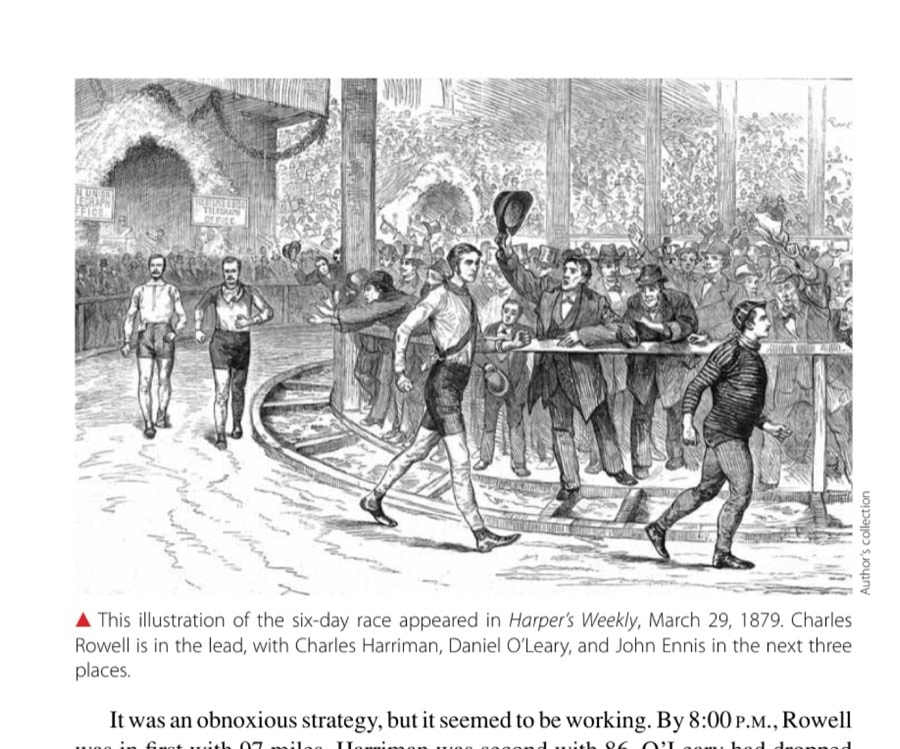
At 4:00 p.m. the arena was already half full, and Rowell’s lead over O’Leary had grown to seven miles, 78 to 71. By now the Englishman’s strategy for defeating the reigning champion was clear: he would hound and harry him. At every opportunity, Rowell followed right on O’Leary’s heels and mimicked his every move. Rowell called the strategy “dogging.” When O’Leary walked, Rowell walked. When O’Leary jogged, Rowell jogged. Occasionally Rowell would pull up alongside O’Leary and give him a “patronizing look.”
Today we would say Rowell was trying to get inside O’Leary’s head.
Author’s collection
▲ This illustration of the six-day race appeared in Harper’s Weekly, March 29, 1879. Charles Rowell is in the lead, with Charles Harriman, Daniel O’Leary, and John Ennis in the next three places.
It was an obnoxious strategy, but it seemed to be working. By 8:00 p.m., Rowell was in first with 97 miles. Harriman was second with 86. O’Leary had dropped back to third with 84 miles, 13 miles behind the leader.
Rowell’s tactics were not appreciated by the partisan majority in Gilmore’s Garden, and the Englishman was loudly jeered whenever he dogged O’Leary. “Rowell was hissed and abused at every step he took,” according to one spectator.
By nine o’clock Monday night, Gilmore’s Garden was sold out, with some 10,000 people once again crowded into the big wooden arena. Thousands more, unable to gain admittance, stood patiently outside the Madison Avenue entrance, eagerly awaiting news from inside the building. “Ticket speculators” mingled discreetly among the crowd, offering 50-cent tickets for 75 cents.
Throughout the city, regular updates on the race were posted on bulletin boards in city parks, outside post offices, and in the windows of newspaper offices, and each of these drew its own large crowd. The crowd in front of the Herald building was said to be as great as it ever was on a presidential election day. Everywhere in New York, it seemed, the talk was of nothing but the great walking match. “Even the weather,” the Herald said, “that traditional sheet anchor of polite conversation, has snapped its chain cable and temporarily disappeared from view.”
A mania gripped the city, arousing intense passions. On the first day of the race, Daniel McCarthy and Henry Hughes, two friends who lived in a rooming
house on Sixth Street in what is now the East Village, got into an argument with James L. Lamb, their landlord. McCarthy and Hughes were rooting for O’Leary to win. Lamb was backing Rowell. An argument ensued, and Lamb was stabbed, resulting in a nonfatal wound. “One would suppose that the fate of the nation depended upon the result of the walking match,” the Herald said.
The mystery of pedestrianism’s popularity Pedestrianism’s popularity mystified many. As one newspaper noted, it was “not an absorbingly entrancing sport.” But the public’s hunger for entertainment at the time was practically insatiable. It’s hard to fathom now, in an age of infinite electronic diversions, but in the 1870s, America suffered from an entertainment deficit. Though urban industrialization had made leisure time possible for millions of working families for the first time, the opportunities for recreation were scant. In short, the public was so desperate for entertainment, especially affordable entertainment, that watching half-dead men stagger in circles for days on end was, if not absorbingly entrancing, at least an unobjectionable way to kill time.
At Gilmore’s Garden, it was becoming apparent that Dan O’Leary was not himself. Whether or not it was the result of Rowell’s “dogging,” O’Leary’s pace was much slower than usual. Several times on Monday he had retired to his tent for long rests. That night, his attendants announced that O’Leary was suffering from a “disordered stomach” and had vomited several times that day but that he would persevere. There were whispers that O’Leary, who had always sipped a little bubbly during matches, was overdoing it this time. At one point he was said to have “swallowed 2 large bumpers of champagne.”
It’s unlikely O’Leary overindulged in alcohol, however. The simple fact was that he was spent. Over the previous 12 months, O’Leary had traversed on foot nearly 3,000 miles in eight competitions and exhibitions. It was a murderous schedule, and he was, as one paper put it, “stale.” What O’Leary was suffering, one reporter speculated, was “simply that warning which nature was giving that the age had been reached when he could not undergo so much fatigue as he had in the past.”
O’Leary refused to give up, but his chances of winning were rapidly vanishing. At one o’clock on Tuesday morning, 24 hours into the race, Rowell was leading with 110 miles. O’Leary was 17 miles behind Rowell and in last place.
At three o’clock on Wednesday morning, several hundred people were still inside the Garden, which remained open continuously throughout the race. The band had packed up its instruments and the vendors had gone home. The bar was closed. Occasionally the arena would fall so silent that the spectators could hear the clompclomp-clomp of the pedestrians’ footsteps as they plodded around the sawdust oval.
For long stretches when all the pedestrians were in their tents sleeping, there was nothing to watch at all, and only the hiss of the arena’s gaslights was audible. Some of the night owls in the Garden were fat cats looking for a little late-night entertainment. Others were factory workers coming off the second shift. And a few were squatters, living at the Garden for the week. They had been there since the race began on Sunday night and would remain until it ended on Saturday night, making beds of their seats each night.
Living on a dollar a week “I had but a dollar,” one of the weeklong denizens explained to a reporter, “and I paid half of it to get into this place. Here I can stay until next Saturday night. The seats are comfortable and I can get a good night’s rest. I can go downstairs and for ten cents I can get a sandwich; which is a better dinner than I can count on many days of the year. In the meantime I can have as good entertainment as the people who have thousands in their pockets to bet on Rowell.” By the afternoon of Wednesday, March 12, the third day of the race, Dan O’Leary was a spent man. “I don’t think I ever felt worse in my life,” he later admitted.
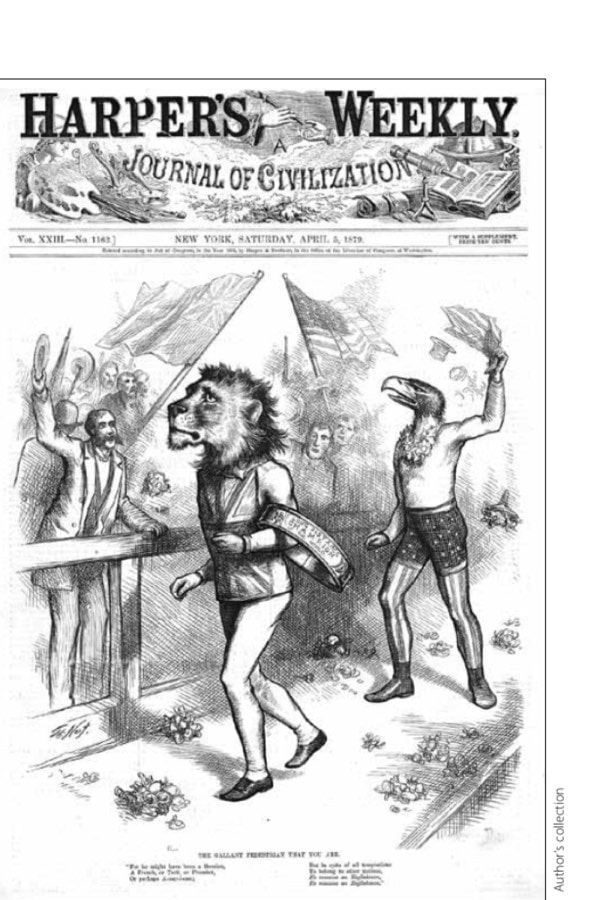
Author’s collection
▲
This Thomas Nast illustration appeared on the cover of Harper’s Weekly on April 5, 1879. It depicts Charles Rowell as the victorious British lion and Daniel O’Leary as the vanquished American eagle.
“His stomach, head, feet, mouth, tongue, and entire body seemed to have given way,” said a doctor who examined O’Leary. The doctor told O’Leary it would be “suicidal” for him to continue. Still, O’Leary refused to surrender. He returned to the track for two more agonizing hours before finally throwing in the towel.
The crowd picks a new favorite Although America’s reigning champion had withdrawn from the race, the outcome was still very much in doubt. At 6:00 p.m. on Wednesday, Rowell was just eight miles ahead of Charles Harriman, the lanky 26-year-old from Maine. Harriman was now the crowd favorite and seemingly America’s best hope for winning the race.
On Friday night, according to the New York Times, “The character of the attendance [was] unusually good.” Among the “gentlemen of distinction” in attendance that night was Chester Arthur, a New York politician who, two years later, would become president of the United States.
By now, according to the New York World, the Garden had “turned it into a Black Hole of smoke and stench and general stuffiness which a week’s ventilation will not remove.” The track itself had deteriorated badly. The pedestrians kicked up fine dust particles with every step. Tobacco-chewing spectators routinely expectorated on the track, causing one pedestrian’s trainer to lament, “It has now got to be a regular spittoon.”
The putrid conditions were taking their toll on Charles Harriman, the gangly Mainer. “The tobacco smoke and the dust are affecting him very strongly,” said a doctor looking after Harriman. “He is not drowsy, but they sicken him and take away the vigor and ability to work.” Said one of the scorekeepers bluntly, “Harriman is a dead cock in the pit, and the belt will never stay this side the water by his work.”
As it became apparent that Charles Rowell would win the race, the Englishman began receiving threats. Early on the morning of Saturday, March 15, the sixth and final day of the race, a “drunken loafer” accosted Rowell on the track. The police subdued the attacker. John Ennis, the Irishman from Chicago, admonished the crowd to leave Rowell alone. “I want you to understand that if this man is injured,” Ennis announced, “I will leave the track and not walk another mile.” The two pedestrians then joined hands and walked a lap together, amid much cheering. Extra police were assigned to the Garden for the rest of the race.
At nine o’clock that Saturday night, Rowell completed his 500th mile while the band played “God Save the Queen.” He led Ennis by 30 miles and Harriman by 50. His lead insurmountable, Rowell left the Garden for a luxury suite at the Ashland House. Harriman retired as well. Ennis completed five more miles before surrendering, making the final score Rowell, 500; Ennis, 475; Harriman, 450; O’Leary, 215.
Dividing up the spoils A few days after the race, the four pedestrians reconvened in an office on Wall Street to divvy up the proceeds. The total receipts exceeded $54,000 (roughly $1.25 million today). For failing to walk the minimum required number of miles (450), O’Leary received nothing. Harriman and his manager split $7,359.32. Ennis took home $11,938.98. And Rowell received a check for a whopping $18,398.31 (roughly $425,000 today)—not bad for six days’ work.
Throughout the 1880s, pedestrianism would remain America’s most popular spectator sport. The top pedestrians earned a fortune in prize money and endorsement deals (Dan O’Leary was the spokesman for a brand of salt), and their images appeared on some of the first cigarette trading cards, which children collected as avidly as later generations would collect baseball cards.
By the mid-1890s, however, pedestrianism was foundering. Charges of race fixing and doping diluted fan interest. Edward Payson Weston was caught chewing coca leaves during a race—a practice that was considered unsportsmanlike, if not outright cheating.
But what really killed pedestrianism was the bicycle. In 1885, an Englishman named John Kemp Starley invented the first practical “safety bicycle,” the kind with two same-sized wheels and a chain drivetrain that
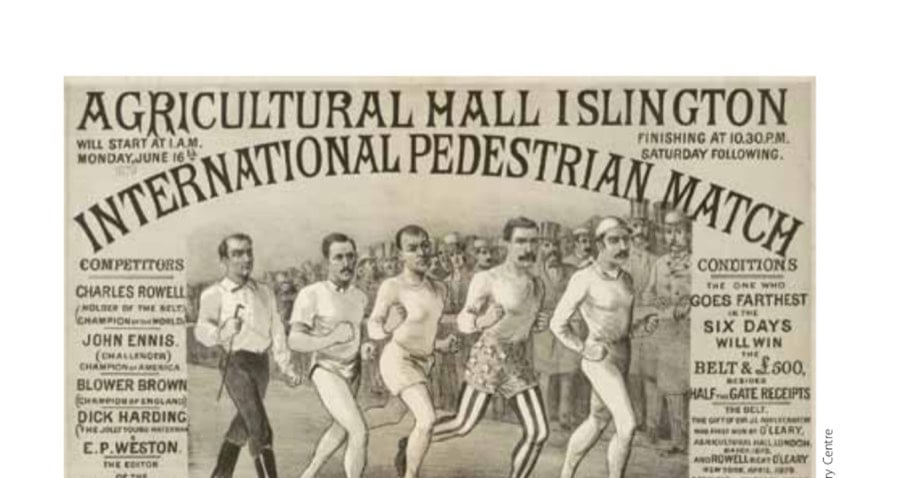
ad
© Islington Local History Centre
▲ This broadside advertised a six-day race in London, June 16–21, 1879. Pictured, from left to right, are Edward Payson Weston, Richard Harding, “Blower” Brown, John Ennis, and Charles Rowell.
we still ride today. The safety bicycle was much faster and more nimble than the old penny-farthing bicycles (the kind with the absurdly oversized front wheel, so named for the British penny and farthing coins, the former being much larger than the latter). Watching the “safeties” race was infinitely more thrilling than watching a walking match.
Baseball was on the rise, too. The National League, founded as a ragtag enterprise in 1876, became a stable, profitable business after team owners imposed a $2,500 salary cap in 1885. Of the eight clubs in the league in 1890, only one, the Cleveland Spiders, no longer exists. The other seven clubs were (and still are) the Braves, Cubs, Dodgers, Giants, Phillies, Pirates, and Reds, though most of those teams have had different nicknames over the years.
Yet pedestrianism’s influence endures, and not only in racewalking. In many ways, walking matches marked the beginning of modern spectator sports in the United States. Never before had so many people attended (and, not coincidentally, wagered on) athletic events. Never before had the media devoted so much attention to them. NASCAR, the National Football League, even sports radio—all are legacies of pedestrianism.
This article originally appeared in Marathon & Beyond, Vol. 19, No. 3 (2015).
← Browse the full M&B ArchiveMore like this
1,000+ stories from 19 years of Marathon & Beyond
The complete archive of the legendary long-distance journal — digitized and free to read.
