

Where Runners Dare
In hindsight, the clues were readily apparent. Perhaps I should have realized this wasn’t exactly a runner’s paradise the first time I had to get out of the way of a Vespa as it slalomed through pedestrians on the sidewalk. The beaten-up, corrugated steel ramps bolted to the curbs at the intersections were not to maintain compliance with a handicapped access law. They were for scooters. The first time a dozen people sidestepped me as I waited at a corner for a light to change and all of them casually ambled into a live intersection, I should have known running here might be treacherous. Traffic signals in Beirut are more like suggestions or hints than rules.
Everyone—drivers, pedestrians, and people on bikes or scooters—seems to operate under a shared trust. If you avoid hitting everyone around you, everyone around you will avoid hitting you, and no one will get hit. Stoplights, stop signs, and the existence of crosswalks are more or less ignored. Turn signals are treated the way an American treats a bidet, as curious and useless. A Beirut car’s horn functions not as an expression of anger but more like reverse sonar. You honk to let others know where you are and that you’re about to do something that might affect them, like pull out in front of them, switch lanes randomly, or not slow down for them as they cross the street on foot.
Strange as it seems, in a week’s time in Beirut, I did not see a single car accident. My friend and fellow traveler and I talked about taking a run through the city’s labyrinthine streets even after discovering that a lot of sidewalks randomly narrow into concrete tightropes or become a stew of rainwater and gravel. It still didn’t dawn on me that I hadn’t seen any runners even after the second time we blundered into an unbarricaded construction site and under the arc of a giant crane lifting something large and capable of flattening us. Nor did it seem an impediment when, once again, we walked too far down the wrong street and a machine-gunwielding, army-fatigue-wearing, catastrophically bored police officer wearily informed us we could not go any farther in the direction we were going.
Running recreationally in Beirut would be like running in a subway car in rush hour. How did I not add all this up? Runners, even more than being creatures of habit and routine, are tenacious. When a race offers a custom bib, I ask to have “Relentless” printed on it, because it seems to me that it’s the most important and pervasive quality of a runner. A runner runs in the rain, in the snow, in the heat, and in the cold. If road construction or a flood or parade gets in the way of your favorite route, a runner makes the necessary adjustments and runs anyway. A city hosting a large international race that boasts on its web site of a 20,000-person field must have runners and must have figured out ways to persevere. Turns out I was wrong.
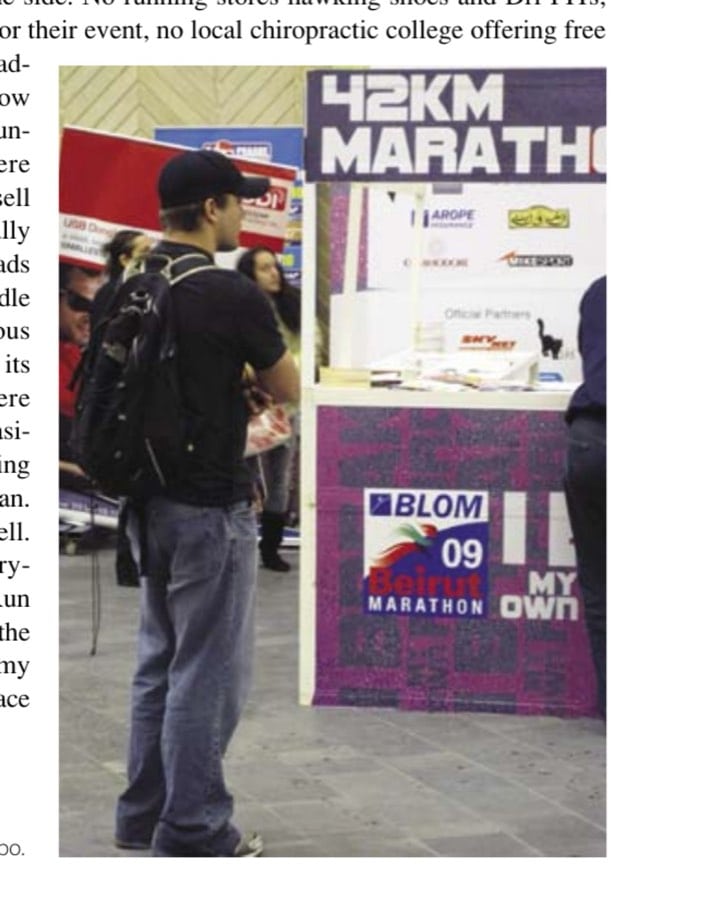
No sale in the crossroads of commerce It began to dawn on me when I arrived at the race-packet pickup, which consisted of a booth about 20 yards wide manned by about a dozen people and two smaller charity booths off to one side. No running stores hawking shoes and Dri-FITs, no other races shilling for their event, no local chiropractic college offering free massages or a sample adjustment. I wondered how there could be 20,000 runners going through here with no one trying to sell them anything, especially in Lebanon, the crossroads of Europe and the Middle East. It’s a place famous for commerce. Among its earliest inhabitants were the Phoenicians, who basically invented ocean-going trade in the Mediterranean. The Lebanese live to sell. Why wasn’t anyone trying to get me to buy a Run Beirut T-shirt? I asked the young man who took my passport and dug up my race
▲
The author surveys the scene at the sparse race expo.
packet, “How many people are you expecting for the 42K?” (Miles, naturally, don’t mean anything here, and most everyone refers to the race as “the 42K,” not the marathon.) “About 600.” “Really?” I asked, surprised. “I thought there was a field of 20,000 runners.” “
Well, Lebanon doesn’t have much of a running culture. There will be about 20,000 people in the 10K, and most of them will walk it. It’s a big charity event. People have been raising money for various causes in exchange for running or walking. The race association’s goal is really to promote a culture of health and fitness in Beirut, so we’re giving out T-shirts to anyone who finishes either race, regardless of whether they registered or not, since we want people to participate even if they can’t afford to register.” (This, apparently, caused something of a minor stampede near the common finishing area for the marathon and the 10K. News reports I saw stated that a crush of people looking for free swag tried to rush the presumably surprised and terrified T-shirt distribution volunteers. T-shirt distribution for the 10K was thereafter suspended. It should be noted that I was safely awarded my shirt and finisher’s medal.)
So my conception of what to expect on race day began to change. I was surprised by Beirut in many ways, not the least of which being that it may be the friendliest city I’ve ever been in. Nearly everyone in the city speaks English (and French and Arabic, to my monolingual embarrassment), many better than I do. More than one person actually approached my friend and me on the street to offer unsolicited advice and directions when we looked confused. If Beirut residents have a problem with Americans, they are engaged in a citywide conspiracy to hide it. American tourists must be a rare sight. Beirut was once famously known as the Paris of the Middle East, but decades of civil war and strife with Israel have crippled that reputation internationally. Almost everyone we spoke with reacted with enthusiasm, or at least amusement mixed with interest, when we told them we were American. The impression I came away with was that having Americans traveling in Lebanon was an exciting prospect. At the very least, we were enough of a novelty to pique the interest of the natives. Almost everyone we spoke with had to be old enough to have some memory of the horror that was the civil war.
Certainly everyone remembers the attacks by Israel in 2006. The echoes of the chaos of war still ring out—from the empty, deteriorating Holiday Inn that stands watch over downtown like a neglected, decaying scarecrow to the Palestinian refugee camp we drove by on the southbound highway leaving the city. The people, however, betray no sign of fatigue from the years of war. The energy of the city is positive. It’s about renewal and resilience. Beirut wants to be a city attractive to foreigners again, but most people aren’t willing to take a chance
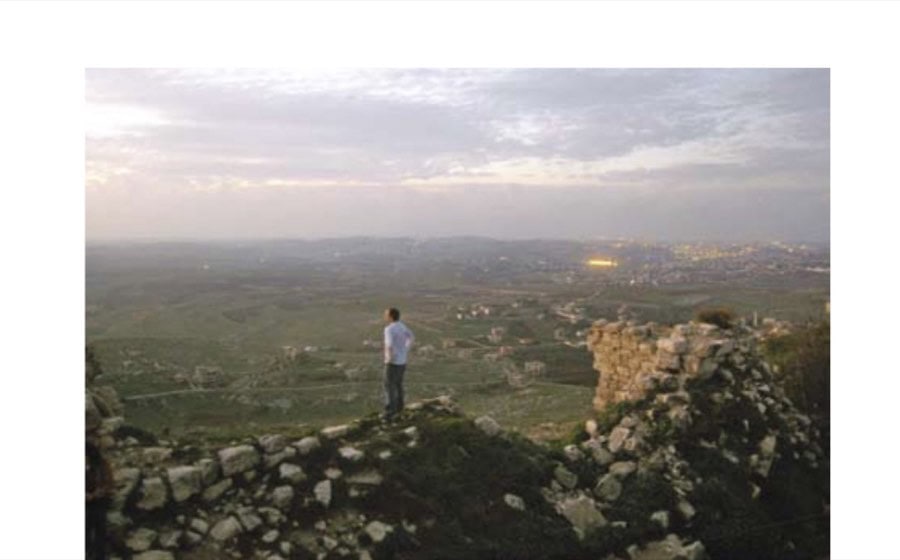
▲ The sun sets on Chauteau Beaufort, just north of the Lebanon-Israel border.
on the country’s stability, and that’s a shame because Beirut, and Lebanon as a whole, is an incredible place.
Where the beautiful people live The people of Beirut, besides being as cordial and helpful as most luxury hotel concierges, are beautiful to a ridiculous degree. They all look like they just climbed out of an early-’90s Benetton ad. The concern for safety is slightly misplaced. Street crime is basically nonexistent, so wandering the streets of Beirut is about as dangerous as wandering the streets of Duluth. The worst thing that happened to us was that most of the cabbies overcharged us by a few thousand Lebanese lira for each fare, or about two or three dollars a pop. What made up for that were the extraordinary ends, especially by American standards, to which some people went to make us welcome.
A group of young women we met in a restaurant during a late lunch (one of whom used the word “irony” in proper context and with greater skill than almost any native English speaker I’ve ever heard try) took us, for no reason other than kindness, on an informal tour of the campus of American University of Beirut, where they were students. With its tiled roofs, sweeping views of the Mediterranean (and hundreds of cats roaming campus!), AUB is stunning. If you were
blindly dropped in the middle of it and didn’t know better, you would guess you were at Stanford or Cal. A couple of days later in Byblos, a city about 30 miles north of Beirut renowned for its Phoenician and Roman ruins, a shopkeeper who had sold my friend a local fish fossil locked up early, walked us to the minibus drop-off, and negotiated a fare for us in Arabic.
My favorite moment may have been in Baalbek, a city 50 to 60 miles east of Beirut. It’s known for two things. It’s the site of the ruins of the largest temple in the Roman Empire, and it’s the cradle of Hezbollah. Hezbollah is a political party, it’s a paramilitary group, and the United States and Israel consider it a terrorist organization. Without wading too deep into the politics of all this, here are a few points of context. First, Hezbollah isn’t Al Qaeda. It’s closer to Sinn Fein in Northern Ireland. Second, being in Lebanon, talking with the people, and seeing the politics and social climate from the street leads to the conclusion that the struggles there are less about religion than they are about class and economics. The Islamic Shiite minority is segregated and impoverished. Hezbollah provides it with social services, access to health care, and education. These are things the central government in Beirut can’t or won’t do. As a result, Hezbollah is wildly popular.
I ran through a three-mile stretch in southern Beirut, near the start of the 42K, under yellow-and-green Hezbollah banners hanging from every lamppost. There were thousands of them. Each one was adorned with the black-and-white face of a serious-looking soldier. I discovered later that these were casualties. Some of the faces belonged to men; some of them looked like in the United States they could have applied for learner’s permits. I swear I didn’t see any two the same.
The highway we took into Baalbeck was similarly bedecked with the flag of the party flapping from every lamppost. Again, there were hundreds and hundreds of them. A few days before we left, the head of the party made news in the United States when he asserted in a speech that our country was essentially the root of all terrorism. This made a couple of members of our family a little nervous about our trip.
Looking for souvenirs to take home As we were driving in under all those flags, which feature a green fist rising up out of Arabic script and clutching an automatic weapon, I wondered aloud, “Do you think they sell those flags to tourists?” “Man, I don’t know,” my friend replied doubtfully. “Yeah, I kind of doubt they’re really excited to sell Hezbollah banners to Americans, huh?” We pulled into the parking lot near the ruins at about noon. Before the vehicle was even in park, it was surrounded by six or seven men. I had
maybe moved halfway out of the passenger seat when an elderly man began shoving fake Roman coins and an English-language guide to the ruins in my hand. “Buy from me!” He kept shouting this over my protests that I was fresh out of Lebanese lira. My companion was under similar assault on the other side of the car. The sales techniques of choice seemed to be either hand something to us and back away or throw things into the car and back away. The price negotiation began after the retreat had created sufficient space between the merchant and his wares. “
Do you want one of these?” my companion asked over the din, holding up a yellow T-shirt bearing a Hezbollah logo. “Yes. Yes, I do,” I replied. Another man hurried over to me, removed my baseball cap, and began wrapping a red-and-white checked scarf around my head. He had a huge grin on his face and he kept shouting, “Arafat! Arafat!” I bought the scarf, too.
The ruins at Baalbek, it’s more than worth noting, are magnificent. It’s a huge site with towering columns and exquisitely detailed temples in a stunning state of preservation. Additionally, Lebanon’s general lack of oversight means that, whereas in America a park ranger or guide of some sobriety would provide regulation, no one is there to tell you not to climb and scramble over whatever you want. As a result, within a few minutes the whole place becomes Indiana Jones fantasy camp.
▲ The Roman ruins at Baalbek: stark, stunning, and unsupervised.
There is not a single safety rail in the whole joint. Our families were right to be concerned about our safety—just for the wrong reasons.
You say your brother lives where? On our way back to the car, we passed a row of shops, each selling Hezbollah flags, shirts, magnets, and more. We walked into one and an older gentleman happily grabbed two flags to sell us. “Where are you from?” he asked us. “
The United States,” I replied. “Ah!” he said excitedly, a smile spreading across his face. “My brother lives in Maine!” The shopkeeper who sold us Hezbollah flags has a brother who lives in Maine. That revelation made me happy as we walked out of the cluttered little shop and into the late day chill.
Running a marathon is a unique way to experience a city. The long, constant street-level perspective is revealing. A runner sees the city in a way even most long-time denizens never have or will. A runner gets to experience all the highlights the race organizers want them to see, but because of the sheer length of the marathon, they can’t hide anything from you, either. They see all the moving parts of the city and all the connective tissue. Beirut’s course was strange in that it didn’t seem designed to take the participants by anything special, nor did it seem to want to obscure anything about the city. The only purpose it seemed to serve was to stay out of the way of the much bigger 10K course, with which it shared a postrace area and nothing else.
The small field was decidedly international. People lined up in gear representing Poland, Iraq, Ethiopia, Italy, Saudi Arabia, Syria, Jordan, Spain, Kenya, India, and Australia. I spoke with one other American, a few Brits, and a gentleman from Scotland.
We took off at 7:00 a.m. The light rain that was misting off and on grew heavier and within half an hour was a steady downpour that lasted about an hour. The race was well run and the course was clean, clear, and controlled. No one in Beirut drinks the tap water, so aid station volunteers handed out sealed 20-ounce bottles of water and Gatorade. There were even a couple of sponge stops, a gelpack station, and a few people independently handing out figs.
The race was chip timed, but only at the start and finish, so no official splits were available. People with clipboards kept craning their necks or even darting out in the course to get a better look at the runners, and I finally surmised that they were taking down bib numbers either to make sure no one cut the course or to ensure no one collapsed and went unaccounted for. The race packet contained two separate bib tags, which I thought was peculiar. Why, I wondered, would they want us to pin one to the front and another to the back? Of course, it was so their manual-ledger volunteers had a better chance of catching the digits. A couple of
▲ The marathon field was distinctly international. Here, a group of Polish runners set off at the beginning of the race through south Beirut.
times I turned and shouted my bib number to a frantic kid who had missed my number, since I opted for my traditional one bib tag pinned in its customary place on my right front thigh. Every corner and intersection was guarded by police officers, but like every police officer in Beirut, they all dressed in full camouflage and a beret, carried a machine gun slung casually on their shoulder, and looked perilously young and as visibly bored as an 8-year-old in church.
The entire course was cordoned off on both sides with pink caution tape emblazoned with the Beirut Marathon Association logo, which looks a bit like a runner who has spontaneously combusted and is sprinting to put out the flames. Both the 10K and 42K courses were sheathed in the shiny pink ribbon, meaning there must have been at least 80 or a hundred miles of the stuff around if you figure in doubled-up spots, ties, and breakage. Whoever has the caution-tape concession in Lebanon made a killing on this one.
A glimpse of home—but moreso Shortly after turning north out of the Hezbollah avenue of banners, the course went past what has to be the largest KFC in the world. The monument to American poultry cuisine was three stories tall and must have been capable of serving deep-fried chicken to several hundred Beirut residents at once. I imagine they were storing the gravy in oil drums in one of the subbasements.
Luxury and poverty exist side by side throughout Beirut. Huge fancy shopping malls with names like Galaxy and City Center abut the course next to pockmarked buildings with dirty sheets serving as window screens or shade for a balcony. Luxury hotels and high-rise condos climb silver and sleek just blocks from bombed-out husks testifying to the recent past. Because of what Beirut has been through over the last 40 years and because there isn’t a middle class in the way we think of one, the city can’t segregate one version of itself from the other. If you have the money to build something ritzy, you may be forced to do it next to the blackened remnants of something that was destroyed in the civil war but that no one can afford to (or is willing to bother to) demolish. If you’re selling something expensive to someone rich, you probably have to do it in the view of someone who barely remembers having had a job.
From cheap birds to exotic cars I ran by a highway underpass where dozens of men were crammed underneath, out of the rain, next to cage after cage of what appeared to be canaries, presumably for sale. A few other people had set up tents and were selling dingy Persian rugs and cheap dresses. No one seemed that excited to watch the race go by. About a half mile farther along, as the race made its first swing near downtown, I ran by a car dealership selling Ferraris, Jaguars, and Porsches. It was closed for the weekend.
Near halfway the rain finally stopped, and I entered that neighborhood. Every race has one stretch or section that stands out for me. I call it “that neighborhood.” In Beirut it was Bourj Hammoud. Originally settled by refugees from the Armenian genocide, the neighborhood lies about two miles east of the downtown and has the flavor of what in America we would favorably call “working class.” The race took one of those winding circuitous jaunts here that signifies a need to tack on some distance to the course. Here the streets grew narrow, and the curbs were packed with more people than I had seen, or would see watching the rest of the race. Group after group of young boys in khaki scout uniforms—members of political-party youth brigades, I would later learn—leaned out in packs to slap my hand. Groups of men and women lounging in tightly packed sidewalk cafes cobbled from folding chairs and boxes clapped and cheered raucously as I ran by. The drab tan buildings rose sharply up from the street and made it feel like running on the floor of a stucco canyon. Tiny balconies jutted from the face of almost every building, and it seemed that every one had at least one person draped over the edge waving at us as we ran by. This energized section made the rest of the race, especially the desolate northern portion near the ocean, seem drab by comparison.
▲ Some of Beirut’s many cats relax and watch the race go by as the course winds through the industrial area north of downtown.
The race finished in the open center of downtown Beirut called Martyrs’ Square. This part of the race most closely resembled an American event. Since both the 10K and the 42K ended here, the place was packed with runners and their entourages. There was the usual complement of support staff, volunteers with water, finisher’s goody bags and medals, and white medical tents for people who had run a lot harder than I had. (My time, you ask? A year of hubris and bad luck left me battling injuries and unable to train adequately. I struggled through this one, held together with duct tape and bailing wire. The last few miles were an act of personal courage I can’t possibly fully describe. Let’s not spend any more energy discussing my time.)
The finish line ceremonies that I left untasted A stage was set up on one end of the grounds, presumably for awards and sponsor announcements and the like, but when I finished, it was being employed as an open-air version of the famous Beirut nightclubs, and techno music was pumping out of a PA at Spinal Tapian volume. I elected to gather my things and head back to the hotel. About an hour after I finished, my friend Nate, a student at AUB hailing from Iowa originally, phoned us at the hotel. He had rented us a car and was going to
take us and his girlfriend Susann down to southern Lebanon for the afternoon. It was midafternoon, and the sun was emerging and shining across the Mediterranean as we drove south out of Beirut. I wasn’t exactly sure where we were going; Nate just had something cool in store for us, he assured us. After about an hour, we found ourselves in the town of Nabatieh in the foothills of the southern Bekaa Valley. Nate and Susann bickered in the front over which way we were supposed to be going and whether they had seen a sign or a landmark of some importance. Every so often we pulled the car over to the side of the road, and Susann asked directions in Arabic; this part of the country is not English speaking. Three times we wound up on a narrow gravel road on the side of a steep hill and three times decided it was the wrong hill. Once, we had our path impeded by a couple of young men sitting alone in their car. They were stopped in the middle of the road several hundred feet above the town. Susan got out to inquire whether we were near where we were supposed to be. There were a few tense moments. Nate and Susann had been joking about stumbling into a hiding place of Hezbollah rockets, but now was it possible that we had wandered too close to some place sensitive? “They were drinking beer,” she informed us when she got back to the car.
We weren’t near where we were supposed to be. I still didn’t know where we were going. After a few more sets of directions and a few guesses at intersections, Nate saw what he was looking for in the distance. The daylight was fading, so he mashed the accelerator and we sped off up the winding narrow hillside road. Finally, with twilight threatening, we arrived at Chateau Beaufort, the ruins of a Crusader castle that more recently had fallen under the ownership of the Israeli occupying army and now flies a Hezbollah flag from an empty, rusting, metal crow’s-nest perched atop the stone remains of a castle turret.
Somehow I found the energy to will my aching legs up the steep, crumbling stone steps and turrets that led the way to the top. For hundreds of years, this place has been an important strategic military outpost, from the Crusaders who built it through the modern struggles it still hosts. Nate pointed to the southeast at some lights that were twinkling several miles away. “That’s the Golan Heights,” he informed us. It occurred to me that there was no way that more than a handful of Americans could possibly have been here before. We were brought here by Lebanese people who had been here before, lived in the country, and spoke Arabic, and we still barely found it.
As night fell, we stood on the ancient ruins while the mosques in the valley began their call to prayer. The sounds of those voices echoed up the hillside in a haunting, beautiful chorus. I climbed up on the remains of a rampart, the spine of a stone edifice created for an ancient war and nearly destroyed by a modern one, and gazed out at the lights coming on in the valley, allowing the call to prayer to wash over me. The entire day had been motion in one direction or another, but as those voices reached me, I felt still.
This article originally appeared in Marathon & Beyond, Vol. 15, No. 4 (2011).
← Browse the full M&B ArchiveMore like this
1,000+ stories from 19 years of Marathon & Beyond
The complete archive of the legendary long-distance journal — digitized and free to read.
