

Why Do People Run 100 Marathons?
? A few years ago, I didn’t even think this was a question that was necessary or possible. Who in their right mind would run 100 marathons? As it turns out, hundreds of individuals are in their right mind and have run more than 100 marathons.
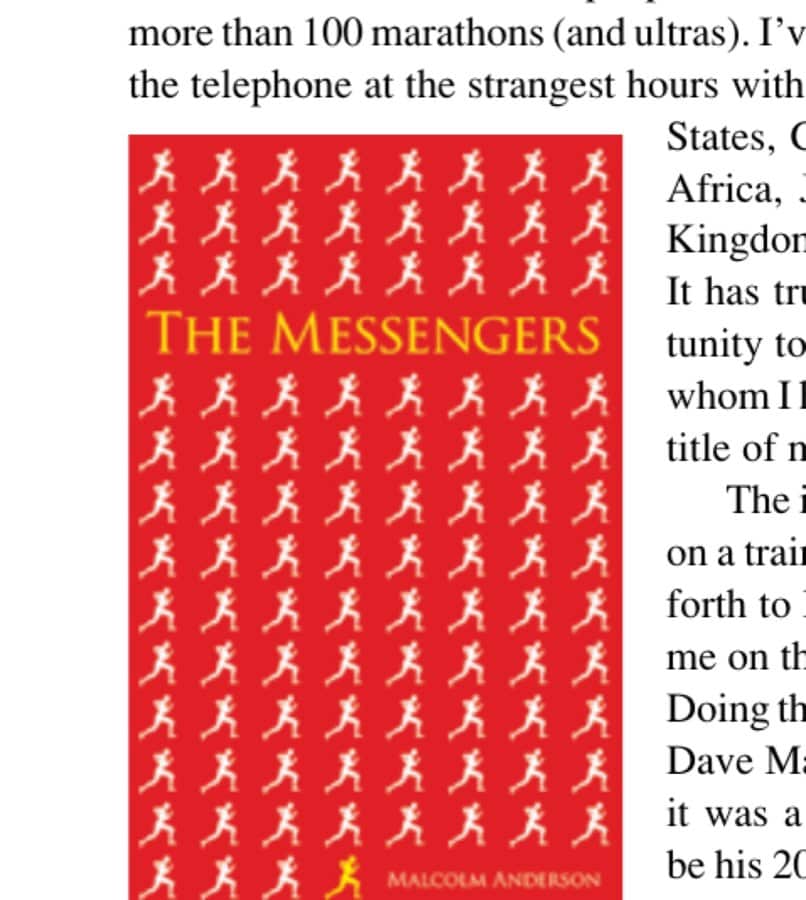
I’ve written a book on people from around the world who have completed more than 100 marathons (and ultras). I’ve met in person, e-mailed, or talked over the telephone at the strangest hours with well over 120 runners from the United
States, Canada, Australia, New Zealand, South Africa, Japan, Germany, Denmark, the United Kingdom, Ireland, Sweden, and the Netherlands. It has truly been a privilege to have the opportunity to meet and learn from these individuals,
whom I have since labeled “the messengers,” the title of my book. The idea of the book began with my standing on a train platform in Athens, shuffling back and forth to keep a bitterly cold wind from freezing
me on the spot. The marathon was the next day. Doing the same thing beside me was a stranger— Dave Major from England. Dave explained that it was a special race for him because it would be his 200th marathon. Two hundred? Had it not
been so cold, my eyes would have popped out in ▲ The author’s book on people from around the world who have disbelief. For the next 40 minutes, I threw quescompleted more than 100 mara- tion after question at Dave. Why? How? Who thons (and ultras). are you people?

Courtesy of Dave Major
▲ Dave Major celebrates the completion of his 400th marathon.
My knowledge of marathon running was turned upside down. I asked Dave if anyone had written about “you people.” He didn’t know of anything but put me in touch with Roger Biggs, the chairman of the 100 Marathon Club UK, who in turn put me in touch with Bob and Lenore Dolphin, the codirectors of the 100 Marathon Club North America. The rest, as they say, is history. As for Dave, he’s run more than 50 marathons each year for the past four years and has started a subscription service with his wife Linda (www.madeyarun. com). They provide not-for-profit running tours.
Why do the messengers run 100 marathons? The answer is simple and complex. At the risk of gross stereotyping, it typically starts with a desire to run “a marathon.” The reasons why the messengers start this way are familiar to us all: weight and health issues, a bet, trying something they don’t know they can do, supporting a charity, the loss of a loved one, a need to turn their lives around due to a life event, and so on.
Nothing “little” about Gina’s accomplishment In London, England, Gina Little, a quiet, unassuming woman, but one who has run more marathons than any other woman from the UK (over 300 and still going), said that she saw the London Marathon go past her place and thought, I could do that. Several other messengers saw the London Marathon on television
Courtesy of Steve Edwards

and thought the same thing. Just north of London, Steve Edwards had a bet with friends in the pub (for a pint of beer) that he could run a marathon. Not only did he win the bet, but he has become an incredible athlete and is one of the greatest
marathoners running. By the end of 2012, and before he turns 50, Steve will have completed 500 of his marathons in under 3:30. Also in England, John Wallace (not Maddog) was bet five pounds that he couldn’t run a marathon. He was offered
another five pounds if he wore a costume. He has worn his Superman costume on more than 250 occasions and registers for each race as Clark Kent. Horst Preisler from Hamburg, Germany, has run close to 1,700 marathons, all of which started
when his wife mentioned that he was putting on a bit of weight around his waist. But 100 marathons? Why? The health benefits that we all know about accrue over time, and there is a sense of accomplishment when the first marathon is
completed. Runners sign up for another marathon perhaps to run a better time, perhaps because the total marathon experience was so enjoyable. And it is quite likely that the lifestyle associated with the training has been extremely positive.
More and more races are completed. In short, running and training for marathons becomes more and more enjoyable. Given all the benefits, why stop? Most of the messengers don’t think about completing 100 marathons
until they are well on the way. At some point, often around the completion of 50 marathons, the possibility of completing 100 becomes much more real, feasible, and tangible. Plans are put in place by
the runners to reach the goal by a certain date. This happens more quickly if
▲
Steve Edwards, at the completion of his fourth 10 Marathons in 10 Days Challenge.
you’ve been talking to runners from 100-marathon clubs, of which there are several around the world. It also happens more quickly if you have plenty of races to choose from. It may be why there are a lot of messengers in the northwest United States, for example. In the United Kingdom, Michaela Sanders had the drive to run as many as possible, as soon as possible, and thus completed her first 100 marathons in an average of 11 days between each race. In 2011 Englishman Traviss Willcox completed his first 100 official marathons in just 688 days! (Traviss also ran a world record 114 official marathons in 2011.) In 2008, at 28 years of age, American Leslie Miller became the youngest female in the world to have run 100 marathons. “For me,” she said, “it’s not about running to beat times; it’s the total experience.”
In Germany, very small marathon events are organized almost every weekend, so the number of races completed accumulates quickly. At the other end of the spectrum, Jim Barnes—who lives in Perth, Western Australia—took many years to complete his 100 marathons, a major factor being the vast distances (and huge costs) required to travel to races. Perth is remote; it takes several hours just to fly to other cities in Australia, and the number of marathons and ultras is relatively few compared with Europe and North America.
Some messengers did not keep track of their races over the years and their 100 just “kind of happened.” One messenger was encouraged by other runners to count the number of marathons he had raced. He discovered to his surprise that he was in the 90s. Another messenger didn’t know the number of events he had won or had placed in, so he had to check. Yet some messengers thought about a goal of running 100 after only a few races. Having completed just five marathons, Dave Major knew he wanted to join the 100-marathon club when he found himself lined up behind a member wearing the club’s vest. Like a number of other messengers, running transformed, perhaps saved, his life. He would say that there was no chance he would ever think of running one marathon in his previous nonrunning life, let alone 100.
Putting it into perspective For the most part, the messengers are goal setters. It is well known that marathoners are characterized as very goal-oriented individuals. The messengers are constantly recalibrating their goals over time: to run faster, to run more ultras, to run more states, to run in more countries, to run more races, period. As the messengers complete more and more marathons, it is inevitable that a decision point is reached whereby they set their sights on reaching the magical 100. The more messengers they meet, the more possible it becomes because they know that if they have the “right stuff”—patience, perseverance, and, importantly, injury-free running—they will attain the 100. It’s an amazing achievement to be proud of, especially con-
sidering that more people have climbed Mount Everest than have completed 100 marathons. The social side of the distance-running experience has been woven into the messengers’ lives and has become increasingly more important for them. Improving health and beating their personal bests may still be highly desirable, but with more and more races completed, more friends being made, and more stories being shared, the world of possibilities opens up. Eventually, PBs are no longer important, and there is a critical moment in their experiences when they realize that their PB will never be beaten again. This brings into focus the realities of why it is that they actually enjoy distance running. There are still new experiences to be gained, new races to do, new distances to run, new places to visit, new runners to meet, new medals to obtain, and new goals to attain. All these things can occur as the messengers move closer and closer to reaching the lofty goal of 100 marathons.
Running multiple marathons becomes a lifestyle, one that is self-reinforcing— one that builds increasing levels of happiness. Mental, physical, emotional, and spiritual health is improved, goals are achieved, and the web of friendships enhanced and broadened. And the goal of running 100 marathons fits neatly into the marathon-running lifestyle: not easily attained, but at the same time not so far away in the distance that it seems impossible.
As we know, long-lasting bonds of friendship are often formed in the short time of running with a complete stranger, even as little as one to two hours, so it’s no surprise that the messengers have amassed a wealth of friendships, shared experiences, and memories with other runners. The more marathons they run, the more they gain and the richer are their social connections. It’s well known in the research literature that social connectedness plays a major role in happiness.
Courtesy of Leslie Miller
▲
In 2008, at 28 years of age, American Leslie Miller became the youngest female in the world to have run 100 marathons.

In simple terms, it seems only logical to continue running because that is what makes you happy. There are many messengers who run more than 20 to 25 marathons in a year. Several messengers run 50 or more marathons a year! Why? The total marathon
experience is a passion that plays such a central role in their lives that it would be hard for them not to run. It’s not just the passion to pitter-patter several thousand steps each week (which still must be enjoyable, even though some messengers
say they “hate running”). The real motivations are the experiences gained, the places visited, the old friendships enriched, the new friendships made, and the satisfaction with their lives that running provides.
This brings us to the concept of apathy. In his book Philosophy and Running, Professor Richard de Witt notes that, “In the Hellenistic concept [of apathy] one does not merely have apathy; rather, one acquires it.” This can be a long, involved
process, and an individual cannot acquire apathy without first having pathos (without first being passionate). De Witt adds, “One must work, and work passionately to understand the universe and to understand one’s place in that universe . . . And
it is this deep understanding of the universe, and your place in that universe, that leads to peace of mind, to mental tranquility, mental unperturbedness . . . one’s passion eventually leads to apathia, the right sort of
apathy—an unworried state of mind.” Indeed, one of the most common recurring themes from interviewing the messengers is their sense of the unworried, both during their runs and in their everyday lives.
That’s not to say that an unworried state of mind is gained only after
Lenore and Bob Dolphin, codirectors of the North American 100 Marathon Club. ▲
Courtesy of Bob and Lenore Dolphin
A good kind of apathy
completing 100 marathons. The unworried state of mind evolves over time and most likely occurs well before 100 marathons are completed. But importantly, obtaining that state of mind—that unperturbedness—gives the messengers a certain something that goes beyond the number of marathons run. There is the deepening of experiences and relationships that the messengers obtain. The “100” is the numerical goal, but the more implicit goal is the continuation of the happiness, contentment, and life satisfaction that occurs with more and more marathons completed.
When I started writing The Messengers, I was focused on the numbers—how many marathons did they run; what times were achieved; what are the PBs; who has run the most marathons; is there a correlation between time, age, number of marathons completed; and so on. The title was going to have “100 Marathons” in it. But somewhere along the way, I realized that I was missing the point. The “100” is a bit of a red herring. While it’s an incredible achievement accomplished by amazing (and wonderfully friendly and giving) people, we run the risk of missing what it’s all about.
The messengers run 100 marathons to achieve a goal they set themselves. The number signifies a considerable achievement. But it’s more than the attainment of a measurable number. The messengers rarely stop at 100. They keep running, and many run hundreds (a growing number have run more than 1,000).
They run more and more marathons because it becomes a lifestyle. It was a lifestyle well before 100 races were completed. The messengers run for the depth and breadth of the total marathon experience. The many health benefits are overlaid with the desire to see new places, gain new experiences, and further the social interconnectedness—the desire (and need) to build on friendships. We are, after all, social animals.
The messengers, quite simply, are happy. And they have messages for us all about what it means to be healthy in the broadest sense of the word—and what it means to be happy. The research literature is abundant with evidence on the connections between physical activity and health. The messengers lead by doing; they lead by example. They run 100 marathons because they can. More importantly, they complete 100 marathons because they believe they can. And they reach 100 because it is an increasingly achievable goal that provides an immense sense of pride and accomplishment.
Over the course of completing 100 marathons, the messengers get to know themselves and their place in the world. They better understand the frailty of the human condition and what running long distances can do to improve that condition. There is much we can learn from the messengers, much of which has little to do with how to run long distances.

This article originally appeared in Marathon & Beyond, Vol. 16, No. 2 (2012).
← Browse the full M&B ArchiveMore like this
1,000+ stories from 19 years of Marathon & Beyond
The complete archive of the legendary long-distance journal — digitized and free to read.
