

Why Do We Run Marathons, Anyway?
Reason #4: You get to see the world. Running marathons all over the country or world can be a real kick. You get to enjoy new experiences and take in a kaleidoscope of visually dynamic sights. Run the prairie, the woods, the beach, the desert—each experience takes you to a place you’ve never been. And it sure doesn’t hurt that all the travel gets you away from work and helps you forget the chores piling up at home.
Reason #5: You get to wear those cool T-shirts. Yeah, the travel’s great, but what’s coolest is all those marathon T-shirts you stockpile. Not only are these shirts not-so-subtle ads for your achievements, but some of the designs are just plain pretty. Remember Amy Parker’s shirt after she’d run the Grandma’s Marathon? What a conversation piece. Hey, so what if she did wear the shirt for 15 straight days? Is there any such thing as too much cool?
Reason #6: It gives you time alone to think. By nature, we runners are inward-leaning people, often uncomfortable in social situations. Perhaps that’s why we appreciate the solitude of our long training runs. It gives us the opportunity for introspection, to contemplate life and mankind’s evolutionary processes. We burn off our hostilities, escape all the bozos, and get a chance to think clearly in a period of calm without the daily interruptions of the workaday world. For many people, this has got to be the best reason for running.
Reason #7: Completing a marathon gives life new meaning. The achievement is a badge of courage, a seal of accomplishment that draws us out of our shells. Besides making us healthier (we hope), improving our self-esteem, and giving us direction, running a marathon also helps make us more comfortable in social settings. Which brings us to . . .
Reason #8: Marathons give us something to talk about. Alas, most of our socializing continues to be with fellow runners who share our passion—but, then, would we really want it any other way? Our marathon war stories fall pretty flat among a gathering of nonrunners who think Nikes are the only brand of sneakers.
Nonrunner at a party back home: “What do you mean you got bused out 26 miles from the Las Vegas Strip at five in the morning in pitch dark? Are you nuts?”
Runner: “Hey, I ran my marathon PR there.”
Nonrunner: “I didn’t know you were into public relations.”
Runner: “Um, I’ll see ya . . .”
So, are these eight reasons enough? Do we really need any more motivation to travel the country year after year to run marathons, experience pain, and bring home another cool T-shirt along with those nice finisher medals? Must we have more incentive to carry us through those training periods that include three-hour Sunday-morning jaunts in the middle of summer and mile repeats during the week?
Getting Mystical
Well, evidently. You see, somewhere along the line a creative soul came up with the hypothesis that running marathons can be a life-altering experience. That being able to put one foot in front of the other for 26.2 miles can cleanse the mind of impurities, make us feel like complete human beings, and enable us mentally to conquer great challenges.
Some even go so far as to claim that marathoning is—shhh!—a mystical experience. To quote Webster’s, “mystical” means something that is “spiritually symbolic.”
I know this because I just looked it up. Until then, I had no idea what mystical meant. I just knew it lent an aura of sorts that made something seem beautifully cosmic. I remember feeling this way and almost crying with emotion after finishing my first marathon in Denver in 1983. I’d say that was pretty mystical, by Webster’s standards.
But, then again, I thought it was pretty mystical when I got a free massage after that first marathon. The pasta carbo reloading a couple of hours later seemed quite mystical as well. Plus, I recall a mystical dream I had after falling asleep in the back of the car during the 110-mile drive back home. I dreamt I was running along the ocean in St. George, Utah.
So, what do we know about mystical experiences, anyway? I’d say not a whole heck of a lot. But judging from personal experience, running marathons sure can make runners delirious, which causes them to act pretty strange. I guess in this strange world in which we live, we runners have found our own weird little mystical niche. Now that I think of it, that’s a catchy name for a marathon. The Weird Little Mystical Niche Marathon. I can see the T-shirt already.
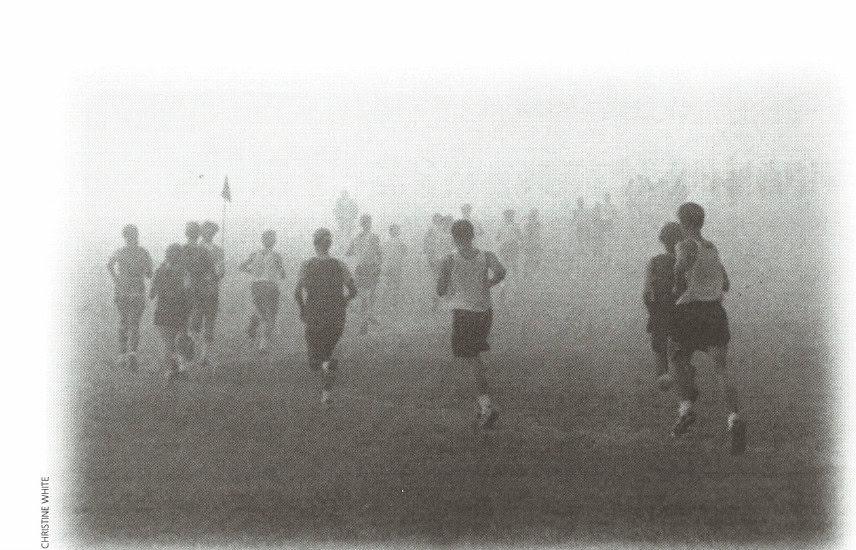
himself into an 11th-place finish. The rest of the team picked up on his self-doubt. The coach was merciless after the race, calling them “gutless.”
There was no trophy last week. The boys were angry and ashamed. No one wanted a team photo. No one wanted to remember the day they were losers.
* * *
This is how runners talk.
“You can do it. You’re the smartest kid out there,” my oldest son tells my youngest son. My oldest son is a runner, too. It’s the race postmortem. Every race has this dissection.
“Whoever wins at State is the guy who has the best head on his shoulders that day. Write on a piece of paper: I believe in myself. Over and over. Hang it up. Just look at it. You’ve got to internalize this. You. For yourself.
“Remember that article in the paper last week about Peterson from South High saying he wasn’t ready for the race because he was thinking about homecoming? What a jerk! More than looking like a jackass, that comment tells you he doesn’t have a head. Peterson—you’ve got him in the head. Chew him up and spit him out like a bad habit.
“You can be a stud if you want to. People will forfeit to you at the starting line. You’ve got the capability of being a monster. A monster. You can be a monster. Just stop being a head case. At the end of the race, whose head is on?”
* * *
“I thought he was toast,” my younger son said. He figured he had second place nailed down, thought he had overtaken the runner in red. Said he didn’t
This article originally appeared in Marathon & Beyond, Vol. 5, No. 5 (2001).
← Browse the full M&B ArchiveMore like this
1,000+ stories from 19 years of Marathon & Beyond
The complete archive of the legendary long-distance journal — digitized and free to read.
