

Wicked Hard Challenge
Many marathons advertise that they have a fast and flat course and are therefore a great Boston Marathon qualifier. The Mount Desert Island Marathon (MDI Marathon) is perhaps the antithesis to that line of thinking. Its race organizers make no secret that they feel a marathon should be challenging, and, thus their course traverses countless hills as it meanders along the island’s rugged coastline from Bar Harbor to Southwest Harbor.
While the course is demanding, it is also scenic. Mount Desert Island is located off Maine’s northern coast and is a popular tourist destination. The marathon runs through some of the best the island has to offer as it dashes in and out of scenic coastal towns and Acadia National Park. The race also takes place in mid-October, when autumn foliage is typically at its peak. The vibrant oranges, reds, and yellows dotting the mountainsides on one side are in sharp contrast with the crashing waves of the dark, foreboding Atlantic Ocean on the other.
This sounded very attractive, so I trained all summer after registering. It would be my first marathon, and I wanted it to be epic.
FRIDAY, OCTOBER 14: ARRIVAL My friend Amy and I arrived late Friday night and set up camp at the Quietside Campgrounds, located outside of Southwest Harbor. Amy wasn’t running the race, but she came along to help me out and to take in the sights. A light rain began to fall as we set up the tent, and we quickly arranged our stuff before the weather took a turn for the worse. The forecast called for rain the entire weekend, so camping out to save a few bucks instead of getting a hotel room was a gamble. I wanted to be well rested for the race and wondered whether camping was a good idea. But being an avid hiker, I’m used to sleeping in tents in adverse conditions.
Tired from the three-hour drive, we crawled into our sleeping bags as a steady rain began to fall while we drifted off to sleep.
DAY TWO: RACE EXPO, SCOPING THE COURSE, PASTA DINNER I awoke before Amy and went for a quick two-mile run in a light but steady rain. The temperature was in the upper 40s, which was about what was expected for tomorrow. I felt comfortable running in these conditions, even with just a pair of running shorts and a singlet. It helped set my mind at ease, knowing the last weather forecast I had seen had called for similar conditions for race day. Unknown to me at the time, an element added to that forecast would prove to be an obstacle for an already-formidable race.
I returned and showered, and Amy and I drove to a restaurant in Bar Harbor where we feasted on a large breakfast. I opted for a big stack of blueberry pancakes, while Amy ate a bit lighter. Afterward, we hit the race expo where I checked in and picked up my bib number and timing chip. Several vendors had also set up there, and we perused the merchandise but resisted the temptation to buy anything.
We then broke out the map and drove the course. I took mental notes of the tougher hills and got a feel for it. It was definitely very hilly. In fact, I don’t recall one truly flat section along the entire course! I reminded myself that with the hills, proper pacing would be absolutely essential if I were to have a satisfying finish.
Once done with the course drive, we headed back to Bar Harbor, where we got most of our Christmas shopping done. Most of the stores were looking to unload their inventories before closing for the season, and we got some great deals. I’m one who procrastinates often, so this was definitely a foreign, yet satisfying experience.
We then drove up Cadillac Mountain to kill time before the prerace pasta dinner. I had hiked up the mountain before and been treated to stunning views of the ocean and neighboring island, but today the summit was socked in and intense wind made walking around difficult. The conditions reminded me of my frequent hikes on the peaks in the White Mountains of New Hampshire, home of Mount Washington and its notoriously awful weather.
It soon became time to eat, and we drove to the dinner where we feasted on large amounts of pasta, salad, and bread while listening to entertaining speeches from the race director, Gary Allen, and the guest speaker and accomplished marathoner, Dick Beardsley. It was also nice to chat with some of the other runners, all of them a very friendly bunch. Once the dinner was over, we returned to the campsite where I quickly fell asleep.
SUNDAY, OCTOBER 16: RACE DAY Prerace The alarm went off at 4:45 A.M., and I awoke feeling refreshed and well rested. A second consecutive night of rain beating against the tent’s fly had lulled me into a deep and satisfying sleep, which I hadn’t expected.
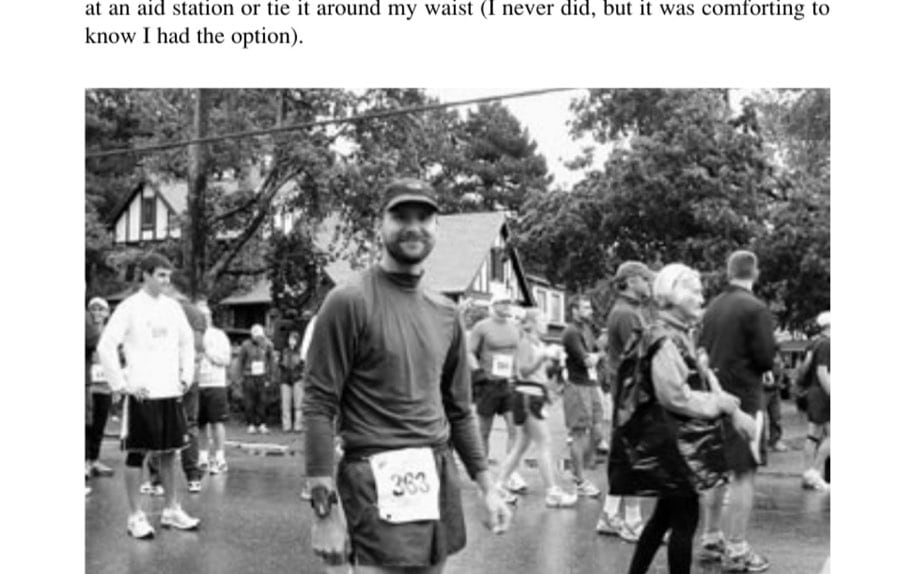
Amy, my good friend and crew member, and I packed up and headed over to Bar Harbor, where the race would start. We arrived at 6:30 A.M., an hour and a half before the start. I spent much of the time flip-flopping on what I would wear, and Amy exercised great patience with my indecisiveness as we made several trips to the car so I could change. Temperatures were in the upper 40s, and a light rain was falling. That I could handle, but my cause of uncertainty was the fierce, 30-mile-per-hour wind with higher gusts that had moved in overnight. Maine weather is notorious for its schizophrenic nature, and this weekend wasn’t much of an exception. I ultimately decided to pin my racing number to my shorts and wear a long-sleeved wicking shirt over my racing singlet. The dual layers would keep me warm, and I could always take off the long-sleeved shirt and ditch it at an aid station or tie it around my waist (I never did, but it was comforting to know I had the option).
▲ The author waits at the start line in Bar Harbor.
Starting Line At 7:45 A.M., I bid a temporary good-bye to Amy and took my place at the starting line. Television host and domestic goddess Martha Stewart gave us a prerace speech. That was very generous of her, but I was focused more on jumping up and down in place to keep warm and didn’t catch much of what she said. In a way, being chilly and trying to fight the cold weather was good because it also diverted my attention and helped keep prerace nervousness at bay. I was anxious to get started and looked forward to the run, which would warm me up.
The race director announced that we were two minutes from starting, and then it really hit me. Over four months of training was about to come to a head. The distance runs, the speed workouts, the recovery runs, the grueling hikes, the tempo runs . . . all of it, for this event, for what I was experiencing at this very moment, and for the challenge I was about to face. I remember thinking that I would look back at this as the beginning of an event that would likely change me forever, and I couldn’t contain my smile.
Martha gave the command for the runners to get on their marks, and then the air horn went off. It had begun. Miles One to Five: Battling the Wind After the start, it didn’t take long for the crowd to thin out and the runners to find their space as the route immediately began a slow and steady climb. I began to warm up and knew I would be fine. I settled into my pace and concentrated on not going out too fast so I would have energy for later.
A few miles later, the route passed through a valley between Dorr and Champlain mountains. Here an already mighty wind became even more ferocious as it bottlenecked and sped up through the mountain pass. Luckily, a taller runner was holding the same pace, and I ducked behind him, drafting off him through the pass. His large frame did a great job of blocking the wind, and it helped tremendously. For the first three miles, I averaged around an 8:00-mile pace, which was the best I had hoped for. However, we would then hit some downhills where I went a bit too fast, hitting a 7:41 split for mile four. This alarmed me a bit, and I vowed to slow down. Miles Five to 10: Cruising This part of the course skirted the coastline and offered fantastic views of the ocean. It also passed through the quaint village of Seal Harbor. The scenery was a great diversion from the wind, cold, and drizzle, and I moved along at a good clip but still a touch faster than I wanted. However, I realized that most of the faster splits were coming on the downhill sections, so I tried not to let it eat at me too much, while still being mindful of my pace.
I talked with a few other runners along this stretch. The excitement in their voices equaled mine, and it was great to be able to feed off each others’ vibes. I was really enjoying myself!
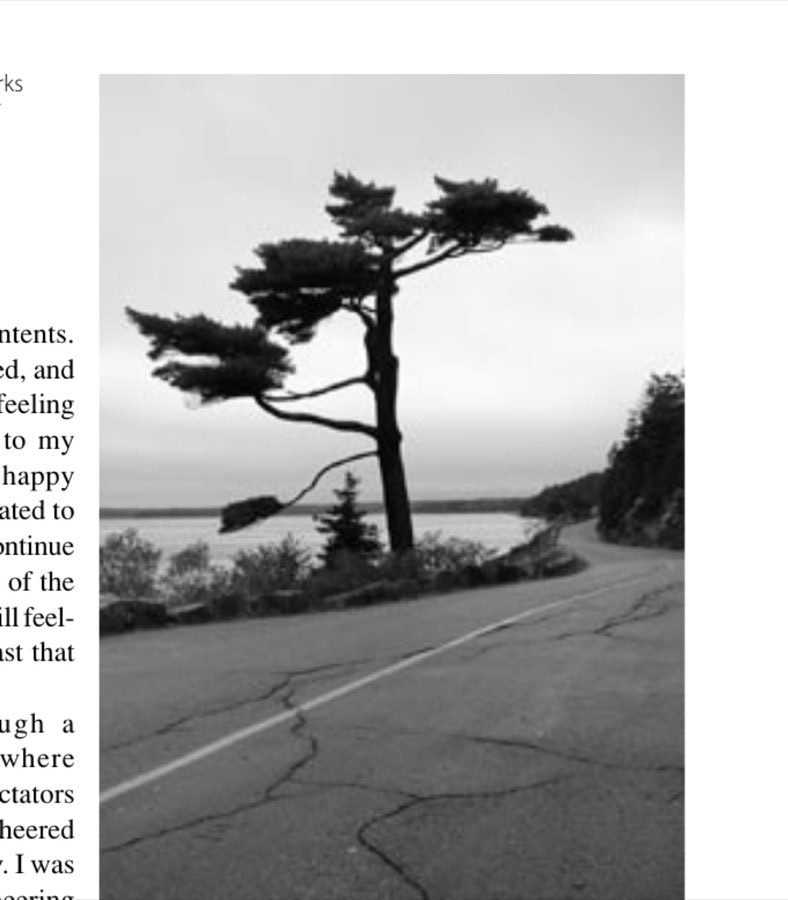
Miles 10 to 15: Time Adjustment The route continued to outline the shoreline and a few miles later passed through the scenic town of Northeast Harbor. After passing through downtown, I hit the 13.1-mile point. I evaluated how I felt and tried to predict my progress for the rest of the race. I had hit it at around 1 hour, 43 minutes, which might seem as if I were on pace to finish in less than 3:30, which is what I had hoped for. However, my legs were growing tired, and the hardest parts of the course were yet to come. I then thought that my original goal of finishing under 3:45 was more realistic, and I would shoot for that. It’s important to note that this wasn’t a letdown. This was my first marathon after all, and the course was super hilly, even more so than the training courses I had been running around my house. Plus, the combination of cold, wind, and rain made it even more challenging. I decided I was doing very well and got myself mentally ready for the next uphill section. A few moments later, I got my first glimpses of the mouth of Somes Sound, the only fjord on the East Coast. Here, the course climbed up again and paralleled the eastern side of the fjord. The uphill was somewhat taxing, but I got through it and smiled when I saw the lone pine tree that marked the beginning of the “Mile of Champions” at the 15-mile point. The tree is also featured in the race logo. This scenic section is dotted with pink granite stones along the roadside that honor previous MDI Marathon winners as well as other members of the community. Combined with the views of the water, it’s one of the most beautiful and unforgettable stretches of the racecourse. Miles 15 to 20: Feeling Funny I cruised along alone for most of mile 16, where the road began to climb again. I remember feeling somewhat dizzy and wasn’t thinking clearly at this point. In my weakening state, the steady beating of my feet against the road seemingly began to hypnotize me, and I couldn’t snap out of it. Something was clearly starting to go wrong, and I knew I should take action to correct it. I began to analyze what could be going on and wondered whether dehydration could be the main cause. It dawned on me that I hadn’t been drinking as much as I probably should have. I had taken only a few sips of Gatorade or water at a few of the aid stations so far, which was in no way enough. I vowed to drink at each aid station from there on to rehydrate and correct the problem.
A few moments after that, I reached a station where some folks were giving out GU, and I took a shot. One hundred yards later I reached a hydrating station, where I downed a huge cup of Gatorade. This time I slowed a little so I could
▲
A lone pine tree marks the start of the “Mile of Champions” at mile 15.
drink the entire contents. A few minutes passed, and the loopy, hypnotic feeling disappeared, much to my relief. I was very happy about that and reiterated to myself that I had to continue drinking for the rest of the race. My legs were still feeling heavy, but at least that was to be expected.
I passed through a couple of points where large groups of spectators had gathered and cheered loudly as I passed by. I was all alone, so the cheering was for me! It was a great feeling and definitely gave me a boost. Some yelled that I was running strong and looked great, even though I didn’t feel like it. In fact, it was in direct conflict with a few minutes later when I felt completely exhausted, and I thought how it would be fantastic to fall down face first near some spectators, knowing I could rely on the kindness of these strangers to rush to my aid, wrap a blanket around me, and give me some hot soup. Mm, that would taste good, especially if it were homemade chicken noodle. I wallowed in this scenario for a few moments and then realized it was a form of negative thinking and counterproductive to my running. I proceeded to get mad at myself for even thinking it, and went back to concentrating on finishing this race with a decent time.
I hit a few more water and Gatorade stops and hydrated. I would reach the end of mile 20 soon, which is the beginning of a large uphill that continues all the way to mile 25. The Boston Marathon may have its Heartbreak Hill, but the MDI Marathon has its soul-destroyer hill, and I took another shot of GU and vowed to conquer it.
Miles 20 to 25: Climbing the Soul Destroyer Near mile 20, the course turns left and begins its ascent as it follows the western side of Somes Sound. I slowed my pace a touch, knowing what was ahead. I also rejoiced, realizing that I was on the final leg of the journey. I have a training run that is 6.4 miles, and I told myself that what I had left was even shorter than that. Yes, what I had left was hillier than that course, but all I had to do was run less than that distance and I would be at the finish line.
The road took a slight bend and revealed what was ahead. There before me was a grand hill that rivaled any I had run before. I remember that it looked like a mountain, and I could see other runners dotting the road in the distance as they ran to the top. I psyched myself up and pressed onward and upward.
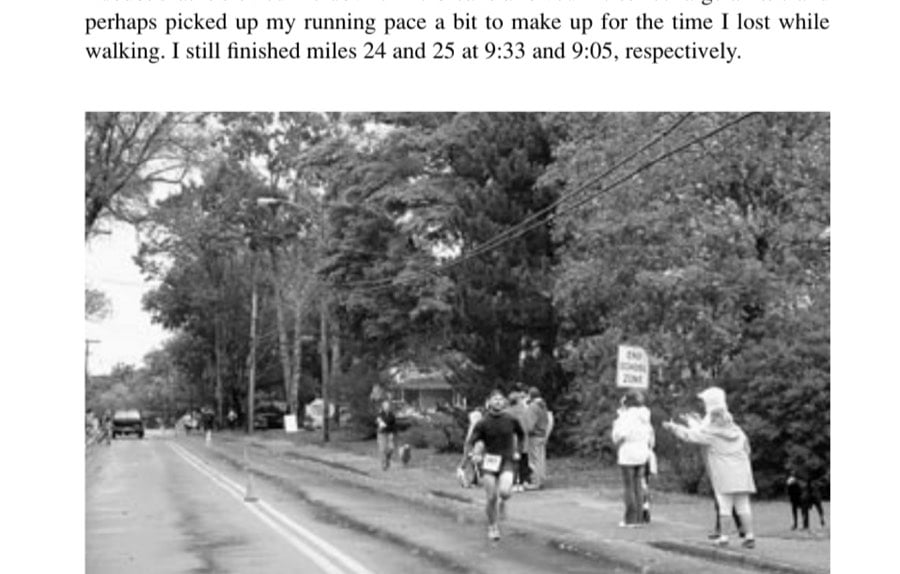
I reached the top of this steep stretch of the gargantuan hill, where it leveled out to only a slight incline and my legs were screaming at me. I didn’t want to, but I took a walk break here for about 30 to 40 seconds. Afterward, I ran on as I continued to climb upward, stopping two more times for walk breaks of about the same length. I would have liked to run the race without any walk breaks, but I doubt that it slowed me down. The breaks allowed me to recharge a little and perhaps picked up my running pace a bit to make up for the time I lost while walking. I still finished miles 24 and 25 at 9:33 and 9:05, respectively.
▲ The author just a few hundred yards away from finishing his first marathon.
I reached the top of the hill and rejoiced as I saw the road begin a steady descent. I wondered whether this could be the end of the uphill, not wanting to believe it simply because I didn’t want to be let down if it wasn’t. But then I saw the mile marker for the end of the 25th mile and I knew that it was. The final 1.2 miles would be all downhill to the finish line. I proclaimed to someone on the sidelines, “Only 1.2 miles to go! That’s it! This is awesome!” As corny as I was, she enthusiastically returned my sentiment and told me to go for it.
Miles 25 to 26.2: The Beginning of the End I picked up my pace and let gravity help carry me down. Gradually, the town of Southwest Harbor became more and more built up with each step, and I soon rounded a small
hill and saw the banner that marked the finish line a few hundred yards away. It looked glorious, and I picked up my pace, kicking with all that I had left. I crossed the finish line, pumping my fists as I did so. I had done it. I finished my first marathon. My official time
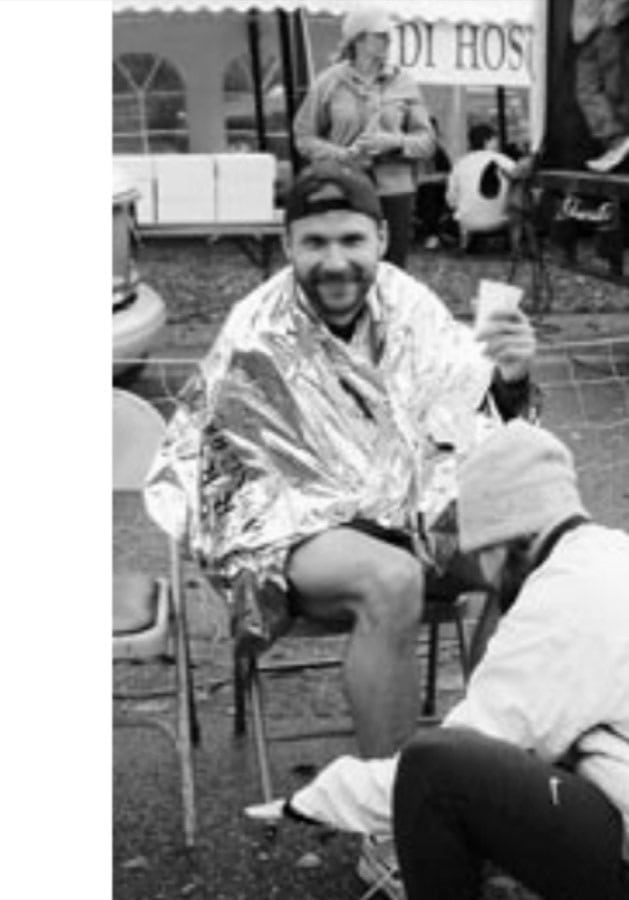
was 3:37:02, good for 67th place out of 510 finishers. A race volunteer quickly wrapped me up in a space blanket, putting her arm around me. In a soothing, caring tone, she asked me repeatedly if I was OK and
how I felt as we walked. I really appreciated that. Throughout this race, the volunteers were simply ▲ A friendly volunteer removes the author’s tim- fantastic. This was a very welling chip. run race.
Amy found me and offered congratulations. She was great in helping me unwrap granola bars and peel bananas and in tending to whatever I needed. She also drove home, allowing me to relax and recover, which I greatly appreciated. Without her help and company, this race wouldn’t have been the same. And since the race, I haven’t been the same either. I have completed several other marathons and ultramarathons, and I’m constantly training for that next big event. The fun is just beginning, and I’m looking forward to a wild ride.
This article originally appeared in Marathon & Beyond, Vol. 11, No. 5 (2007).
← Browse the full M&B ArchiveMore like this
1,000+ stories from 19 years of Marathon & Beyond
The complete archive of the legendary long-distance journal — digitized and free to read.
