

Wineglass Marathon
CRYSTAL-CLEAR, 65-degree days and cloudless, moonlit 25-degree nights create some strange magic on the flora and landscape of upstate New York in early October. Long, bowing leaves clinging to cornstalks take on a pale, almost skinlike hue. Rich blue and deep purple wine grapes appear even more luxuriant when placed against the exhausted vegetation around them. But nature’s autumn magic is even more prevalent in the gloriously colored leaves of the hardwood trees that cover the hills of the Finger Lakes region of the southern tier of western New York.
In a favored autumn, if early rainstorms haven’t stripped the trees, the fall foliage of northeastern U.S. draws millions of appreciative gawkers. They come in cars and trucks and belching tour buses; they stay in tents, campers, Winnebagos, and Airstreams; some tourists are even lucky enough to find the occasional fall foliage railroad tour. The leaf peepers seem intent on ratcheting up Kodak stock as they try to turn raw film into photographic masterpieces. Others sit quietly on folding stools, spending the day trying to paint nature’s palette as it’s displayed before them. Local autumn festivals include the Cohocton Fall Foliage Festival, the Hammondsport Grape Pumpkin Festival, the Rockwell Museum Chili and Chocolate Roundup (belch!), and the Harvest Days Weekend in Hornell.
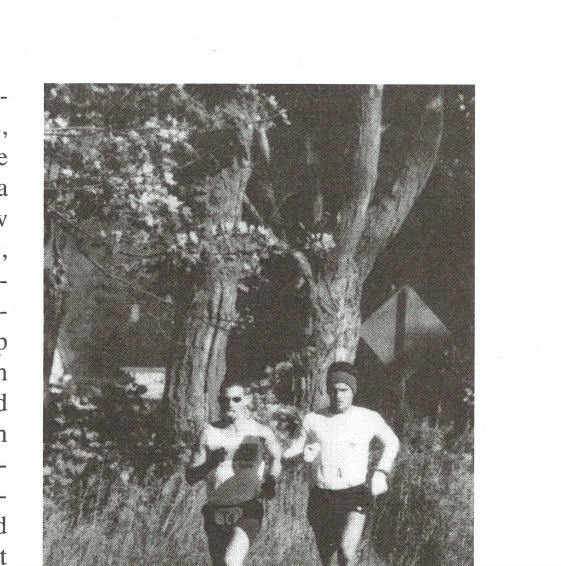
MARATHONING THROUGH THE FOLIAGE
The region doesn’t forget marathoners, either, especially those who have worn themselves out doing the tour of the man-made monuments in Washington, D.C., or who have run the five boroughs of New York City once too often dressed only in their underwear. If you’re just exhausted from running with tens of thousands of other runners who obstruct the view, and you just want to get away from it all, New York State’s wine country offers the Wineglass Marathon (formerly Taylor Wineglass, before the Taylor Winery was sold), set for its 16th year in October of 1997. The race is home to 400 in-the-know marathoners who come for the back country roads and the chance to file away pleasant running and racing memories—most of them vivid and unforgettable—for the coming winter.
Picking up a race number and not feeling like one is increasingly difficult at most marathons. Not so at Wineglass. Walking into the Bath, New York, Local #1013 Union Hall of Amalgamated Flintglass Workers on Pulteney Square, you feel like you’ve come to run the hometown 10K instead of a challenging marathon. Race director Mark Landin and his committee might just as well have stepped out of a Norman Rockwell painting. In a matter of moments they have visiting runners feeling involved, relaxed, comfortable, an integral part of the event—well, actually, more like one of the family. The expo vendors act as though they are at a community picnic instead of at work trying to sell you something, and the grape, cheese, and juice buffet never makes a runner feel guilty about going back twice. The impression that you are at a down-home, local 10K race vanishes, at least momentarily, when you nearly spill your juice on Don Kardong, 1976 Olympic marathoner and current RRCA president.
Even though the race is small as far as race entrants go, the organizers go out of their way to bring in speakers who will say something the average runner will take to heart. Don Kardong is no exception: “Never, ever give up on your dreams,” says Don. “With any goal in life, whatever it is, before you get there, you’ll believe you’ll never get there from here.” Did Don Kardong ever meet Buckaroo Bonzai? Or perhaps more appropriately, has Buckaroo met Don?
START-TO-FINISH COVERAGE
The Wineglass Marathon also features a marathon relay, which for 1996 had 73 teams. Even though the race has a 9:00 A.M. start time, in early October the sun hasn’t had time enough to radiate off much of the nighttime chill, and the sight of 473 marathoners and scores of relay team members doing their imitation St. Vitus dance to keep warm in temperatures very near freezing raises the fetching prospect of making a million dollars by finding a way to harness all that energy.
The race is covered live by local radio stations WVIN (98.3 FM) and WABH (1380 AM), both of which are well-intentioned, but as with most local media, the stations are a little behind in their marathon expertise.
The Basics
| Wineglass Marathon & Team Relay P.O. Box 117 Corning, NY 14830 |
|
| PHONE: | 607/937–6184 |
| FAX: | 607/974–4627 |
| RACE DIRECTOR: | Mark Landin |
| YEAR RACE ESTABLISHED: | 1982 |
| SANCTION: | USATF |
| START TIME: | 9:00 A.M. |
| COURSE RECORD HOLDERS: | |
| Male: | James Garrett, United States, 2:27:34 |
| Female: | Elsi DeOliveira, United States, 2:56:56 |
| Relay/Male: | Corning Inc., 2:25:00 |
| Relay/Female: | Fleet Feet Trio, 3:07:32 |
| Relay/Mixed: | Team Redline, 2:33:35 |
| PRIZE MONEY: | |
| 1st place: | $1,000 + Steuben crystal + jeroboam of champagne |
| 2nd place: | $500 |
| 3rd place: | $250 |
| 4th place: | $125 |
| Masters: | |
| 1st place: | $250 + Steuben crystal |
| 2nd place: | $125 |
| TIE-IN EVENT: | Marathon-length 3-person relay |
| NO. VOLUNTEERS: | 600+ |
| MARATHON FINISHERS IN ’96: | 394 |
| PROPORTION MALE/FEMALE FINISHERS: | 80% male; 20% female |
| COURSE MARKING: | every mile |
| NO. AID STATIONS: | start/finish, relay exchange points |
| FUTURE RACE DATES: | 05OCT97, 04OCT98, 03OCT99, 01OCT00 |
| ENTRY COST FOR 1997 EDITION: | |
| Before 21SEP97: Full $25, Relay $20/person | |
| By 04OCT97: Full $35, Relay $25/person | |
| Race day: 05OCT97: Full $50, Relay $40/person | |
AREA HOTELS: In Bath—Old National Hotel, 607/776–4104. In Corning—Comfort Inn, 607/962–1515 and Radisson Hotel, 607/962–5000. In Painted Post—Hampton Inn, 607/936–3344, Econo Lodge, 607/962–4444, and Holiday Inn, 607/962–5021.
FOR INFO ON THE CORNING AREA: Bath Chamber of Commerce, 607/776–7122; Corning Chamber of Commerce, 607/962–4686; and Hammondsport Chamber of Commerce, 607/569–2989.
GETTING THERE: From New York City, pick up Route 17 in Paramus, New Jersey, and follow it all the way to Corning. Route 17 west of Binghamton is a beautiful, modern four-lane expressway that parallels the Catatonk and west and east branches of the Owego rivers. The Catatonk and the west branch of the Owego are fed from Lake Cayuga, one of the Finger Lakes, while the east branch of the Owego begins near the town of Marathon, located just off I-81. From eastern and western Pennsylvania, use I-80 to reach Williamsport. Then take the 180 bypass through Williamsport to Route 15 north toward Mansfield. Stopping for a few minutes at the overlook above Tioga Reservoir is worth the trip, if you can find a place to park among the tour buses. Pack the camera and all the color film you can carry. From Tioga to Corning and Painted Post is a brief 20-minute drive. From the west, Route 17 runs all the way to Erie, Pennsylvania; and coming from Buffalo or Rochester in the north, take I-90 to I-390 south, which will merge with Route 17 about 3 miles west of Bath. The Elmira/Corning Regional Airport, noted mostly for its hang glider flights over the Finger Lakes and the wine country, accommodates jets and commuters (USAir and Northwest). If you are glider-inclined, call Harris Hill Soaring at 607/739–3219. The best bet from any direction is to drive into Steuben County and the South Tier and go with the local slogan: “Uncork New York!”
Obviously, neither radio announcer had ever toed a marathon starting line.
There was discussion early on regarding the speed at which members of the lead pack were eating up the turf through the town of Bath. The announcers agreed that the group was running between 5 and 6 miles per hour, which, according to our math, translates to 10- to 12-minute per mile pace. Yet at the 17-mile mark, the listening audience was urged to rush to the finish area at the Corning Glass Works because the leader would be there in 30 to 45 minutes.
While discussing the size of the field, one announcer noted that the 1995 edition of Wineglass had been the largest to date, due to the fact that most of the runners were using the race as “a tune-up for the 100th or 101st Boston Marathon.” See how far the BAA has spread its confusion over which running of the race occurred in 1996? The fact that Wineglass was a qualifier for Boston never got mentioned. The saving grace was that both stations broadcast oldies rock ‘n roll, and they featured the Mamas and Papas on race weekend. Ironically, the runners couldn’t hear—and enjoy—the broadcasts since the race was sanctioned by the RRCA and USATF, which meant there was a warning posted: “No Headsets Allowed on the Course.”
THE WINNERS’ OBSERVATION
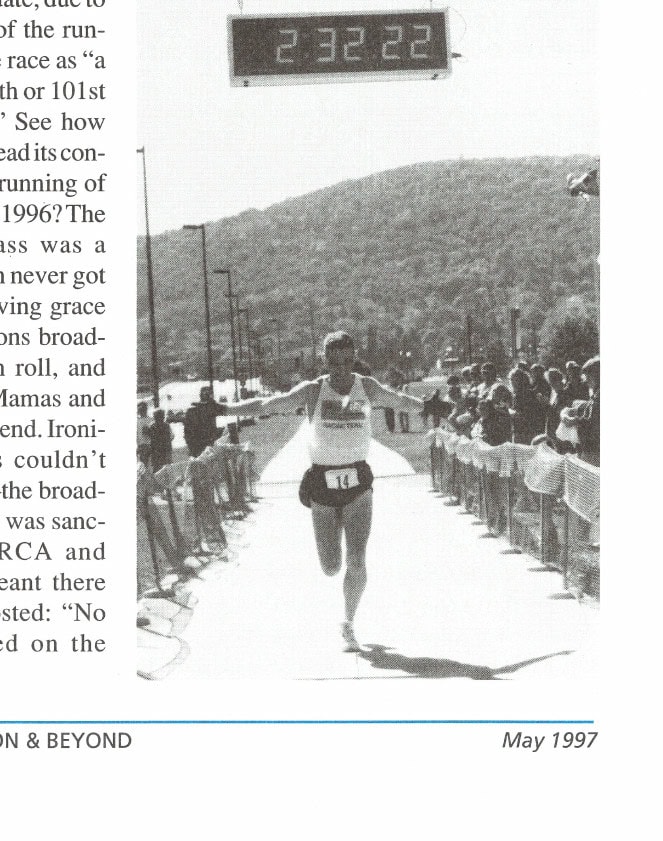
Dave Ciaverella of Canton, Ohio, won the 1996 edition of the race. His feat is noteworthy, not for the winning time (2:32:24) but for Ciaverella’s postrace quote. A physician who puts in 100-plus-hour weeks, Ciaverella said, “I’ve got a week off now. I’m just going to drink Guinness and relax.”
Elsie DeOliveira of Crompond, New York, set a women’s course record of 2:56:56 in 1996. She was third in 1994 and second in 1995. “I love this town,” she says. “The reason I come here is because the course is so beautiful. The people are wonderful.” Her comments pretty much reflect the opinion of everyone who’s ever run the course.
THE COURSE, PAST AND PRESENT
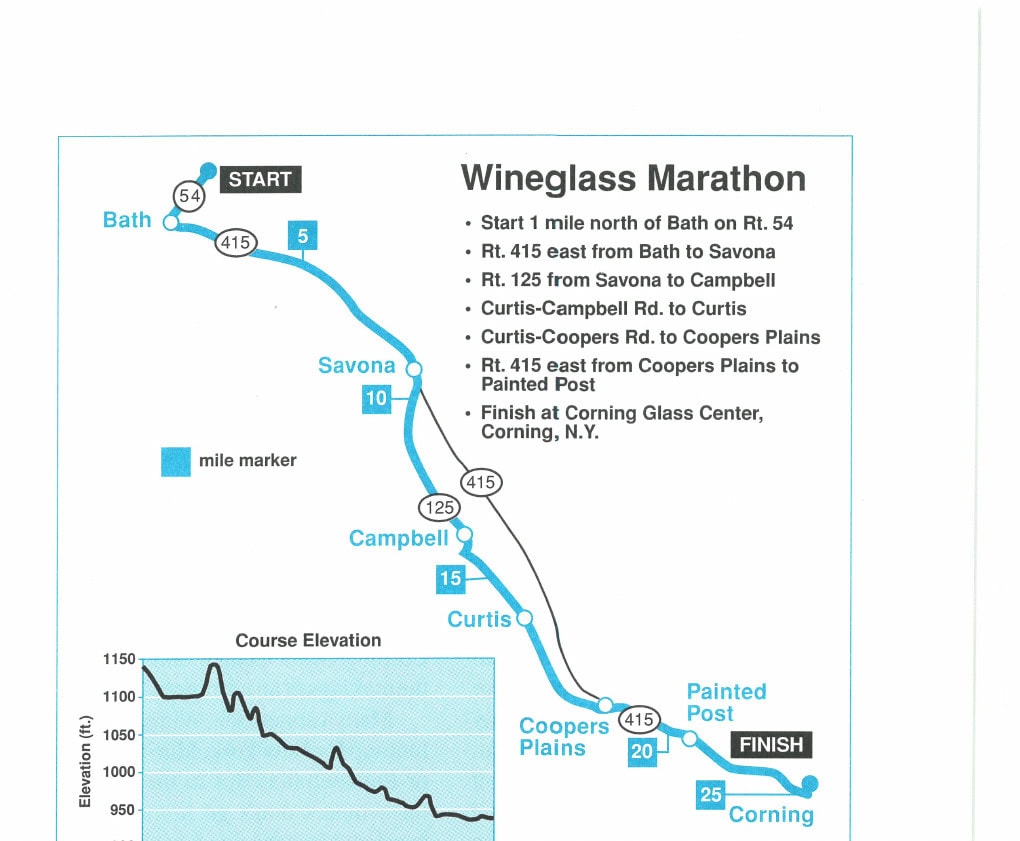
The current course is rolling, beautiful, and easily accessible and safe for spectators who want to follow the progress of their runners. The race starts at the parking lot of Philips Lighting on Route 54 in northern Bath. The first three-quarter mile is downhill into Bath. After a flat run through Bath, the course makes a quick left and then an uphill right onto Route 415, which runs parallel to the main north-south highway, Route 17. For the remainder of the marathon, runners travel on roads that are parallel to Route 17. The course passes through the very small villages of Savona, Campbell, Coopers Plains, and Painted Post, before entering Corning. These villages have no more than 800 townspeople. Route 415 has easy-off/easy-on exits at these four villages, so access to the course is extremely simple.
In the mid ’80s and early ’90s, the course began at the Taylor Winery about four miles north of Bath. Running out of the valley for the first two miles or so was difficult and made for a very slow start. After coming out of the valley and passing the state trout hatchery, runners ended up on Route 54 just north of the Philips Lighting. From that point, the course was the same as just described, but it ended at a public park in Painted Post and never went into Corning. For a few years in the early ’90s, the course started at the park in Painted Post and finished at the Taylor Winery. The food, drink, and body massages were available in a large storage area inside the Taylor plant, amid cases of New York’s finest wine.
Must See/Must Avoid
GO SEE IT
Uncork New York. Grapes destined for bottling rather than for eating have been grown commercially in upstate New York since 1854. Reds, whites, blushes, and sparkling champagnes are all made in Steuben County. Hammondsport, a short drive from Bath, is home to the Bully Hill Vineyards, Dr. Konstantin Frank Wine Cellars (aka Chateau Frank), Heron Hills Winery, Olde Germania Wine Cellars, and the Pleasant Valley Wine Company. All are open daily for tours and tasting.
Corning. If history and museums are your thing, Steuben County will fill the bill. Corning (aka Crystal City) offers the Rockwell Museum, home of the largest collection of Western American art in the eastern U.S. Frederic Remington and Charles M. Russell are featured, as well as early Steuben glass, firearms, and antique toys. Also in Corning is the Glass Center, which features the Museum of Glass, the Museum Studio, the Hall of Science and Technology, and the Steuben Factory. After New York City and Niagara Falls, Corning is New York State’s largest tourist attraction.
Hammondsport. Hammondsport is known as the “cradle of aviation” and features the aviation pioneer Glenn H. Curtiss Aviation Museum as well as the Greyton H. Taylor Wine Museum, which contributes to the town’s dual fame: wine capital of New York State.
Elmira. Aviation again. If you are interested in soaring, Elmira is the home of the National Soaring Museum, which beautifully details the history of motorless flight.
Letchworth State Park. If after 26.2 miles of beautiful natural scenery you haven’t had enough, you can walk out some of the stiffness in Letchworth State Park, one of the most beautiful natural settings in the eastern U.S. Waterfalls, lush meadows, thick forests, and wildlife abound.
Watkins Glen State Park is also nearby. Highlights there include towering cliffs, grottoes, 19 waterfalls, magnificent rock formations—all within a 1.5-mile gorge. A side trip up the hill to the world-famed Watkins Glen International Race Track is a must.
AVOID IT
Nothing. The entire Steuben County area is clean, neat, and well maintained with tree-lined city streets morphing into winding country roads as soon as they leave town. A beautiful blending of natural beauty and gently intruding civilization. All in all, it a setting to lust after, not avoid.
THE FINISH
The current finish area is on the sidewalks just in front of the Corning Glass Center. There is plenty of free parking at the plant, and access to the main highway is one traffic light away. Runners find plenty of food and drinks at the finish, and there is a full medical staff present as well. The only thing missing from years past is the distinctive bottle of wine given to each finisher. Vinted just for the marathon, the wine had included the race’s logo right on the bottle.
RACE AMENITIES
The expo is very, very small—a few vendors selling shoes and clothing—and is held at the local union hall in Bath. The setting is nice, as the hall is at the back side of the village park, right at the center of town. Half a block from the hall is the road leading to the start.
Wineglass has no official finishers’ booklet, although complete results are published in the Runner’s Gazette, which each finisher receives a copy of a few weeks after the race.
The hospitality of Bath and the surrounding area and the cleanliness, modern architecture, convenient shopping, and tourist-friendly attractions of the Corning area make the Wineglass Marathon a must-do week-
Runner’s High/Runner’s Low
HIGHS
- Flat, fast, scenic course
- 200-foot elevation drop
- Only two small hills (at miles 5 and 22)
- Super race organization
- Neat T-shirts
- Fall foliage
- Wine country
- Small field
- Low key
- Stunning glass finisher medals
- Easy course access for family and friends
- Great photo ops
- Corning Glassworks finish area
LOWS
- Course changes over the last few years
- Taylor Wine Company, previous sponsor, sold
- No more commemorative bottle of wine for finishers
end for the entire family. Add a small but intimate field, a finish line whose attractions and amenities match any megamarathon in the world (fruit, vegetables, pizza, massages, excellent medical attention, etc.), quick and accurate results, an outstanding race T-shirt, and a glass finishers’ medallion, made just for the race by the Corning Glass Center, and you have the makings of an unforgettable event.
Many runners use Wineglass as a tune-up for New York, Marine Corps, or Philadelphia. But in the process, the winners don’t go home empty-handed: They receive $1,000, a jeroboam of champagne, and a Steuben Crystal trophy.
The Bottom Line
We have weighed various aspects of a marathon within a 1,000-point scoring grid. Besides the author of the article, a dozen runners at the race were randomly chosen to score the race for us. (WM = Wineglass Marathon.) The results follow:
1. HISTORY/TRADITION
Evaluate the race’s sense of history and tradition.
[Possible points: 30 WM score: 19]
2. ENTRY FORM
Is the race entry form clear, concise, attractive, complete, and easy to fill out?
[Possible points: 20 WM score: 18]
3. ENTRY COST
For most races, the entry fee covers between 30 and 50 percent of the cost of putting on the event. Rate the value of your dollar relative to this race.
[Possible points: 30 WM score: 25]
4. LOCALE/SCENICS
Is the race held in an area that is easy to get to and scenic, offers adequate food and housing services, and nonrace activities for family and friends?
[Possible points: 50 WM score: 43]
5. REGISTRATION
Is registration well-organized and efficient? Does it bog down unnecessarily?
[Possible points: 20 WM score: 19]
6. PRERACE ACTIVITIES
Evaluate activities such as pasta feeds, parties, and so on, during the days before the race.
[Possible points: 50 WM score: 34]
7. EXPO
Does the expo offer a fair number and variety of booths relative to the race’s size? Are there quality exhibitors and good guest speaker(s).
[Possible points: 50 WM score: 30]
8. COURSE
Take into consideration the following: degree of difficulty, certified, sanctioned, quality of road or trail surface, adequate mileage and directional markers, aid stations, medical coverage, race communications, accessibility to course for friends and family, typical weather, and so on.
[Possible points: 400 WM score: 344]
9. RACE AMENITIES
This category includes race T-shirt, finisher’s medal, finisher’s certificate, adequate and efficient finish area, ease of sweatbag retrieval, showers, postrace refreshments, awards ceremony, raffles, results postcard, results book, and so on.
[Possible points: 250 WM score: 217]
10. VOLUNTEERS
Are the volunteers experienced and adequate in number?
[Possible points: 100 WM score: 90]
TOTAL SCORE FOR WINEGLASS MARATHON:
839 points (out of 1,000)
This article originally appeared in Marathon & Beyond, Vol. 1, No. 3 (1997).
← Browse the full M&B ArchiveMore like this
1,000+ stories from 19 years of Marathon & Beyond
The complete archive of the legendary long-distance journal — digitized and free to read.
