

Wonders Down Under: Adrienne Beames And Derek Clayton
In July 1969, a man walked on the moon. Our world would never be the same. The modern age of marathon running was launched at that same time, with three journeys into the unknown, all three blasting off, of all places, from Melbourne, Australia.
1. On December 3, 1967, when the men’s world marathon best had stood for two years at 2:12:00, suddenly the news broke that an unknown Australian named Derek Clayton had won Fukuoka in 2:09:36.4: sub-2:10! When no one had even gone sub-2:12! The shock was as if the first sub-two-hours marathon were to happen not in 20 or 30 years from now but today, right now, while you’re eating breakfast and reading this Marathon & Beyond.
2. Two years later, Clayton was no longer unknown, his big bony figure, fast low stride, and raw aggressive attitude featuring in every top marathoner’s bad nights. He was still the only man on earth to have broken 2:10. He had had injuries and surgery and we began to think he might be a one-shot. But on May 30, 1969, this time in Antwerp, he knocked our brains out again, running one whole minute faster, 2:08:33.6.
3. Two more years on, August 31, 1971, just as the new breed of American and European women marathoners were jostling to be first to break three hours, another unheard-of wonder from down under beat them all to it, by an even bigger margin than Clayton’s. Adrienne Beames had run 2:46:30, said reports from Werribee, a bit outside Melbourne. It was a giant leap for womankind.
What was in the Melbourne water? How did this ultimate triple whammy happen? Did it happen? Controversy swirls around all three performances, especially the last two. In most record progression lists, those entries are laden with cautionary footnotes. Every statistician, course measurer, historian, eyewitness, rival claim-
ant, and rumormonger has had their say. But not many people have troubled to ask the athletes themselves what they think. I was recently in Melbourne, where both Clayton and Beames still live. So I went to hang out with each of them a while, to chat in a friendly runners’ way about whether they did it, when they did it, how they did it, what it meant, and how they live now. Both interviews are exclusive to Marathon & Beyond.
Adrienne Beames Adrienne Beames lives alone in the Melbourne suburb of Caulfield. Across the road is the green and pleasant Caulfield Park, and it’s less than a five-minute jog to the famed Caulfield Racecourse, a perfect grassy training location for a runner. Beames can’t run or even jog any more, but the tram from central Melbourne, six miles away, conveniently stops 50 yards from her front gate. The modestly conventional concrete one-story house stands in its own garden, which looks somewhat in need of tidying.
Inside, her home immediately strikes you as strangely functional, not like a woman’s private dwelling. There is little on view that’s personal or decorative, nothing for comfort, no softening of the edges, and no evidence of food, even in the kitchen, or equipment for preparing it. The furniture is mostly metal chairs, there’s a massage table, a chiropractic adjustment bench, and the walls are covered with faded body charts, diagrams of the human skeleton, charts of nutritional values, pictures of exercises. It’s in fact an old-style chiropractic surgery frozen in time, the workplace of kinesiologist Fred Warwick, Beames’s coach, mentor, manager, and companion and a major player in the story.
Warwick died in March 2008, a month after Beames suffered a serious traffic accident that has left her movement severely restricted. She can walk, but tilted over and limping, and getting up into the tram is a struggle. No wonder the garden looks uncared for. She is understandably restless in manner. Her immaculate hair and nails are the main signs that she still has pride. She is 71 (born September 1942), seemingly with no family. A few weeks after my visit, she fell and broke her wrist and was in hospital for more surgery. Former Aussie steeplechase star Trevor Vincent, an enthusiast devoted to his country’s running history, generously keeps an eye on her and helps at problematic times. Lonely, almost forgotten, and struggling to cope, these are difficult years for Adrienne Beames.
She was eager to talk about the very different years 40 years ago, when she had success, companionship, direction, and fame. She was happy simply to have visitors. The purpose of my visits (Kathrine Switzer was with me the second day, providing female empathy) became one of showing her a little kindness from the global running community and interest in her story. My aim was to let her tell that story as she recalls it. I was not going to cross-examine her.
▲
Adrienne Beames soon after her 2:46:30 marathon in 1971.
Roger Robinson: Do you live alone here, Adrienne? Adrienne Beames: Yes, Fred died five years ago. I had my accident in February 2008, and he died in March. There’s a taxi service I can use, but it’s very slow coming. It’s hard keeping fit. I use the indoor bike and do a bit of upper-body work, and I walk two laps round the park over there. I get my hair and nails done, and twice a year I go to America for dental work. But I’m alone. I hate it. RR: Have you always lived here? AB: Before Fred died, I lived in the flat [apartment] out the back. Now I let that out for a bit of income, and the tenant helps me with any house problems. The house was Fred’s. He was like a brother. We were very close, but it was platonic. RR: Fred Warwick was a naturopath as well as a chiropractor, kinesiologist, and masseur. AB: They used to talk of his “magic fingers” and “golden hands.” He was masseur for the Commonwealth Games at Brisbane in 1982. He could cure anything. And he believed it all had to be natural. This is the booklet he wrote, Nature’s Way. He specified my diet. I still eat only juices, fruit, nuts, salads, raw veggies, a little fish, and some vitamin supplements. I fast one day a week, and once a year I fast for 14 to 21 days. RR (revising plans for dinner this evening): And on that diet you were running how much? AB: Twice a day, 120 miles a week. Plus a lot of gym work and exercises. RR: Let’s go to the beginning. What was your background? Any sports talent in the family?
Courtesy Adrienne Beames
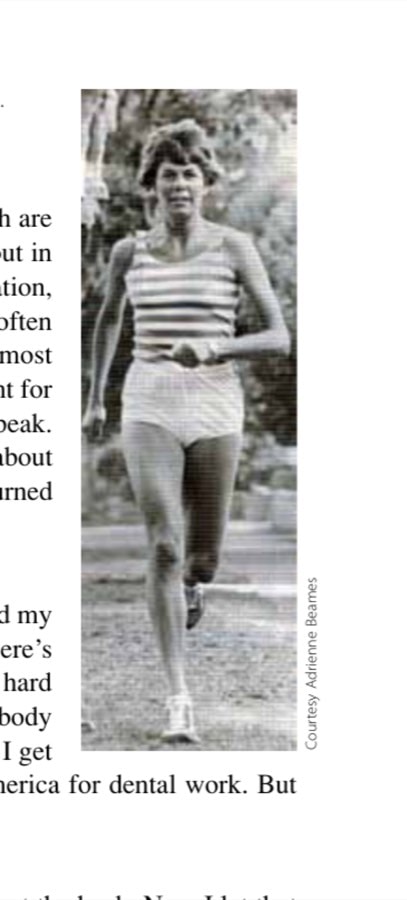
I provide a few contextual footnotes below, which are worth reading before you form opinions. I’ve set it out in Q&A form, but at the time, it was more of a conversation, sometimes cyclic as conversations about the past often are, with Adrienne returning to the things she feels most strongly about. I’ve only made it a little more coherent for easy reading. I let her speak here as she chose to speak. Readers should make their own judgments, especially about the day in 1971 when the unknown Adrienne Beames turned the world of the women’s marathon on its head.
AB: My father was Percy Beames, a very famous Aussie-rules footballer, cricketer, and journalist. Yesterday when you were speaker at the MCG (Melbourne Cricket Ground) we were in the Percy Beames Room. RR: Did you show early talent as a runner? AB: I was good at tennis at school, and an interstate tennis player. And I was three times Victoria state squash champion. As a singer I reached the semifinals of the Sun Aria competition. I could have gone in that direction. I didn’t get into running till I was 26, through a girl I was playing squash with. We used to run the men’s cross-country. I used to run with Brenda Jones [later Carr], who was second in the 800 meters at the Rome Olympics in 1960. I liked the feeling of cross-country, so I gave away squash. That was 1969.
Although I’d only just begun, I was second or third in the Australian crosscountry and got selected for the international championships, along with Raie Thompson of Adelaide. Brenda didn’t go. It was in America—Frederick, Maryland. I remember Doris Brown from USA was there, and Cheryl Bridges, and Rita Lincoln from England.1 RR: How were you training? AB: That was when I met Fred. He had been a professional runner. Professional athletics and road running were big in Victoria back then. It was a full alternative sport to amateur athletics, although the prize money was only small. Fred was good. He ran 29 minutes for 10,000 meters and a 2:32 marathon on track training. There was a professional marathon every year in Melbourne. Fred modeled my training on Arthur Lydiard’s Run to the Top so put me on to twice a day, with a six-miles morning run, then track reps or fartlek, and 22 miles on Sunday. I soon improved on that work. Our philosophy was from Zatopek. He said, “The toughest man wins.” And the toughest woman. My diet was strict, too. I used to run on the Caulfield racecourse. There were half a dozen or eight women running seriously. I ran for the Brunswick club. We had a team in the Victoria championship road relay in 1969. RR: No Australian team went to the international cross-country in March 1971, so the next time the world heard of you was on August 31, 1971. The world has never stopped talking about it. Tell me how it all happened. AB: The athletic association wouldn’t consider a marathon for women or letting me run any open marathon. But we knew women were running marathons in America and Europe. We knew I had done the work for that distance. I’d run 10 miles in 57 minutes and regularly ran 20-plus miles. We planned the race for six months. I asked the Victoria Women’s Amateur Athletic Association for timekeepers, but they weren’t interested. There was some prejudice not only against me as a woman but Fred as a tainted professional. So Fred organized the race himself,
Courtesy Adrienne Beames
▲
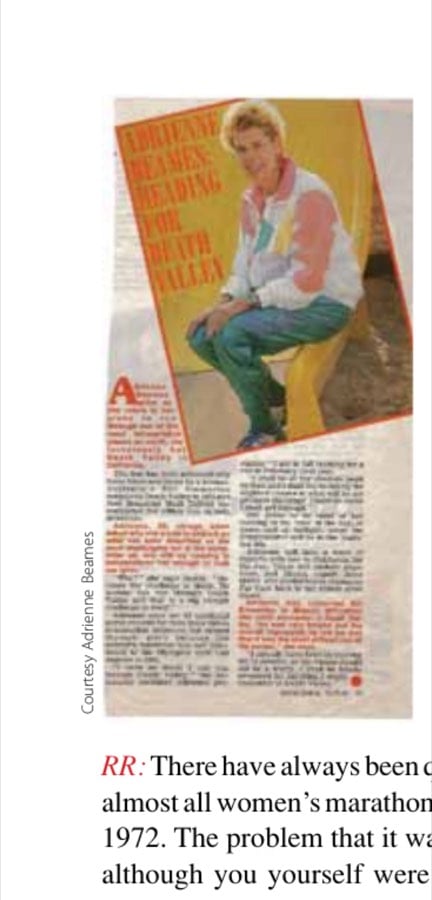
Coverage in an Australian magazine for Adrienne Beames at age 47, running 100 miles a week to prepare for the Badwater Ultramarathon.
using the course at Werribee [20 miles southwest of Melbourne; the aboriginal name means “backbone” or “spine.” These days it’s a commuter suburb, part of Greater Melbourne.] That exact same course was
used every year for the annual men’s professional marathon. So it was an established course, properly measured. Because the AAA wouldn’t help, he brought in guys from professional athletics as officials. We had three good timekeepers; the chief was
Mr. Jack Logan, who had been an athletics official for years. They were all experienced and qualified. It was a proper race. I was so fit, I ran 2:46. I still have the trophy, engraved with “Women’s world
record” and my time, “2:46:30.” 2 RR: There have always been questions about your run being unofficial, even though almost all women’s marathons were unofficial in 1971, including all at Boston until
1972. The problem that it was organized by officials from professional athletics, although you yourself were amateur, is one I hadn’t heard before. These days no one understands how the people who ran the amateur sport hated and feared
professionalism. But your time was recognised as authentic overseas, especially by America’s leading authority, Dr. David Martin. Did it change your life? AB: Yes, for the next five years. I was offered a track scholarship to Texas A&M
University, the first woman to get one, I think. I studied physical education so that I could teach when I got back to Australia. Fred wasn’t with me. He came over at the end of my time, when I ran the Fiesta Bowl Marathon in Scottsdale,
Arizona, in 1977. I won that in 2:46:25. And that was despite the heat, more than 80 degrees Fahrenheit, and blisters. And there was a last-minute switch of course, so it was long. I was 69th overall.
RR: That suggests that your 1971 time is credible as in your range, whatever the issues about it being unofficial. But many people in America were, and still are, skeptical of your world record. How did you get on in your time there?
AB: I eventually had 13 world records, including road 5K and 10K.3 I ran the Rose Bowl 10 miles in 1977, when Jacki Hansen was in the field. And the Bakersfield 10 miles in 1979. I won the Los Angeles 10,000 meters in 1978, first woman in
34:14. There were some top Americans in that race. I love competition, love to win. I was running best on road. I did a good half-marathon in 1978, 1:14, and
52 for 15K. I was 94th in the San Francisco Bay to Breakers, in 42:03. My fares to that were raised by the Women’s Sports Association of Texas A&M.4 RR: Still on the same training and diet? AB: Yes. I was totally dedicated. This is a quote from Fred. [She shows me a faded newspaper clipping]: “My greatest problem is to put limits on Adrienne’s mileage. Very rarely do you get a person like that.” RR: Then you went back home. And still driven to run high mileage, you got interested in ultras. AB: That was 1979. I started teaching phys ed. There was a Victoria Marathon Club, and through that Franz Stampfl [the famous Austrian-born coach] put on a 50-mile track race at the Melbourne University track. I ran in March 1980, ninth overall in 7:04:34. That same year, when I was 37, I started the Manly 100-mile track race. The papers called me “Bionic Beames.” At about 40, I was thinking I’d like to meet someone and settle down. At 41, I aimed at the Sydney-to-Melbourne race, 548 miles. About then I got a foot injury. I did a daily 1K swim and was eating only five meals a week, all raw, with a three-day fast quite often. At 47, in 1989, I aimed at the Death Valley Badwater race and was putting in 100 miles a week. RR: And then you went back to university. AB: I got my Graduate Diploma in Sports Science in 1992. That year, they made a film before the Barcelona Olympics about the greatest Australian runners. It had Herb Elliott, Betty Cuthbert, Ron Clarke, Rob de Castella, and me. I’ve got a video of it but I can’t work the player. I’ll ask the tenant to set it up if he can find an extension cord and you can come back tomorrow. RR: Any thoughts of the future now, Adrienne? AB: I’d like to meet someone and settle down. The next day my wife, Kathrine Switzer, joined me on the 40-minute tram ride out from central Melbourne. The house was closed. We had to wait in Adrienne’s small front yard, sheltering from the cold winter wind, until she limped anxiously into sight along the street. The taxi to bring her from the nail salon had failed to show, so she had to hobble a mile to get home. There is still a lot of brave determination inside her. She was restlessly eager for us to see the video, but the player didn’t work despite help from the kindly tenant, an immigrant from Eastern Europe. We tried to get to a vegetarian restaurant Adrienne knows, but there was a tram breakdown, the line ahead was closed, and we had to disembark on a windswept intersection in St. Kilda East. Eventually we helped Adrienne clamber up into another tram that would take her back to her home, and we watched it rattle away along the gray suburban street, carrying the first woman to run a marathon faster than three hours.
Notes 1 There were two rival women’s international cross-country championships in 1970, before the IAAF took over the event in 1973. The Australians ran in the English-speaking version at Frederick, Maryland, won by Doris Brown (Heritage) in 15:04 for 2.5 miles, with England’s Rita
Lincoln second. Cheryl Bridges (later Flanagan) was fourth American, 18th place in 16:02. The next year, Bridges (mother of today’s Shalane Flanagan) ran 2:49:40 for the marathon, which is given as a world record in lists where Beames is discounted. Beames placed 38th and last at
Frederick, in 17:44. 2 A report in the next day’s Melbourne Age, September 1, 1971, by Ron Carter, emphasizes the legitimacy of the course and timekeeping and provides some splits: 62:50 at 10 miles, 2:00:02
at 20 miles. That all hangs together and means she slowed a little in the last six miles, not unusual, especially as there was a headwind at that point. The Age quotes Beames as saying she had a target time of 2:50 and was ahead of that the whole way. The account is not an eyewitness
report but clearly compiled from comments by Warwick and Beames after the event, perhaps volunteered by them, and filled up with quotes of astonishment from famous Melbourne runners like Ron Clarke and Derek Clayton. It mentions no other runner, except for Warwick himself,
who (interestingly) “ran alongside Miss Beames yesterday.” 3 Beames’s best times, as given in the Nature’s Way pamphlet: Track: Mile 4:28.8 (1972); 5,000 meters 15:48 (1972); 10,000 meters 34:08 (-); 50K 3:07:11 (1978); 50 miles 7:04:34 (1980).
Road: 4 miles 21:52 (1971); 5 miles 27:35 (1972); 15K 52:14 (1978); 10 miles 57:23 (1971); 20K 71:17 (1977); half-marathon 1:14:14 (1978); 15 miles 1:27:33 (1972); 20 miles 1:57:47 (1978); marathon 2:46:25 (1977). 4 Beames was unspecific about the year she ran Bay to Breakers or her placing among the women.
Cheryl Bridges Flanagan won in 1972 and 1973 and the teenage prodigy Maryetta Boitano in 1974-6.
Derek Clayton My conversation with the legend was informal and fluid, and because this was Derek Clayton it was stimulating and vigorous, full of vivid memory and strong opinion. We talked during a good lunch, with Kathrine Switzer also there to tune in to one of her heroes, in a restaurant more or less halfway between Melbourne city and his semirural home. He then kindly drove me to the home of Adrienne Beames, a long way out of his way. I’ve tidied our rambling chat a little and have popped into the text (in italics this time) a few background notes and an occasional private comment.
This is not a full biography or assessment of Derek Clayton. For those, go to his own excellent book, Running to the Top (1980), or Rich Benyo’s insightful article, “Derek Clayton: World’s Fastest Marathoner” (Runner’s World, May 1979), posted on www.RichardBenyo.com/shorter.
Tall, powerful looking, very fit, and ruggedly self-confident, Clayton makes quite an impression when he walks in—the craggy face unmistakeable, even after many years, and with the thick black hair now white. At 71 (born November 17, 1942), he’s still an elite runner’s combination of being warm, good-humored, zestful, forthright, and potentially competitive. It’s kind of like meeting a semi-retired John Wayne for lunch. The six-gun isn’t on show but you sometimes hear it clink.
Roger Robinson: The last time we met, Derek, we were speakers at the Hospital Hill Run in Kansas City, and you were vice-president/sales director for Runner’s World. So you finally resisted the lure of America. Derek Clayton: Bob Anderson sold the magazine to Rodale, and I didn’t want to move to Allentown [in Pennsylvania]. I loved America, but I also loved this place, Melbourne, and it was an ideal time to return. I did a two-hour bike ride this morning. I’m a mad keen golfer and play every Thursday and Saturday. I’ve been an Aussie since I was 20. I’ve got two kids, and now I’m a new grandfather. [He beams proudly]. But those were good years, in America. I enjoyed the culture and opportunities of the running boom, I liked the work, and I did it well. I got on well with the Runner’s World editor, Rich Benyo, who was unusual because he didn’t clash with Bob Anderson. Bob could be difficult, but then again so could I. Most of the time we got on well and still keep in touch. Bob brought his models to Melbourne not long ago for his swimwear calendar and we did the shoot in my factory. I import glass for the building industry, but not much work got done that day. RR: Let’s go back. Born in Barrow-in-Furness, in the northwest of England, a tough steel and ship-building town, even tougher in the middle of World War II, with bombing and food shortages. Then you mostly grew up in Ireland . . . DC: My father was English and my mother was Irish. Their marriage broke up when I was 8, and my mother took my sister and me to live in Belfast . . . I played soccer, in the school’s first team. I was fit and strong and a good runner—I ran all over the field. I almost took up bike riding but we couldn’t afford a bike. One day I went to the running club. I never ran on the track, but that day I did four laps in 4:57. I ran off to join the RAF as a cadet and ran on the RAF athletic team. I wasn’t a bad runner even then. I could have stayed on but the military life didn’t suit me, being told what to do all the time. I wanted to try something different so resigned and decided Australia was a good place to start a new life. RR: You came in 1963, when you were 20.
He came out on an “assisted passage,” which meant paying only 10 pounds sterling for the journey by sea. The assisted-migrant scheme was subsidized by the Australian government to build the postwar population and economy. It certainly got its money’s worth with Derek Clayton. DC: Australia’s different. I was attracted to the wide-open spaces. I loved it. But it wasn’t easy. Mum and my sister came out to Melbourne and got jobs, but I was responsible for them, and I also went to night school after work, to be a civil engineer. We never heard from my father. Then years later, after the world records, I was running at the White City in London, against Ron Clarke, and outside the gate the kids were there wanting autographs, and in the crowd there was a man who made eye contact with me. I thought it might be him. Before the Munich
Olympics a telegram came: “Bring home the gold. Dad.” I threw it away. I didn’t think it was in good taste when I hadn’t heard from him since I was 8. RR: And you were running in those first years in Melbourne. DC: I wanted to be a miler, like Herb Elliott. I did intensive interval training, sometimes every day. I joined St. Stephen’s Harriers, a great bunch. It was a great track scene in Melbourne, with guys like Ron Clarke, Kerry O’Brien, and John Coyle, world record holders or close.
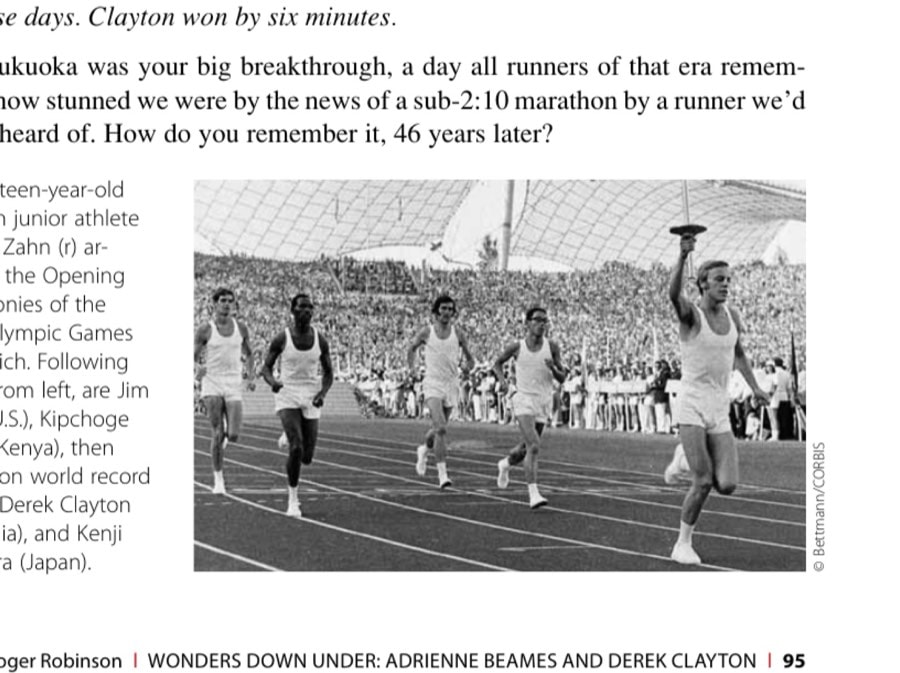
Clarke was a multiple world record breaker. O’Brien had the 3,000-meters steeplechase WR and was fourth in the high-altitude 1968 Olympics, just edged for the bronze by USA’s George Young. Running with those guys . . . ! It dawned on me that I’d never be fast enough to be a good miler, but I had great ability to run close to my max for a long time. My heartbeat then was 33, 34. I began to do long runs and push up the mileage. RR: You won the Victoria marathon champs in 1965 in 2:22:12, then DNF’d in the national champs in Ballarat in 1966. DC: I had some good local results. I ran a fast 15 miles and beat Ron Clarke by a minute. So I was getting there. Then I won my first Australian marathon title in Adelaide in 1967, in 2:21:58, and then did a 2:18. For the trip to Fukuoka, on December 3, I lifted my training to 150 miles a week. I wanted to give a good account of myself and do a personal best.
When Clayton won his first Aussie champs in Adelaide, the nonfinishers included Ron Clarke, Tony Cooke, and Dave Power. Australia was a running powerhouse in those days. Clayton won by six minutes. RR: Fukuoka was your big breakthrough, a day all runners of that era remember—how stunned we were by the news of a sub-2:10 marathon by a runner we’d never heard of. How do you remember it, 46 years later?
© Bettmann/CORBIS
▲
Eighteen-year-old German junior athlete Gunter Zahn (r) arrives at the Opening Ceremonies of the 1972 Olympic Games in Munich. Following Zahn, from left, are Jim Ryan (U.S.), Kipchoge Keino (Kenya), then marathon world record holder Derek Clayton (Australia), and Kenji Kimihara (Japan).
DC: Beforehand I felt like a small fish in a big pond. Races like Fukuoka were things I’d only read about. My plan was to run a personal best—better than 2:18!—by hanging with the leaders. I hung in there. Just hung in. They dropped off, dropped off. Mike Ryan was up there pushing it, up at the front till just before halfway. Then he dropped off.
Ryan the New Zealander had been third in the 1966 Commonwealth Games marathon and would be third in the 1968 Olympics. I had no idea how fast we were running. I’d never run with kilometer splits. Just as well he didn’t know. The splits were the fastest in history: 5K 15:06, 10K 29:57, 15K 44:57, 20K 59:59, halfway 1:03:22, 30K 1:30:32.
Sasaki caught me with about 15K to go. I started doing surges on and off, and at 35K I was away again. Then I just ran like hell to the finish. Later there was a fuss about a moment when I took a water cup from the Japanese, but it was nothing, he just handed it to me when I couldn’t get one without breaking stride. It seems he was expecting to share it and wasn’t impressed when I handed it back empty. I had no idea how fast I’d run. I just wanted to win the race. I was in a dream knowing I’d won what was called the unofficial world championship. After about five minutes, someone handed me a bit of paper that had 2:09 written on it, but I thought it meant 2:19, so I was disappointed.
The time was 2:09:36.4, a world best by an almost incredible two and a half minutes. He slowed a little from 35K, with 15:39 for that 5K, but the splits are consistent. RR: Now you were a favorite for the 1968 Olympics. DC: In Mexico City, at altitude. They took the team out there six weeks beforehand, supposedly to acclimatize. I hated it. Twenty miles a day through pollution in a city I didn’t like. But you had to do it their way. I didn’t handle it. Ron Hill was there, he hadn’t made the British marathon team but was running the 10,000 meters, and he helped me. “I’m stuffed, Ron. There’s nothing there,” I said. I was never up there.
In the Australian champs Clayton had beaten John Farrington by two minutes, in 2:14. In Mexico, Farrington was up with the leaders early on, but Clayton could never get in contact. His strength still showed, as he improved from 10th at halfway to finish seventh. RR: Then just when people were writing you off as a one-race wonder, you came back at Antwerp in 1969. DC: I had knee surgery after Mexico. It was a torn meniscus, but I put off the surgery until after the Olympics. Then I kept pushing the training up. I didn’t do regular 200-mile weeks like some people have claimed, that’s too much, but I pioneered high-quality high mileage.
The big buzz idea in marathon training on all the websites in 2014 is Renato Canova’s “extending specific endurance,” which means high-volume training at or close to your goal marathon pace. Clayton had that sussed in 1967.
I did go over 200 miles a few times, but at the quality I was running, it was obviously too much. It’s the quality that’s important. I don’t like going slowly. I drive fast, I do everything fast. That’s why I bike hard now. Ron Clarke was my favorite training partner, because he kept me honest. We used to try to break each other up hills. A lot of people wouldn’t train with me, as I ran too hard.
After the Fukuoka record, I thought I could break 2:08, if conditions were right, with a flat course, cool weather, and top competition. I earmarked Fukuoka again, but injury prevented me. After the knee surgery, I was running brilliantly in 1969. I accepted an invitation to race a marathon in Ankara, Turkey, only 11 days before the Antwerp race. Expenses were covered at the Turkey race, and I planned to treat it just as training. I was running 25 miles anyway every Saturday in training. It was at 5,000 feet altitude and hot and humid. I thought I’d run 2:20 but won in 2:17:26, obviously worth much faster, well ahead of two Turks. Second was Akcay, who had been ahead of me in Mexico. I beat him by five minutes. It was a great result, but of course I’ll never know how much it took out of me for Antwerp. RR: Expenses? People now forget you and other top runners had to fit all that training and traveling around a full-time job, and there was strictly no monetary reward for winning high-profile races or in your case transforming a whole sport. DC: The story got round that Antwerp paid me $500 or $1,000 for the world record, and I got banned for a while because of it. But it was travel expenses. It cost me that much in phone calls to get it sorted out. But common sense prevailed.
The financial details of today’s world-record bonuses are not made public, but 500 times that figure might be a starting point. RR: Did Antwerp provide pacemakers? DC: Absolutely no way. I wanted real competition. It’s about winning. I cringe at all this pacemaking. Winning was my adrenaline rush. RR: There are a number of accounts of that Antwerp race on the Internet. It sounds as if you were pretty positive beforehand. DC: I knew I was running well. I knew I had a faster one in me than Fukuoka. So I said beforehand, “I’m gonna go for the world record.” It was a good field—Jim Hogan, Jim Alder, Ron Grove, two Kenyans, and the Japanese Usami, who was only a minute behind me at Mexico.
Hogan had won the 1966 European Championship marathon and Alder the 1966 Commonwealth Games. Stories abound about the reaction among the other
runners to Clayton’s prerace world-record pronouncement. Amateurs were expected to be self-effacing in those long-ago days. Today such predictions are standard from media-conscious sponsored elites. RR: So you had the competition, the flat course, and the conditions were reportedly perfect. It started in the evening and went on after dark, a cool night with no wind. The fast early pace was set by Bob Moore of Canada, whose best was 2:21 at Boston six weeks earlier, so the 15:00 first 5K was way over his head, though perfect for you. Since Moore recently went on record as saying he found you “obnoxious,” it’s unlikely he was sacrificing himself to help you. DC: To be honest, I wasn’t interested in the others, as I had my own race plan and was determined to stick to that. Even splits was my aim. I was leading by 9K anyway, and only Usami came with me. I was alone from a bit after 10K, which was 30:06. They were either intimidated, or they expected me to blow up. I had a schedule of times on the back of my hand, and the split times were called out, unlike Fukuoka, where I had no idea. This time I knew where I was on time and ran as hard as I could to the finish. RR: OK, the tricky question. In that phenomenal Antwerp race, May 30, 1969, you ran 2:08:33.6, bettering your own world record from 1967 by a minute and giving you the two fastest times in history, by a huge margin. It was nearly 12 years, 1981, before Rob de Castella broke your record. The world was stunned, and many were skeptical. The accuracy of that course has been disputed ever since. Ron Hill regarded himself as world record holder for his 2:09:28 in 1970, and some lists give that as an alternative progression. I’ve talked to other top runners of the time who are convinced it was short. Mind you, they weren’t there. DC: It’s understandable that there were questions, because 2:08 was considered impossible. I had asked the organizers beforehand to double-check the course because I knew a record was possible. I found out later it was 80 meters long. Look at the splits. What split would you question? It was a cool, still, nighttime race, and being tall and solidly built compared to most runners, I always struggled in the heat. The cool night run really suited me. I felt like a well-oiled machine that night. I was in great form, and 2:08:33 was slower than I knew I was capable of. I was suffering the last 5K, but knew I was on course for a world record.
Splits: 5K 15:00, 10K 30:06, 15K 45:17, 20K 1:00:30, 25K 1:15:41, 30K 1:30:56, 35K 1:46:14, 40K 2:01:55. RR: More disappointments came in the Games marathons. Ron Hill had his best day in the Edinburgh Commonwealth Games in 1970. What happened? DC: I failed the medical beforehand. I had a bad cold. The team doctors wanted to stop me running. I had to get a waiver to run. It wasn’t bullheadedness, I was getting back problems, I knew the body can break down, and I needed to take
every opportunity. I was up there early on, but I got chest pains. I tried to give it my best shot but ended up in hospital with pneumonia. Jim Alder, who’d been third behind me at Antwerp, got the silver medal.
We skipped the remaining running years. Clayton had one more outstanding marathon in him, the 1971 Australian championship, when he won decisively in 2:11.08.8. At that date, only Hill, Bill Adcocks, and Clayton himself had run faster. It was the fifth-fastest marathon in history, done with an all-Aussie field of 42 in Hobart. He was among the leaders in the 1972 Olympics in Munich until halfway, finishing 13th in 2:19:49.6, and he was up there again for a while at the 1974 Commonwealth in Christchurch but did not finish that one. RR: And then? DC: I had an Achilles problem. I was fed up with the body breaking down. You know, when I first started we didn’t have good shoes. I trained in Dunlop Volleys. On my intensity of workload, there were always problems. So I retired. I’d lost my motivation. I’m like Ron Clarke, I’d run with a broken leg. But I did what I wanted to do. RR: Looking back, how do you see it? DC: It was a short career. I started at 19 and retired at 31. I’d given it my best shot. Eleven years was enough. Fukuoka was the best moment, because it came so out of the blue. It was better than any gold medal, it was so unexpected and almost unbelievable. I was different from most runners, as I ran for success only. Without the ability to achieve my high standards, running would not have had any interest for me. Given the choice, I would have preferred to be a professional soccer player. RR: And you got headhunted by Runner’s World? DC: When running took off in America, I was the world record holder. It was a good time. I had cousins in the US, my mother’s brothers were there and their kids are US citizens. I was earning good money with Bob Anderson, and I was invited everywhere as speaker. One year I gave 55 lectures, all round the States. I wrote my book, Running to the Top. I was fortunate that I was able to take advantage of my marathon reputation years after my retirement. RR: Then when Anderson sold out, you came back to Melbourne. DC: With my wife, Jen, always. Yes, I developed my own business as well as putting back into running. I was Chairman of the Melbourne Marathon for 10 years, and on the board of the Victoria Institute of Sport. And I got seriously into golf and biking. It’s a bike culture here in Melbourne. I’ve got an expensive bike, and I ride with guys 30 years younger. A group of 20 of us from Melbourne went to France and rode the Tour de France People’s Race. That was great, 100K a day,
up through the Pyrenees, and all the young guys sitting on me into the wind and trying to get me on the hills. But I’m still strong and competitive. RR: You seem a satisfied man. DC: I’ve got a lot to be thankful for—a successful marriage, great kids, a lovely home. I designed and built it myself. I like to have a project. You need to have a goal and do everything to achieve it. Nothing in life is easy. Running’s the same. I tell my kids to never have regrets and give everything your best shot. It was tough, training in the dark after a work day from 8:30 a.m. to 5:00 p.m., but that’s the way it was. I loved the long, tough nature of it. For me, to win a marathon was the ultimate high. Now, though I still have the business, others do most of the work. As well as the Tour de France, I’ve played golf on most of the top courses around the world, and in June I’ll play 16 great courses in 18 days in Ireland and Scotland—another marathon! I had a knee replacement five years ago, and I’m in good shape. I bike, play golf, and go to the gym. This thumb surgery is clearing up, and I’ll soon be back into serious golf. If I died tomorrow, I’ve had a good life.
Derek Clayton dropped me outside Adrienne Beames’s home, where I would hear a very different life story. I watched the man who ran the world’s first two marathons under 2:10 drive his sleek BMW confidently away.
This article originally appeared in Marathon & Beyond, Vol. 18, No. 3 (2014).
← Browse the full M&B ArchiveMore like this
1,000+ stories from 19 years of Marathon & Beyond
The complete archive of the legendary long-distance journal — digitized and free to read.
