

Worst-Case Scenario
Disasters on Course Are Often Resolved Behind the Scenes. How the Cincinnati Flying Pig Marathon Dealt With a Fire on Race Day. by Betsy M. Ross
“W
e may have to delay the marathon at least three hours.” Few words can put a chill down a marathon staff’s spine quite like the word “delay.” For runners and walkers who have their pre-event routine timed to the minute, any kind of a disruption is upsetting at the least and devastating at the worst. But that was what the Cincinnati Flying Pig Marathon faced the morning of Sunday, May 4, at the start line for the 10th annual running. With a record field of more than 16,000 ready to go at 6:30 a.m., a house fire along mile 22 of the route had just turned into a three-alarm inferno, forcing the closure of that stretch of the course.
As the public relations firm for the Flying Pig Marathon, it was the responsibility of Game Day Communications to disseminate the information to various media outlets while keeping runners and walkers informed of the developments and assuring everyone that yes, the marathon would go off as close to schedule as possible. So how do you do that while controlling your message to the media and keeping participants calm? By anticipating as many crisis scenarios as you can think of.
The fire may have broken out at 5:30 a.m. on race morning, but the preparation for this moment started months earlier. Each winter the marathon staff goes through every possible race disruption that comes to mind—from water-main breaks to fires to excessive heat to a tooclose-to-call finish. Those who have worked in the event business have seen these unforeseen events happen from time to time.
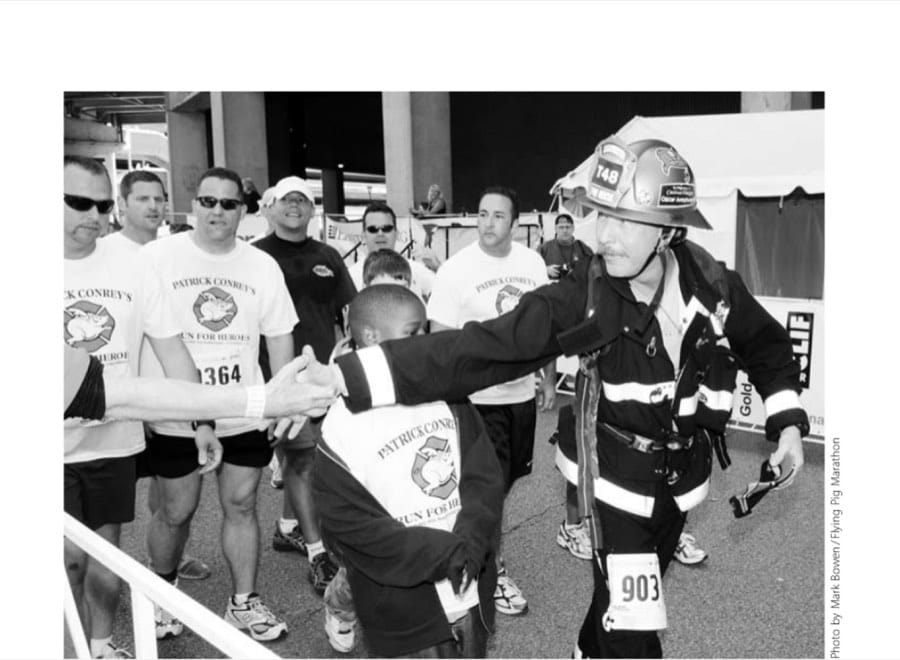
Photo by Mark Bowen / Flying Pig Marathon
How each staff deals with the crisis, though, separates the good events from the great. The Flying Pig’s crisis manual includes every possible emergency along with a plan of action for each one. In each plan, the appropriate staff members are consulted, and then one Pig official is designated as the media spokesperson. Designated spokespersons have gone through media training and speak only about their area of expertise to make sure the correct message is presented. For example, with a medical incident, the medical director meets the media. For a weatherrelated incident, the staff consults with the Pig’s TV partner’s meteorologist with the executive director as the media contact, and so on. Coincidentally, this year, for the first time, we included a fire on the course as one of our possible crises and planned for it. Who would think it actually would happen?
So when word of the fire along the course came down, the marathon’s executive director (Iris Simpson-Bush), the race director (Don Connelly), and the Cincinnati Police Department’s liaison to the marathon (Sergeant Greg Lewton) met at the start line to decide the plan of action.
At the same time, the marathon’s media partner, WLWT, the NBC affiliate in Cincinnati, was preparing to go on the air at 6:25 a.m. for live marathon coverage.
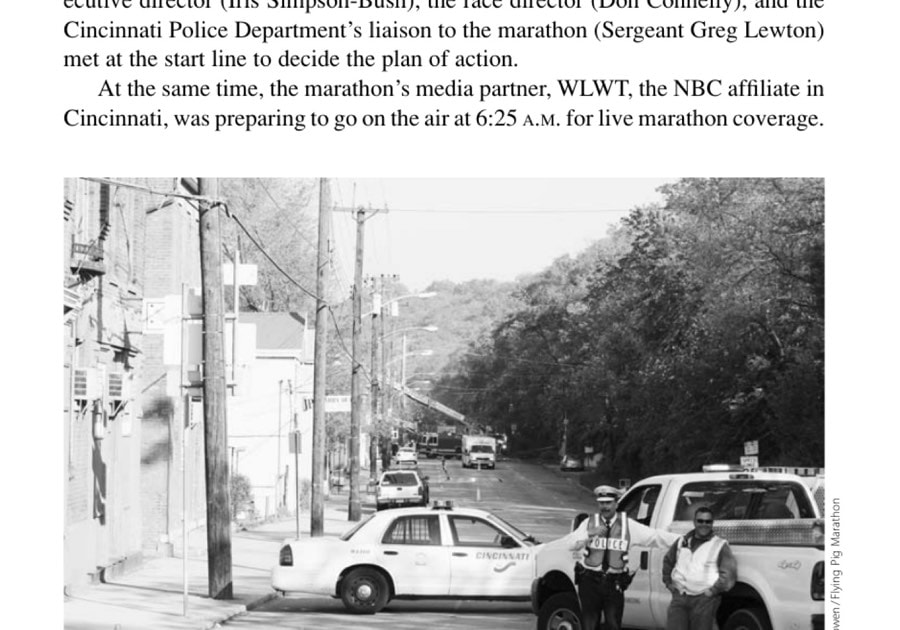
Less than an hour before the start of the Flying Pig Marathon, a three-alarm fire forced part of Mile 22 to be closed. Race officials and the Cincinnati Police were able to set up a safe detour with minimal delay to the start time.
And of course, thousands of runners were heading to the start line. While the early discussion focused on how long it might take to clear the route, the next option was how to route runners around the danger.
At 6:05 a.m., with the start of the marathon less than a half hour away, Iris, Don, and Sergeant Lewton decided to go to the scene of the fire to see for themselves just how the course might be routed around the emergency. So with sirens blazing in the police car, the marathon decision makers went to mile 22 to decide the safest way to detour the runners and walkers.
At 6:20 a.m., the call came to the start line: the course would be moved a block, adding about a quarter mile to the marathon, and the start would be delayed about 15 minutes while police and safety crews set up the detour.
Only then, when the decision was made and the plan of action set, did the announcement go to the runners, the media, and the Pig’s online audience through Twitter (www.twitter.com), a social-media instant-messaging service. In fact, at the same time the delay was being announced to the runners at the start line and on live television, instant-message followers were getting that same information so there were no opportunities for rumors or false information to be spread about the start of the event.
Once the first delay message went out just before 6:25 a.m., start line announcements kept the runners informed every couple of minutes about the situation on the course and the adjusted start time. To their credit, the runners understood the reason for the delay, accepted the change, and were more than gracious about the circumstances. Keeping the runners informed and updated as soon as the facts were known helped the situation.
The delay was less than 15 minutes. Participants for the opening ceremonies stayed for the minimal delay, and the pink fireworks to celebrate the Pig’s 10th anniversary went off just as the runners were hitting their stride along the riverfront.
Crisis planning that took place months before paid off in the 45 minutes it took to find out about the situation, deal with it, and disseminate the information to the affected parties. Because of the advance planning, staff members were cool, calm, and determined to find a quick solution.
In all, there were three key components to working through this crisis: 1. Relationships with the city. If it had not been for the close working relationship between the marathon and the police, finding a satisfactory
detour around the fire would not have been as easy as it turned out to be. Having a close working relationship with the safety departments makes the big decisions a lot easier. 2. Communication with the media. Working with the Pig’s television partner
to get the word out about the delay through announcements, interviews
Photo by Mark Bowen / Flying Pig Marathon
After fellow firefighters in Cincinnati quelled a fire on race morning, Florida firefighter Pat Conrey, who completed the marathon in full fire gear, reaches the finish line after running in honor of three Cincinnati area firefighters who had recently died in the line of duty.
with selected marathon staff, regular news, and start line updates made dissemination of correct information easier and prevented false information from getting out. 3. Technology. This was the first year in which the
Pig used Twitter as a way to directly communicate with marathon followers (mostly spectators following their runners). Using this free method of social-media instant messaging, Twitter subscribers across the country knew instantaneously about the delay and were kept
up to date on the course changes. Of course, none of this would have worked as smoothly as it did without the crisis manual formulated in advance. But at the end of the day, the relationships with key planners and media, along with the relationship between the marathon and its record crowd, made the 10th-anniversary Cincinnati Flying Pig Marathon one to remember.
This article originally appeared in Marathon & Beyond, Vol. 12, No. 6 (2008).
← Browse the full M&B ArchiveMore like this
1,000+ stories from 19 years of Marathon & Beyond
The complete archive of the legendary long-distance journal — digitized and free to read.
