

The crowning of an olive-branch wreath atop the winner’s head at the Boston Marathon is far from a cliché. There is a deep, soulful connection and meaning between the wreath, Boston, and the ancient Olympics. The
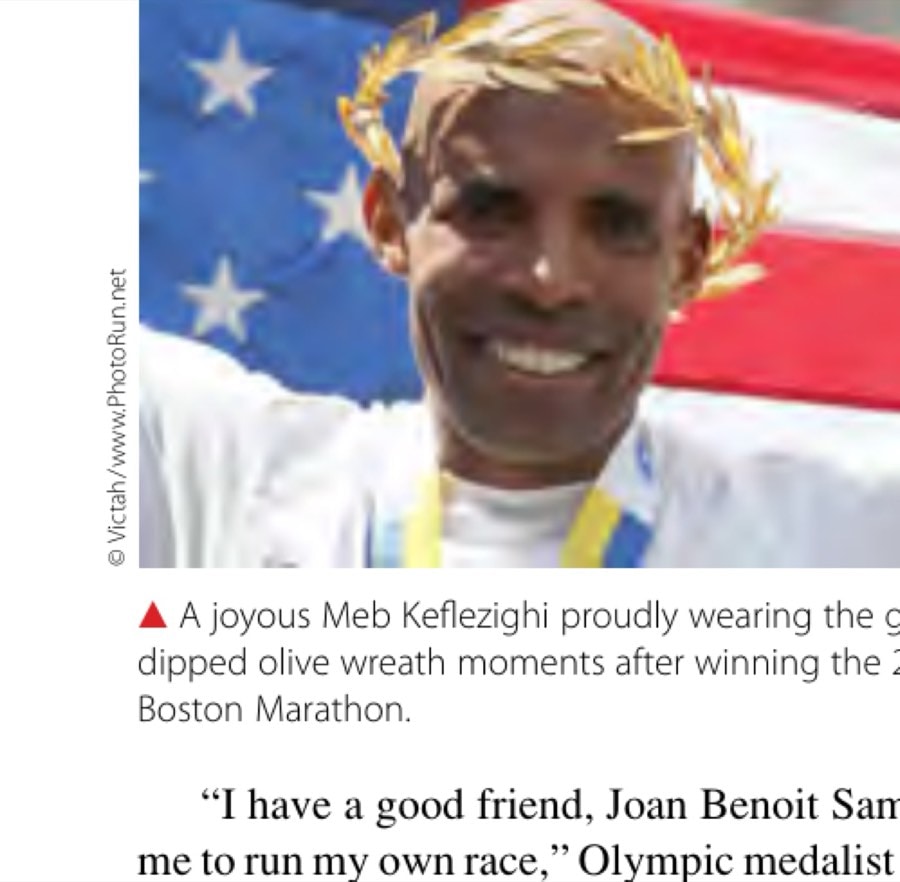
history of that thread—through Greece, the Olympic Games, the marathon, and the Hub—is intertwined over thousands of ▲ A joyous Meb Keflezighi proudly wearing the goldyears and miles. The bestowal of
dipped olive wreath moments after winning the 2014 the wreath is a symbol of peace, Boston Marathon. competition, and unity. “I have a good friend, Joan Benoit Samuelson, and for three years she’s told
me to run my own race,” Olympic medalist Shalane Flanagan said about the 2014 Boston Marathon. “I wanted to go out and do just that. I wanted to see if it was good enough to win the olive wreath.” Flanagan, born about 16 miles northeast of Boston, was seventh overall and
the first American woman. Her remarks about the olive wreath speak volumes about the respect in which it has been held for centuries. The Boston Marathon has crowned its victors with a wreath even more times
than has the modern Olympic Games. Sandrine Tonge of the International Olympic Committee (IOC) said that it is neither mandated by the IOC nor directed in the Olympic charter to present wreaths to winners. Individual Organizing Committees
for the Olympic Games (OCOG) have featured olive-branch wreaths in only four Games since its resurrection: 1896 Athens (olive-tree branches), 1912 Stockholm, 1936 Berlin, and 2004 Athens.
Massachusetts native Deena Kastor won bronze in Athens and received one of those rare olive wreaths, known in Greek as a kotinos. “Just prior to stepping into the stadium for the Olympic-marathon medal ceremony,” Kastor recalled, “a presenter told us women that the six marathon medalists—we three women and the three men who would compete a week later—will receive our laurel wreaths from Athena’s ancient olive tree: ‘It is a way of honoring an event with rich history here.’ I was ecstatic!”
Meb Keflezighi of the United States won a silver medal in the men’s marathon and was crowned in front of 70,000 people in Athens Olympic Stadium as part of the 2004 closing ceremonies. “I decided to go with the marathon because it was in Athens and it was the original course,” Keflezighi said, “and [the medal ceremony] would be in the closing ceremonies.”
Ancient origins The rich history of the ancient Olympic Games dates back to at least 776 BC, according to the IOC’s Factsheet: The Olympic Games of Antiquity, although myth and legend recount that the Olympic Games predate humans through heavenly competition between such deities as Kronos (the king of heaven) and Zeus (the Greek god of all gods), as noted in Aaron J. Atsma’s “The Theoi Project: Greek Mythology.” For more than 1,000 years, until Roman Emperor Theodosius I abolished them in AD 393, the Games honored Zeus in the shadows of his monuments and temples in Olympia, Greece, according to Factsheet: The Olympic Games of Antiquity.
The ancient Games were held in Olympia every four years, a period of time known as an Olympiad. Only one champion was announced in each event, and the champions received a number of symbolic items of victory. At the conclusion of the Games the champions received a crown made of an olive branch, according to Factsheet: The Olympic Games of Antiquity.
Also noted in Factsheet: The Olympic Games of Antiquity is that the sacred nature of the olive branch can be traced to nearly 1000 BC in Olympia, where olive trees were among the vegetation that grew in the religious land of Altis, where it is believed Zeus was widely worshiped.
As referenced in “The Theoi Project: Greek Mythology,” Altis was a place of worship where legend told of two adult children of gods—Apollo (son of Zeus) and Daphne (daughter of Peneus). Daphne rejected Apollo’s relentless pursuit.
Eros (aka Cupid) shot an arrow of love into Apollo and an arrow of hate into Daphne, forever cursing Apollo to never earn Daphne’s love. Apollo’s incessant pursuit finally forced Daphne to call upon her father for help. He transformed her into a laurel tree, and Apollo resigned himself to declaring the tree sacred with great honor.
Later, the decision to fashion a wreath made from the sacred branches near the Temple of Zeus is said to have originated from the Oracle of Delphi upon request from Iphitus, King of Elis, according to The Olympic Games in Ancient Greece by Nicolaos Yalouris (general supervisor). After nearly 1,500 years without the Games, archeological digs began to uncover some of the centuries-old ruins, according to Factsheet: The Olympic Games of Antiquity. In 1892, Pierre de Coubertin of France began his quest to resurrect the Olympic Games, which led to the founding of the IOC two years later and the first modern Olympic Games in 1896.
Early Boston Much as de Coubertin was swept up in the Olympic ideals, so too was the Boston Athletic Association (B.A.A.) by the new Games. Club members not only excelled in the competitions, but they brought back with them the same values and spirit that had inspired the Frenchman.
As a direct result of the B.A.A.’s highly successful participation in the 1896 Games, the Boston Marathon was born in 1897. The B.A.A.’s Tom Burke—who famously started the first race in Ashland with a drag of his heel for the Pleasant Street start line and a simple “Go!” command—had won a pair of events in 1896. King George I of Greece presented Burke olive-tree branches (in place of wreaths) as part of the official recognition, as described in the Official Report of the Games of the I Olympiad, Athens, 1896.
In 1931, the Boston Marathon presented an olive-branch wreath to the winner, reportedly for the first time. George Constantine Demeter, a law professor, author, and the first Greek-American in the Massachusetts House of Representatives, arranged for the delivery from Greece of a wreath made from Hellenic olive branches.
For 17 races, Demeter cherished the honor of crowning the champions, one of whom was his sponsored pride and joy from Greece, Stylianos “Stelios” Kyriakides.
Kyriakides connection At the 1936 Berlin Olympics, in the shadow of Adolf Hitler, Kyriakides competed in the marathon alongside John A. Kelley, the 1935 Boston champion. The two became friends and Kyriakides ran at Boston two years later. Among the spectators along the course was Michael Dukakis, a 4-year-old Greek-American from Brookline. “Pheidippides’s run—running from Marathon to Athens to tell the Greeks that we had beaten the Persians—every Greek kid knew that story,” Dukakis said. “First [Boston] Marathon I watched was in 1938 [when Kyriakides] dropped out. It was terrible; the Greeks were [all disappointed].”
Kyriakides returned in 1946 to compete against Kelley, his friend and the defending champion. On the Greek’s shoulders stood more than personal pride. Kyriakides carried with him the hopes of his post-World War II homeland, which was destroyed by the Nazis, who nearly killed him during the war. “
Kyriakides . . . was just out with his family on a Sunday,” Dukakis said. “So this Nazi officer told him to empty his pockets, and he has his identification card from the ’36 Olympics, which might have even had Hitler’s picture on it or [a Swastika]. The officer looks at it [and tells him to] ‘Pick up your stuff and go home.’ He had almost been executed by the Nazis during World War II.”
By the time Kyriakides arrived for the 50th Boston in 1946, he was so underweight that his journey nearly ended before it began. “He didn’t weigh 120 pounds—his wife thought he was nuts, everybody thought he was nuts [to run],” said Dukakis. “The doctors in Hopkinton turned him down. They wouldn’t let him run. George Demeter vouched for him.”
At the Hotel Minerva he owned in Boston, Demeter housed and fed his 36-year-old compatriot. And on Patriots’ Day, Kyriakides (2:29:27) beat Kelley by a full two minutes in the fifth-fastest time over the first 20 years that Boston was 42 kilometers. A 12-year-old Dukakis watched this momentous race from the sidelines. “
I was there in Kenmore Square when Kyriakides and Kelley were running neck and neck in 1946,” Dukakis recalls. “As they came down Kenmore Square, Kyriakides began moving out ahead of Johnny Kelley. Of course us Greek kids were terribly conflicted because we loved Kelley, but this guy was Greek! It was an incredible race.”
Dukakis connection In 1951, Dukakis the student ran the 55th Boston in 3:31:00 for 57th place, 10 spots ahead of seven-time champion Clarence DeMar. “DeMar was ahead of us and we finally passed him,” Dukakis said. “It looked like a shuffle, but let me tell you something, it was a fast shuffle—probably six, six-and-a-half [-minute pace]!”
Dukakis deepened his relationship with the great race as the 65th governor of Massachusetts when he helped award the medal and wreath in 1975 when Bill Rodgers won the first of his four titles. “I always aimed hard for the win at Boston,” said Rodgers, “and it was always a tremendous feeling of satisfaction and happiness when I did win and received the unique gold medal and laurel wreath.”
Dukakis is proud of his heritage and his connections to the Boston Marathon as a runner, a Greek-American governor, and a podium presenter. His hometown hosts 2.25 miles of the course. “Remember, for Brookline kids, this was the event. We were all out there,” said Dukakis.
Boston in the early ’80s The early 1980s for the Boston Marathon were filled with turmoil, public apathy, the Rosie Ruiz cheating scandal, and warring factions. There was a very real possibility of “losing” the event when a potential deal had apparently turned over control to a Boston lawyer (though the B. A. A. would still organize the race). Lawsuits and bad press followed, all under the watchful eyes of television and radio stations and newspapers. “
It was bad. Everybody was mad at us,” recalled Tim Kilduff, the Boston Marathon race director in 1983-84, replacing Will Cloney, who served as the race director from 1947 to 1982. “The runners were mad at us; there was the whole amateurversus-professional thing where [the B. A. A.] wasn’t going to pay [prize] money; we had to straddle a number of demands and needs.”
Guy Morse, the race director from 1985 to 2000, recalls that the early 1980s were indeed difficult times. “Probably around 1981 or 1982, I recall having to come up with a plan B, as there was a chance the official wreaths would not arrive in time from Greece,” Morse recalled. “At that time, many things seemed very loosely organized and as the race itself was going through so much turmoil, a detail like the wreaths was left to chance. In any event, I secured backup wreaths made and stored by a local florist, which I believe we actually had to use one of those years.”
1984 Boston Amid the ruins arose an olive branch of peace from the very heart of its origin. In 1984, around the time
the Massachusetts Supreme Judicial Court voided the contract and returned the Boston Marathon to the B.A.A., Greek-American Hellenic Chronicle newspaper publisher and editor Peter Agris of Boston proposed creating a link between the Boston Marathon and Greece by way of olive-branch wreaths direct from the Hellenic Republic.
Kilduff brought the proposal to the B. A. A. board of governors, and a letter from Agris to Boston mayor Raymond Flynn confirmed the details, stating in part: “Beginning with the 1984 B. A. A. Marathon on April 16, the Government of Greece will . . . arrange each year to send two olive wreaths and two medals direct from the birthplace of the Marathon in Greece . . . [and] . . . On the day of the Marathon, April 16, Mayor Flynn and Gov. Dukakis will place the authentic wreaths on the heads of the male and female victors at the finish line.”
Kilduff and Morse both understood the significance of this new venture. “It’s a gift,” acknowledged Kilduff. “The concept of a gift from the people of Greece is how this all started. You know, I have a decent understanding of the marathon from a logistical, technical, and organizational perspective, but it wasn’t until I visited Marathon, Greece, and stood on the ground near the Tomb of the Athenians that I got the historic and emotional connection. Every year, I sit there with a big smile on my face [seeing] this once simple ceremony now being such a big platform for telling this story of the marathon, ancient Greece, Stylianos Kyriakides, and the Battle of Marathon.”
Marathon was the origin of the apocryphal tale that Pheidippides ran from the battlefield to Athens to announce that the Greeks had triumphed over the much larger Persian army—and that he died upon delivering the news. “
The battle was essentially the spiritual start of the marathon run,” Kilduff said. “That was really the birth. It’s evolved since then—had to wait a long time before somebody came up with this long-distance run in 1896—but the fact of the matter is, it’s a legitimate connection. “
And if you look at what was at stake at that point—which is all the more reason to connect governments—what was at stake was, essentially, in Athens they were developing the democratic form of government and that battle allowed that development to continue. When you’re out training for a marathon, you don’t think about this. But it’s pretty powerful stuff.”
The Alpha Omega Council, a Greek-American organization that Agris founded in 1976 to help spread Hellenic awareness, also promotes this message. Nicholas Kourtis, the Marathon Education Committee chairman, embraces that connection, especially as a tool for people to learn more about that lineage. “[
That Greek victory over the Persians] allowed ancient Greek civilization to flourish and make advances in democracy, science, philosophy, and the arts, all of which have provided the basis of much of Western civilization as we now know it,” he said. “It has also inspired others to stand against powerful empires
and improbable odds in the defense of liberty. [The Patriots’ Day link] is the embodiment of the citizen-soldier concept running from ancient Athens to Lexington-Concord and their Minutemen also facing down an empire in defense of republican liberty.”
While inherently rich in history, the Boston Marathon and those wreaths are bonds that Morse sees as intrinsic. “In the case of the Boston winners’ olive wreaths, to me, it was of utmost importance to resurrect and nurture that tradition in particular,” Morse said. “So many other traditions and usual ways of doing business were being tested and often abandoned in the name of progress. The wreaths, I realized, were not only a sacred link to our past but in actuality were linked to our very birth. “
Additionally, the wreaths and the relationship with Greece also symbolized the importance and worldwide support this marathon enjoyed. . . . [T]he Boston wreaths may be the single most enduring symbol of success, endurance, and grace in our or any sport.”
Peter Lemonias, Alpha Omega Council trustee and also chairman of the 2014 and 2015 Boston Marathon wreath ceremonies, endeavors to continue that tradition. “The wreath ceremony helps remind all of the Boston Marathon’s Greek origins,” he said. “The wreaths presented at the wreath ceremony are a gift of Greece and her people to the B. A. A. and all the people associated with the marathon.”
1984 recipients “Flown from Athens via Olympic Airways, the crudely fashioned wreaths resembled the original crowns presented to the Olympic Game victors with the symbolic olive branches, ancient symbols of peace,” said Peter Agris’s daughter, Nancy Agris Savage. Since 1984, the Greek consulate in Boston has presented the wreaths to B. A. A. officials several days before the marathon.
© Paul Clerici
▲
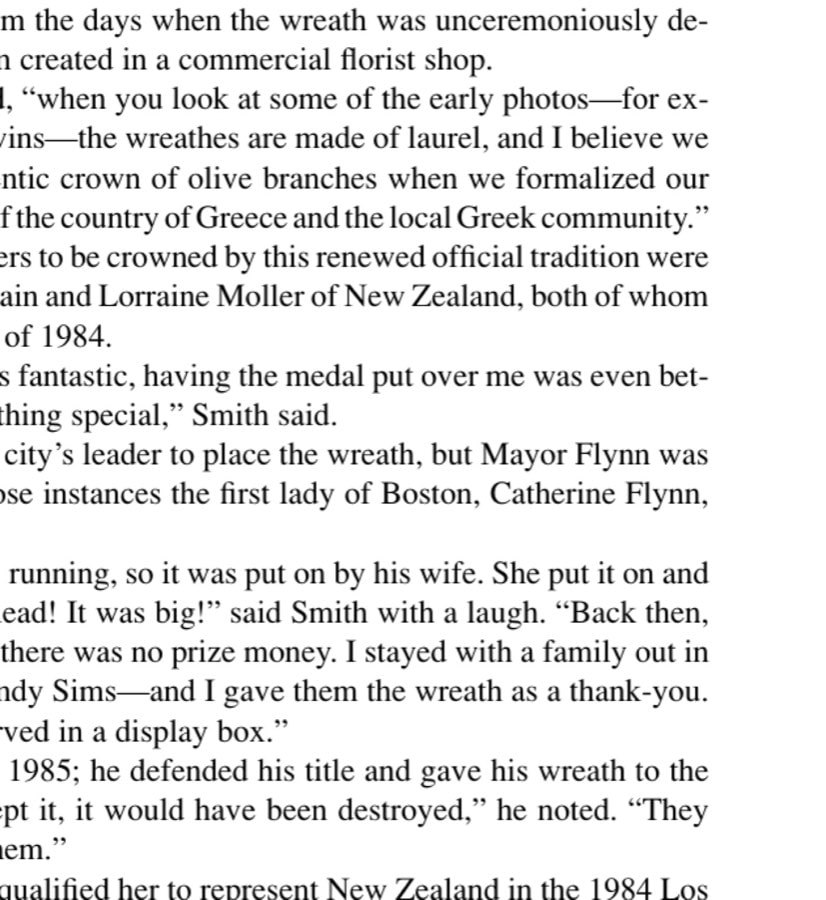
Former Massachusetts governor Michael Dukakis holding a photo of when he took part in the presentation of wreaths at the Boston Marathon, this one from 1986 with champion Robert de Castella.
This was a far cry from the days when the wreath was unceremoniously delivered to the race or even created in a commercial florist shop. “Of note,” Morse said, “when you look at some of the early photos—for example, Johnny Kelley’s wins—the wreathes are made of laurel, and I believe we moved to the more authentic crown of olive branches when we formalized our relationship and support of the country of Greece and the local Greek community.”
The first Boston winners to be crowned by this renewed official tradition were Geoff Smith of Great Britain and Lorraine Moller of New Zealand, both of whom won in the Olympic year of 1984. “Winning the race was fantastic, having the medal put over me was even better; the wreath was something special,” Smith said.
It’s customary for the city’s leader to place the wreath, but Mayor Flynn was usually a runner so in those instances the first lady of Boston, Catherine Flynn, performed the honor. “Yeah, the mayor was running, so it was put on by his wife. She put it on and the wreath fell over my head! It was big!” said Smith with a laugh. “Back then, you didn’t stay in hotels; there was no prize money. I stayed with a family out in Holliston—Barry and Sandy Sims—and I gave them the wreath as a thank-you. And they’ve had it preserved in a display box.”
Smith did likewise in 1985; he defended his title and gave his wreath to the Sims family. “If I had kept it, it would have been destroyed,” he noted. “They did a fantastic job with them.” Moller’s victory also qualified her to represent New Zealand in the 1984 Los Angeles Olympic Games Marathon. “
I can remember crossing the finish line, knowing that I had very likely just made the Olympic team for the inaugural women’s marathon in L. A. just a few months later,” she said. “Within minutes, I was escorted . . . to a podium, where I was handed a huge bunch of red roses and a laurel wreath was placed upon my head. Race director Will Cloney and Senator John Kerry stood beside me and applauded. I felt like a queen. Whenever I visit Boston, I always get those same good feelings—an uplifting sense of belonging to a wonderful history.”
Ceremonies The related ceremonies over the years have also grown. Early finish line ceremonies consisted of a lone official—usually Demeter in full suit, jacket, and tie—chasing after the winner at the finish line in an attempt to place the wreath upon the champion’s head in a somewhat dignified manner. There were times, however, when he waited for the moment the winner actually stopped. VIPs soon joined the festivities, as well as some kind of staging. In 1968, when Amby Burfoot of Wesleyan University won, however, he was more concerned about remaining upright.
“I remember my complete collapse into [race official] Jock Semple’s strong arms. I felt like an overcooked noodle at that point—a fairly apt description, given the warm sun and temperatures of the day,” he recalls. “After that, it’s all a blur.”
Semple held up Burfoot long enough for the champ to make his way to the temporary stage on Ring Road, where Mayor Kevin White placed the wreath. “I remember that the laurel wreath was too large, so it seemed to slip down onto my ears,” Burfoot says.
Rodgers won Boston four times between 1975 and 1980, and while the award presentation was nevertheless noteworthy enough to be accompanied by officials, politicians, media, and spectators, finish line pomp was still in its infancy. “
The Boston Marathon was not so tightly choreographed as it is now, [and] that includes the finish line for the winners,” he said. “There was no national anthem played; however, each instance I was quickly gathered up by several policemen and taken to a sort of podium where the laurel wreath was placed on my head.”
In the ensuing years, though, while winners were still being crowned at Boston, the reverence began to fade, recalls Kilduff. Enter Constantinos Orphanides, the consul general of Greece in Boston. Coinciding with the 2006 unveiling in Hopkinton of The Spirit of the Marathon statue of Kyriakides alongside 1896 Athens Olympic
Marathon winner Spiridon Louis, a formal wreath-receiving ceremony was instituted at the Greek Consulate General of Boston.
ad
Explains Morse: “The order went to Greece in plenty of time for creation and transport of the wreaths—on Olympic Airways most of the time—and at no cost to the B.A.A. or the city. The consul general for many years stored the wreaths in a refrigeration unit at the consulate and delivered them to us on race day. In later years, we formalized the presentation of the wreaths to the B.A.A. in a more appropriate ceremony that the special relationship deserved and thereby had all the important items in our hands several days prior to the event. They were kept cold and ‘spritzed,’ first at our florist’s locations then at our own offices on race weekend.”
Added Kourtis: “In the past, the wreaths have been cut from olive trees in the beautiful areas of Greece around ancient Marathon, carefully woven into wreaths, and then sent to the United States and to Boston via the secure auspices of the Greek foreign ministry.”
It was largely due to improvements in communications, organization, and planning that the foresight of the Greek community and the B.A.A. put together a ceremony worthy of the wreaths’ arrival and delivery. “
It’s evolved,” said Kilduff. “To drive home the connection to ancient Greece, that’s what motivates all of this. People run marathons all over the world. Do they understand its origins? Most of them probably don’t. The Hellenic community got involved, the B.A.A., the Greek-American community, Alpha Omega Council, Dimitri [Kyriakides] with the Stylianos Kyriakides story and statue, and in 2010 the 2,500th anniversary of the Battle of Marathon, it all fits in—all parts of the evolution.”
That evolution has grown from the wreaths’ being delivered by hand at the airport decades ago to the full pageantry at Boston’s capitol building today. The consul general of Greece receives the wreaths from their homeland and, in front of various leaders, presents them to the B.A.A. “
In addition to remarks of the consul general and the B.A.A. executives, we typically have the singing of the national anthems of Greece and USA, remarks by Metropolitan Methodios of the Greek Orthodox Church, remarks by political leaders, and others,” Lemonias said. “The audience consists of political leaders, interested academics, athletic directors, marathon-related organization representatives, marathon runners, former star runners of the Boston Marathon, members of the Boston diplomatic community, and representatives of numerous GreekAmerican organizations.”
Boston gold In honor of the 2,500th anniversary of the Battle of Marathon, gold-dipped olivebranch wreaths were awarded to the winners of the 2010 Boston Marathon. That special connection between Greece and Boston was heightened and strengthened
in the aftermath of the bombings that shattered the 2013 Boston Marathon. In recognition of Boston Strong and all that carried the community, the city, and the world to the 2014 anniversary, golddipped olive wreaths from Greece were once again created. “
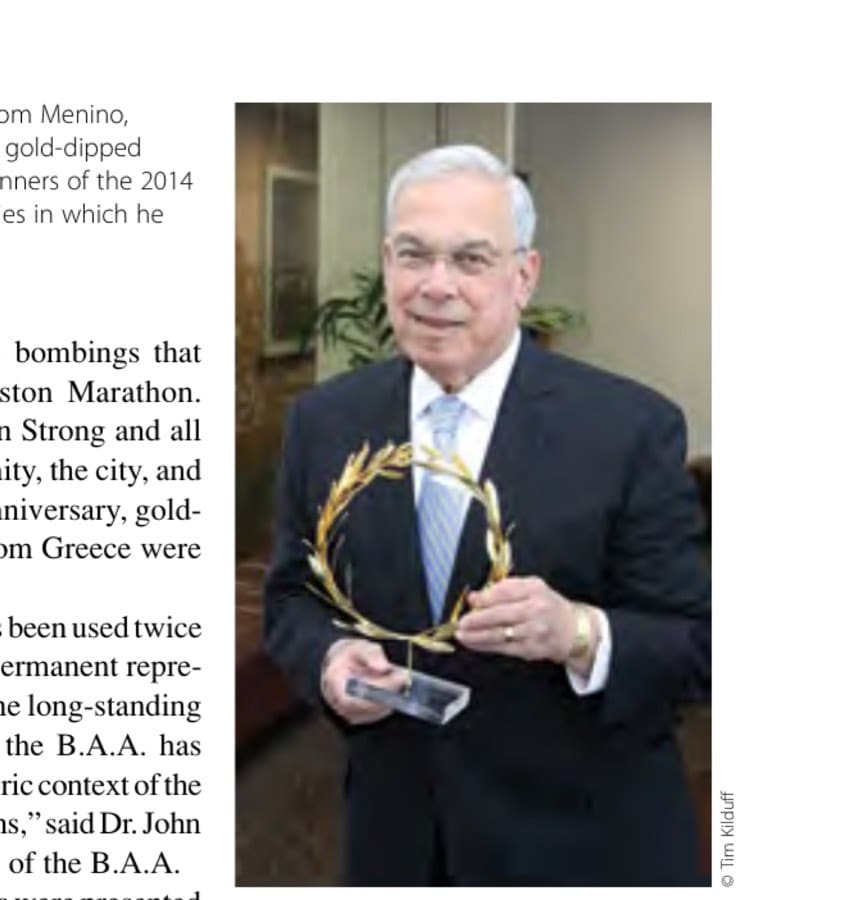
The gold wreath has been used twice by the B.A.A. and is a permanent representation and signifies the long-standing and lasting association the B.A.A. has with Greece and the historic context of the birthplace of all marathons,” said Dr. John V. Coyle, past president of the B.A.A.
For 2014, the wreaths were presented by Consul General of Greece Iphigenia Karas to B.A.A. President Joann Flaminio in a ceremony in the Great Hall at the State House in Boston. On race day, 2014 winners Ernst Van Dyk (men’s wheelchair), Tatyana McFadden (women’s wheelchair), Rita Jeptoo (women’s open), and Keflezighi (men’s open) were respectively crowned by Coyle; Dr. Michael P. O’Leary, a member of the Board of Governors; Massachusetts governor Deval Patrick; and Boston mayor Marty Walsh. “
It has truly been a personal honor to place the wreath on the winner’s head,” said Dr. Coyle. “And every time, I am struck by its significance going back to the original ancient Olympic marathons, where the winner received the wreath as his prize. To be affiliated with such an important legacy is awe inspiring.”
McFadden competed as a member of Team MR8, named in honor of Martin W. Richard, the youngest of the bombing victims, and wore the ubiquitous yellow-and-blue jersey. “[The wreath] was definitely beautiful, absolutely gorgeous,” she said. Immediately following the ceremony, McFadden—as the champions often do— saluted the spectators along the nearby bleacher sections on Boylston Street. She had noticed in the stands the big cowboy hat atop Carlos Arredondo, the spectatorturned-first responder in 2013 who was captured in an iconic image as he aided severely injured survivor Jeff Bauman out of harm’s way.
© Tim Kilduff
▲
The late Boston mayor, Tom Menino, proudly holding one of the gold-dipped wreaths bestowed upon winners of the 2014 Boston Marathon, ceremonies in which he partook each year.
“The cowboy,” McFadden said with a smile. She decided to give him the wreath. “Just reading his story, knowing his background. He gave so much support to Boston, and being so brave—everyone being so brave—I really wanted to give him the wreath on behalf of everyone as a thank-you.”
Keflezighi punctuated the emotional and cathartic vibe in Boston when he became the first American men’s winner since Greg Meyer in 1983. Keflezighi’s heartfelt exuberance and pride were seen and felt worldwide when he blessed himself and then punched the air in excitement as he crossed the finish line.
Keflezighi was initially unaware that the 2014 edition of the olive wreath was dipped in gold. “I knew they came from Greece,” he said. “And then to have it and then [for it] to come now, full circle, to not only get the wreath of olive leaves that come from the actual olive trees surrounding the fallen Athenians at the tomb, which I ran [past on] the course in 2004 in the Olympic Games, and in 24-carat gold, it’s amazing!”
Being crowned For both the presenter and the receiver, the placing of the wreath brings with it the historical lineage of those who have come before, from mythical gods and heads of state to elite athletes. “
That the olive wreaths have arrived from Greece is lost on no one involved with the B.A.A.,” said Dr. O’Leary. “We understand our historical roots, and we are proud of continuing our traditions for all to witness in this very public ceremony. Certainly, the presentation of the olive wreaths to the champions is one of the most visible and direct ties to our past and communicates instantly to a worldwide audience our heritage.”
Kastor says of her knowledge prior to winning her first wreath, “I was an English major with emphasis in creative writing and a second major in journalism, so I knew a lot about Greek literature. Add my love of the marathon and you can see that my love of the laurel wreath goes beyond signifying a win. It signifies rich tradition, excellence, and honoring a history [of] great athletic achievement.”
Travel with the wreath Due to the delicate nature of the wreath, it takes planning to bring one safely home. In Kastor’s case, the 7,000-mile journey from Athens in 2004 all came down to the final hurdle at US Customs and Border Protection inside Los Angeles International Airport. “I hand-carried the wreath on the three airplane rides back to Los Angeles, but immigration said I couldn’t bring it through customs because it was vegetation. ‘Oh, no!’ I begged, with no sign of the officer budging,” Kastor recalled. “One
© Tim Kilduff
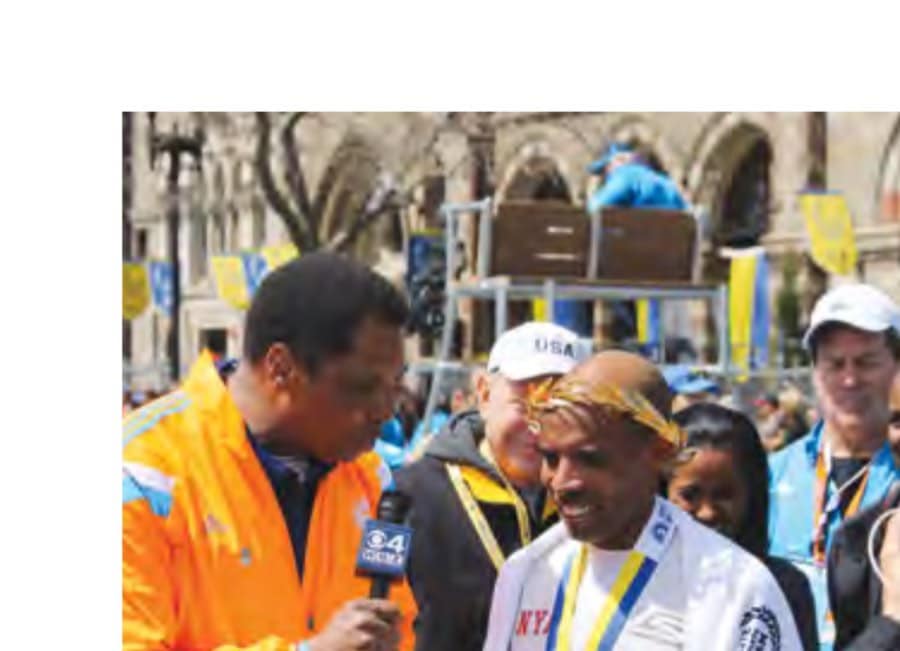
▲ At the 2014 Boston Marathon, champion Meb Keflezighi of the United States wears his gold-dipped wreath while being interviewed by WBZ-TV 4 Boston sportscaster Steve Burton, as Meb’s coach (Bob Larsen), wife (Yordanos Asegdom), and brother (Merhawi), from left, look on proudly behind him.
of my teammates said, ‘She just won a medal in the Olympics.’ That is when my fate changed. In Olympic Team circles it’s called dropping the ‘O’ word for the sake of benefits. The ‘O’ had been dropped, and after posing for photos with the officers wearing my medal, I was allowed to go through customs with my wreath in hand.”
From the same Olympic Games, however, Keflezighi experienced a different fate when his wreath was reportedly stolen during the postrace press conference (a gold-dipped wreath was later mailed to him as a replacement). But the bouquet of flowers he received with his medal accompanied him all the way to his first date with his eventual wife, Yordanos, who was waiting for him in Florida. “
I flew with that all the way,” he said. “The stewardess wanted to have it, but I said, ‘No. You can have it for seven hours’ for the flight. She put them in a nice vase, and I hand-carried those to Tampa. They didn’t stop me at security. I guess they knew I was in a rush—I was late for a date! We went straight to Olive Garden—my first date with my now-wife—and they said at Olive Garden they just saw me on TV and they took care of dinner. That was nice.”
But in Boston in 2014, the wreath remained close to Keflezighi. “We held onto it. While I was doing my tours, my wife brought it home and packaged it. We will frame it.”
On display The life of a wreath can vary. It can wilt easily or live on inside shadow boxes and frames. Rodgers openly displayed his 1975 crown in a framed shadow box at his Bill Rodgers Running Center store in Faneuil Hall Marketplace in Boston
for nearly 35 years until the store closed in 2012. “Charlie has my ’75 laurel wreath,” he said of his brother, who is now the keeper of the store’s running memorabilia. “Neither of us knows what happened
to the others. In ’75, I won a unique trophy that disappeared at some point after the laurel wreath and medal and trophy were presented to me. The trophy was in honor of [Rodgers being] the first American runner that day as we celebrated our
country’s birthday. I never saw it again.” Kastor undertook a tremendous effort to protect, preserve, and display her Olympic treasure. “The wreath hangs in a corner of our home’s great room. I had Joel St. Marie, a professional framer and photographer, treat the wreath with a
preservative, then create a shadow box for it.” Smith’s generosity in 1984 and 1985 indirectly saved his two wreaths. But Burfoot has no trace of his 1968 crown. “Gosh, I have no idea what became of the wreath. It might have gone back to Wesleyan with me or back to Groton [Con-
© Paul Clerici
▲
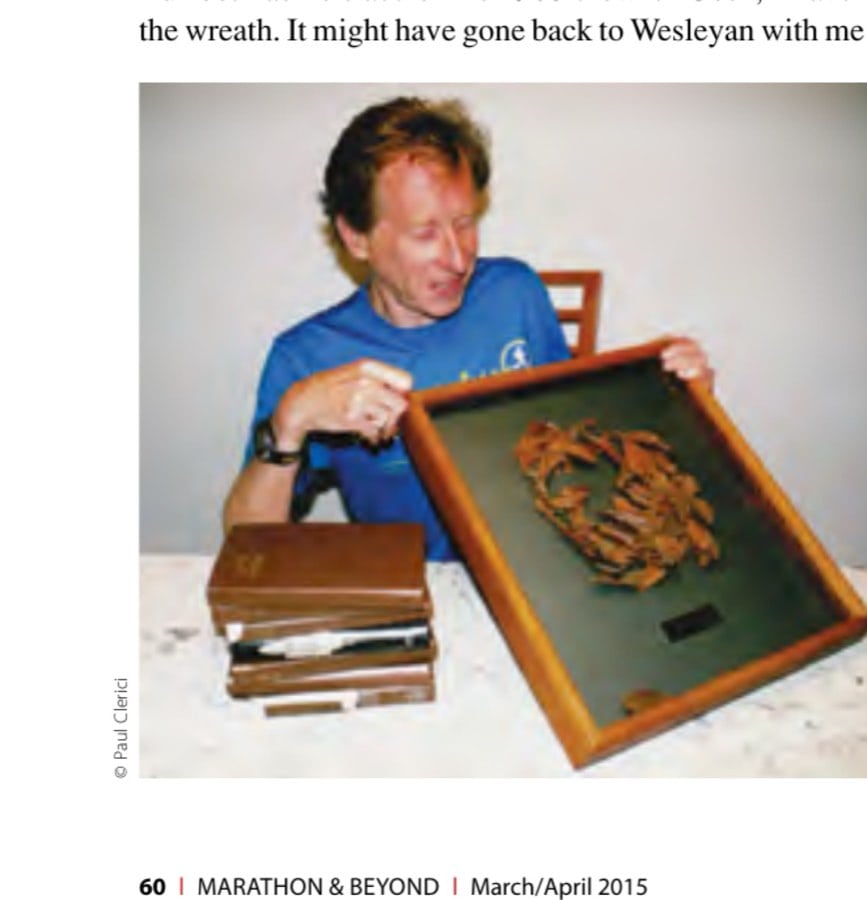
Four-time Boston Marathon winner Bill Rodgers wistfully looking at his 1975 wreath, which was displayed in this shadow box at his store for decades.
necticut] with my father. I never saved it or anything. I had a little winner’s medal that said B.A.A. Boston Marathon with a tiny diamond in it. And my memories. That was all I wanted.”
References Atsma, A. J. 2000-2011. The Theoi Project: Greek Mythology (website). Auckland, New Zealand: http://www.theoi.com. de Coubertin, P. and T. J. Philemon. 1897. Official Report of the Games of the I Olympiad,
Athens, 1896: The Olympic Games B.C. 776 – A.D. 1896: Second Part, The Olympic Games in 1896. English Translation by A. v. K. Athens: Charles Beck, Publisher; London: H. Grevel and Co. (Courtesy LA84 Foundation Digital Library Collection, Los
Angeles, California). Olympic Studies Center. 2012. Factsheet: The Olympic Games of Antiquity Update – May 2012. International Olympic Committee (IOC), Lausanne, Switzerland. The following reference source material was provided by the International Olympic Committee (IOC) departments of Media Relations, Press Office, Reference Service, in Lausanne, Switzerland, courtesy of Andrew Mitchell, Emmanuelle Moreau, Rachel Rominger, and IOC Media Relations manager Sandrine Tonge: Drees, L. 1967. Olympia: gods, artists and athletes. London: Pall Mall Press. Yalouris, N., ed. 1982. The Olympic Games in Ancient Greece. Athens: Ekdotike Athenon.
This article originally appeared in Marathon & Beyond, Vol. 19, No. 2 (2015).
← Browse the full M&B ArchiveMore like this
1,000+ stories from 19 years of Marathon & Beyond
The complete archive of the legendary long-distance journal — digitized and free to read.
