

“Young John” Kelley
Editor’s note: April 20, 2007, will mark the 50th anniversary of John J. Kelley’s Boston Marathon win. Young Johnny Kelley was the only American to win the Boston Marathon in the decade of the 1950s. We celebrate Johnny’s accomplishment by reprinting this chapter from Masters of the Marathon (Atheneum, 1983).
It is impossible to tell the story of the younger John Kelley (who is no relation to the other, older John Kelley) without telling the story of Johnny “Jock” Semple. John Semple was born in Glasgow, Scotland, on October 26, 1903, in a second-floor apartment not far from the steel mill called Dixon’s Blazes because of the hellish light its furnaces cast through the closely built, nondescript apartment buildings both day and night. John was one of three sons born to Frank and Mary Semple. At age 4, John and his family packed up and moved to Clydebank, a shipbuilding city on the River Clyde.
With more than a little encouragement from his father, Johnny worked part time for a local butcher. He would get up at 6:00 A.M., walk from house to house taking orders from the butcher’s customers, and deliver the goods on his way home from school in the evening. He earned 50 cents a week for his work. His father was a strong believer in the benefits of going to school, but Johnny was of the belief that it was better to have a nickel in your pocket now than to have the promise of a quarter after you got out of school. Quitting school at 14, he went to work at the Singer Sewing Machine plant, where his father also worked. The war was on, and there was plenty of work available.
Singer sponsored an annual sports day, and with the help of a soccer trainer who lived in the apartment below his, Johnny got some valuable training tips. He won the 100-yard dash, and it was not long before he was recruited by the Clydesdale Harriers, a local running club that stressed the social rather than the competitive end of running. The Clydesdales liked to win, but they felt that the fun was in the running and the physical exercise.
A SLIP TOO FAR As Semple recalls, “I improved rapidly as a runner until the day before my 16th birthday, when I broke my arm in a qualifying race for the Scottish National Championships. Though my arm was placed in a cast, I did not want to reduce my training. So I invented a workout at my job. I had many spectators each day as I slipped down to the main gate at the Singer plant to wait for the noon bell. Each day I tried to get a little extra running in by timing my exit more closely with the bell, but one day I missed, and my foot touched the ground outside the gate one second before the bell. That afternoon I got a call up to the boss’s office. He was an old fuddy-duddy with a personality like a fish, and he fired me. He also had seen me running my weekly soccer-score pool.”
Johnny decided to try going back to school to learn a trade. He chose the profession of a joiner (a carpenter who uses fine-grained wood). His apprenticeship paid only $3 a week, however, and with this he had to buy his own tools. He left that job and took one at a shipyard while he continued to train as a joiner. He worked at the shipyard for two years, but then a strike was called, and he was again out of a job.
Times were tough, and Johnny couldn’t see that things were improving greatly. One evening over supper, his father gave him quite a shock. He asked Johnny if he would like to go to America to try his luck there. Johnny jumped at the chance.
Johnny landed in Philadelphia full of enthusiasm—due partially to being on dry land again—and after looking for work for a few months while living with relatives, he secured a job as a carpenter at a shipyard. Although he loved the job, he eventually lost it and had to go knocking about looking for other work. However, he was soon able, by landing odd jobs, to get a place of his own. He also once again became involved in athletics by joining the Kensington Athletic Club.
Philadelphia was working on putting together a major exhibition to celebrate its sesquicentennial. Semple worked laying floors for the Japanese exhibition. One of the events the exhibition planners had scheduled was a marathon run. Johnny decided to train for it and began immediately by running 10 miles through the streets of Philadelphia that night after work (as Rocky Balboa would do at dawn 50 years later). He upped his training to 90 miles a week, and even a dislocated shoulder suffered at work did not stop his training—he ran with his shoulder in a sling.
The day of the race, Johnny hitchhiked out to Valley Forge for the start. The marathons in the United States at that time could be counted on the fingers of two hands, with some fingers left over. The marathoners all knew one another, and they ran in most of the country’s marathons.
Johnny started off the race enthusiastically. At one point, a spectator yelled out to him that he was in 10th place. That egged Johnny on because there were trophies waiting at the finish line for the first 10 finishers. At 22 miles, however, he got a cramp in the leg. He worked in vain to recapture 10th place, finishing 11th, one place out of the trophies. After crossing the finish line, he wobbled to the grass, dropped onto it, and lay there for a half hour recovering. “You did well,” one of the competitors said to him, coming by to see if the young newcomer was still alive. “Stay with it. But don’t be surprised if it takes you at least three years to run a decent marathon.” For Johnny Semple, Bill “The Bricklayer” Kennedy’s prediction was highly accurate.
SPECIAL BONDS AMONG THE ROAD RACERS “We were considered oddballs, yet we put up with it,” Semple recalls. “We put up with it for the camaraderie. I would try to do everything I could to beat the man next to me in a race, summon every competitive juice, but the minute it was over we shook hands and we were friends. But not on the roads. On the roads, we gave each other no quarter. That’s how life was in the Depression, anyway. Most of us found ourselves in and out of jobs, and our running served as ventilation for that frustration. We carried the lesson of the road over into our lives: if a man could be tough out there, he wouldn’t succumb under normal circumstances. Most of us were laborers. Once in a while a college man tried the marathon, invariably without success. We were praised for our sportsmanship and camaraderie, but we weren’t considered serious athletes. Except in Boston, but then only for one day a year.”
When he was 27, Jock decided to give the Boston Marathon a try. It was the start of the Depression, and work was spotty at best. He left Philly at 7:00 A.M., hitchhiking, and made it to Cambridge by 9:00 A.M. the next day. It was 1930, the year Clarence DeMar won Boston for the seventh time. That day Johnny was in 15th place at 10 miles and began moving up; he very badly wanted one of the prizes, which were being given to the first eight finishers. Ultimately, he finished seventh. For Johnny, it was the greatest day of his life. His mother had come to visit his brother in Lynn, and both of them were standing at the finish line. The Philadelphia newspapers put his accomplishment under the headline WEST PHILADELPHIA IRISHMAN HITCHHIKES TO BOSTON AND FINISHES SEVENTH. Johnny was furious. To be a Scotsman and be called an Irishman!
He hitchhiked back to Philadelphia and two days later was fired from his job. It was one of those times in life when you feel things happen for a purpose. Nothing held Johnny in Philadelphia, and Boston was the mecca for running; he packed his kit and moved.
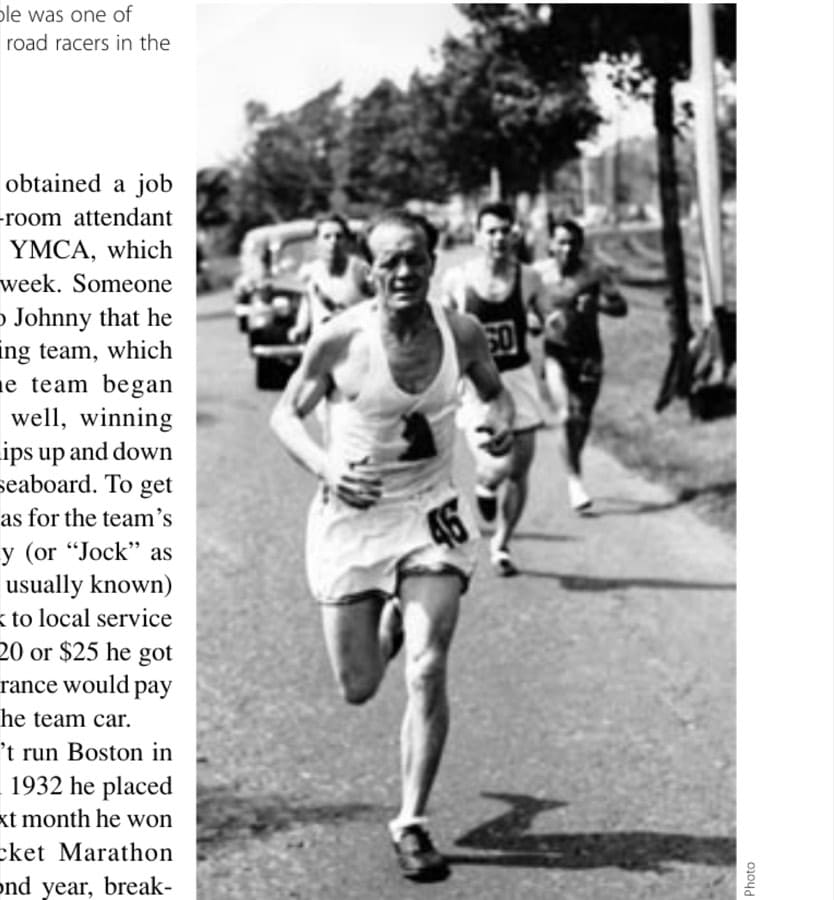
Semple obtained a job as a locker-room attendant at the Lynn YMCA, which paid $11 a week. Someone suggested to Johnny that he start a running team, which he did. The team began to perform well, winning championships up and down the eastern seaboard. To get money for gas for the team’s trips, Johnny (or “Jock” as he was now usually known) would speak to local service clubs; the $20 or $25 he got for an appearance would pay for gas for the team car.
He didn’t run Boston in 1931, but in 1932 he placed 10th; the next month he won the Pawtucket Marathon for the second year, breaking DeMar’s record for the course. He wanted to try out for the Olympic team but was not allowed to because he was still a citizen of Scotland. In 1932, he defended his New England marathon title.
The Depression was deepening, however, and it was not long before the Y felt that even at $11 a week, Jock Semple was a luxury it could not afford. He was let go. Having nothing to do, Jock decided to hitchhike out to join C. C. Pyle’s transcontinental run, but he was talked out of giving up his amateur status by Monty Monteverdi, when he met him during a stopover on his way to the West Coast. “Don’t throw your amateur status away on a crook,” Monty advised him.
Jock turned around and headed back to Boston, where he applied for work at the United States Shoe Machinery Company. While he was waiting in line, one of the company’s officers recognized him. The shoe company wanted to put together a road race in conjunction with its annual carnival. Ultimately, the young
B.A.A. Photo
▲
Jock Semple was one of America’s top road racers in the 1930s.
officer and Jock came to an agreement: a job for his services and for offering his expertise on behalf of the company’s running efforts. Jock began his association by sharpening dies and sweeping floors; he earned $16 a week. Semple had received his job partially on the strength of his promise to put together a running team, and so he began recruiting members of the Lynn YMCA team. Pretty soon, United Shoe was making itself felt on the road racing scene.
IN DESPERATE NEED OF A JOB Then Jock got himself married to a very lovely Scottish girl, on New Year’s Eve 1938. The year 1939 was a good one for him and Betty personally, but brought problems at work. The United Shoe team took second in the nationals, and the bosses felt that wasn’t good enough. Jock revealed the state of affairs at United Shoe to Walter Brown of the Boston Athletic Association, who urged him to come on over to the B.A.A. Jock did just that, bringing along most of his runners from United Shoe. The team did very well, but then the war came. Jock enlisted in the Navy.
After he got out in 1945, Jock wanted to continue in sports in some capacity, so he set his sights on being a physical therapist. He talked to Win Green, the Boston Bruins’ trainer, about a job, but Win told him to go back to school. Win sent him over to see Walter Brown, the man who had formed the Boston Celtics basketball team. Walter used his influence to get Jock into Boston University and further arranged a carpentry job for him to supplement his income. Walter also hired him part time to guard doors at the Boston Garden, always making sure he got doors high up in the building so he could study during his working hours.
Jock’s life gradually became meshed with Walter Brown’s. He began doing everything from taking the Celtics out on early-morning runs to officiating over his own rubdown room. He became also the main man at the B.A.A. When it started, the B.A.A. had been a wealthy club, with its own building; now, its fortunes diminished, the B.A.A. was down to one telephone—in Jock’s rubdown room. Affectionately dubbed Salon de Rubdown, this room was hidden away in the bowels of the Boston Arena. After that burned down, it was relocated to the Boston Garden.
Jock had been set up in his work by Walter Brown. Brown had purchased the equipment he needed to get started and had given him the room to use. Therefore, Jock never forgot when, during one rubdown under Jock’s practiced fingers, Walter mentioned that he hoped a B.A.A. boy would someday win the Boston Marathon. As he attempted to revive the club, Jock kept searching for the one standout runner who might become the club’s star and bring Walter’s dream to reality.
The B.A.A. road racing team continued to improve under Jock’s direction. Jock acted as a talent scout when he went to races. Although his principal job was to get his team there and to see that the runners had what they needed to make
their best competitive effort, Semple was always on the lookout for new talent to lure under the B.A.A. umbrella. Jock’s approach to prospective talent was interesting. “I employed a standard approach in my recruitment efforts in the 1950s,” he says. “I sought out a man’s wife or girlfriend first. While the men were out on the course during a race, I’d take the lady aside. ‘The great advantage to having a man run for the B.A.A. is that my B.A.A. boys come home tired after I’m finished with them,’ I said. Usually this elicited a polite nod, but little interest. ‘After men get out of work . . . you know the diversions that exist for a man,’ I repeated each weekend [at races] in towns such as Haverhill, Belmont, and Somerville. ‘Some men don’t come home at all. Soon after they get married, they discover the gin mills, and the elbow bending, and soon their wives have to trek down to some dark men’s bar in their housecoats. Never my B.A.A. boys. They come home every night, very tired.’ “
If I got the ladies hooked on the elbow bending, I didn’t have to say anything more. I gave them an application, which they asked for, and by the next race a dozen women would run up to me with completed forms for their husbands or fiancés.”
WHEN FIRST JOCK MET JOHNNY It was at one of these races that Jock first saw Johnny Kelley. The year was 1948, an Olympic year. The 15K race, at Fall River, Massachusetts, on July 4, would be the last major road race before the American team left for the Olympics in London. Vic Dyrgall was brought in for the race. He was then the best 10,000meter man in the United States. It was assumed he would be a shoo-in, that no one would be foolish enough to challenge him.
Dyrgall went out at the gun on a pace that was supposed to shake anyone foolish enough to give him a go. It didn’t work. Two high school kids pasted themselves to him, one on either side. The smaller of the two wore track shoes from which he had removed the spikes, and to accommodate the road, he had wrapped them all around with adhesive tape. The temperature was about 100 degrees. The heat and the abrasive road, combined with the kid’s pounding, began to loosen the tape; pretty soon it was coming apart in strands, and as it came off, so did the thin spikes, which began to disintegrate under the pounding. By two miles, there was nothing left of the shoes; they had fallen away, and the kid was keeping up with Dyrgall in his bare feet!
The heat and the rough road became too much, however, and at four miles the kid dropped out to nurse his bloodied feet. He sat down on the side of the road, picking pieces of asphalt and grit out of them. Jock, who had been driving behind the leaders, had watched the entire drama unfold. He stopped to ask the kid if he wanted a ride. “Yes, sir, thank you, sir,” the kid said. Jock asked him what his name was. “Johnny Kelley, sir,” he said. The almost-too-polite high school kid
bore the name of one of the Boston Marathon legends, one of the three men who would soon represent the United States in the Olympic Marathon in London. Jock muttered to himself: “Say hello to the new generation.”
Johnny Kelley didn’t know who Jock was, and in his fairly discombobulated state, he didn’t much care. The race he had just dropped out of was only his second race on the roads; his first had come the previous year at Littleton, Massachusetts. Here he had met his namesake, the elder Johnny Kelley, who had turned to him before the start of the race and had made his day by saying, “You’ve got runner’s legs, kid.” The young Johnny Kelley did not finish that race.
His friend George Terry, by the way, had gone along with him on that one, and it was friend George Terry who had been running on Vic Dyrgall’s other shoulder at Fall River. Here are Johnny’s recollections of the race: “I had sent away for legitimate shoes from a mail-order house, but they had not arrived. So I had taken a pair of my track flats, removed the spikes, and wrapped them around and around the toes with adhesive tape. First came the blisters, then came the unraveling tape, and finally the shoes burst. Soon I was relegated to a ditch before a kindly official picked me up in his car.”
That was probably the only time in his life that Jock Semple had been referred to as a kindly official. Jock’s reputation was based chiefly on his scathing tongue and his quick—often unrehearsed—comebacks.
It would be a mere 10 days until the paths of Jock Semple and Johnny Kelley would cross again at the Sons of Italy 10-Mile Handicap Road Race in Haverhill. Handicap races were very popular during the period. Faster runners were given handicaps based on their previous performances. They were required to stand at the starting line for the number of minutes of their handicap while other, slower runners were given the gun and a head start. There was one prize at the end for whoever took first place and another prize for the best time.
TRASH TALK ON THE WAY TO THE RACE Johnny Kelley took a train to Haverhill. It was a Tuesday evening and the streets of Haverhill were fairly deserted, but soon Johnny saw two other fellows carrying gym bags. Johnny asked them if they were runners, and as they made their way to the race, the three struck up a wiseguy banter, most of it centering on the impossibility of this kid’s name being the same as that of the great John Kelley.
The two runners were George Waterhouse and George Pike; the former ran for the North Medford Club, while the latter ran for what he called “Semple’s outfit.” The three of them assembled with the mass of other runners in the second-floor hall. A television set in the corner was bringing a Red Sox-Senators game to the Sons of Italy hall. Johnny was fascinated by seeing something that was going on 40 miles away.
“You won’t run far watchin’ that thing all night,” someone behind him said. Turning around, he encountered, but did not recognize, the man who had helped him out of the ditch in Fall River. “Where’s your sidekick?” the man asked. “The other fella that put the scare into Dyrgall?”
Johnny made the connection and explained that Terry had had to work. Jock went into a harangue about how he didn’t know runners worked, and this led to an interchange with Fred Brown of the North Medford Club. Pretty soon they were both getting the business from the rest of the runners, who were used to the two of them going at each other.
Semple offered to go out and see the race director on Johnny’s behalf. He told the race director it was Kelley’s first race and got him a five-minute handicap. He brought the kid’s number back and reported that Waterhouse and Pike would be on scratch—the last to start. Jock spent a few more minutes with the kid, pumping him up, telling him that the two races he had dropped out of were only dress rehearsals. “Tonight’s your big performance,” Jock told him. By the time he crossed the finish line, Kelley knew he had taken both the time and place prizes.
Because of the somewhat complicated mathematics involved in handicap racing, there is a lot of standing around after the race, waiting for the official results. In this instance, there was quite a bit of additional dickering going on, because the Haverhill Sons of Italy were not eager to give prizes to a new, unknown squirt. One official wanted to give the Hamilton watch for best time to a veteran racer from Somerville; another felt George Pike should get it. Meanwhile a third official was trying to change the results around in order to drop this John Kelley fellow down a few notches. Jock watched the maneuvering while maintaining an uncharacteristic calm.
After 20 minutes, Jock had had enough. His voice boomed above the confusion, and his voice carried the sound of the Lord with it. “For cripes sake!” he roared. “This man is unquestionably your time-prize winner.” “What? The boy?” “
Use your noggin, man. Your head isn’t just a hatrack. If he didn’t win the time prize, how in the hell did he start five minutes ahead of your scratch man and finish seven minutes ahead of him? Answer me that.”
No one could answer that one. And there had been absolutely no way for them to deny the place win—he had obviously finished first. So at 10:09 that night, Johnny Kelley stood on the train platform wearing a bright new watch and lugging a trophy. He had been thrust across the threshold into another world, into a world inhabited by “kindly officials” like Jock Semple.
A unique relationship developed between Jock Semple and Johnny Kelley. Kelley had lost his father early in his running career, and Jock contends even today that he was more a father figure for Johnny than a coach. During Johnny’s college career, certainly, Jock wasn’t just his coach.
Johnny went to Boston University on a running scholarship. He entered college in 1950 and was housed at Myles Standish Dormitory. Although he was still going with a girl back in Groton, he dated at school too, his interest centering on a music major by the name of Jacintha “Jessie” Braga. His scholarship was not a full scholarship—running scholarships seldom are—so Johnny made ends meet by working 15 hours a week in the dorm cafeteria. His coach at B.U. was Doug Raymond. Raymond had some things in common with Jock Semple: he was a Scotsman and an ex-navyman. But their methods of coaching and their interests in running were poles apart.
Johnny became adept at playing both sides of the fence. Raymond wanted him to become a miler. Semple wanted him to be a marathoner. During the week Johnny trained at the track with Raymond, doing gut-wrenching workouts day after day with no letup; on Saturdays, he would head down to the Boston Arena and let Jock throw him on one of the massage tables so Jock could work the sore spots out of his legs. Then Jock would send him on a 20-mile run with the B.A.A. regulars down to Jamaica Pond and back.
A constant battle, then, raged around Johnny’s head over his potential talent. He needed the scholarship to continue his studies in English, so he was required to submit to Raymond’s training techniques, yet his heart was with the pavement pounders and Jock. He ran with a B.U. jersey, but he and his heart belonged to the B.A.A. Johnny conducted a constant campaign to get Doug Raymond
▲
Young Johnny ran innumerable quarter-mile repeats for Boston University at Nickerson Field, outside of Boston.
Boston University Sports Information / Image Bank
A FATHER FIGURE
to introduce other methods into his training regimen, which consisted only of repeating laps. It didn’t work. Fred Wilt, an F.B.I. agent who also happened to run—very well, as a matter of fact—went to Europe to compete and came back touting fartlek training (“speed play”). When Johnny broached the possibilities of the B.U. team trying fartlek, Coach Raymond replied: “If it weren’t for those years of quarter-mile repeats, he wouldn’t know fartlek from my grandmother’s pickle jar.” Johnny broached the subject to Jock, who replied, “Oh, he’s onto somethin’, all right, Johnny. It’s a far more natural way to train than all that in-and-out quarter stuff. But we knew it, the idea of it, in the Old Country when I was your age.”
The battle continued apace. While his battles with his courses raged in college, and the battle between Jock and Doug Raymond raged, and the battle between Joanie in Groton, Connecticut, and Jacintha in Boston raged, the Korean War was also moving along rather briskly.
Johnny’s college career was coming to an end. There had been some track victories and some defeats. The Korean War and army drab were staring him in the face. And then, to complicate matters, Emil Zatopek exploded onto the scene. “
I run until I can’t run anymore. And then I run some more,” Zatopek said as he set the running world on its rear with his triple victory in the distance events at the 1952 Olympic Games.
INTERPRETING ZATOPEK’S TRAINING To Doug Raymond, Zatopek’s performance justified massive repeat quarters; to Jock, it was Zatopek’s far-ranging runs through the countryside that were important. Johnny modified Zatopek’s training principles somewhat and began working harder at his running, but he never grew to enjoy the track. One of the reasons may have been that B.U.’s track, indoors and made of boards, was less than inviting.
Zatopek’s success changed theories about training in most of the world. Unfortunately, as far as road racing went, the United States had a lot of catching up to do—even in its own premier race, the Boston Marathon. The last time an American had won was in 1945, when the other John Kelley (John A. Kelley) had won his second Boston.
Young Kelley decided in 1953 that he would begin training for that year’s Boston. Obviously, Jock was ecstatic. Johnny knew that Doug Raymond would not be so favorably disposed. Jock decided to keep a low profile, because he wanted any decisions on Johnny’s future to come from Johnny himself. He didn’t want to jeopardize the kid’s scholarship—yet he did want to see Johnny take his cracks at Boston. And he still had the dream in the back of his head that he would see Johnny winning Boston. That would fulfill Walter Brown’s dream, also.
▲
Emil Zatopek’s training methods changed distance running forever.
Dr. Edward H. Kozloff Collection
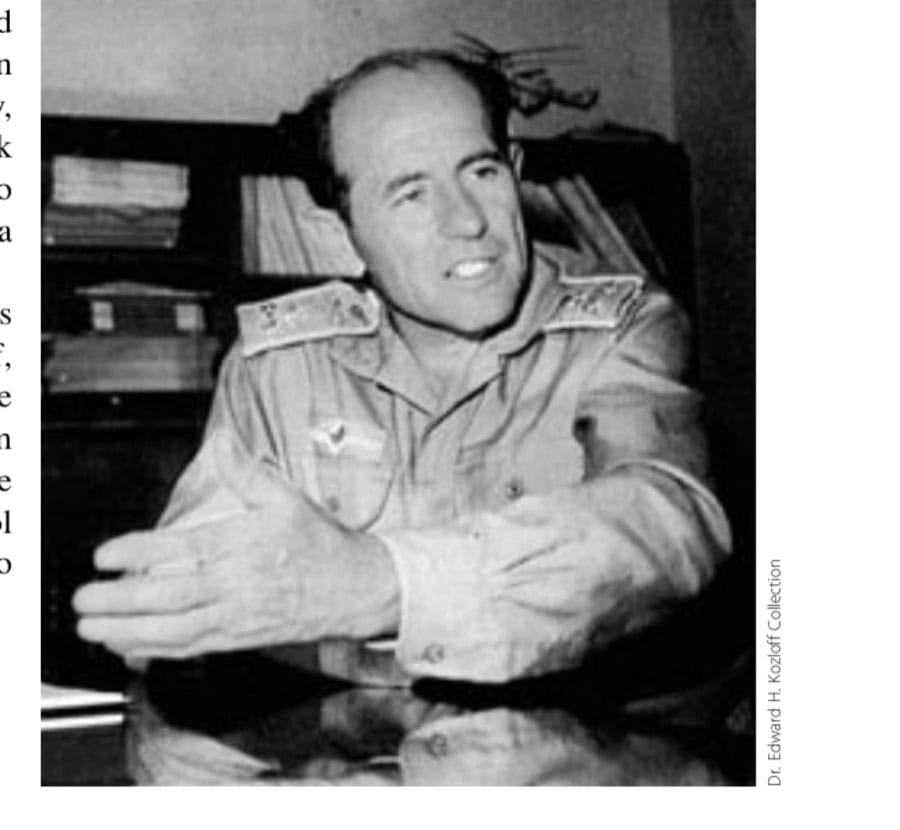
Jock spent his time hammering Fred Brown and his North Medford Club, while Doug Raymond spent his time hammering Jock. Just a mention of Fred Brown would set Jock off into a harangue, so the mention of Jock Semple in Doug Raymond’s locker room would send the B.U. coach off on a harangue against what he called “those ham-and-eggers.” Nowhere was the distinction between the college boys—the track men, the pure athletes—and the laborer—the road racer, the plodder, the pavement pounder—drawn more succinctly than in Doug Raymond’s ranting and raving, which invariably ended with: “Don’t bother me with this nonsense. I don’t want to hear the word ‘road’ again.”
Johnny continued to engage in a very precarious balancing act that was further complicated by his studies and his part-time jobs. He worked as a short-order cook in the evenings and in the basement of a jewelry store on Saturdays.
His tenacity about Zatopek’s methods eventually broke Raymond down, and the coach allowed Johnny to work some of Zatopek’s continuous running with speed work thrown in; while the rest of the team ran the board track, Johnny ran around Braves Stadium—at a fast pace. On Saturdays and Sundays, he would take long, easy runs for endurance unless there was a college meet on Saturday. He worked in a little extra mileage by running from the college to his short-order cook job at nights.
Poor Doug Raymond. You have to sympathize with him. Johnny didn’t break the news to him that he was going to run the 1953 Boston Marathon until two weeks before the event. And to add to that, he had made other decisions in his life, too; in January, he announced to his track coach that he planned to get married to Jacintha Braga.
He didn’t make his announcement himself, however. Instead, like the Myles Standish his dorm had been named after, he sent his old high school buddy, George Terry, to
break the news. Johnny pumped George for Doug’s response. It had been fairly simple and direct: “Jeepers Crow, I can’t believe it!” Johnny and Jessie got married on the evening of January 17; that same night, Johnny also ran anchor on a two-mile relay team at the Knights of Columbus track meet at the Boston Gardens. They moved to a third-floor room on the Back Bay; it featured a hot plate for a stove, and not having an icebox, they put perishables on the windowsill and hoped the winter cold would preserve them. The rent was $64 a month.
THE CONVERSION OF DOUG RAYMOND As spring came along, Johnny’s enthusiasm grew, and even Doug Raymond, seeing that he was fighting a losing battle, came around. The Boston Marathon was going to be no parade in the park. The Japanese were sending a team, and the Finnish team had been in the United States for weeks getting ready for the race.
The United States was—rightfully—given little hope of winning or even of making a dent in the foreign running machines. The press began billing Johnny as America’s only hope and even got poor, beleaguered Doug Raymond into the prerace publicity. One shot showed Raymond and Kelley together at Braves Field; instead of going berserk, Doug came out in support of the whole affair.
Jock took stock of things, looked over the entry lists, and told Johnny that he was picking him to finish fifth. “No offense,” he said. “You’re going to do OK; but Johnny, I watched those Japanese practicin’ out on the course today, an’ jeez, nobody’s goin’ to beat them.”
When the race started, Johnny kept up with the leaders, hanging with a little Japanese runner through the halfway point in Wellesley, where the Japanese runner relentlessly moved away from him. Johnny had run faster than he had anticipated, and he had to play the rest of the race as a hang-on affair, while he watched Veikko Karvonen of Finland move past him, then another Japanese runner, and then Karl Leandersson of Sweden. Jock’s prediction had come true: Johnny finished fifth—top American, but to the rest of the marathoning world, it was still just fifth place. Jock and Johnny were both quite thrilled by the performance—especially since the little Japanese runner, Keizo Yamada, ran a course record of 2:18:51.
As Jock helped Johnny away, wrapped inside a warm army-surplus blanket, the two glowed in their accomplishment. Jock found a place for Johnny to sit down in the Soden Building, and Johnny felt a hand clap him on the shoulder. It was Doug Raymond ready with congratulations. “For gosh sakes, you really were America’s only hope,” his track coach said.
Jock, down at Johnny’s feet unlacing his shoes, did a slow burn, grumbling enough so that Raymond noticed him. “What d’ya think of him, Jock?” Raymond said. “Wasn’t he great? Wouldn’t you say his performance is worth my talking to the athletic director at B.U. about our getting him a special jersey for the race next year?” “
Yeah,” Jock spat out, “one wi’ a unicorn on it!” (The unicorn was the B.A.A. symbol.) The battle between B.U. and the B.A.A. had taken another significant step toward open warfare. Johnny was back the next year, all right. A month before the 1954 race, he ran the course as a practice workout and did it in about 2:28—complete with commuter traffic. He felt ready. His performance, which was again best American and which was close to the previous year’s time, placed him seventh. From the start, the race was between England’s Jim Peters, the best marathoner in the world, and Finland’s Karvonen. There was a lot of excitement about the entry of 1948 Olympic marathon champion Delfo Cabrera of Argentina, but he was now 37. Cabrera lost the lead early to the duelists, Karvonen and Peters. Karvonen won in what was a grudge match to get back at Peters for an earlier humiliation in his homeland. Johnny was pretty much overlooked, even by Jock, who had paid money out of his own pocket to bring Peters over. Jock wrapped Peters in the army-surplus blanket meant for Johnny as Peters staggered across the finish line, completely exhausted.
THE RACE ACCORDING TO JOCK Jock’s role at the Boston Marathon had escalated from being merely one of the officials to being the major-domo. He hustled, cajoled, browbeat, and bullied runners onto the buses; he scanned entries and was empowered to accept or reject them.
Jock, with his Scottish brogue and brusque manner, had become as much a story as the marathon itself. Reporters loved him because he was never stingy with a quote—quotes usually directed at their heads as he told them what he thought of people who interrupted the training of his runners or who got in the way of the machinery of the Boston Marathon.
To someone unfamiliar with the Jock Semple legend, he could be incredibly intimidating. He dispatched cheaters, fakes, and phonies who tried to sully the Boston Marathon. His verbal invective was similar to a bolt from the blue or the bite of an enraged shark.
On the other hand, his treatment of authentic, serious runners was like that of a mother taking her child to her breast. Toward Johnny Kelley, whom he referred to as his star, he was downright fatherly. Johnny’s continued success at road racing was an unspoken affirmation
that he and Doug Raymond were going to split and that Johnny was going to be all Jock’s. But first, a word from Uncle Sam. Uncle grabbed Johnny up when his four years of college were over, even though Johnny was still two courses and eight weeks of student teaching short of graduating. He stayed in the army a year and a half and then returned to Boston with $120 a month from the GI Bill, a job as a 25-year-old stock boy at Thomas Long’s jewelry store, and membership on Jock’s B.A.A. team.
Even though he had not been gone long from the marathoning scene, things had changed radically. In the 1955 Boston, Nick Costes had placed fifth and had been first American, while Japan’s Hideo Hamamura lowered Yamada’s record to 2:18:22. During that furious race, Costes had run some nine minutes faster than Johnny’s best. Jock was supremely confident on behalf of Johnny, and he set out a formula for success. “Get yer mileage up, inject the right amount of interval work, race every so often, an’ come in fer regular massages an’ diathermy treatments, an’ you’ll run wi’ the best of ‘em, mark my word.”
Among his training improvements, Johnny was running a 16-mile workout along the Charles River five mornings a week. To Johnny and the rest of the United States runners, the 1956 Boston Marathon was going to be very important: it was going to be one of two marathons used to pick the U.S. Olympic Marathon team. At the same time, the Boston Marathon was becoming increasingly important to foreign runners as a meeting place where the world’s best could sock it out early in the season. Johnny Kelley’s work was obviously cut out for him, but Jock was all confidence.
The 1956 race was a barnburner. Antti Viskari, a military man from Finland, ran 2:14:14, a new world record. Johnny Kelley was again first American. But this time he was in second place overall, a mere 20 seconds over Viskari’s incredible time. He had stayed with the Finn through 25 miles and was still running exceptionally well at the finish line, but Viskari had pulled a kick out of somewhere, and Johnny couldn’t match it. Johnny was assured a berth on the U.S. Olympic team, as were Nick Costes (fourth place, 2:18:01), and Dean Thackwray (fifth place, 2:20:40).
A COURSE TOO SHORT There was understandable merriment in the B.A.A. for two full weeks—until the course was remeasured and found to be 1,100 yards short. The times were disallowed for world’s-best performances, but it did not in any way negate the Olympic team selection. Unfortunately, when the team traveled to Melbourne in December for the Olympic Games, its results were dismal. England’s Jim Peters had given up his
running career after learning that Melbourne was going to be extremely hot. Hot it was. Johnny finished 25th, one place behind Nick Costes; Dean Thackwray did not finish. The indomitable Zatopek had finished sixth, despite just having recovered from a hernia operation.
Johnny returned to his home in Mystic, Connecticut, seriously considering giving up running. He had taken second place with a sterling performance at Boston; he had won the AAU marathon championship the following month on the tough Yonkers course, but the Olympic marathon had devastated him. He had two weeks left of teaching reading at the junior high school in Groton before Christmas vacation. Johnny stopped training and looked forward to a much-needed holiday season—during which time he hoped to make up his mind about what role, if any, running would play in the rest of his life.
His disenchantment with running was only temporary, however. If it hadn’t been, it is likely that Jock Semple would have made it temporary, whether Johnny wanted it to be or not. Besides, once the weather begins breaking in the Northeast, it breaks the hold of gloom on people as well; then spring brings to mind thoughts of Boston. And Jock hadn’t yet kept his promise to Walter Brown to have a B.A.A. runner win the big one.
Because Patriots’ Day fell on Good Friday, the race was moved to Saturday, April 20. There were 140 entrants for the 1957 race. Among them was an impressive foreign field: Veikko Karvonen (winner in 1954) of Finland, his teammate Olavi Manninen, Koreans Soong Chil Han and Chiang Woo Lim (the Koreans didn’t bother coming if they didn’t think they could win), Keizo Yamada (winner in 1953) and Nobuyoshi Sadanaga of Japan, Canadian Gordon Dickson, and Pedro Peralta of Mexico.
The day before the marathon, the young Johnny Kelley and his wife, Jessie, spent the night with the elder Johnny Kelley and his steady date, Laura Harlow. (Jock thought it was a terrific idea, because Johnny Kelley the Elder was in the habit of going to bed at nine o’clock, which would assure Johnny the Younger he would get a good night’s sleep.) Young Kelley awoke at 4:45 in the morning, stared at the ceiling, and soon heard the other Johnny tapping at his door to see if he wanted to go out for a little workout to vent some of the nervous energy that builds up before a race. They went to the Belmont Golf Course and ran the slopes easy. Johnny the Elder was Mr. Boston Marathon, and the early-morning golfers greeted him warmly, urging him to a good race. “Thanks, pal,” he would answer. “Don’t forget my son here.”
The unrelated father and son got back, had a hearty breakfast, and went to Hopkinton for the checking in. The runners were herded inside a snow fence and their names checked off as they were shouted off. As the names rolled out, the quality of the field became apparent. It had been a dozen years since an American had won Boston, and the elder Johnny Kelley held that honor.
Andy Yelenak Collection
▲ The two Johnny Kelleys shared a name and a deep love of the Boston Marathon.
AMERICA’S TRIO Young Kelley’s lifelong friend George Terry, who was also running along with their friend Rudolfo Mendez, told Johnny that he felt one of them would win it. When Walter Brown aimed his sawed-off shotgun into the air at noon and fired, he didn’t realize that he was putting the finishing touch to his most cherished
dream: a B.A.A. runner in the winner’s circle. The temperature was in the high 60s, just the way Johnny Kelley liked it. The race was truly a nationalistic affair. There were segments of Japanese fans
cheering their contenders on, and the van attending the Finnish team leapfrogged from one checkpoint to the next, urging on their runners. In the lead pack, the three Americans ran coolly and under control, rattling the Finns; it was a matter
of turning the tactics on the Finns and Japanese, who usually ran as a team instead of as individuals so as to be able to set a favorable pace and set up strategy moves and blocking techniques. George Terry began developing blisters and dropped off the pace just beyond
Natick. Before the 14-mile point, Rudy Mendez dropped off the pace, and Johnny
was the lone American left in the lead pack. But the Japanese had also dropped back. The only runners left were the Finns, the Koreans, and Johnny Kelley. Jock had been on the press bus, but the pace had been too fast to allow the bus to stop at checkpoints so that members of the press could get out and watch the race up close. The oranges and sponges Jock had stuffed into his pockets for Johnny’s use were merely ruining the inside of Jock’s pockets. Finally, at 16 miles, Jock leaped from the moving bus, passed a sponge to Johnny, and asked him how he felt. “Terrific, Jock! I can’t believe it!” Johnny yelled.
The leaders went into the Newton Hills and Karvonen put on a desperate surge, hoping to break the pack and gain some control of the pace so he could ultimately slow it down; he wasn’t looking all that good. Johnny responded to the surge, going with him; Manninen, Lim, and Han did not respond and dropped behind.
Kelley and Karvonen ran along Commonwealth Avenue in Newton together, with nine miles to go. Johnny decided to gamble. On the second of the Newton Hills, Johnny threw in a surge and the Finn fell behind. Johnny continued to blast the hills, topping Heartbreak and feeling fine. He was all alone.
In the press bus, Jock was going wild, pounding the side of the bus, shouting, “There’s nobody in sight!” At the 21-mile point, the press bus had sped up to get the reporters to the finish area at the Lenox Hotel. Jock bounded off the bus, clenching his woolen army-surplus blanket. Walter Brown was with him. They were trying to see over the heads of the crowd. “Think he can hold it?” Walter asked. “
Sure,” Jock said. “You know that’s all I ever wanted,” Walter said. “I know,” Jock answered. “It’s all I want, to see a B.A.A. boy win the Boston Marathon.” “I know,” Jock repeated. Walter regarded Jock strangely. “
You told me,” Jock said. “Years ago.” Walter smiled upon realizing that Jock had remembered so well. The crowd began to get restless, and then there was shouting, and then there was specific shouting—the leader was coming, and he was an American.
From Johnny’s perspective, it was like this: “I remember also catching a glimpse of Jock as I pummeled down Exeter Street over those last delicious yards. He opened and closed his arms with the blanket, and behind him I saw Walter Brown, beaming. As I crossed the line, I saw them both, and we were all smiling. Years later—so many Bostons between then and now—I realize we made a triangle.”
MASTER OF THE AAU MARATHON Johnny went on to retain the AAU marathon championship the next month, when it was again held at Yonkers. Incredibly, Kelley would win this race eight years straight!
Russ Adams / Boston Herald
▲ A proud—and relieved—Jock Semple glories in Johnny’s 1957 Boston win, as Jessie seals it with a kiss.
But he would never again win Boston. In fact, no American would win Boston again until 1968—and then it would be one of young Johnny Kelley’s protégés, Amby Burfoot of Groton, Connecticut, a student at Wesleyan College and a roommate of Bill Rodgers, who would himself win it four times. And so the line from Jock Semple to his racing companion Johnny Kelley the Elder passed to the next generation, Johnny Kelley the Younger, and from there would extend to Amby Burfoot and on to Bill Rodgers—to men with road racing in their blood, men who keep running long after track runners’ competitive days are over.
Jock Semple continues to preside over the Salon de Rubdown, having less and less to do with the Boston Marathon as it goes through radical changes that are breaking his heart. And Johnny Kelley the Younger? He has quit teaching school and is a freelance writer with a big and happy family. He still runs Boston, consistently under three hours, and he continues to love running. Editor’s note: Since this profile was published in 1983, Jock Semple, Johnny Kelley the Elder, and Young Johnny Kelley’s wife, Jessie, have all died. The Boston Marathon weathered some rough times in the 1980s but is now more successful than ever. Today, Young John continues to write of his running adventures, and he definitely continues to love running.
This article originally appeared in Marathon & Beyond, Vol. 11, No. 2 (2007).
← Browse the full M&B ArchiveMore like this
1,000+ stories from 19 years of Marathon & Beyond
The complete archive of the legendary long-distance journal — digitized and free to read.
