


Men are about twice as likely as women to lose the plot in the second half of a marathon. That’s the finding from a new analysis of 873,334 Berlin Marathon finishers going back 27 years, published this month in Scientific Reports.
The Berlin course is flat and the weather is usually cool, so the researchers used it as a clean setting to isolate how sex affects pacing. They pulled every finisher between 1999 and 2025, calculated how much each runner slowed between the first and second halves, and flagged anyone who lost 20% or more as having hit the wall.
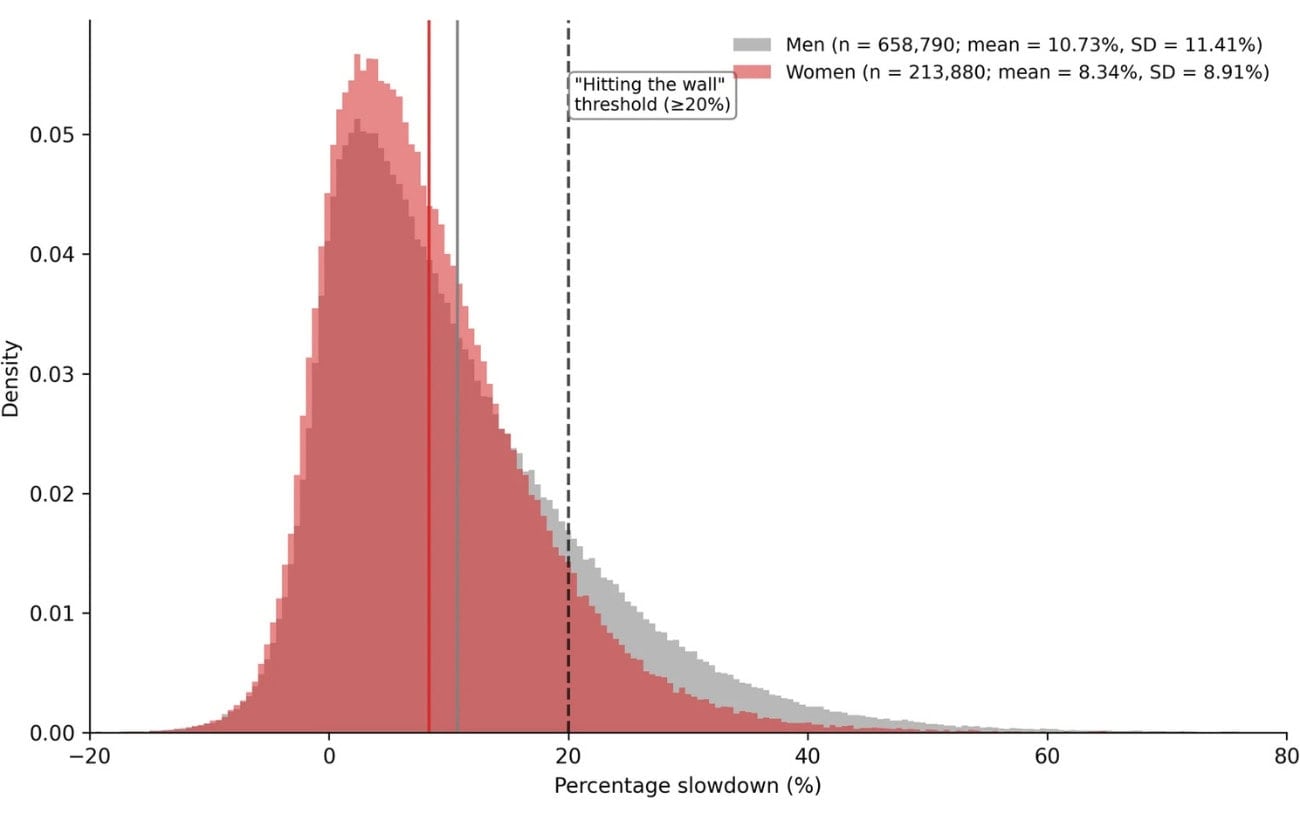
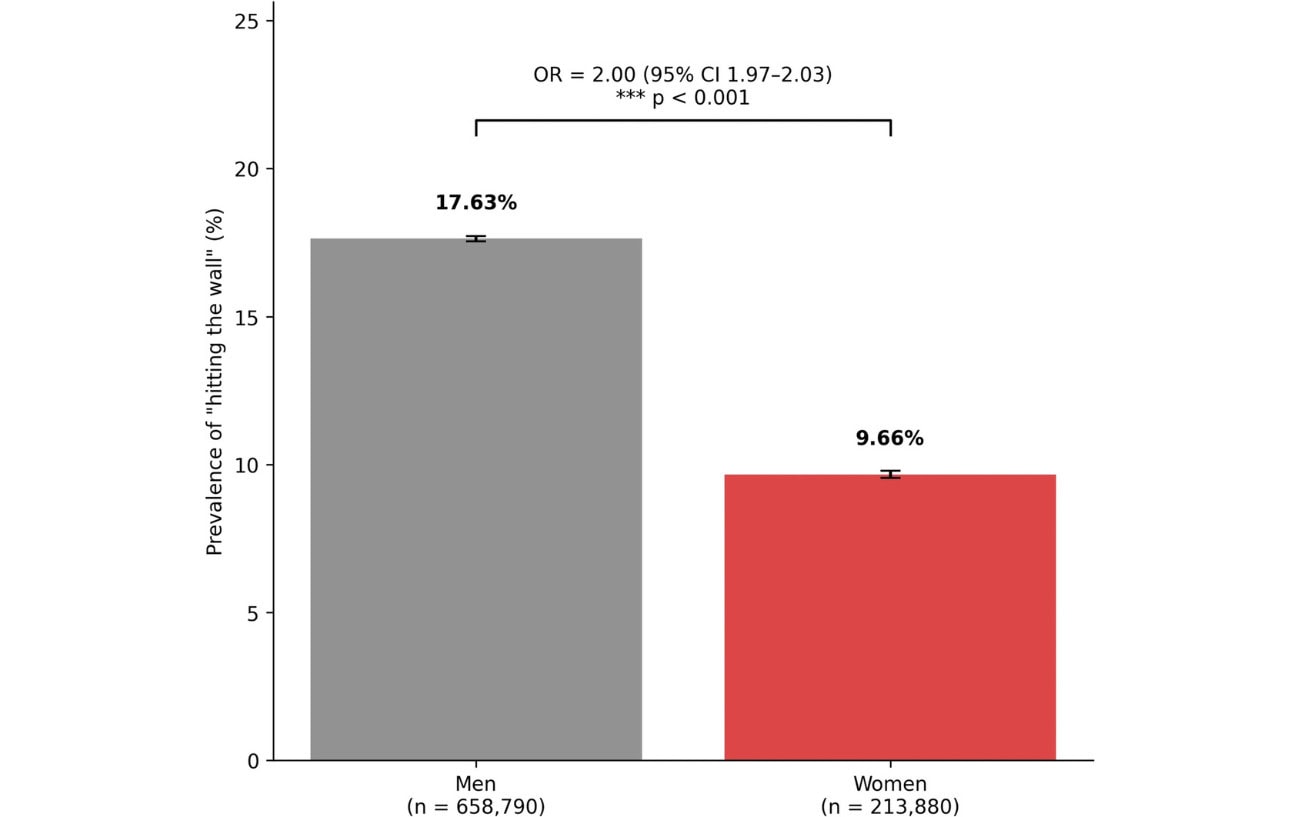
Men slowed by 10.73% on average. Women slowed by 8.34%. Of the men with valid split data, 17.63% hit the wall. Only 9.66% of women did. The odds ratio came out to exactly 2.00. After adjusting for age and finish-time category, it jumped to 3.88.

The fastest men fare the worst
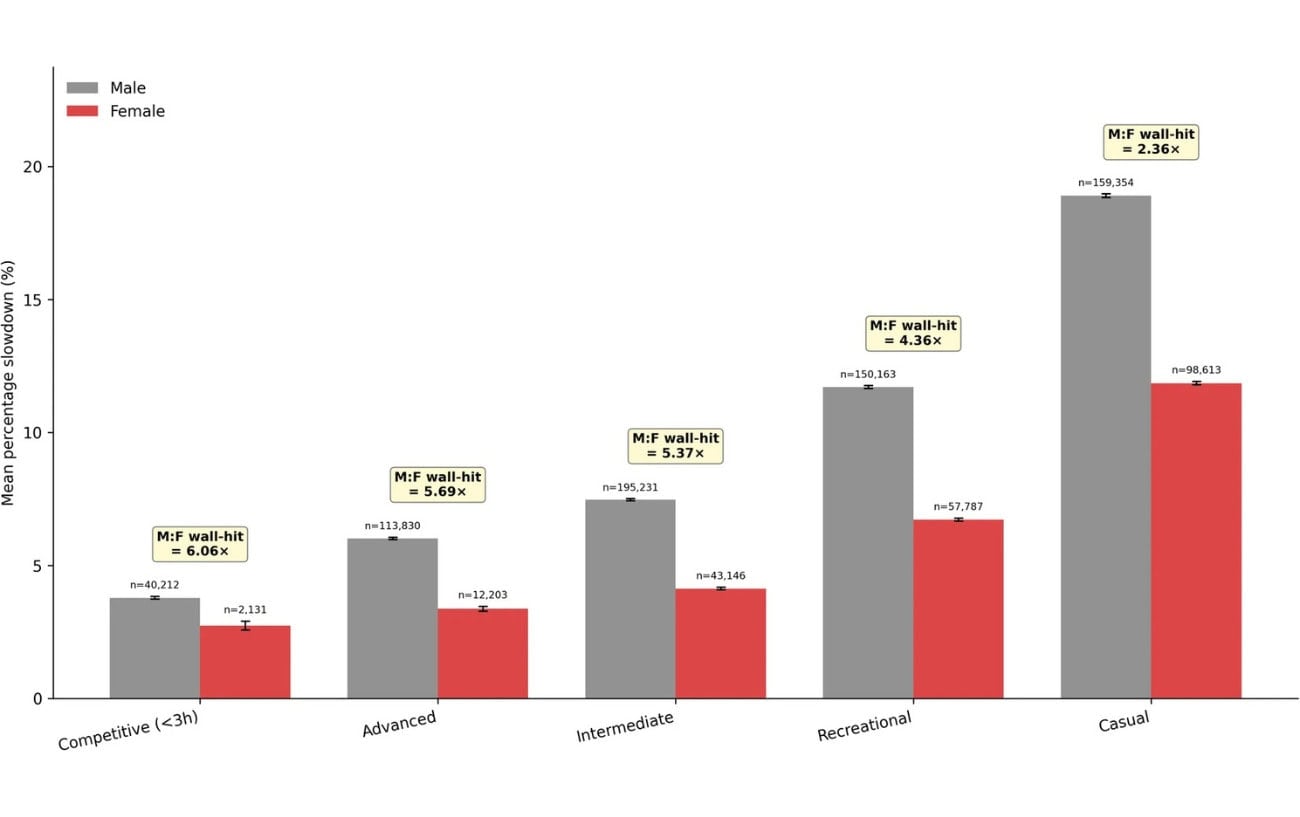
You’d think elite runners would pace better than the back of the pack, and they do in absolute terms. But the sex gap actually gets wider up front, not narrower.
Among sub-3-hour finishers, 1.42% of men hit the wall. For women in the same time bracket it was 0.23%. That’s a 6.06-fold higher risk for the fastest men.
“Superior physiological conditioning does not inoculate male runners against catastrophic pacing failures,” the authors write. Experience isn’t a fix either. The pattern held whether the runner was 25 or 55.
At the slow end of the field it stops being a gap and starts being a demographic. Among Casual finishers (over 4:30), 41.62% of men hit the wall. For women in that group, 17.66%.
Not a fluke of any one era
The team also ran a trend test across all 26 editions in the archive (2020 was cancelled). The year-to-year gap bounced around between 2.8 and 19.9 percentage points, which is what you’d expect given weather and cohort changes. But there was no upward or downward drift over the 27 years.
That matters. It rules out the idea that this is a symptom of one training fad or one qualifying policy. The authors call it “a structural feature of marathon pacing.”
The 5 km splits told the same story. From the 5–10 km segment to the 35–40 km segment, men slowed by 17.8%. Women slowed by 12.6%. Men’s pace also jumped around more segment to segment.
Why the split
The paper offers two explanations and refuses to fully commit to either.
Physiology first. Women burn a higher share of fat at steady endurance efforts, carry a bit more Type I muscle fiber, and spare glycogen longer. Glycogen is what runs out when you hit the wall, so that alone would push the numbers in this direction.
Then there’s the behavioral piece, which is harder to prove from race data. The authors point to a body of work in behavioral economics showing men “more often overestimate their competitive ability and tolerate higher risk in competitive contexts.” On a start line, that reads as going out too hot.
The authors don’t oversell it. “The present dataset does not directly measure psychological variables,” they write. They treat the behavioral read as a hypothesis, one worth testing with proper psychometrics.
What runners should do with this
The paper’s own advice, aimed at ambitious male runners, is blunt: “conservative starting splits and a focus on negative splitting.”
That’s the female pacing pattern the data describes, and it’s also the standard coaching advice for anyone chasing a personal best or a Boston qualifier. The Berlin numbers suggest a lot of guys, including the experienced ones, still aren’t doing it. If you’ve ever crossed 30 km and felt your legs go from tired to gone, this is what the data is picking up.
A few caveats worth naming. The dataset only includes finishers, so anyone who bonked hard enough to drop out isn’t in the count, and the true wall-hit rate in the starting field is probably higher. The archive also doesn’t track individual runners across years, though a duplicate-stripped sensitivity analysis gave almost identical numbers.
RunClub
Get more running stories — join RunClub
Daily running news, a community of 300,000+ runners, free training plans for every distance, and a daily running game. Free to join — no card.
Already a member? Log in →









Join the conversation
I agree that slow pacing at the outset is the key. My splits have narrowed when I have been a patient starter - especially in Boston.
As a male runner, I know how important this is, though the data is still incomplete, even though it appears more salient with ultramarathoners and gender.