


The medal ceremony was barely a minute old when the runners started leaving.
One by one, the athletes who had finished behind Seth Clevenger at the NCAA Division III Indoor Track and Field Championships stepped off the podium — first after his 5,000-meter win on Friday, then again after his 3,000-meter win on Saturday.
The crowd cheered them on. Clevenger stood alone.
It was a quiet, pointed act of protest — and it’s now the biggest story in college running, even if much of the mainstream sports world hasn’t figured that out yet.
Sound on https://t.co/MljUVmoKbg pic.twitter.com/3iMN5fSQpO
— Alex Predhome, Track and Field Enjoyer (@Predamame) March 15, 2026
A Suspicious Glow-Up
Clevenger, 22, grew up in Haddonfield, New Jersey, where he was a three-time state champion and a New Balance All-American. Impressive credentials. Iowa State came calling, and off he went to become a Cyclone.
For three years, he was fine. Solid. Not the guy making the top seven for NCAAs, but a contributing member of one of the best distance programs in the country. Then he had hip surgery in late 2024, missed a chunk of time, and came back in the fall of 2025 running like a different person entirely.
At the Nuttycombe Invitational in October — if you don’t follow college cross country, think of this as the biggest regular-season meet in the sport — Clevenger finished 19th overall. Not just 19th among Iowa State guys. 19th in the whole field, ahead of runners who would later place at the NCAA championships. His coach, Jeremy Sudbury, called it “a massive breakout race.”
Eight days later, Sudbury announced that multiple athletes had been suspended “for breaking team rules.”
Clevenger never competed for Iowa State again.
Same thing happened in the men’s D3 3k. Clevenger wins, and they all walk off the podium. pic.twitter.com/yCqcY7mv9L
— Alex Predhome, Track and Field Enjoyer (@Predamame) March 15, 2026
What His Teammates Say
This is where the story gets complicated — and credit goes to LetsRun.com’s Jonathan Gault, whose deep-dive investigation in early March broke the allegations wide open and is the backbone of what we know here.
According to LetsRun.com’s reporting, two former Iowa State teammates told the publication that Clevenger admitted, during the 2025 cross country season, to using BPC-157 — an experimental peptide that promotes muscle recovery and is explicitly banned under NCAA rules. One of those sources showed LetsRun.com what he says is a screenshot of a text message from Clevenger’s number confirming the admission.
A third teammate told LetsRun.com that he opened Clevenger’s refrigerator at an off-campus apartment and found multiple packages labeled “human EPO.” For those new to the term: EPO is erythropoietin, a drug that increases red blood cell production and, in turn, the body’s ability to carry oxygen to working muscles. It is perhaps the most infamous substance in endurance sport — synonymous with the Lance Armstrong era of professional cycling. It is banned under both NCAA rules and the World Anti-Doping Code.
That teammate told LetsRun.com that when he asked Clevenger about it, Clevenger said he was taking it and felt he had to in order to make Iowa State’s top seven for nationals. He also allegedly warned the teammate: if you tell anyone about the EPO, I’ll tell them you used peptides too.
There’s more. A 24-second video surfaced last month appearing to show a Gmail inbox — one that multiple sources told LetsRun.com matched an account used by Clevenger — containing a receipt for an order of EPO placed in December 2025. The billing address listed on the receipt was registered to Clevenger’s grandfather.
Clevenger’s attorney, Louis Guzzo, has denied it all. In a statement posted to Clevenger’s Instagram, Guzzo wrote that “Seth Clevenger is not taking and has not taken drugs to enhance his running performance,” called the video “unequivocally false,” and noted that Clevenger voluntarily took a blood test at Rowan in February that came back negative for EPO.
Clevenger himself has declined interviews. When he spoke to DyeStat after his first race for Rowan in January, he kept it brief: “Some people said some things about me. Weren’t true. So I just didn’t feel respected at my previous institution. Decided to come to Rowan where people actually respect me.”
Everyone on the podium just walked off. https://t.co/0o5bPz3Fil pic.twitter.com/hNPj7ppdGJ
— Alex Predhome, Track and Field Enjoyer (@Predamame) March 14, 2026
So Why Is He Still Running?
Good question. Here’s the frustrating answer: because he never failed a drug test.
Under NCAA rules, a positive test for a banned substance triggers an automatic one-year suspension. But allegations, admissions, receipts, and teammate testimony? Those are handled by the individual school. Iowa State suspended him from the team. That was within their rights. What they couldn’t do — and what no one apparently can do — is make that suspension follow him to a new institution.
When Clevenger transferred to Rowan University (conveniently located 20 miles from his hometown), he was immediately eligible to compete. This isn’t the first time the NCAA’s eligibility rules have allowed an athlete under a cloud of doping allegations to keep racing. Rowan confirmed his eligibility, cited federal privacy law, and declined to comment further.
The United States Anti-Doping Agency told LetsRun.com it was aware of the case but has no jurisdiction. The NCAA is not a signatory to the World Anti-Doping Code, which means USADA operates in a completely separate lane.
In a statement to LetsRun.com, USADA’s Director of Intelligence and Investigations, Dan Burke, didn’t pull punches. He described the NCAA’s anti-doping program as suffering from “a lack of independence, limited testing volume, absence of specialized analyses, minimal out-of-season and no-notice testing, insufficient transparency, and the inability to pursue non-analytical cases” — and compared it to “the fox guarding the henhouse.”
The placing field of the Men's 5K in the #d3track podium walked off the stage rather than be pictured with the champion.
— d3photography.com (@d3photography) March 14, 2026
And went to the side and held their own group photo.
IYKYK pic.twitter.com/gY2W5XSodR
700 Athletes Sign a Petition. The NCAA Shrugs.
Emmanuel Leblond, the reigning NCAA Division III cross country champion from Johns Hopkins, had seen enough. He started a petition calling for a formal investigation and a provisional suspension of Clevenger before the indoor championships. More than 700 Division III athletes signed it.
The NCAA let him run anyway.
It’s a familiar kind of institutional paralysis. The NCAA has shown it can act swiftly on minor eligibility infractions — a D3 runner accepting a community donation to stay in college, for instance — while appearing far less equipped to handle the messier, more consequential questions about competitive fairness.
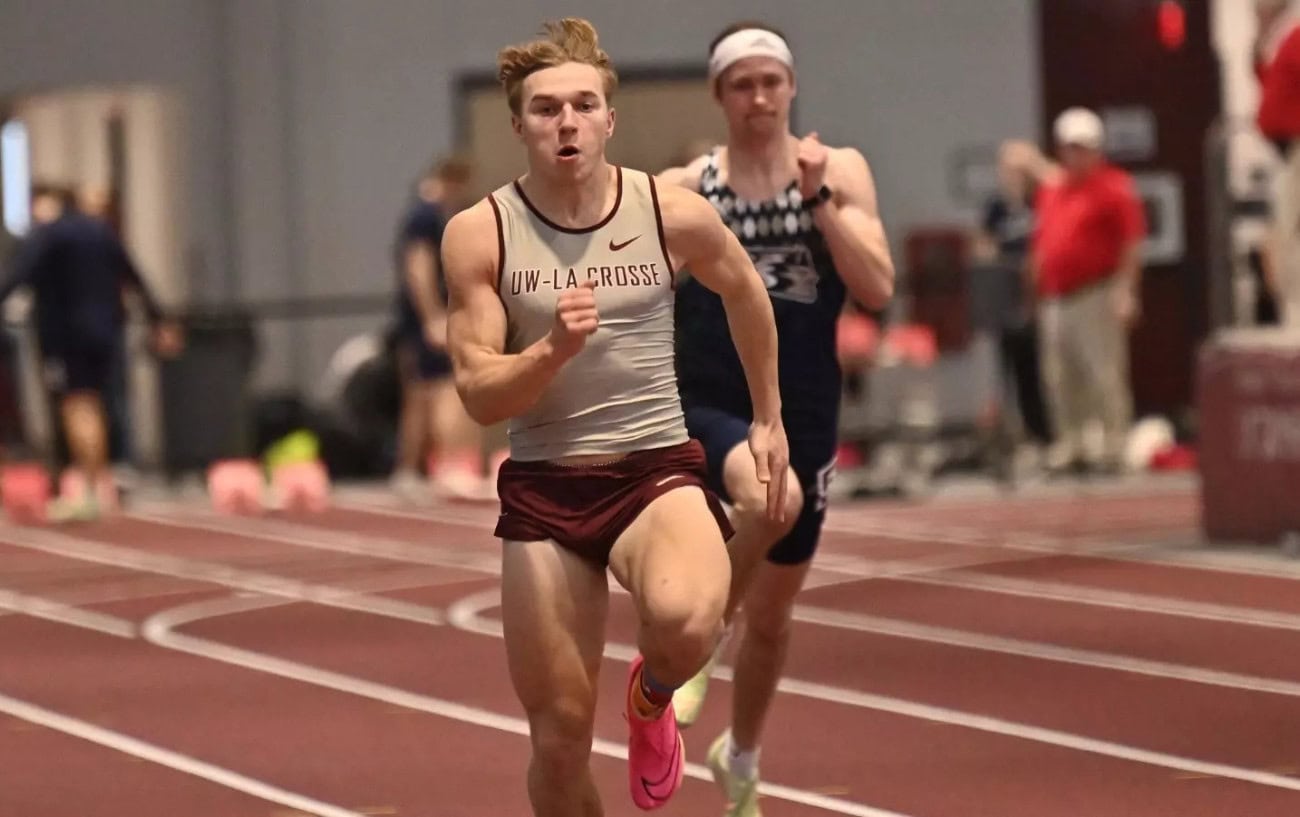
At the championships in Birmingham, Alabama, Clevenger was untouchable. He ran 13:35.55 in the 5,000 meters — obliterating the previous Division III meet record by more than 12 seconds. The next day, he won the 3,000 meters in 7:54.92, crossing the line more than 10 seconds ahead of the second-place finisher. Both races were wire-to-wire.
Both podium ceremonies ended with everyone else walking off.
In a video posted on X by track and field commentator Alex Predhome, you can watch the moment play out: Clevenger steps forward to receive his trophy, and within seconds, the other finishers quietly step down and drift away. A few races later, they’re posing together — medals, trophies, grins — with the caption that’s since gone viral in running circles.
The sport’s anti-cheating infrastructure has long struggled to keep up with those willing to bend the rules. This case may be the starkest illustration yet of what happens when enforcement tools don’t match the scale of the problem.
What the runners on that podium understood is that waiting for institutions to act is a slow game. So instead, they made their statement in real time, in front of a crowd, for 20 seconds on a medal stage in Alabama.
The crowd cheered. The sport noticed.
Primary reporting credit: Jonathan Gault and LetsRun.com, whose March 2026 investigation broke the allegations and provided the detailed sourcing underpinning this article.
RunClub
Get more running stories — join RunClub
Daily running news, a community of 300,000+ runners, free training plans for every distance, and a daily running game. Free to join — no card.
Already a member? Log in →








Start the conversation