


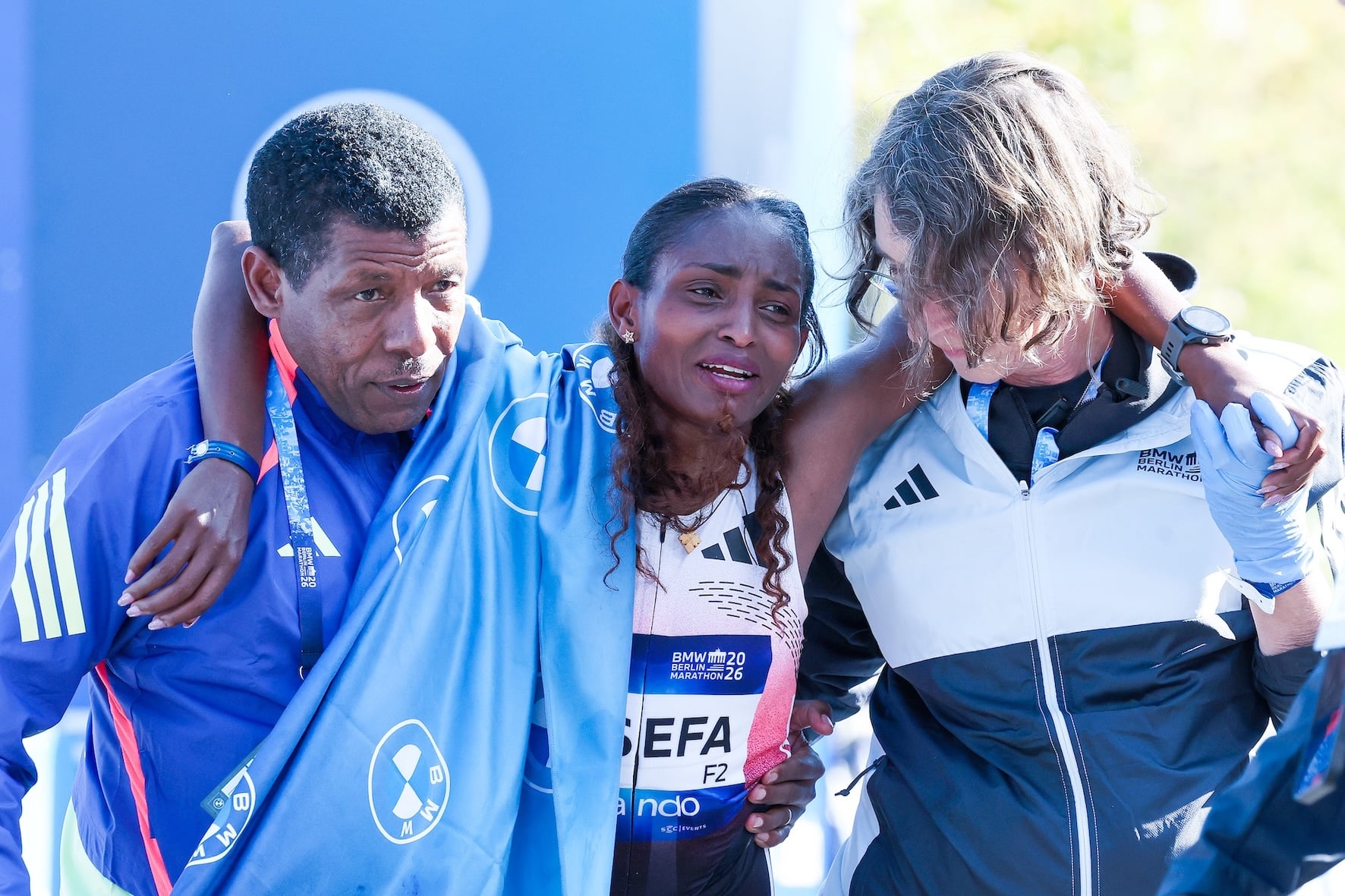
Tigst Assefa reached 40K of the Berlin Marathon on Sunday 10 seconds inside world record pace, and by the time she crossed the line in a course record 2:11:04, her right Achilles tendon had ruptured completely. Her manager, Gianni Demadonna, told Marathon Handbook that the pain started at around 31K and turned acute near 40K. “She tried to continue because she knew she was near the end, but the last 500 meters were terrible,” he said. She had surgery the next day. I was standing by the big screen near the finish as her projected time drifted from 2:09 into 2:11, and I still believe that without the injury she would have broken the world record that morning.
It was one of the bravest runs I have ever watched, and I have felt uneasy about it ever since. On our instant reaction podcast a few hours later I kept returning to the idea of winning at all costs, because on Sunday the costs were right there on the road for everyone to see: a runner at the peak of her career limping for the best part of 10 minutes, then a hospital, then an operation. I don’t have a tidy answer for what that should mean, for her or for the rest of us, and I’m not convinced there is one.

At 40K, Assefa was just under seven minutes from a world record, a €50,000 ($57,000) bonus and a third Berlin title, with the €30,000 ($34,000) winner’s prize doubled for any time under 2:15:00. Berlin was only her second marathon of the year, after she won London in April in a women-only world record, and months of training had gone into that single morning. Stepping off the course would have meant giving all of it up for a tendon that, as far as she knew in that moment, might still hold. Professional runners weigh that kind of trade their whole careers, and Assefa understands the risks of her job far better than anyone watching from the barriers. I’m not going to tell her she got it wrong.
What I keep wondering is how much of a choice it really is when it has to be made two hours into a race run at the limit of what any woman has done, with the finish close enough to hear and crowds lining the final stretch, which is about the worst moment anyone could pick to weigh a career against a single result. Demadonna told AFP that the tendon gave way gradually over the closing kilometers and that “the tendon was completely gone when she ran the last two kilometres.” Nobody outside her medical team can say whether stopping at 40K would have left her with a partial tear and a shorter recovery. If it would have, was the win worth the extra months? She may well say yes, and I suspect most athletes in her position would say the same.
World Athletics’ competition rules give a medical delegate the power to order a runner to retire from an event mid-race, although the cases that stay in people’s memories tend to be the opposite problem, where help came too late. Callum Hawkins was leading the Commonwealth Games marathon on the Gold Coast in 2018 when he collapsed in 28 C heat with about 2K left, and help took long enough to reach him that BBC commentator Steve Cram asked on air, “Where on Earth is the help? You cannot just wait at the finish line,” ABC News reported. Nobody wanted a doctor to pull Assefa off the course at 41K, least of all me. Leaving it entirely to the athlete, though, means the line gets drawn by the person in the most pain of her life with a world record in front of her. I go back and forth on whether that is respect for her judgment or a convenient way for the rest of us to avoid the question.
Paula Radcliffe went to the Athens Olympics in 2004 as the marathon world record holder and stepped off the course at 36K, after racing on a knee that had needed a cortisone injection and a heavy course of anti-inflammatories. “I know I was called a quitter a lot at the time and criticised for stopping, but I think something in my mind kicked in, self-preservation,” she told Sky Sports years later. She won the New York City Marathon that November.
So what would we have said if Assefa had stepped off the course at 40K? She would have lost the race, the record and the prize money, and I’m sure somebody would have called her a quitter too, because somebody always does. I think she would still have been a hero, and not only because of Sunday. The official world record belongs to Ruth Chepngetich, who was banned for three years for a doping violation after she set it in Chicago, and the mark still stands because the ban came later. Assefa has spent the last few years showing us where clean women’s marathon running is going: 2:11:53 in Berlin in 2023, two women-only world records in London and now 2:11:04 on a tendon that was tearing. None of that would have been undone by one DNF, and I hope we would have applauded her just as loudly.

The same all-in attitude runs through the amateur side of the sport now, and I see more of it every year: runners racing through niggles to protect a streak, a PR or a Boston qualifier, and treating a DNF as something to keep quiet about. When researchers surveyed 3,913 finishers of the 2010 Bonn Marathon, 49 percent said they had taken painkillers before the start, according to the study published in BMJ Open in 2013. Adverse events were four times as common among those runners, 16 percent against 4 percent, and all nine runners admitted to hospital had taken them, three with kidney failure, four with bleeding ulcers and two with heart attacks.
Amateurs, I think, need to be careful about taking their cues from the elites here. Assefa’s job is running, and when she got hurt a leading foot and ankle surgeon operated on her the next day, with the months ahead planned around her recovery. That doesn’t make it easy for her, since her income depends on racing and she won’t race for a long time. Most of us, though, have a 9-to-5 to show up for on the Monday after a marathon, and a torn tendon means crutches on the commute, time off work and a season without running, all for a finishing time that means a lot to us but doesn’t pay the bills. Sudden, sharp pain in the middle of a race is one of the clearest signs to stop, and a DNF costs far less than months on the sidelines. Watching the best marathoner in the world limp to victory can make carrying on look like the brave choice, when her situation has almost nothing in common with ours.

Next month I’ll be on the start line of the Toronto half-marathon, and since Sunday I have caught myself wondering what I would do if something went wrong at 18K. I’d like to think I would stop. I’m not sure I would, and I suspect plenty of runners reading this would say the same, because all of us have given something up to get to a start line and learned to treat a certain amount of suffering as the price of a good result. Assefa’s run showed the sport at its most extraordinary. It also showed how rarely anyone knows where sacrifice ends and real damage begins until afterward, on a scan or in a surgeon’s report, long after the moment when stopping could have changed anything.
Assefa, for now, has a long way back. “It will be two months without walking, then one month of walking and cycling, and after that she will start running slowly,” Demadonna said.
RunClub
Get more running stories — join RunClub
Daily running news, a community of 300,000+ runners, free training plans for every distance, and a daily running game. Free to join — no card.
Already a member? Log in →



Join the conversation
Why are you assuming Assefa is clean? We don\'t actually know.