


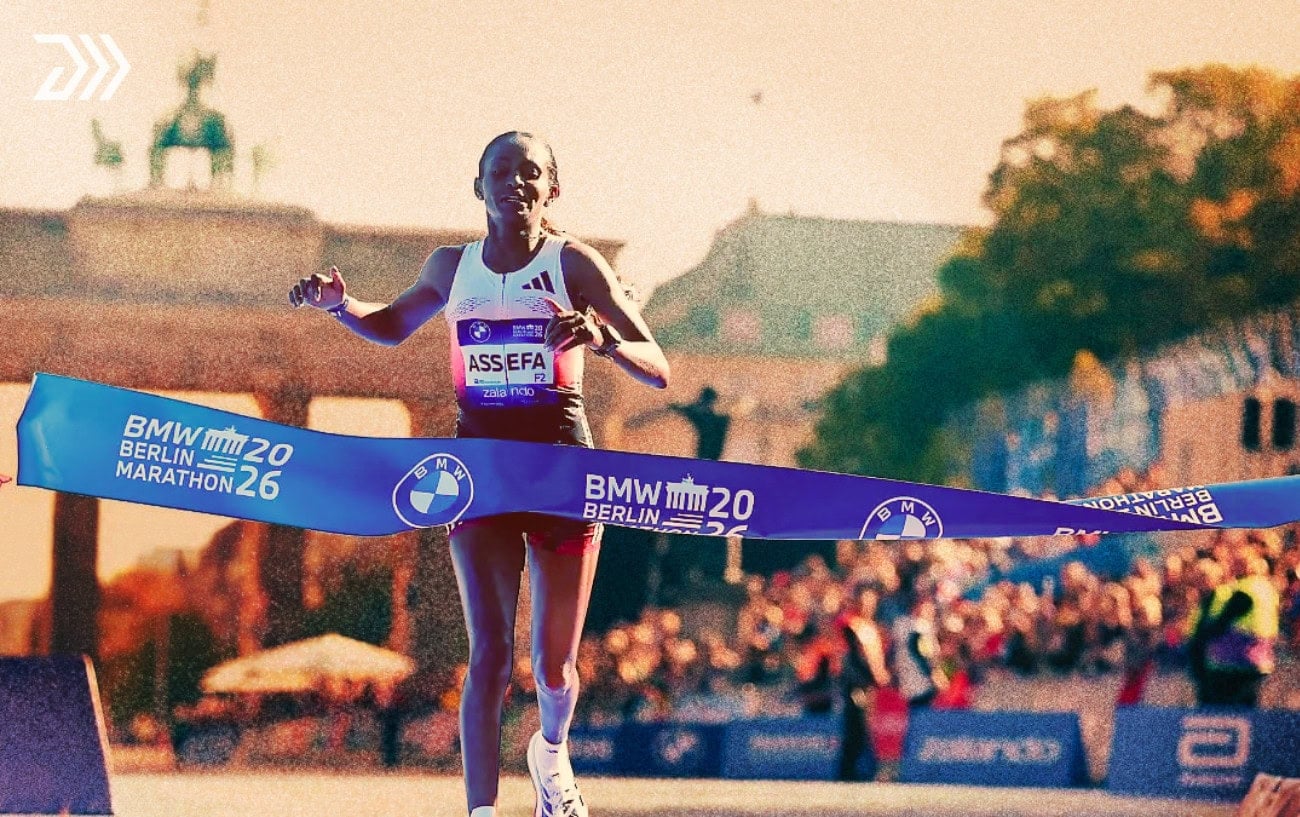
Tigst Assefa underwent surgery on Monday to repair a complete rupture of her right Achilles tendon, her manager, Gianni Demadonna, confirmed to Marathon Handbook. The operation came one day after the Ethiopian won the BMW Berlin Marathon in a course record 2:11:04, the third-fastest women’s marathon in history, while running the final kilometers on the injured tendon.
Assefa was taken to a hospital in Berlin directly after the race and then traveled to Bavaria to be treated by Dr. Johannes Gabel, who leads foot and ankle surgery at BG Unfallklinik Murnau, a trauma and rehabilitation hospital south of Munich. Demadonna, who had described Gabel to another outlet as one of the best surgeons in Germany, confirmed that the operation went ahead as planned. “Yes, and today he performed the surgery,” he said.
His answers settle the question left open in the first day of reporting, when accounts of the injury ranged from muscle problems and cramping to a partial tear. “She had a complete tendon rupture,” Demadonna said.
A recovery with no set timeline
Demadonna had previously been quoted as saying Assefa could need about six months before she races again. Asked by Marathon Handbook whether that remained the expected timeline, he said the team is not yet certain.
“We don’t know,” he said. “It will be two months without walking, then one month of walking and cycling, and after that she will start running slowly.”
Under that plan Assefa would not resume running until at least three months after Monday’s operation, and Demadonna gave no estimate for her return to competition.
“After the surgery today she was sleeping most of the time,” he said. “She is very sad about the injury and about missing the world record.”
Pain from 31 kilometers
The injury did not arrive all at once. According to Demadonna, Assefa began to feel some pain at around 31 kilometers, well before she showed any visible sign of trouble on the broadcast.
She held world record pace regardless. Assefa passed 30 kilometers in 1:32:15 and ran her next two 5-kilometer segments in 15:17 and 15:28, reaching 35 kilometers 14 seconds ahead of the schedule for Ruth Chepngetich’s world record of 2:09:56 and 40 kilometers in 2:03:00, still about 10 seconds up on it.
Somewhere around that point, the pain became acute. “At around 40K, though she doesn’t remember exactly where, she felt a lot of pain,” Demadonna said. “She tried to continue because she knew she was near the end, but the last 500 meters were terrible.”
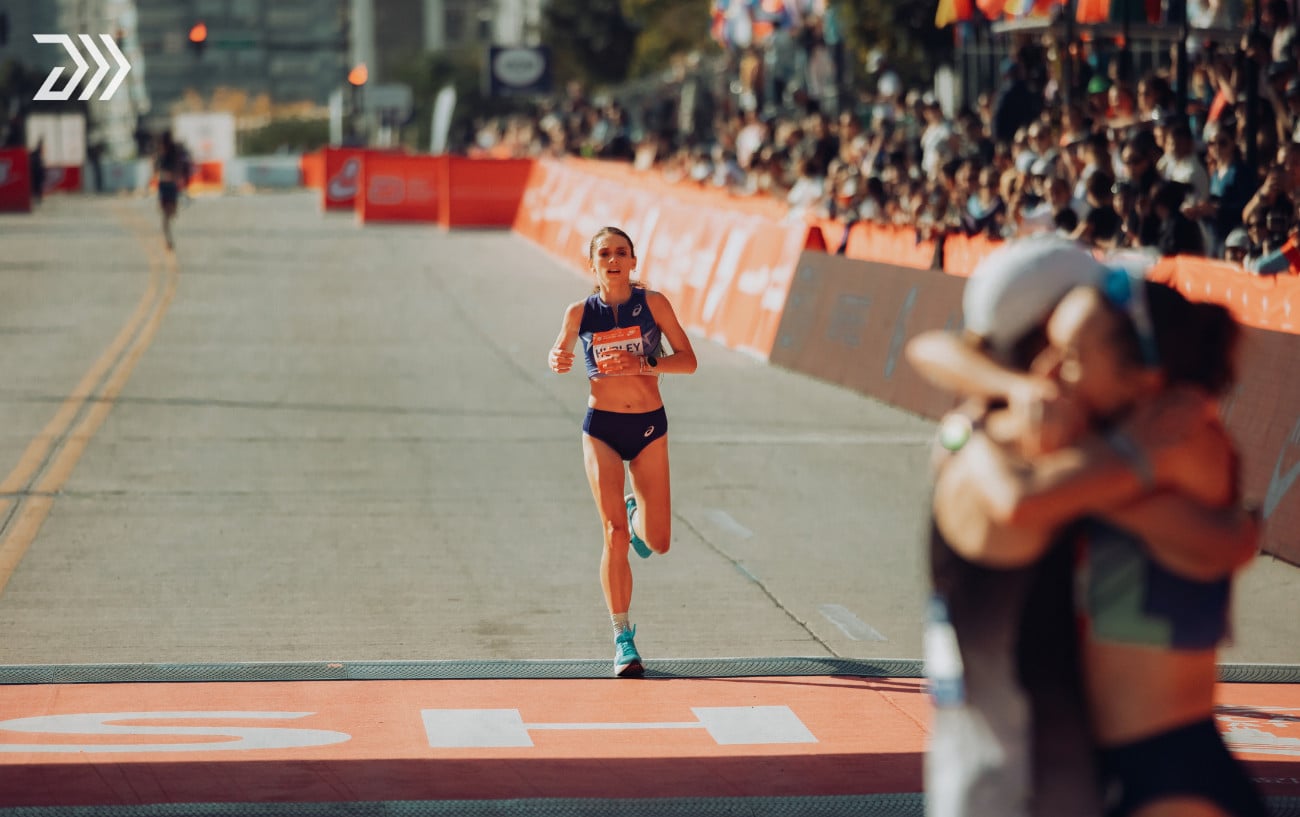
Viewers could see the change. Assefa’s stride shortened and began to favor her left leg in the closing mile, and by the final stretch she was limping and wincing with each step. She covered the last 2.195 kilometers in 8:04, more than 30 seconds per kilometer slower than any of her earlier splits, and sat down just past the line before collapsing to the ground and removing her shoes. “After the finish line she was not able to walk,” Demadonna said.
Haile Gebrselassie helped her out of the finish area, and she was still with race doctors when the podium ceremony took place. “To finish like this, I’ve never seen something like this. The pain is hard to imagine,” Berlin race director Mark Milde said on Sunday, in comments carried by AFP.
Asked whether Assefa had any problems with her right leg or Achilles in training or in the buildup to Berlin, Demadonna was direct. “No. She did not have any pain,” he said.

A third Berlin title
Even with the late slowdown, Assefa won by nearly six minutes over her compatriot Bedatu Hirpa, who finished second in 2:16:53. Her time took 49 seconds off the 2:11:53 she ran in Berlin in 2023, which stood as the world record at the time.
The win was Assefa’s third in Berlin, following her victories in 2022 and 2023, and her second marathon in five months. She took the Olympic marathon silver medal in Paris in 2024 and has won the London Marathon twice, setting a women-only world record of 2:15:50 in 2025 and lowering it to 2:15:41 this April.
The Ingebrigtsen precedent
Assefa is the third of the sport’s best-known distance runners to be set back by an Achilles injury this year. Sifan Hassan withdrew from the London Marathon in March with an Achilles problem, and Jakob Ingebrigtsen had surgery in February on a long-running issue with his left Achilles.
Ingebrigtsen’s case offers the most prominent recent comeback, though his injury differed from Assefa’s. His surgery addressed damage to the sheath surrounding the tendon, a problem that dated back to the spring of 2025 and hampered him at last year’s World Championships in Tokyo.
Six months after that operation, Ingebrigtsen won the European Championships 5,000m in Birmingham on Aug. 10, in his first race in 11 months. On Sept. 11 he added the 5,000m title at the World Athletics Ultimate Championship in Budapest in 12:59.24. “I am extremely happy to run sub-13 minutes,” he said afterward. “Being injured I was fearing the worst outcome.”
A complete rupture is a more serious injury than the one Ingebrigtsen had repaired, since the tendon itself must be surgically reattached, and the two months without walking that Demadonna described reflect that. How closely Assefa’s return follows Ingebrigtsen’s will depend on how the tendon heals over the coming months, which her team said it cannot yet predict.
RunClub
Get more running stories — join RunClub
Daily running news, a community of 300,000+ runners, free training plans for every distance, and a daily running game. Free to join — no card.
Already a member? Log in →



Join the conversation
Thank you for this exceptional update (it\'s by far the most comprehensive yet) and I hope Assefa continues to draw on her great courage to heal well.