When working towards any running goal, a running-specific strength training routine is integral to your training program.
Most gym goers who are not runners are often teased by the phrase “don’t skip leg day,” as much attention is focused on arms, chest, and back muscle groups. As runners, legs are usually the primary focus as we pump up our quads, hamstrings, and calves.
However, we must remember to include all of our muscle groups, including our core, when planning gym workouts to improve our strength, posture, stability, and mobility.
In this guide, we will provide 12 of the best core exercises for runners and discuss the benefits of including core workouts in your training program to improve your running performance and overall health.
What Does Core Strength Mean?
When we think of our core, we often think of our abs. Yes, our abs are a component of the core, but other parts of the body are also included in the core muscle group.
Our core is comprised of a long list of muscles, but to simplify it a bit, it includes our abdominals, obliques, lower back muscles, pelvic floor, diaphragm, hip flexors, and glutes.
So, pretty much the entire middle section of our bodies! From running, jumping, and holding ourselves up, our core does tremendous work in day-to-day movements. Having a solid core will benefit not only our running but our lives in general.
How Does A Strong Core Make You A Better Runner?
Having good core strength can:
- Promote more consistent movement control1Sato, K., & Mokha, M. (2009). Does Core Strength Training Influence Running Kinetics, Lower-Extremity Stability, and 5000-m Performance in Runners? Journal of Strength and Conditioning Research, 23(1), 133–140. https://doi.org/10.1519/jsc.0b013e31818eb0c5 and better running efficiency2Fredericson, M., & Moore, T. (2005). Muscular Balance, Core Stability, and Injury Prevention for Middle- and Long-Distance Runners. Physical Medicine and Rehabilitation Clinics of North America, 16(3), 669–689. https://doi.org/10.1016/j.pmr.2005.03.001
- Increase running performance in terms of speed
- Decrease the risk of running injuries
- Improve posture, resulting in better running form and running economy
- Develop better balance
- Improve stability, especially vital for trail runners on technical terrain
These are plenty of great reasons to ensure core exercises are included in your strength training routine!
Now, let’s check out those core exercises to get you started today on your new core routine.
How Many Times A Week Should Runners Do Core?
As a running coach, I suggest to all my athletes that they strength train twice a week and always add a round of core exercises to the end of the session.
Even 10–15 minutes per session can be effective when done consistently.
12 Great Core Exercises For Runners
Before you begin this workout, warm up with 5-10 minutes of light cardio to get your blood flowing.
#1: Knee to Elbow Plank

You’ve most likely heard of full planks (high planks), side planks, and elbow planks, but today, we will add a bit of a challenge to this bodyweight plank variation.
- Begin in a full plank position (extended push-up position), with your hands planted firmly on the ground and your wrists, elbows, and shoulders stacked in a straight line.
- Engage your core and lift your left leg and right hand, bringing your left knee and right elbow together beneath you.
- Return your left foot and right hand to their starting positions and immediately bring your right knee and left elbow together beneath you.
- Repeat for the desired number of reps.
As another variation, you could also do mountain climbers!
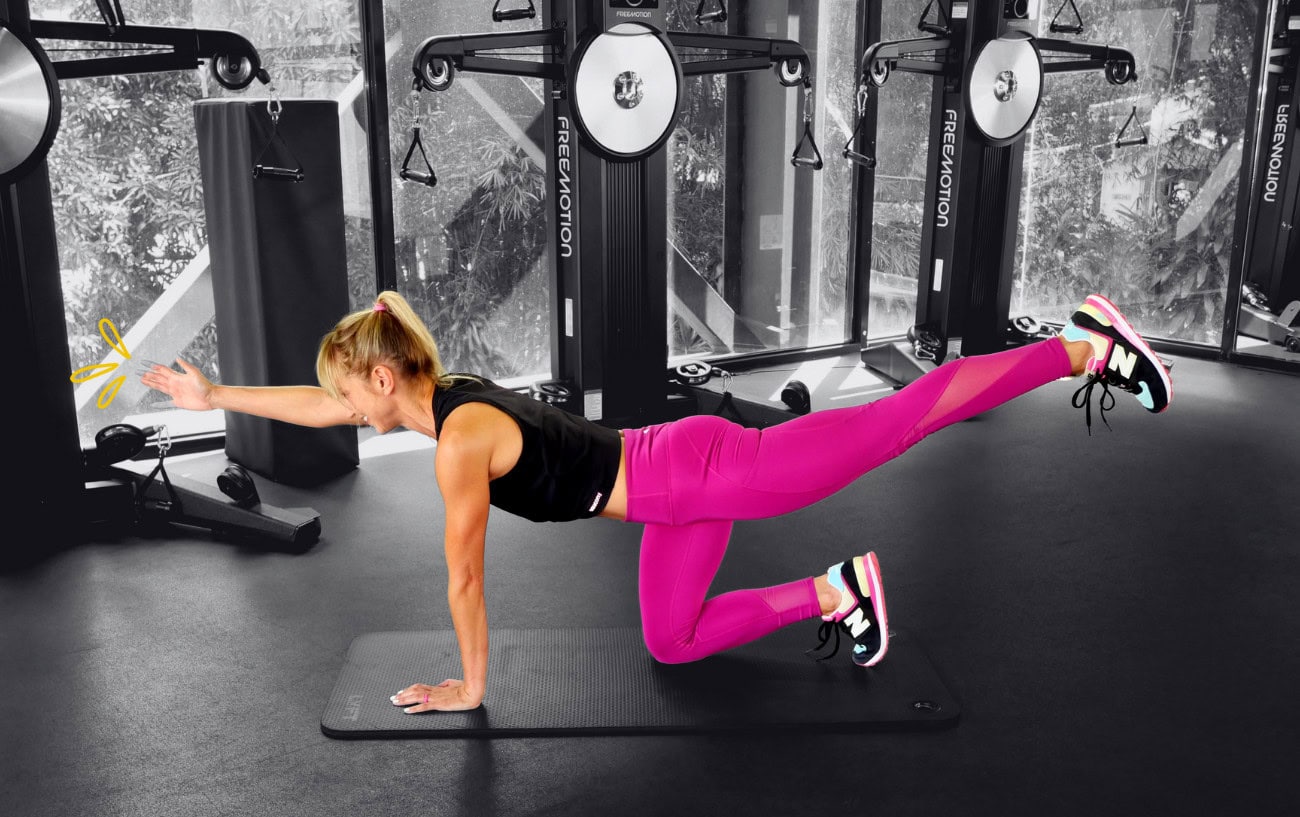
#2: Bird Dog

This next core exercise works the abs, low back, thighs, and glutes and helps improve stability, balance, and coordination.
- Begin on your hands and knees with your back straight and your hands shoulder-width apart.
- Engage your core.
- Simultaneously lift your right leg and push it back with your glute so it is straight out behind you and your left arm straight out in front of you.
- Hold this position for a second.
- Return to the starting position.
- Repeat for the desired number of reps.
- Repeat on the other side.
#3: Half-Kneeling Pallof Press

Any exercise that starts with “half-kneeling” will be challenging and full of stability work. If this starting position is too difficult for you, you can perform this core exercise from a standing or a full-kneeling position.
This will give you more stability during the exercise movement.
- Begin in a half-kneeling position, holding a dumbbell or kettlebell to your chest.
- Engage your core and push the weight straight out in front of you without moving the rest of your body or tipping over to one side.
- Hold the weight in the extended position for a second or two.
- Return to your starting position.
- Repeat for the desired number of reps.
- You can switch legs with each set.
#4: Half-Kneeling Halo with Kettlebell

We stay in the same half-kneeling position for this core work exercise to challenge our stability.
- Begin in a half-kneeling position, holding a kettlebell to your chest, handle side down.
- As you keep your core stable, circle the kettlebell around your head, returning to your starting position each time.
- First, circle clockwise, then counterclockwise, alternating each time.
- Repeat for the desired number of reps.
#5: Runner’s Crunch

For this core exercise, we are putting a twist into one of the basics, the crunch. It’s called a runner’s crunch because you perform this while “running” simultaneously, using your hip flexors to raise and lower your alternating legs.
- Begin by lying on your back, legs extended out in front of you, and arms bent at 90 degrees.
- Engage your core and lift yourself off the ground, bringing your right knee to meet your left elbow.
- Alternate legs and arms right side to left side.
- Repeat for the desired number of reps.
#6: Reverse Crunch

- Begin by lying on your back with your arms at your sides and knees bent.
- Engage your core, raise your legs and bring your knees toward your chest as you bring your hips and lower body off the floor and reach your feet toward the ceiling.
- Slowly bring your hips back down to the mat and repeat. The further you can kick your legs up without losing good form or technique, the better!
- Repeat for the desired number of reps.
#7: Leg In and Outs

- Begin by lying on your back, arms by your side, and knees bent and tucked toward your upper body.
- Extend your legs completely, keeping your back flat on the floor.
- Hold your legs extended briefly, then slowly bring them back into the starting position.
- Repeat for the desired number of reps.
#8: Single-Leg Glute Bridge

This unilateral exercise is excellent for strengthening muscle imbalances as it works one side at a time.
- Begin by lying on your back with your knees bent, arms by your sides, and heels on the floor at hip-width apart.
- Lift your right leg and extend it straight parallel to your left thigh.
- Engage your core and lift your hips up off the ground, aligning with your left knee.
- Hold this position for a second or two, activating your glutes and keeping your hips aligned.
- Lower your hips to the starting position.
- Repeat for the desired amount of reps.
- Repeat on the other side.
Note: You could also place a resistance band just above your knees for added resistance.
#9: Standing Dumbbell Woodchop

- Stand tall with your feet shoulder-width apart.
- Grip a dumbbell, one hand on each side, and bring it down to your left hip.
- In one strong, controlled movement, engage your core and swing the dumbbell diagonally across your body up to your right shoulder.
- Repeat for the desired number of reps.
- Repeat on the other side.
Note: This exercise can be done in a kneeling or half-kneeling position if you would like to add more difficulty to your strength workout.
#10: Single Kettlebell Farmer’s Walk

- Hold a kettlebell in your right hand a few inches from your thigh.
- Holding this position, engage your core and walk forward.
- Do not allow your body to lean to one side or the other to compensate for the weight. You must keep your body upright at all times.
- Repeat for the desired number of steps.
- Repeat on the other side.
#11: Superman

- Lie facedown on the floor with your arms extended in front of you and your legs straight behind you.
- Engage your glutes and core, lift your arms and legs off the ground simultaneously, and squeeze your shoulder blades together.
- Hold this position for a second or two.
- Gently lower yourself back to the floor.
- Repeat for the desired number of reps.
Note: You can also perform this exercise by alternating lifting your right arm and left leg, and then lifting your left arm and right leg in constant movement.
#12: Suspension Roll Out

For this exercise, you will need a suspension device such as a RIP or TRX.
- Begin by kneeling on the floor with a handle in each hand.
- Engage your core, keep your torso straight, and lean forward slowly, bringing the handles in front of you and keeping your arms straight.
- When you are fully extended, pause for a second.
- Slowly bring the handles back to your starting position.
- Repeat for the desired number of reps.
So, are you ready to kick it into high gear with these core exercises for runners?
A strong core helps improve your running performance, decrease injury risk, and boost overall movement control. Try incorporating these into your weekly training schedule for a well-rounded routine.
You can also check out our other exercise guides, including squat variations, lunge variations, and plank variations for runners.