


Anyone circling a spring or fall marathon for a PR attempt in 2027 has a new variable to plan around, and it is forming in the Pacific Ocean. The El Niño building there is on track to be one of the strongest ever recorded, and climate scientists expect the heat it leaves behind to make 2027 the warmest year on record.
The U.S. Climate Prediction Center’s September update put the chance of a “very strong” event this fall and winter at more than 90 percent, and said it could surpass every El Niño in records going back to 1950. “We should be clear that this is an unprecedented event,” Adam Scaife, the Met Office’s head of long-range forecasting, told the Associated Press. His colleague Nick Dunstone said 2027 is “very likely to replace 2024 as the warmest year on record.”
The last event on that scale came in 2015 and 2016, when sea surface temperatures in the central Pacific peaked 3.08 C above normal on Nov. 18, 2015, the highest daily reading on record, and climate scientist Zeke Hausfather wrote for Carbon Brief last month that every model run for this event peaks above it, with the average around 4.1 C. The year after that event, 2016, became the warmest on record at the time, the third straight year to set the mark. NASA estimated that El Niño alone added 0.12 C (0.2 F) to it.
The 2023 El Niño played out the same way. It peaked in December 2023 and kept pushing temperatures up through the first half of 2024, which the EU’s Copernicus Climate Change Service confirmed as the warmest year in records going back to 1850 and the first calendar year more than 1.5 C above pre-industrial levels. Europe had its hottest year on record too, with spring and summer each running about 1.5 C above their 1991 to 2020 averages. The lag is the reason a peak this winter points to a hot 2027.
What Heat Does to a Marathon Time
Researchers at Nanjing University of Information Science and Technology put a number on the tipping point in a 2024 study in npj Climate and Atmospheric Science, matching 678 race results from 96 of the world’s top marathoners with the weather on the day. Elite times were best at around 12 C (54 F) and got steadily worse above it. Beyond 15 C (59 F), every extra degree cost an average of 0.56 of a minute, about 23 seconds for men and 43 seconds for women. The authors traced more than half of that effect to thinner air, since warm air holds less oxygen per breath.
The penalty grows further back in the field. A 2012 study in PLOS ONE led by Nour El Helou analyzed close to 1.8 million finishes across six major marathons from 2001 to 2010 and found runners were fastest between 3.8 C and 9.9 C (39 F to 50 F), depending on their level. Withdrawals rose with the temperature, and the worst race in the data set was Chicago in 2007, run at 25 C (77 F), where the withdrawal rate reached 30.7 percent.
An earlier study by Matthew Ely and three co-authors, published in 2007 in Medicine and Science in Sports and Exercise, found the top men slowed by 1.7, 2.5, 3.3 and 4.5 percent as wet-bulb globe temperature, a heat measure that also accounts for humidity and sun, climbed from 5 C to 25 C. The gap between the coolest and warmest races works out to about six minutes for a 3:30 marathoner, and slower runners lost more than the leaders did.
Climate Central’s analysis of marathon weather, published last October, set the ideal range for recreational runners at 37 F to 51 F. Of the 51 U.S. marathons it studied, only seven had better than even odds of a race day in that range, with Boston near the top at 74 percent. A separate large-scale study on ideal marathon weather put the sweet spot at 35 F to 55 F.
How the Majors Fared in the Last Two Record Years
The years that followed the last two big El Niños, 2016 and 2024, were both the warmest on record at the time, and the six World Marathon Majors give a fair picture of what that meant on race morning.
| Race | 2016 | 2024 |
|---|---|---|
| Tokyo | 48 F to 52 F (9 C to 11 C) | 49 F (9.6 C) at the start |
| Boston | 69 F (21 C) at the start | Mid-60s F (about 18 C) by late morning |
| London | 45 F to 46 F (7 C to 8 C) | 46 F to 48 F (8 C to 9 C) |
| Berlin | 59 F to 64 F (15 C to 18 C) | 48 F to 55 F (9 C to 13 C) |
| Chicago | 51 F to 56 F (11 C to 13 C) | 60 F to 63 F (16 C to 17 C) |
| New York City | 54 F to 57 F (12 C to 14 C) | 43 F to 48 F (6 C to 9 C) |
Ranges are hourly readings across race morning at the nearest airport or park weather station, from the Iowa Environmental Mesonet archive. Single figures are as reported by race organizers or the AP.
Four of the six majors in 2016 spent at least part of race morning above the 12 C mark, and three did in 2024. Boston was warm both times: it started at a “warm 69 degrees” in 2016, according to LetsRun, and in 2024 runners were using water to cool off by late morning, with temperatures in the mid-60s. Berlin 2016 warmed to 18 C by midday, and Kenenisa Bekele still ran 2:03:03, six seconds outside Dennis Kimetto’s world record of the time.
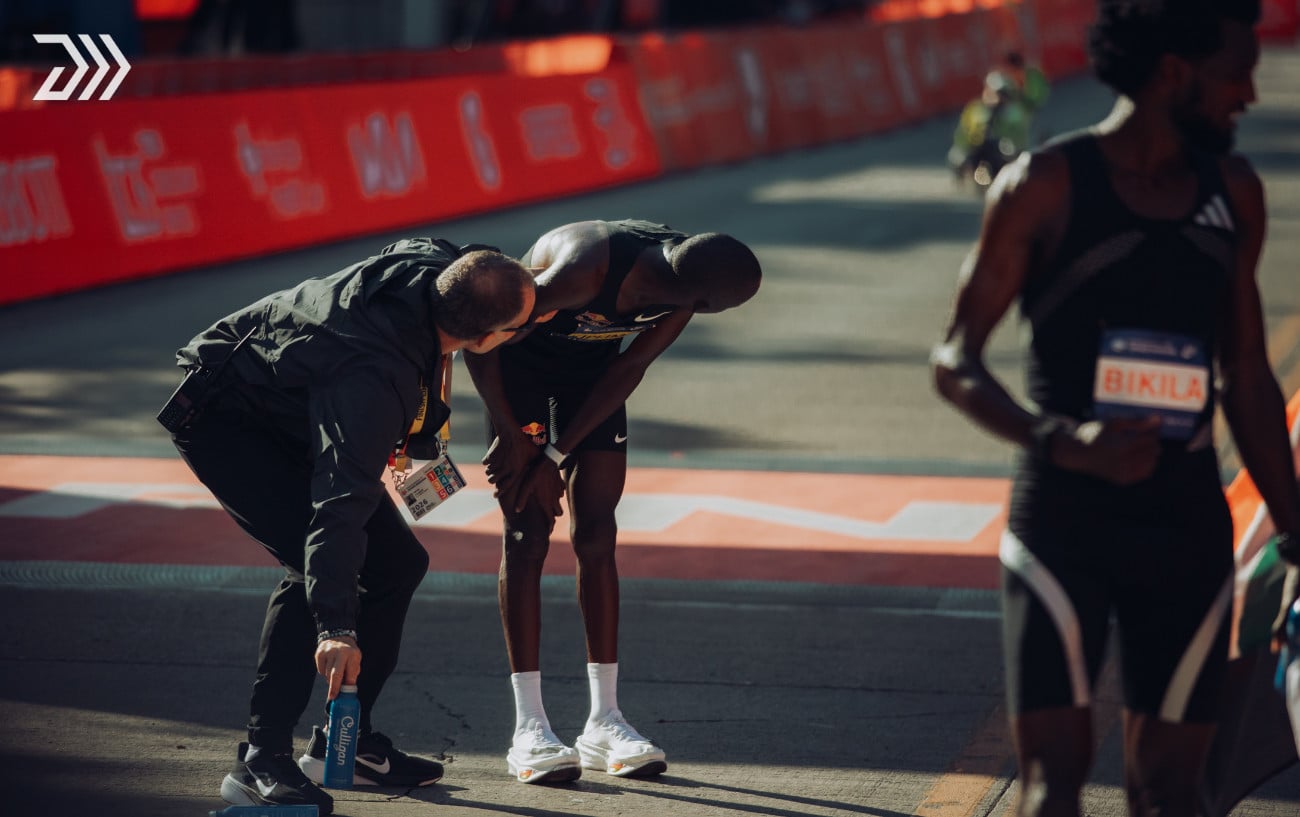
Eliud Kipchoge set the London course record of 2:03:05 on a 7 C morning in 2016, and Benson Kipruto ran a Tokyo course record of 2:02:16 in 2024 in sunny, 9.6 C conditions. A hot year shifts the odds without fixing the weather on any one Sunday. In the fall of 2023, a few months after NOAA declared El Niño had arrived, organizers called off the Twin Cities Marathon on Oct. 1 with 88 F in the forecast. A week later, Chicago was forecast to start at 47 F and Kelvin Kiptum ran 2:00:35 for what was then the world record.
El Niño also reaches some regions more than others. The European Centre for Medium-Range Weather Forecasts has described summer seasonal forecasts for the northern mid-latitudes as highly uncertain, and in the U.S., El Niño springs have tended to run wet from Massachusetts to New Jersey, a pattern that holds in some years and not others. ECMWF’s models have this event fading through 2027, with a La Niña possible by the end of the year. What a record El Niño does is stack a hotter year on top of a warming trend, which leaves fewer of the cool mornings that a PR usually needs.
Races Are Already Moving
Twin Cities will run on Oct. 17 in 2027, its first date change in 45 years. “We’ll take a 39-degree start over a 70-degree start,” race director Ed Whetham told the AP in August. The Sioux Falls Marathon has shifted from August to September after heat canceled its 2024 race, and the Long Beach, Little Rock and Air Force marathons have all moved their start times earlier in the morning. On the runner’s side, heat acclimation in the weeks before a race and pacing by effort once the day turns warm are the main levers, and MH’s guide to running in the heat covers both.
Boston opens the spring majors in April, and London follows on April 24 and 25, running over two days for the only time with 100,000 runners split across the weekend. The year’s biggest championship marathons come in September, when Beijing hosts the World Athletics Championships from Sept. 10 to 19.
RunClub
Get more running stories — join RunClub
Daily running news, a community of 300,000+ runners, free training plans for every distance, and a daily running game. Free to join — no card.
Already a member? Log in →





Start the conversation