


Fred Kerley’s career has been defined by dramatic turns of speed and bigger-than-life ambition.
On Tuesday, the 30-year-old Texan who once ruled the 100m was provisionally suspended by the Athletics Integrity Unit (AIU) for allegedly missing three doping tests in a 12-month period, a breach treated under anti-doping rules the same as a positive test.
The suspension, which Kerley intends to fight, is the latest chapter in a turbulent two years that have taken him from the top of the sprinting world to the brink of a lengthy ban.
The AIU said Kerley’s missed tests qualify as “whereabouts failures” under the World Anti-Doping Code, which requires athletes in a registered testing pool to provide daily location details so they can be tested without notice. Three missed tests or filing failures in a year can trigger a sanction of up to two years.
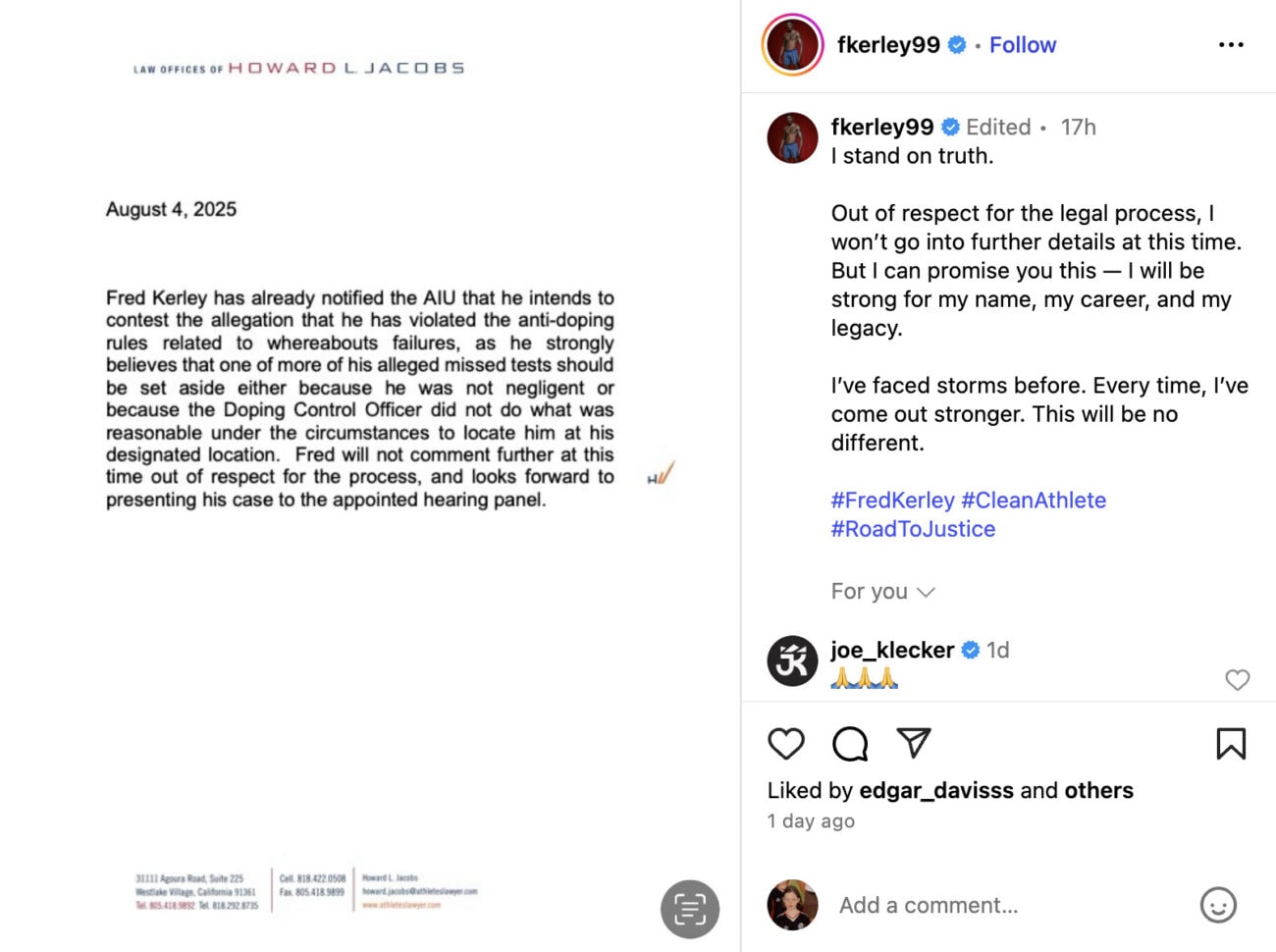
Kerley’s lawyers issued a statement saying he “strongly believes that one or more of his alleged missed tests should be set aside” because he was not negligent and because the doping control officer “did not do what was reasonable under the circumstances to locate him.”
On social media, Kerley struck a defiant tone: “The 100m should be a straight sprint. 2025 has presented many hurdles. Thanks to all my supporters.”
A Champion in Decline
For much of the past decade, Kerley’s story was one of calculated reinvention. Originally a 400m runner, he shifted focus to the 100m ahead of the Tokyo Olympics, a gamble that earned him silver in 2021.
In 2022, he claimed the world title in Eugene, Ore., running 9.86 seconds to edge Marvin Bracy-Williams and complete a rare sprint résumé that also included medals in the 200m and 400m. His personal best of 9.76 still ranks among the fastest times in history.
But the past 18 months have been marked by controversy. In May 2024, Miami-Dade police were called to Kerley’s home after an argument with his then-wife, which authorities described as potentially “life-and-death.”
In January this year, he was arrested again in Miami on charges of battery, resisting a police officer, and breach of the peace. That incident involved hurdler Alaysha Johnson, who told police Kerley punched her during an argument at a hotel before a Grand Slam Track meet.
Kerley admitted there had been an altercation but called it a misunderstanding. Grand Slam Track suspended him from its Philadelphia meet as the case moved forward. His lawyers have denied the charges.

What’s at Stake
If the AIU upholds the whereabouts violation, Kerley would be ineligible for two years, sidelining him through much of the 2026 season and dealing a major blow to his chances of contending at the Los Angeles 2028 Olympics.
The AIU process can take months, and athletes have occasionally overturned missed-test rulings if procedural errors are found, as in the case of other high-profile sprinters.
For now, Kerley’s future hangs in the balance. Only three years ago, he was the fastest man on the planet, the rare sprinter with the range to win at 100, 200, and 400 meters.
Today, his name is just as likely to appear in police reports and legal filings as on a results sheet. Whether this is the beginning of the end or the setup for another comeback remains to be seen, but the gap between those two outcomes has never looked wider.
RunClub
Get more running stories — join RunClub
Daily running news, a community of 300,000+ runners, free training plans for every distance, and a daily running game. Free to join — no card.
Already a member? Log in →




Start the conversation