


Sabastian Sawe ran his key 30-kilometer training session 67 seconds faster ahead of this weekend’s London Marathon than he did in the buildup to Berlin 2025. His heart rate was lower the whole way. That’s according to data compiled by Maurten, the Swedish sports nutrition company that works with Sawe’s team in Kenya, and shared with Marathon Handbook.
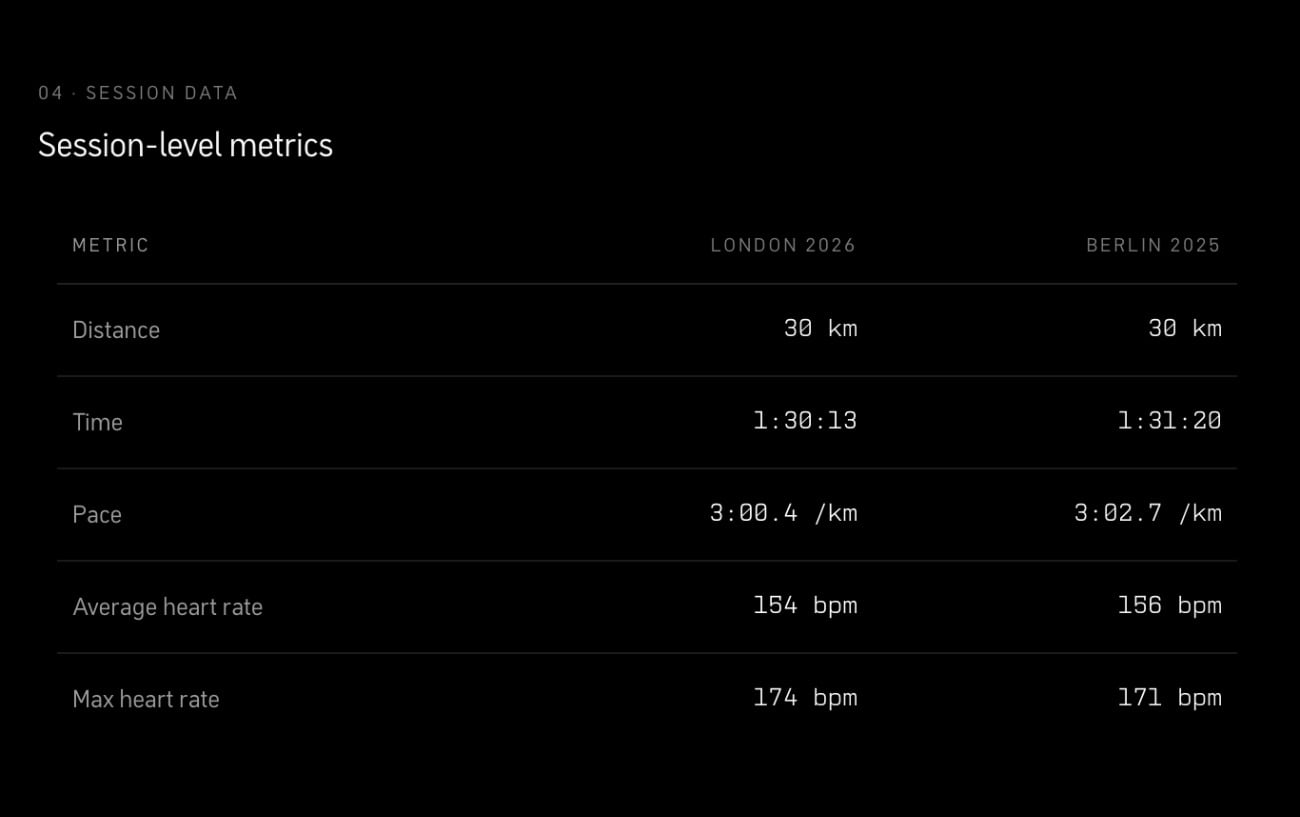
The London tune-up clocked 1:30:13 at an average of 3:00.4 per kilometer. The equivalent Berlin session came in at 1:31:20, or 3:02.7 per kilometer. Same runner, same distance, same spot in the training block. Faster output, less cardiovascular strain.
“1 minute 7 seconds. That’s how much faster Sawe ran 30km in the lead-up to London 2026 than he did in the lead-up to Berlin 2025. And he did so at lower effort — while consuming 95–100 grams of carbohydrates per hour,” wrote Christina Gustavsson of Maurten in the note shared with Marathon Handbook.

Every split better
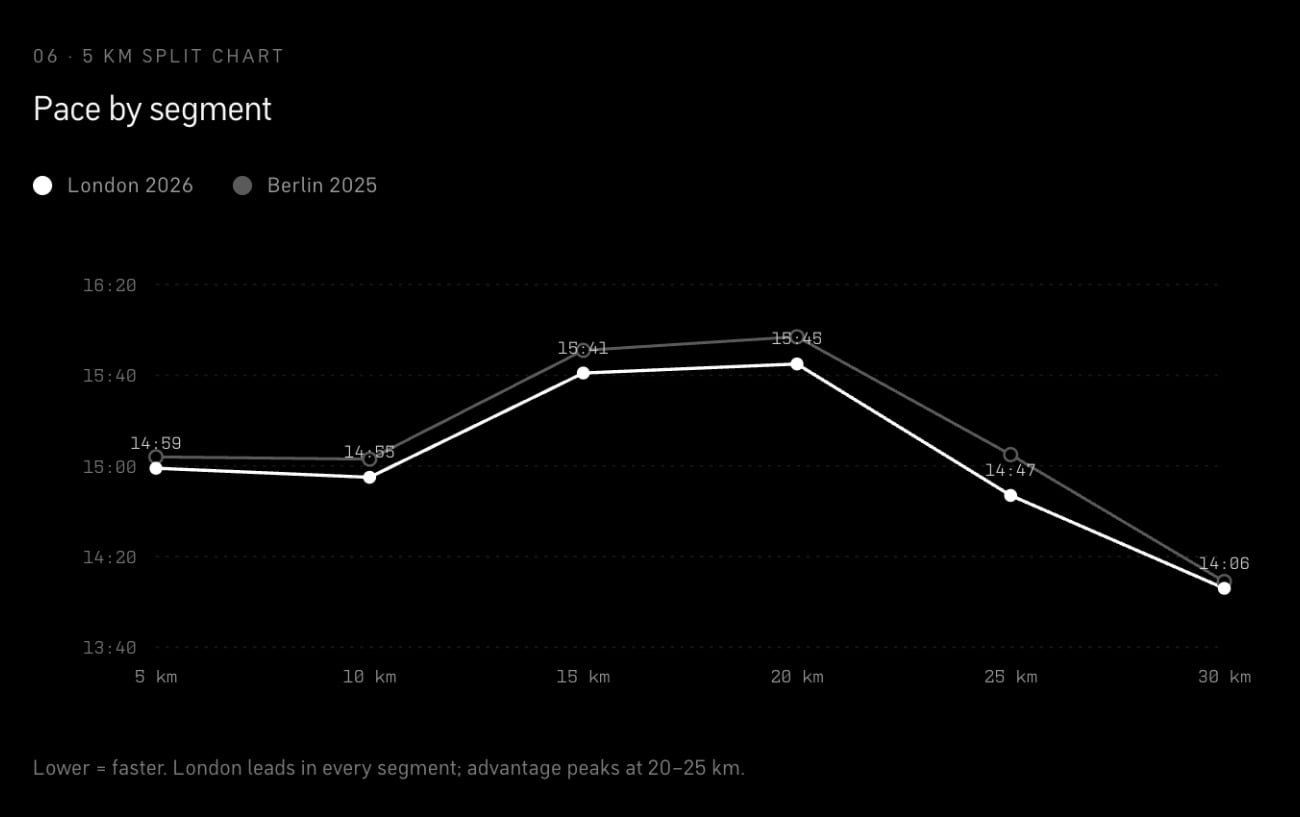
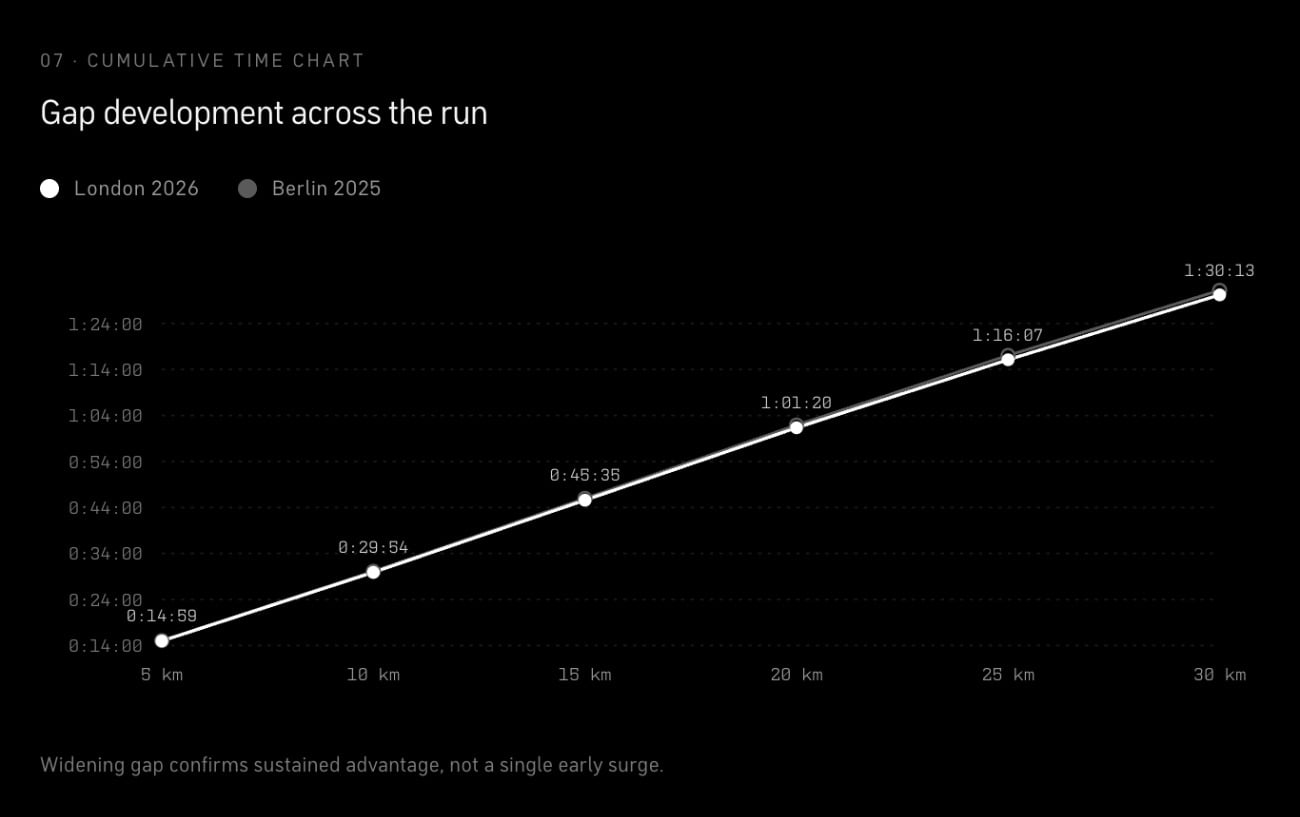
Sawe opened slightly faster in London and then kept widening the gap. At 5K the difference was just 5 seconds. By 25K it was 56 seconds. The gap closed the run at 59 seconds on split totals, with session timing putting him 67 seconds ahead overall.
The decisive stretch came between 20 and 25 kilometers. Sawe ran 14:47 in that segment in London, against 15:05 in Berlin. That 18-second cushion is the kind of late-race split coaches scrutinize closely, because it shows what a runner can still produce once the legs have been loaded. It’s the sort of thing a well-built long run is designed to develop.
His final 10K was also noticeably quicker. He covered the last third of the run in 28:53 in London, compared with 29:14 in Berlin.
Lower heart rate, higher ceiling
Sawe’s average heart rate for the London session was 154 beats per minute. For Berlin, it was 156. A 2-beat gap is small on paper, but the direction matters: he was running faster while his engine was working slightly less hard.
His maximum heart rate, on the other hand, was higher in London (174 versus 171). Maurten’s read on that is straightforward. Sawe was able to push into a higher gear late in the run without losing control over his overall pacing. That combination, lower average load with access to a higher ceiling, is the profile you want heading into a championship-level race.
Fueling at the edge of what’s possible
The nutrition side of the data is where things get more specific. During the Berlin 2025 buildup, Maurten used a carbon-13 breath tracing method to measure how much of Sawe’s ingested carbohydrate his body was actually burning in real time. By 30 kilometers, that number had climbed to roughly 100 grams per hour. That sits at the top end of what sports scientists currently consider physiologically sustainable.
The method works by tagging the carbohydrate drink with a naturally heavier stable form of carbon (¹³C), then measuring how much of it shows up in exhaled CO₂. A rising signal across the run means the gut is absorbing fuel and the working muscles are burning it. Sawe’s reading climbed from a baseline of −18.5‰ to −3.0‰ by 30K, with exogenous carbohydrate oxidation rising steadily from 45 grams per hour at the 5K mark to 100 grams per hour by the end.
That kind of gut capacity is not a given. It has to be trained, session by session, by progressively exposing the intestinal transporters to higher carbohydrate loads. The Berlin profile is evidence of a runner who has done that work.
Who put the numbers together
Joshua Rowe, Maurten’s Head of Sports Tech, ran the analysis and has been working directly with Sawe’s camp in Kenya. The full interactive breakdown of both sessions is available publicly at athlete.maurten.com. It includes 5K split charts, cumulative time graphs, heart rate data, and the substrate traces from Berlin.
What the numbers say about Sunday
Taken together, the picture is of a runner showing up in London in better shape than he was before his last major. Faster pace, a slightly lower heart rate, a stronger close, and a gut trained to hold near the ceiling of carbohydrate absorption through 30 kilometers. For a runner preparing to race the world’s deepest marathon field, those are the boxes you want ticked.
Training numbers never win a marathon on their own. Race day brings weather, tactics, and a hundred small decisions in the final 10K that no lab can simulate. But if you’re looking for signals in the weeks before London, these are the kind worth paying attention to.
RunClub
Get more running stories — join RunClub
Daily running news, a community of 300,000+ runners, free training plans for every distance, and a daily running game. Free to join — no card.
Already a member? Log in →












Start the conversation