


Michael Johnson’s Grand Slam Track League made its long-awaited debut on Friday night in Kingston, Jamaica—an ambitious, high-stakes attempt to reimagine professional track and field.
But for a sport that’s always chasing its own spotlight, this wasn’t just another meet. It was a gamble. And depending on where you were sitting, the bet either showed real promise—or just how far the sport still has to go.
The on-track action delivered drama, surprise victories, and Olympic-caliber performances. But off the track, a half-empty stadium and underwhelming production left something to be desired. Still, if Johnson’s goal is to build something lasting, not just flashy, this was a starting point.
A messy one, maybe—but a start nonetheless.

The Vision
Grand Slam Track is trying to fix a sport that many agree is broken. Too many meets, too few stakes, and a confusing global calendar.
Johnson’s solution? Fewer races, more stars, head-to-head competition, and a big payday—$100,000 for each event winner by the end of the four-meet series.
Athletes are divided into two groups: “Racers,” who commit to all four meets, and “Challengers,” who pop in for specific events. That structure, plus no prelims and no pacers, is meant to make the racing feel more like championships—and less like time trials.
It’s also a test of how well a sport that thrives during the Olympics can sustain attention in April, May, and June.
That’s a tough sell, especially in a place like Jamaica, where track is beloved but only when there’s a compelling reason to watch.
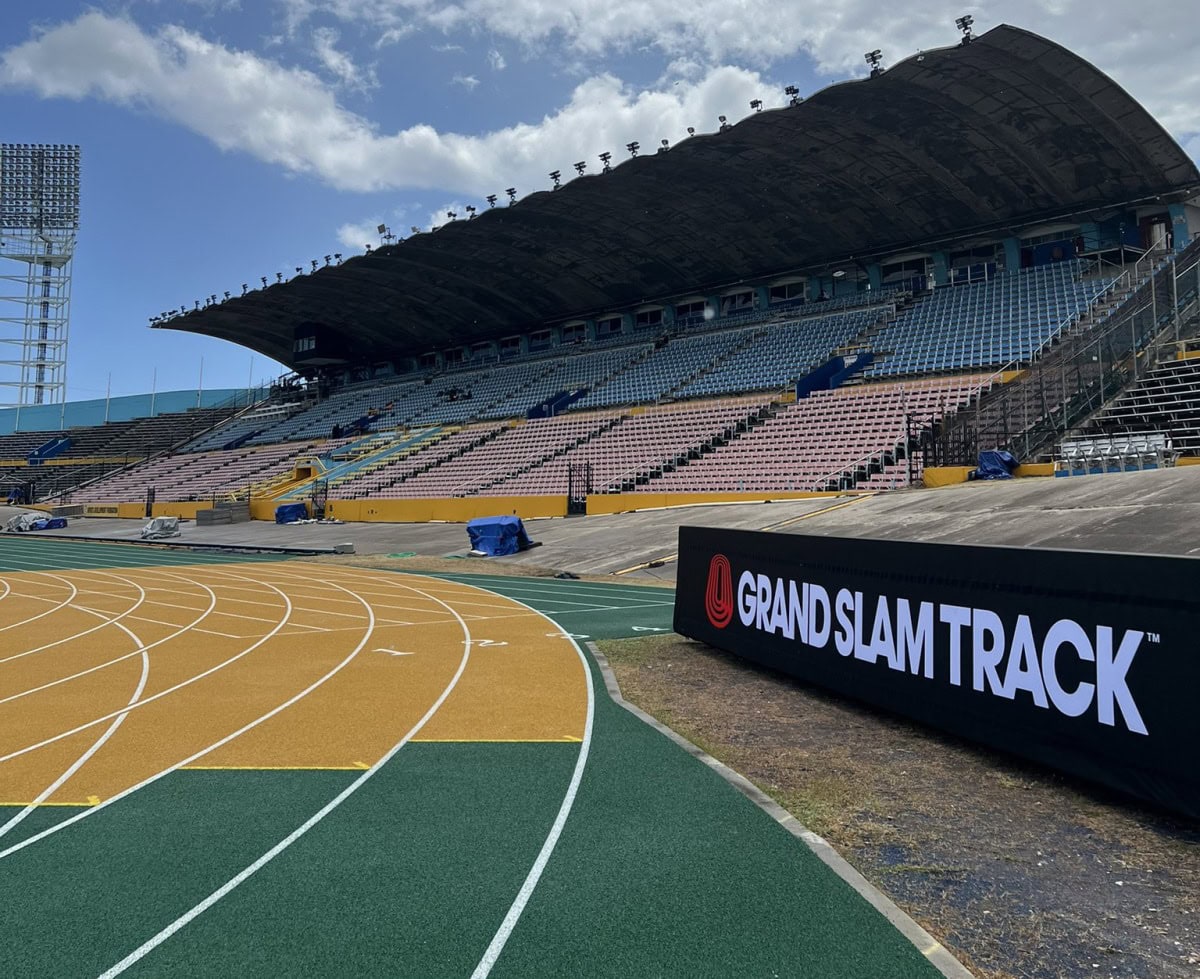
On Friday, the crowd at National Stadium barely hit 4,000, despite a lineup stacked with Olympic medalists.

The Racing: Unpredictable, Sometimes Odd, But Often Fun
If you’re a fan of pure competition, this was your meet.
The men’s 5000 meters might have been the slowest international race you’ll see all year—14:39 for the win—but it was also one of the most thrilling.
Grant Fisher, a double Olympic medalist and world indoor record holder, used a perfectly timed final lap to take the win in a blanket finish over Cooper Teare and Dylan Jacobs. An American sweep, in April, against a field that included Hagos Gebrhiwet and Ronald Kwemoi? That doesn’t happen every day.
Fisher’s 51.6-second final lap was impressive, but he was quick to add context. “We were jogging for that entire race, so you were pretty fresh at the end,” he said. Still—51 is no joke.
Gebrhiwet, for his part, looked like he was reliving his Olympic meltdown from Paris, going too hard with 400 to go and fading badly. It’s a mistake you’d expect a 10-year veteran of the pro circuit to avoid by now, but here we are.
On the women’s side, Nikki Hiltz put together one of the best performances of the night, taking the 800 meters in a personal best 1:58.23. That’s not even Hiltz’s primary event—they’re a 1500 specialist—but the race played perfectly into their hands.
With Mary Moraa surprisingly off her game and fading to last, Hiltz seized control at the bell and held off a late surge from Diribe Welteji and Jessica Hull, both of whom also set PBs.
For Hiltz, who already won U.S. indoor titles in the 1500 and 3000 this year, this was another level. If they can carry this form into the 1500, they’ll be tough to beat.

Not all the American distance stories were as sunny.
The women’s 3000, a potential proving ground for U.S. contenders like Elise Cranny and Whittni Morgan, turned into an East African masterclass. Ethiopia’s Ejgayehu Taye crushed the field in 8:28.42, more than 15 seconds ahead of the top American. Morgan and Cranny were solid—but nowhere near threatening.
Sydney McLaughlin-Levrone was another undisputed star of the night—and likely the one who felt the most like a marquee attraction.
Her 52.76 in the 400 hurdles wasn’t just the fastest time ever in April, it was also an effortless show of dominance.
No one was even close. The Jamaican crowd, known for backing its own, roared for McLaughlin-Levrone. Sometimes greatness is just too undeniable to ignore.
Gabby Thomas had a solid win in the women’s 200, running 22.62 to comfortably beat Olympic 400 champ Marileidy Paulino.
But in this format, where you need to win both your events (200 and 400 in her case) to take home the $100k, Thomas now finds herself in a tough spot. If Paulino wins the 400 on Sunday, Thomas may need more than just a win—she may need help from someone else to stop Paulino.
The men’s 100 closed the night with a thriller, as Kenny Bednarek edged Jamaica’s Oblique Seville by just 0.01. Bednarek’s been working on his start, and while it still didn’t look crisp, his top-end speed carried him through.
Fred Kerley, on the other hand, looked like a shadow of his Olympic self—finishing 7th in 10.30, his slowest 100 in years.
Chris Bailey also turned heads in the men’s 400, posting a 44.34 to beat Olympic silver medalist Matthew Hudson-Smith. That’s either a sign Bailey is on the cusp of a breakout season—or just way sharper than his competitors this early in the year. Either way, it was a statement.

What Didn’t Work: The Empty Stadium, the Daylight Broadcast, the Missing Splits
It wasn’t all roses.
The stadium looked cavernous and empty on camera, especially during the meet’s early races. That’s a major visual problem when you’re trying to sell this as a world-class product.
A smaller venue or a later start time under the lights would have helped. Instead, we got wide-angle shots of mostly empty bleachers—less “big-time event,” more “early heat at a regional.”
The TV broadcast missed the mark too.
Rather than diving into what makes Grand Slam Track different, the pre-show leaned on generic tropes about the host city.
And for a league built on storytelling, the absence of split times in the results—especially for distance events—was a glaring oversight.
That said, none of this is fatal.
The WNBA wasn’t packed in its early days either. Growth takes time, especially when you’re trying to rewire how people think about a sport.
So, Was It a Success?
It depends on your definition.
If you tuned in for great racing, you got it. If you were hoping for packed stands and slick production, it fell short.
But this isn’t a finished product—it’s a startup. And for a first try, Grand Slam Track gave us reasons to believe.
It showed that track, when presented with stakes and structure, can deliver drama. It proved that stars like Hiltz, Fisher, and McLaughlin-Levrone can still shine even in April. And it reminded us that, for all its flaws, this sport still has a deep reservoir of talent and potential.
Follow our home page for updates following the results from Sunday’s meet!
RunClub
Get more running stories — join RunClub
Daily running news, a community of 300,000+ runners, free training plans for every distance, and a daily running game. Free to join — no card.
Already a member? Log in →





Start the conversation