


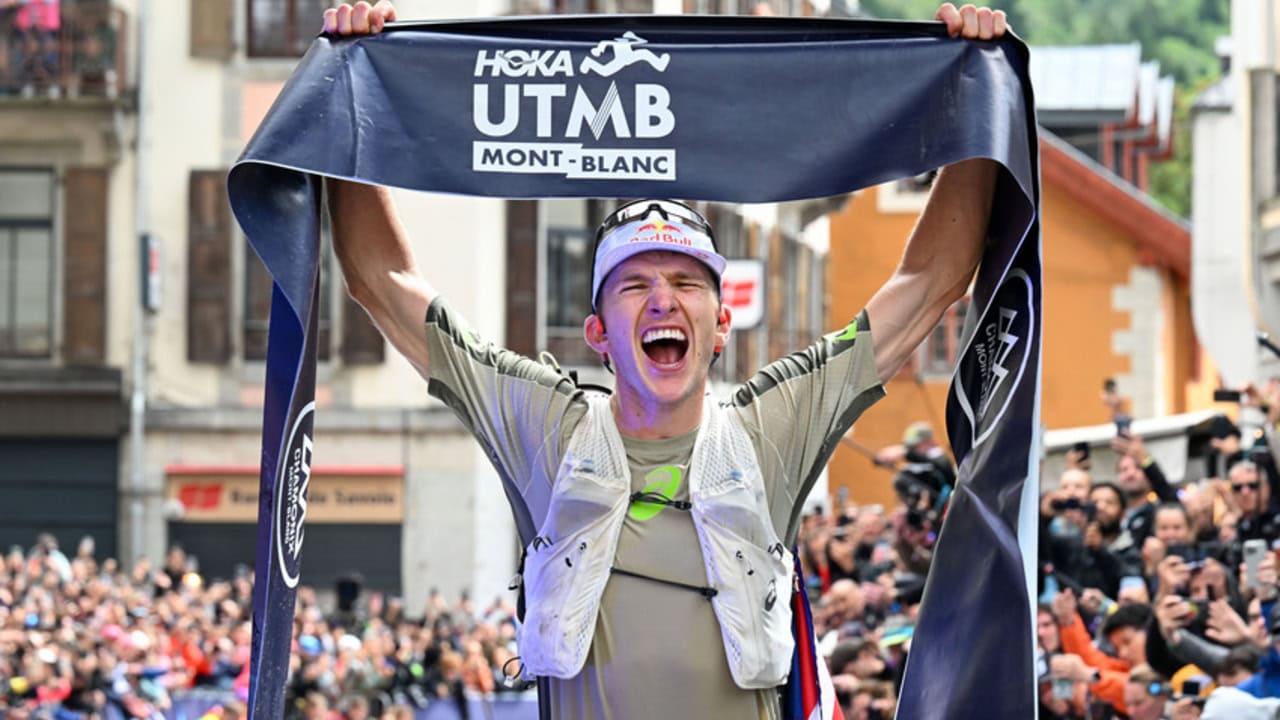
When Tom Evans crossed the finish line in Chamonix this past weekend, he didn’t just complete UTMB; he laid down one of the most calculated, consistent, and impressive performances of the entire 2025 field.
Thanks to a behind-the-scenes look from Garmin UK, we now have a full breakdown of Evans’ race data, and it offers a rare glimpse into what it actually takes to run 100+ miles through the Alps at an elite level.
From average heart rate to total climbing, here’s how Evans put together a masterclass at the world’s biggest trail race.
A 19-Hour Effort Across the Alps
- Total Time: 19:18:58
- Total Distance: 172.95 km (107.5 miles)
- Total Ascent: 10,127 meters (33,229 ft)
- Max Elevation: 2,541 meters (8,337 ft)
The UTMB course is infamous for its scale, both in beauty and brutality. Runners loop around Mont Blanc through France, Italy, and Switzerland, hitting multiple alpine passes and climbing the equivalent of Mount Everest — twice.
Evans’ finishing time puts him among the very best to ever race it. For comparison, Kilian Jornet won in 2022 in 19:49, and Jim Walmsley ran 19:37 to win in 2023. Evans not only beat both those times, but did it looking composed, in control, and — if you saw the finish line photos — genuinely happy.
Note: The 2025 course saw a slight detour due to weather near Grand Col Ferret, but the overall distance and elevation gain remained comparable to previous years.
Heart Rate to Courmayeur, Then Feel to the Finish
In his post-race breakdown, Evans revealed that he ran most of the first half strictly by heart rate. “I based my effort off heart rate till Courmayeur,” he said. “Then feel to the finish.” That strategy — steady early, instinctual late — is a smart one, especially in a race where the real suffering usually kicks in after 100K.
He also mentioned using Garmin’s ClimbPro feature as his main data screen during the race. ClimbPro gives real-time gradient and elevation breakdowns during climbs, letting runners pace themselves on terrain that can otherwise chew you up if you go out too hot.
- Average Heart Rate: 140 BPM
- Max Heart Rate: 179 BPM
- Idle Time: 15 minutes, 32 seconds
Evans’ ability to keep his average HR at 140 over nearly 20 hours says a lot about both his aerobic conditioning and his discipline. That he only stopped for 15 minutes total — including aid stations and gear changes — is even more telling.
Pace, Calories, and the Reality of Moving for 19 Hours
- Calories Burned: 13,687
- Average Pace: 6:42/km (10:47/mi)
- Best Pace: 2:47/km (4:29/mi)
Over the course of the race, Evans was burning somewhere north of 700 calories per hour — a massive output that required a near-perfect fueling plan. He’s previously talked about using a combo of Precision Fuel & Hydration gels and drink mixes every 30–45 minutes in races, and it’s safe to assume he stuck to something similar here.
That 2:47/km best pace might raise some eyebrows, but it was likely logged on a short road or downhill section. Still, holding a 6:42/km average over the terrain UTMB throws at you is no joke.
Through the Crowd, and Into the Data
Evans was cheered all the way through the Alps by British fans, international trail running diehards, and those oversized cardboard celebrity masks you see every year at UTMB. The vibe, as always, was part race, part party.
And through it all, Evans was glued to the data. “I use the data to push harder in some sessions and make sure I back off in others,” he wrote on Instagram. “My main screen was ClimbPro.”
Garmin’s watch tech, especially ClimbPro, heart rate zones, and Training Readiness, has become a key part of Evans’ prep, allowing him to optimize effort not just during races, but across training blocks and recovery.
A Historic Performance on a Historic Stage
Final podium results weren’t posted at the time of writing, but Evans’ sub-20-hour run puts him squarely in the top tier of UTMB history. It’s his fastest UTMB yet — and one of the fastest ever recorded on the modern course.
Whether he lands on the podium or just outside, the performance is a reminder of what Evans is capable of when healthy and dialed. After injury setbacks and a couple of hard races in 2024, this was a statement run — measured, relentless, and smart from start to finish.
And judging by that finish line hug, he knew it too.
RunClub
Get more running stories — join RunClub
Daily running news, a community of 300,000+ runners, free training plans for every distance, and a daily running game. Free to join — no card.
Already a member? Log in →




Start the conversation