


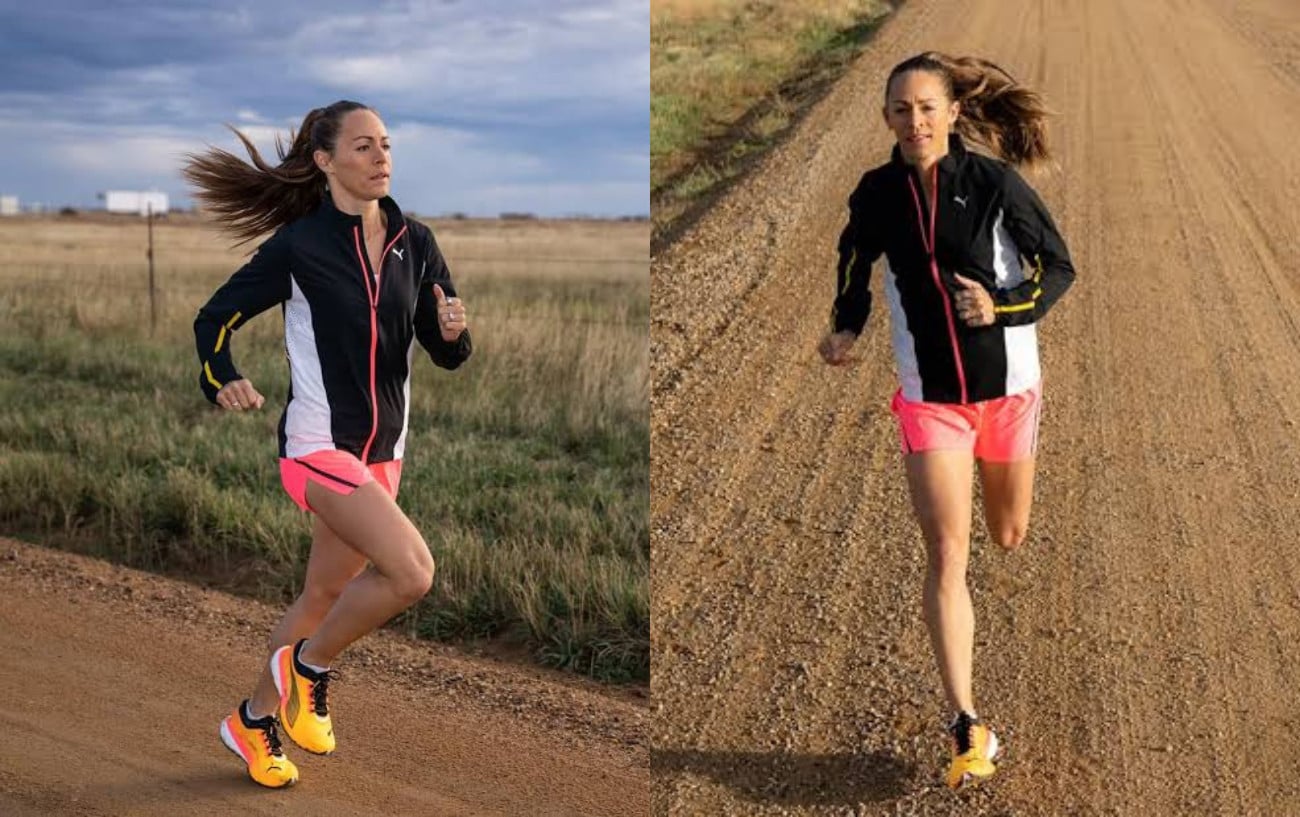
Jenny Simpson went into cardiac arrest on the infield at a community mile in Raleigh on June 16, and it took bystanders, an ambulance crew and two hospitals to keep her alive. She left Duke 10 days later. In August she said an inherited condition in her heart muscle was the cause, and that she would not be running again. Beyond that she had said very little.
That changed on Sept. 7, when she went back through the whole thing on The Rich Roll Podcast. She has had heart surgery since June, she said, and now carries an implanted pacemaker and defibrillator. She is on medication, and her team at Duke will image her heart every six months.
The implant is there for the electrical fault, and it does nothing for the disease underneath it. Arrhythmogenic right ventricular cardiomyopathy turns muscle in the right ventricle into fatty, fibrous scar that gets in the way of the signals setting the heartbeat. Running is out for a mechanical reason: push the heart rate up, the ventricle dilates, and more of the affected tissue meets the current. She said it is “unlikely” she will ever run again.

She had left the genetics open in August. ARVC is inherited, and Simpson said she was tested for it, her parents were both tested too, and no marker showed up in any of them.
That makes her gene-elusive: she has the disease without an identified mutation. Most research tying hard training to faster ARVC has followed relatives of already-diagnosed patients, and among gene-elusive patients the European Heart Journal puts exercise intensity before diagnosis at roughly five times that of patients carrying a desmosomal mutation. A genome-first study published this year found no such link in carriers picked up by population screening. Running, in Simpson’s words, “didn’t cause it but it revealed it.”
The rescue was longer and uglier than anything that came out at the time. Simpson said she was given CPR for more than 20 minutes and took several shocks on the infield, three more at minimum in the ambulance, and her heart stopped again at the hospital. She was on life support when they moved her overnight from UNC Rex to Duke. She has no memory of June 16 at all, and none of the five days after it.
The defibrillator that first brought her back was not the ambulance crew’s. It was in a car in the parking lot, and it belonged to Joey Pointer, the Fleet Feet chief executive who hired Simpson in February, and to his wife, Ivy. They keep one because their child has congenital heart disease. Pointer ran for the car, and as CBS News reported last month, Ivy Pointer was among those doing compressions.
What Simpson wants out of it is not a screening drive. Teaching runners to spot ARVC is not her mission, she said, because hardly any of them have it and it is hard to catch anyway. The thing worth changing is whether a bystander is willing to start.
Of the more than 350,000 Americans who go into cardiac arrest outside a hospital each year, only about 40 percent get CPR from a bystander, the American Heart Association reports, and just 9.1 percent of adults treated by emergency crews for a non-traumatic arrest survive to leave hospital. At marathons and half-marathons, cardiac deaths roughly halved across 2010 to 2023 against the decade before, while the arrest rate did not move, which the researchers credit to CPR and defibrillators on course rather than to anyone getting better at spotting the runners at risk.
She asked listeners to “resist the temptation to adopt fear,” and said too many people hold back and wait for someone qualified to turn up. Those first minutes decide more than whether a person lives. The bystanders on that infield saved her life, and they spared her brain, her kidneys and her lungs.
Simpson took the world 1,500m title in 2011 in 4:05.40 and Olympic bronze in Rio five years later in 4:10.53. Her eight Fifth Avenue Mile wins remain the record, and she retired at the 2024 New York City Marathon. She has not called a race since June, and her husband, Jason, has pushed his Leadville entry to next year. The next MRI is the first that can show which way the disease is going.
RunClub
Get more running stories — join RunClub
Daily running news, a community of 300,000+ runners, free training plans for every distance, and a daily running game. Free to join — no card.
Already a member? Log in →








Join the conversation
I am glad she survived. I have had 2 cardiac arrests in the past 3 years. Thanks to bystanders I received CPR and survived. I too have an ICD implant. I am still running... though my wife doesn\'t like it.