

50 Down, 100 to Go
On my final lap of the Umstead 100/50-Mile Endurance Run outside of Raleigh, North Carolina, I encounter several race casualties. One man is sitting on the side of the trail with his head in his hands. Soon, I pass another man who is limping badly and literally dragging one of his feet behind him. I pass another man who makes a strange whimpering sound with every step. A woman running in the opposite direction looks at me and asks, “Why are we doing this?” I think about her question very hard and can’t answer it, but I do reflect on how I came to be in this race.
MY PLAN
My running background was limited before my first marathon in 1998. I had been jogging short distances for weight control since 1994 and usually ran a few 10Ks each year. The only longer distance I remember doing is when I set out for a six-miler one night and, feeling good, ran 12. Apart from that, I had never been interested in long distances.
In 1996 I switched all my efforts to lifting heavy weights and bulking up in size. In one year I went from my 175 pounds (at six feet tall) to 225. The craziness stopped toward the end of 1997, as I was getting married and now wanted to lose weight. To aid my cause, I decided to train for a marathon.
To help achieve my goal, I picked up my old Jeff Galloway running book and set up a plan: regular runs during the week with a slowly increasing weekend long run. It worked great.
By October 1998 I ran the Marine Corps Marathon in 3:38 and was down to my regular old 175 pounds. But I had a problem. Before I ran my first marathon, I was so hyped up after reading how finishing a marathon has changed peoples’ lives, how it was the toughest thing a person had ever done, and so on, that I felt very let down after finishing my first one. It simply wasn’t that hard. I had stiff legs for a few days afterward but felt I could have run another one the following weekend.
Four weeks later, after finishing the Atlanta Marathon, I remained disappointed and dissatisfied. I started searching the Web for other marathons to run and came across information on ultramarathons. “I’m in!” I yelled inside my head. I immediately signed up for the Umstead 50, which was a mere four months away.
To train for the race I ran the Myrtle Beach Marathon (February), Shamrock Sportsfest Marathon (March), and PowerMan Alabama (10K run, 60K bike, and 10K run, also in March). I also ran a 32-mile training run, which felt much harder than a marathon plus six miles. It was during this training run that I realized the 50-mile distance would not be easy.
RACE DAY
Conveniently, my wife and I have friends who live a few blocks from the Umstead course. Curiously, they had never heard of the race. We spent the night at their house, where I drank three cups of hot tea before going to bed. At this point I learned my first lesson: don’t drink caffeine the night before a race.
The alarm went off at 4:30 A.M., and after only two hours of sleep, my first reaction was to turn over and sleep some more. But then I remembered why I was here: my first 50-miler.
I dressed, and my wife and I drove the three-minute drive to Umstead State Park. There, we made our way down the long, dark, winding, rocky trail to race headquarters, where we heard lots of laughter and talking coming from the meetinghouse. Inside we found probably 75 (mostly) guys, hanging around talking and joking. What a sight at 5:00 A.M.!
After getting my race number, I did my quick prerace preparation. I applied Vaseline in the right places, ate a PowerBar, drank lots of water, and stretched. I also tried to eat some Hammer Gel I’d recently bought for the first time, but I had a hard time sucking it out of its plastic flask, so I tossed it away. I learned my second lesson: bring foods you know; this isn’t the time to try something new.
THE FIRST 10 MILES
Umstead is staged in Raleigh at Umstead State Park. It’s primarily a 100-mile event, but a 50-mile race option is also offered. The race consists of a 10-mile loop with an aid station at the start and halfway point. For the most part, the course consists of continuous rolling hills with 4,000 feet of elevation gain for the 50 and 8,000 feet for the 100. At first sight, the hills don’t look that difficult. The course is 100 percent trail and carpeted with small gravel rocks that (also) at first sight don’t seem to pose much of a problem.
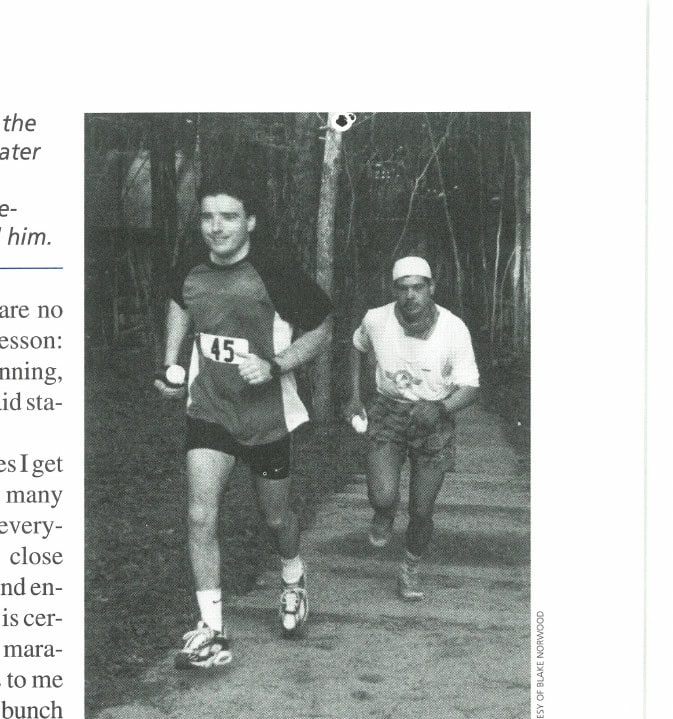
My wife and I follow the crowd of about 150 runners heading down to the start, situated at the bottom of a short but fairly steep hill covered with small rocks. As the gun goes off I find myself at the front of the crowd and racing to the top of the hill. I make it up to the top first and am a bit surprised since I don’t have a flashlight and have no idea which way to turn, so I slow down and tuck in behind a couple of guys with flashlights. I take off at a fairly good pace and follow these two front-runners, who are chatting away.
I listen in on their conversation, which concerns some of the 100-mile races they’ve run, including Western States, Leadville, Wasatch, and Hardrock. Hearing the descriptions of these incredible mountainous races leaves me in awe. I join in the conversation and discover one of the guys is named Jose Wilkie, who seems to talk at 100 mph, and is attempting to run 13 100-milers in one year! (Wilkie ended up running 14. See Marathon & Beyond, volume 4, issue 5.) The other guy, Tom Green, seems to have run every major 100-miler in the United States. Both guys apparently know everyone in the race, as most runners we see on the out-and-back shout “Hi, Tom!” or “Hi, Jose!” as they pass.
At the five-mile point I run straight past the aid station crew, who stare at me, while Tom and Jose stop for a drink. After running down a tiny path for about two minutes, I hear Jose yelling behind me. I run back to the station to catch up with the two guys. They tell me the aid station was the turnaround point, even though there are no signs. I learn my third lesson: know the course you are running, and don’t rely on signs or aid station crews for directions!
During this first 10 miles I get the opportunity to talk to many runners since at this point everyone is running relatively close and all are in good spirits and enjoying the run: trail racing is certainly more enjoyable than marathon road racing. It occurs to me that ultrarunners are a great bunch of people.
THE SECOND 10 MILES
I keep the pace up well and continue running with Tom and Jose. My legs feel good, with no problems whatsoever. Jose is still speaking at 100 mph, and I wonder how in the world he has the energy to run at the same time. On this loop, Jose and Tom start to walk up the steeper hills. I’m really surprised by this and think these guys can’t be the great runners I initially thought they were since I know I could easily run up these hills.
We talk with many other runners as we pass them and others pass us. Some run with us for a few miles, and from them I hear stories about such races as Badwater, Marathon des Sables, and the Eco Challenge. These people seem invincible as they tell me of their experiences of surviving hypothermia at high altitude, sleeping in deserts and on mountains overnight after losing equipment, and various other near-death experiences. It is indeed an honor to run with these guys.
As the sun rises, we run past many of the beautiful freshly blooming flowers the Umstead course has to offer, and with the smell of the early morning dew on the grass and the sound of the river running by, I feel it’s going to be a great day.
THE THIRD 10 MILES
I keep the pace with Tom and Jose, but it gets tougher. My early enthusiasm wears off as reality sets in and I realize this is not going to be easy. As I pass the marathon distance my legs start to tire. During training I had run my 32-mile loop very slowly, and I realize I have taken off way too fast by running with these two experienced ultrarunners. It is at this point I realize that most of the runners were saving their legs by walking the steeper hills. I feel I have just crossed a threshold of fatigue I haven’t experienced before.
Toward the end of this 10-mile loop, Jose moves ahead, and Tom and I run together. When we reach the aid station Tom and I split up; I figure he has run ahead of me since I spend about 10 minutes chatting with my wife. At about this time I suddenly feel extremely tired and realize I am moving into new territory in terms of mileage.
Psychologically I am strong, but I am concerned about how my body will react to this new distance. I feel like changing my shoes and socks but don’t because I am so tired I don’t have the energy. I also now want to get the run over as soon as possible.
At the end of 30 miles I have learned another lesson: never take off fast in an ultra unless you know what you are doing.
THE FOURTH 10 MILES
As I head out for my fourth loop, I’m glad I’m on my own since I can run my own pace and not have to keep up with the faster runners I have met (and also not slow them down, which I probably did). But about two miles into the loop, Tom runs up from behind me.
“I thought you were in front of me, Tom!”
“No,” came the reply, “I spent some time at the aid station.”
Oh no, I think. Now I’m gonna have to keep up with him. We run together for a while, and I think Tom realizes that I’m tiring since by now I can hardly reply to anything he’s saying. Somewhere around four miles along the course, Tom takes off ahead and I’m on my own again; as much as I liked running with Tom, by now I am so tired I cannot even force a word out of my mouth.
The original upbeat demeanor of all the runners has at this point disappeared, as friendly “Hellos” have been exchanged for, at most, grunts as we pass each other. At this point I wonder if I’m on the last lap. This illusion seems to help me get to the main aid station, whereupon I realize I still have 10 more miles to go.
Stopping at the 40-mile point confirmed for me that one of the best features of the Umstead race is the main aid station. An extremely attentive woman immediately asked approaching runners what they wanted and then handed them whatever food or drink they asked for. Unfortunately, I never got a chance to thank her.
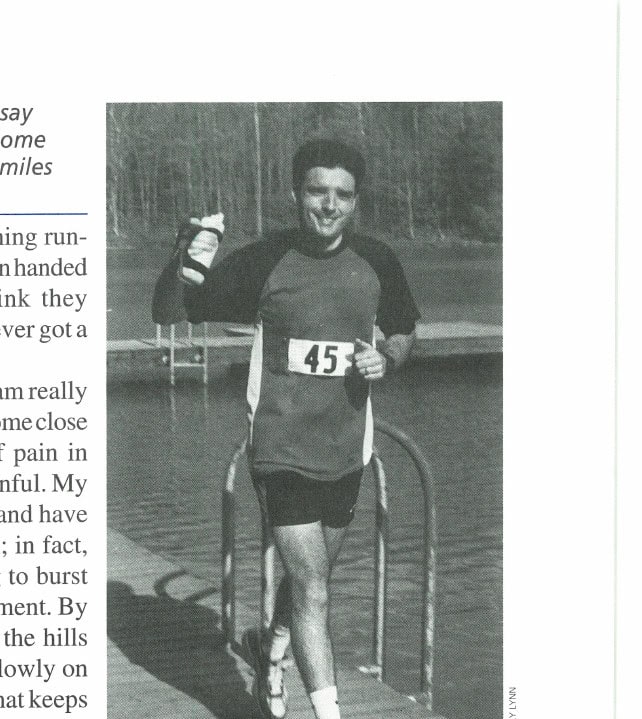
By the end of this loop, I am really hurting. I have never before come close to experiencing this kind of pain in my legs. Even walking is painful. My feet feel like red-hot pokers and have by now swollen a great deal; in fact, they feel like they are going to burst through my shoes at any moment. By now I am walking up all of the hills and can only shuffle along slowly on the straights. The one thing that keeps me sane is knowing a downhill will arrive soon. Next lesson: bring an extra, larger pair of shoes to each ultra.
THE LAST 10 MILES
Leaving the aid station after running 40 miles was one of the hardest things I have ever done. I am absolutely physically wasted and probably shouldn’t have set out again, but I do. I have to finish. By now my body is in total pain; every step is torture. I feel as if I’m running without shoes on a bed of nails. With each step the rest of my body feels as if baseball bats are pummeling it. Even the handheld water bottle I have been carrying the whole race feels like a 50-pound dumbbell, so I empty it out, thinking I can drink the water supplied on the route.
My mind starts to wander; I lose focus and start to think crazy thoughts. I wonder to myself if I could actually experience any more pain than I am experiencing at this moment. That is, is there any limit to pain?
I try to imagine how painful Ironman would be, or being stuck high on Mount Everest overnight with no oxygen, or even running a six-day ultra. I even think about asking one of the few mountain bikers passing if I can borrow his bike!
ELDORET, KENYA—We’re halfway up a steep hill leading out of the town of Iten when our Range Rover sputters to a stop. Our driver, Charles, climbs out and lifts the hood, and we watch as steam rises into the deep blue afternoon sky.
“What’s wrong?”
“I don’t know,” Charles says, shrugging his shoulders. “Could be many things. Maybe a leak in the radiator. We need some water to check.”
I volunteer to get some water. Some local kids have been watching us, and, barefoot and nimble, they lead me to their nearby family farm. We cross a field, slide on our stomachs beneath a fence, then clamber through some bushes before arriving at a neat, mud-brick house. A cooking fire burns in the yard, and on a plank set across two tree stumps a woman sits with her children. After explaining what we need, the kids and I grab buckets and fill them from a 55-gallon barrel.
For a minute, I don’t want to leave. Here is a quiet, far-off place, where the Internet, cell phones, and satellite dishes have not yet intruded. There are no deadlines, no e-mail. The yard is crowded with fruit trees, and the woman’s
bright smile is framed by the green scarf covering her head. I drink in the scene. But the others are waiting, and we run back, the water sloshing back and forth in the buckets.
Back at the Range Rover, Charles pours the water into the radiator, and it streams out the bottom onto the asphalt road. “Yes, you see, it is leaking. . . .”
Sieg Lindstrom, a writer for Track & Field News, shakes his head and mutters that we are in trouble. I agree. My AAA membership won’t work here, and there are no auto shops around, no service stations, no used parts stores where we can buy another radiator. “I’ll hitch a ride back to Eldoret and get a car to pick us up,” I say. “Or I can run to Brother O’Connell’s [whose school in Iten has produced scores of elite runners] and ask for a place for us to stay for the night.”
Charles shakes his head, not listening. “Does anyone have some curry powder?” he asks. Curry powder? No, don’t make a habit of carrying it around. Don’t have any black pepper or cumin, either.
Charles rummages around in the glove compartment. “Ah, here it is,” he says, holding up a package of curry powder. He opens it and pours a bit in the radiator with some water. The water still leaks right out. Charles fills the radiator once again and adds more powder. This time, the leak slows. Finally, he tops off the radiator, mixes in the rest of the curry powder, and, like magic, no water leaks out. The radiator leak is sealed.
Charles starts the Range Rover, leans out the window and waves to the large group of locals watching us, then turns and says, “Everyone in Kenya is a mechanic.”
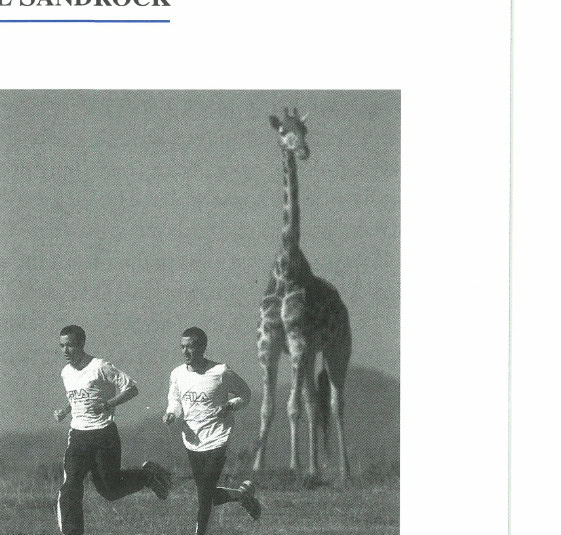
I was in Kenya as part of a trip with several other journalists to the Fila-sponsored training camps in the Rift Valley. Since the Kenyan domination of long-distance running began in 1968 with Kip Keino’s two Olympic medals, people have asked why this small, East-African country has produced so many outstanding runners.
The line of greats that began with Keino has continued unbroken to this day. In 1999, Kenya had an astounding 106 marathoners faster than 2:14. The total for the United States, which has roughly 200 million more people than Kenya? Two.
Oh, it’s the altitude, the genetics, the diet, the talent, people have said, attempting to explain the Kenyan success. What I found during my visit to Kenya, starting with my first morning there, is that the success springs from all these reasons, along with something more.
I woke up early my first day in Eldoret, a town of 18,196, near the border of Uganda. I pulled on my running gear and jogged up the street, past the slaughterhouse on the outskirts of town. Even at 6:00 A.M. crowds of men are lined up at the entrance. The stench from the butchering is overwhelming, and I quickly run past and up a hill to the outskirts of town, where the asphalt ends and endless miles of dirt roads begin.
In the distance, flames rise from burning fields in preparation for planting. It is quiet and cool, but even at this early hour, scores of people are walking into town. I turn and run past a small cluster of huts, then loop back to the main road. A young, fit runner is coming my way, and in the universal greeting of runners around the world, I ask, “How far you going?”
“One hour, 30 minutes,” he replies. “Would you like to join me?”
We begin running together. He tells me his name is Daniel. We talk as we run over the small hills, the soft dirt feeling good beneath my jet-lagged legs. The conversation ebbs and flows with the rising and falling of the hills, and as we run, I look out at the distant mountains, the lonely acacia trees, the broad fields, and I think of the history of the Rift Valley.
Fossil skulls discovered last year in the Republic of Georgia provide evidence that our ancestor, the mysterious Homo erectus, left Africa, perhaps somewhere near where we are running, roughly 1.1 million years ago. According to news reports, those first humans, armed only with a few primitive stone tools, started a dispersal across the globe that eventually led to you and me, reading and writing, running and relaxing.
As Daniel and I run along, I listen to our rhythmic breathing. When we travel, I think, we too take our primitive tools (pen, paper, a pair of running shoes) and go on our own migration around our city, state, nation, and world. In that, we are driven by what must have driven those first Homo erectus. Like them, we explore our world, and when we visit a new country like Kenya, it is as new for us as it has been for all who have come before.
It was here in East Africa, the great mythologist Joseph Campbell explained, that the ancestor of the Homo erectus, the australopithecine, emerged. In his lecture series Transformation of Myth Through Time (Harper & Row), Campbell provides an artist’s rendition of australopithecine running across a field that does not look much different from the fields we are now passing through. “He has picked up a tool and is running, but the important thing is the legs,” Campbell writes. “Apparently the first essential development of the hominid, distinguishing him from the arboreal ape, is this kind of running leg, which released the hands.”
Apes, Campbell says, walk using the knuckles of the front legs or arms. “It used to be thought that the brain enlargement was the main distinction; not so anymore. It was the legs. This left the hands free for manipulation, and then the brain increased.”
When we run, we are tracing that evolutionary development. Watching the sun rise in the distance this African morning, I feel an empathy with our lineage of ancestors, australopithecine, then Homo hablis, then Homo erectus. I don’t imagine them being cautious creatures, creeping through the grass. No, that is not how our ancestors would move. They were runners, our first human ancestors, just like you and me. They ran across these same plains, I think.
Maybe those first runners chased antelope or wildebeest to get food, or maybe they were chased by lions or leopards that hoped to make them food. Either way, when they were done chasing or being chased through this valley, I have the feeling that our first ancestors would then run for the sheer joy of it, simply because they felt like it. Just as we do sometimes.
But, ah, what heartache, what suffering, what unforeseen disasters Homo erectus unleashed with those first steps out of Africa. A few miles down the road, Daniel asks me what I am thinking. I explain all this to him and tell him that perhaps it would have been better if Homo erectus had stayed put in the Rift Valley, had been content to hunt and be hunted and not to have populated the world. “Maybe if we had not become erect, thinking people . . .”
“Why not?” he asks.
“Read the paper any day,” I say. “You want to shake your head in shame and cover your eyes to avoid knowing what humans do to each other.”
Yesterday’s Daily Nation newspaper, I continue, had an editorial titled “The God of Women Is Dead,” in reference to another terrible incident in Nairobi. “That is what I mean.”
Daniel listens and is quiet for a stretch. “No,” he finally says. “I don’t agree at all. I think there was no way around it. When our ancestors’ brains grew bigger, their dreams grew bigger as well. They wanted to explore, to see what was beyond that mountain range, that river, that forest. That is what all of us want to do. That is why I am training every day. I want to see the world. I want to have a nice home, a nice car, like the good runners here. I will be running the Discovery race on Sunday. Can you introduce me to [Fila coach] Dr. Rosa there?”
“I don’t know him well, but I will try,” I say. “What are the races like?”
“You are running strong,” he tells me. “I am sure they will let you enter. That way you can see for yourself.”
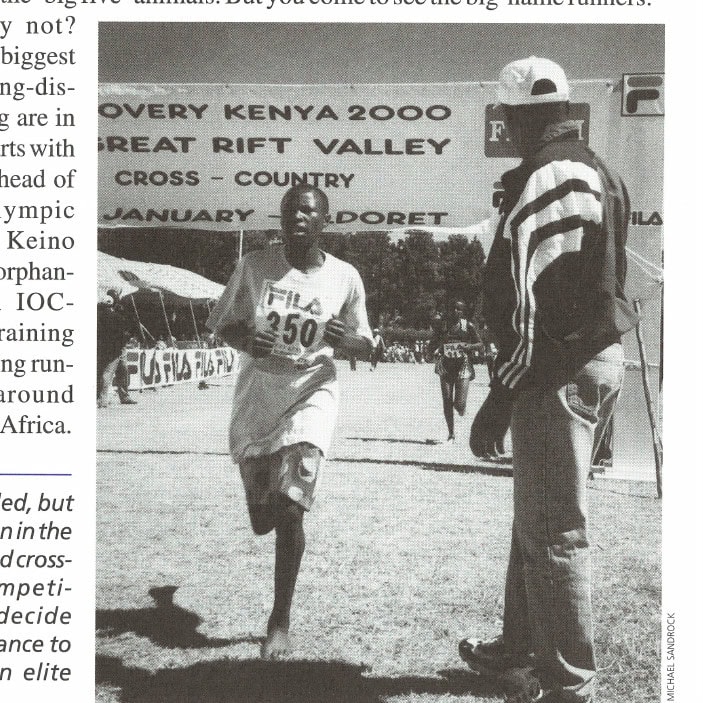
That is how I found myself standing with two-time Boston Marathon winner Moses Tanui at the Fila Discovery Cross-Country 12K race on a hot Sunday morning late last winter. The others in my group were sitting in the shade, sipping some cool drinks and chattering with the myriad world-class runners who volunteer to help at the race.
“Are you certain you want to run?” Tanui asks.
“Sure.” I am in pretty good shape, I tell him, having run 27:52 for five miles at altitude recently and averaging about 10 miles a day with people like former
world-record holders Steve Jones and Arturo Barrios. I tell him taking part in two Discovery races will be a good way to learn what grassroots running in Kenya is like.
“Are the races tough?” I ask.
Tanui smiles, a kind of Cheshire cat I-know-something-you-don’t-know smile. “You will find out. I think you are in for a big surprise,” says Tanui, who has a personal best of 2:06:16 in the marathon, third fastest ever. A few months later, Tanui would place third at the 2000 Boston Marathon, in that race’s closest finish ever. Elijah Lagat, who won the 2000 Boston in a thrilling homestretch sprint, as well as 1999 winner Joseph Chebet are, along with Tanui, part of a unique training camp system set up in the Rift Valley by Fila, the Italian sports manufacturer.
After arriving in Nairobi, I was eager to get to western Kenya as soon as possible to see the depth of Kenyan running firsthand. “Hmmm. You are an interesting tourist,” says Simon Mukuna, head of Sights of Africa Safari Tours in Nairobi, when I tell him I don’t have time to go to the Masai Mara game preserve because I am in a hurry to get to Eldoret. “Most mzungos come to Kenya to see the ‘big five’ animals. But you come to see the big-name runners.”
And why not? Many of the biggest names in long-distance running are in Eldoret. It starts with Keino, now head of Kenya’s Olympic committee. Keino also runs an orphanage and an IOC-sponsored training camp for young runners from around sub-Saharan Africa.
This article originally appeared in Marathon & Beyond, Vol. 5, No. 2 (2001).
← Browse the full M&B ArchiveMore like this
1,000+ stories from 19 years of Marathon & Beyond
The complete archive of the legendary long-distance journal — digitized and free to read.
