

The Couple That Runs Together
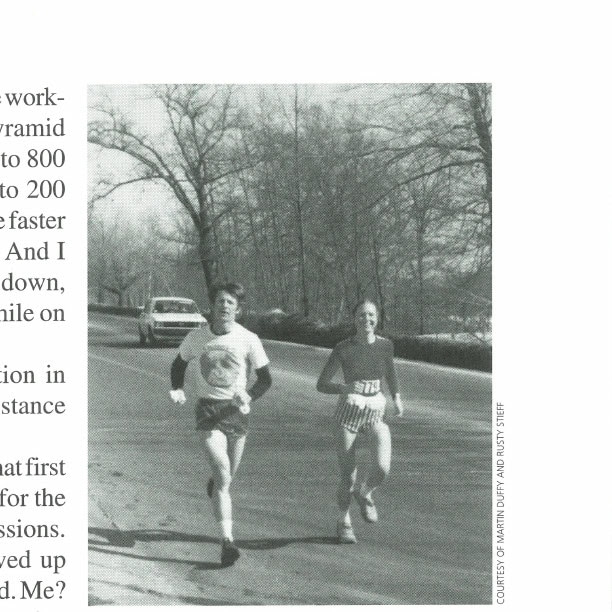
Rusty would too. The rest of the workout was more of the same: a pyramid of distances from 400 meters to 800 meters, and then back down to 200 meters. Every repeat just a little faster than the rest. I could do that. And I did. We jogged a mile to cool down, and I went home with a big smile on my face.
And so began my education in the science of longevity in distance running.
A bunch of people started that first summer with us, showing up for the Wednesday evening track sessions. People came and went, showed up when their schedules permitted. Me? I was hungry. I wanted to learn what Martin and Rusty knew. I’d been running for 15 years but hadn’t experienced a breakthrough in my race times until the previous autumn when, spurred on by the loss of a relationship and the ensuing grief (or desire for revenge, I’m not sure which), I took 21 minutes off my marathon PR in a single race. The tide was turning. I wanted to improve. I’d never done track work, let alone with someone of Martin and Rusty’s caliber. It was time to get serious and learn how to race well and how to run well. This was our mission, and Martin and Rusty were up for the challenge.
MARTIN’S BEGINNINGS
Before I ever ran with Rusty and Martin, I knew that Martin had been informally coaching many of his friends for years and that he had coached Rusty to an Olympic Trials qualifying standard. Behind every great runner, there’s an equally awesome coach—or at least someone who won’t let their athletes get away with undertraining, overtraining, or doing anything rash in the days leading up to a major race. That’s Martin in a nutshell: his calm is equaled only by his dry, effortlessly hilarious sense of humor.
Martin began running as a student at Fall River High School in southeastern Massachusetts. “City of hills, mills, and unpaid bills!” Martin jokes. Then, a hint of seriousness crossing his expression, he talks about how running came into his life.
“My introduction to running was 45 years ago, when I ran a sub-5-minute mile as a high school sophomore. This was the biggest high school in the state, and there were only three lettermen in the sophomore class. There were only a few sports—baseball, basketball, football, and track. I don’t remember any other sports. For women, there was only basketball. And because of my running, I was one of the lettermen in high school.”
After undergraduate studies at Tufts University in Medford, Massachusetts, he moved to the Philadelphia area for graduate work at the University of Pennsylvania. Martin ran his first Boston Marathon in 1970 while still a grad student.
It was a soggy day but memorable for Martin because his mother came out to cheer for him and stood on a street corner despite the rain to watch him run. Soon after, he came back to the Boston area to work for the president of Harvard University. Martin ran the stifling hot “Run for the Hoses” in 1976 and the 100th Boston—with Rusty—in 1996. And he’s run every Boston in between. And since.
LEARNING FROM THE MASTER
No matter what happens in a race, Martin sees it as an opportunity to learn more about the craft of racing. When I almost stayed home from the 1999 Marine Corps Marathon for lack of fitness due to illness, Martin encouraged me to run it to see what would happen. I wound up cramping severely over the second half of the race. Determined to finish no matter what, I ran the second 13 miles 24 minutes slower than the first, shuffling home in a painful 4:30. I returned to Boston and dutifully reported to Martin what had happened.
“Water,” Martin said simply. “You were sick the week before and didn’t drink enough water.” Martin had counseled me if I wasn’t feeling well to consider dropping out at the 7-mile mark, where the course loops back past the Arlington Cemetery starting line. I reminded him of the year he finished the Boston Marathon with a 103-degree temperature.
“Yes, but that was crazy!” Martin laughed. By the way, did I mention that Martin also ran Boston one year with a stress fracture in his foot?
“Running Boston is like climbing Mount Washington,” Martin philosophizes. “It’s something you do once a year.” Has he ever thought of dropping out? The stress fracture, the 103-degree temperature, the heat of ’76? Nope.
“But Martin has dropped out of marathons before,” Rusty jumps in. “He’s just never dropped out of Boston.”
And the rest, as they say, is history: one of the longest current streaks in the Boston Marathon.
LIFE AND RUNNING AT CHEZ DUFFY-STIEFF
Martin and Rusty don’t just run well. They run smart. They run consistently. Both of them work full-time jobs. They are busy people. And yet they make running a priority in their lives. Not enough to become obsessive, but enough to remain great runners and stay human while doing it. Just hearing about them from Ted was enough to get me to rearrange my Wednesdays so that I could consistently make it down to the track for their workouts.
While visiting their home in Belmont, Massachusetts, I asked them about their running trophies. You would think that with a double running pedigree as impressive as Martin and Rusty’s, their home would be something of a shrine to their accomplishments in the sport. Shelves and walls covered with trophies, medals, and framed singlets, right? Not quite.
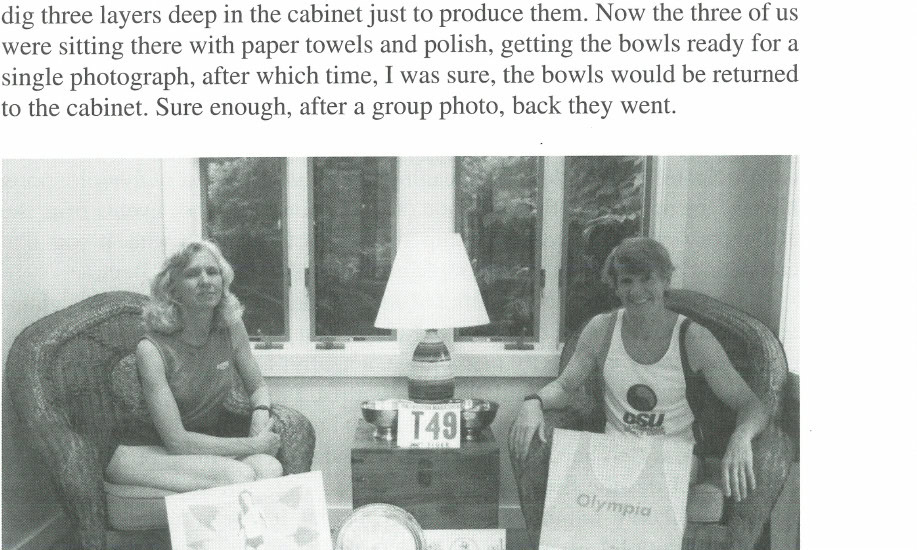
“Honey, come help me with the silver polish,” Rusty called out from underneath the dining room dish cabinet. A pair of silver bowls—prizes from the Ocean State Marathon in 1983, the race in which Rusty qualified for the 1984 U.S. Olympic Trials—sat tarnished with age in the back corner. She’d had to dig three layers deep in the cabinet just to produce them. Now the three of us were sitting there with paper towels and polish, getting the bowls ready for a single photograph, after which time, I was sure, the bowls would be returned to the cabinet. Sure enough, after a group photo, back they went.
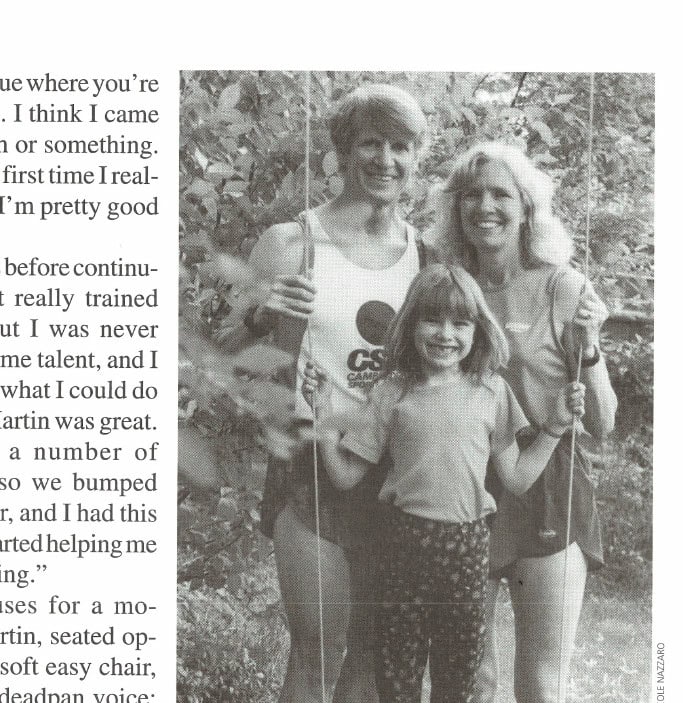
As we sat in the living room reminiscing about Martin and Rusty’s running origins, their daughter Brianna bounded into the room. A lean, energetic, little blonde girl of seven, she ran from kitchen to living room to sit with her parents as they talked with animation of their experiences running in everything but the kitchen sink in the Boston area over the past 20-plus years. All I could think of when I saw her was, “Kid, you have no idea how lucky you are.” With genetics like that, you just have to believe they’ve spawned an even faster specimen of Duffy. Belmont High School, prepare for all those track records to be broken in about the year 2009.
RUSTY’S STORY: FROM NON-JOCK TO OLYMPIC TRIALS
This past spring I asked Rusty about her unexpected journey from self-professed nonathlete to Olympic Trials qualifier. Rusty wasn’t the family jock. “I was at my family place in Rhode Island, and my cousins were going out to run. It was about a 2-mile run, and they said, ‘Do you want to come along?’ It’s the first time I remember running, and then I just started doing it for exercise a little.” Of such inauspicious beginnings are Olympic Trials marathoners made.
We were sitting in her living room, a scrapbook of running photos and newspaper clippings littering the coffee table. It had been 16 years since her U.S. Olympic Marathon Trials experience. I was eager to hear what it was like to participate in one of the most meaningful events in women’s Olympic sports history: the opening of the marathon (and all shorter distance events from the 800 meters on up) to women competitors. Not to mention what it was like competing against eventual Olympic gold-medal winner Joan Benoit.
Lest anyone think that the debut of an Olympic Trials competitor is a glamorous coming-out party, take heed in Rusty’s first racing experience. “The first race I remember was pretty memorable, actually! I wanted to run the Bonne Bell [now Tufts Health Plan] 10K for Women. I thought I’d do another race first, to try it, so I did the 5-mile race at Fresh Pond in Cambridge. I had no idea how to pace myself because I’d never run a race before. I thought you just kind of ran! So I did the first lap faster than I’ve ever run anything. I did it at something like a 6-minute pace, and at that point, I was not running 6-minute-miles in training! And my second lap around the pond, I could just feel I was dying, getting slower and slower, and I was thinking, ‘I just want this to end!’ But I knew that the first three names got in the paper, and I think I was third, but I got a quarter of a mile from the end, and my legs just went under me. It was a hot summer day, and I hadn’t eaten lunch, and I fell down and couldn’t get up. So I never finished the race. And in fact, I ended up going to the hospital.”
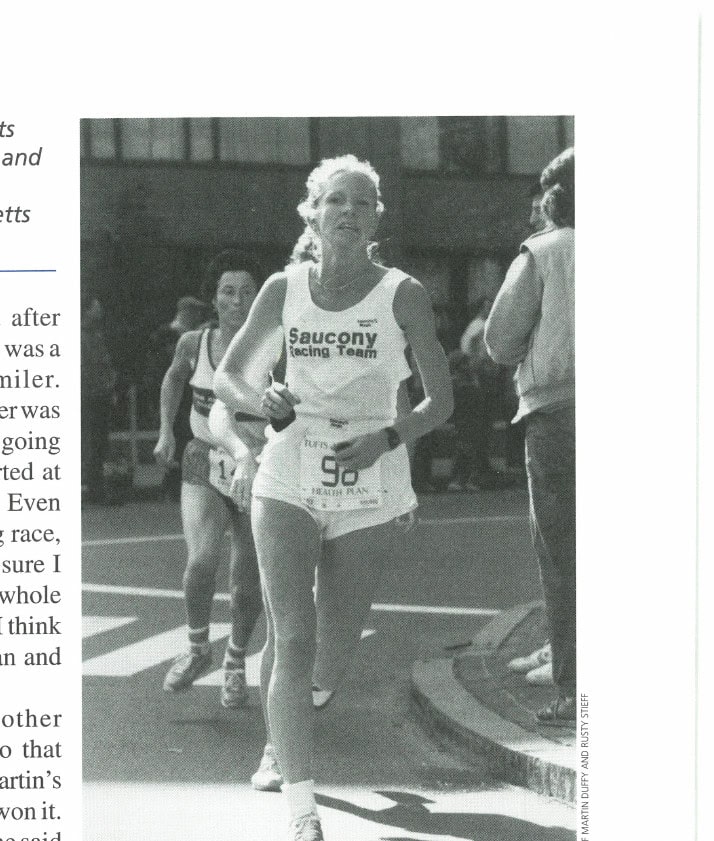
Things improved after that. “My second race was a local Belmont 5-miler. Johnny Kelley the Elder was there. This time I was going to pace myself. I started at the back of the pack. Even though it wasn’t a big race, I was going to make sure I didn’t overdo it. The whole race I passed people. I think I was the third woman and 19th overall.”
There was another memorable quality to that race, Rusty added. “Martin’s girlfriend at the time won it. But I didn’t know!” she said with a laugh. That was in 1978. It would be a few more years before she and Martin would team up—first as coach and pupil, later as husband and wife.
“We met through running, actually,” Rusty says. “I think when you’re a runner, you kind of know the other runners around, especially if you’re in the same geographical area. I saw Martin occasionally on the streets of Belmont, and I ran into him a couple times at the Harvard track. In fact, I think that’s where I first really talked to him, sometime in 1982. I was asking him, ‘Okay, I’m going to do the Bonne Bell 10K again, and I want to improve my time—do you think I can do it? My goal was always to run a 6-minute pace for a reasonable length of time.'”
I ask Rusty if she was aware at that time what an extraordinary pace that was for a female distance runner. “You know, I just knew from running the Bonne Bell for a few years,” she replies. “I’ll never forget the first year I ran it. It was pretty daunting. There were about 3,000 women running it back then. You see all these women, and a lot of them look like they’re in pretty good shape, and you have no clue where you’re going to fit in. I think I came in about 160th or something. And that’s the first time I realized, I guess, I’m pretty good at this!”
She laughs before continuing. “I hadn’t really trained that much. But I was never great. I had some talent, and I wanted to see what I could do with it. And Martin was great. He coached a number of people. And so we bumped into each other, and I had this goal, and he started helping me with my running.”
Rusty pauses for a moment, and Martin, seated opposite us in a soft easy chair, pipes up in a deadpan voice: “And since then, we’ve had a child.” And laughter fills the room.
A 3:05 FIRST MARATHON
From her beginnings running the local 10K races, Rusty graduated to the marathon. Her first marathon was the 1983 Silver Lake Marathon in Massachusetts. She ran with Martin and Rich Cowgill, a colleague from her workplace who ran with her during their lunch breaks. They had been gently encouraging Rusty to run strong during the race, but by the time they got within a mile of the finish line, she had had enough. Spotting a female competitor ahead of her, she yelled at Martin and Rich: “Now don’t tell me to pass that woman!”
Of course, as soon as she gave herself permission not to run any faster, she did exactly that. “Once the pressure was off, I could relax a little,” Rusty recalls. She was able to pass her competitor to finish in 3:05:36, placing third overall in the women’s division.
From there it was on to her Olympic Trials qualifying race, the Ocean State Marathon in 1983. She had to find just over 14 minutes of improvement, a goal that Martin had convinced her was achievable with her level of talent. Rusty explains: “The way they came up with the qualifying time for the Olympic Trials was that they took the top 100 women’s marathon times for the previous year. The 100th time was 2:51:16. So that became the qualifying time for the Trials.”
I asked Martin how to go about taking 14 minutes off an already impressive marathon time in less than a year. With a grin he replied, “You find a downhill course for them to run!”
Then, more seriously, he talked about the training process. “What you need to do is very gradually build your way up, have a goal, and then run a system, basically, to achieve that goal, or to come as close as you can to accomplishing it. So it’s a question of putting in the time and having the luck of having your health hold up to do your time.”
THE QUALIFIER
“My qualifying for the Olympic Trials was a miracle,” Rusty says. “Ocean State was a race that Martin ran every year. I started off with another woman who had run a good marathon. I think she had run a 2:45. We started off together, and she was saying, ‘You can’t go out too fast, you can’t go out too fast.’ Well, I ran the first mile with her, thinking, ‘This feels really slow.’ We get to the first mile, and it was about a 6:42 first mile. I had to average 6:32s for the race to qualify. And I thought, ‘That’s it! I’m running my own race!’ I ran the next two miles extra fast to catch up.”
Unbeknownst to Rusty, though, her time woes weren’t over. “The race felt like work the whole way. But then I got to about a mile and a half to go, and I thought, ‘I think I’ve got it made; I think I’m okay.’ And there was some guy in the crowd who sounded like he was a coach, a gym teacher, a track guy. He yelled at me, in a not particularly friendly way, ‘You better kick butt to have a chance of making it!’ It’s almost like he knew I was trying to qualify. And I thought, ‘okay,’ and I gave it what I had the last mile and a half, and I made it by four seconds. So who knows? If he hadn’t said that, maybe I would have missed the whole thing.” Rusty clocked 2:51:12.
So it was on to Olympia, Washington, for the legendary race where Joan Benoit, fresh off arthroscopic surgery 17 days earlier, would win the race and, later in the year, the Olympic gold medal. Rusty recalls that she and many of the other competitors were friendly but that the contenders—Benoit among them—kept to themselves before the race. Rusty’s race in Olympia wasn’t particularly satisfying. A recent flu bug took the spring out of her step, and she finished well behind the leaders—but she made it to the starting line of the first-ever Women’s Olympic Marathon Trials.
Not bad for a runner who had only been plying her trade for seven years.
PATIENCE, YOUNG JEDI
It’s five days before the 2000 Philadelphia Distance Run Half-Marathon, and I’m preparing to run there to test my fitness for the Chicago Marathon, five and a half weeks away. In my heart I have a PR goal in mind for the Philly race, but it’s been a tough summer, having spent a couple of months in Asia running in stifling heat and humidity, not being able to crank out a single fast mile even on a track. I want Martin to run my legs off, help me get my confidence back by putting me through a tough track workout. But he doesn’t. Instead, we run a simple pyramid workout, one of the easiest I’ve ever done with him—a mile warm-up, then 2×200, 2×400, and 2×200, each successive repeat a little faster than the last, but not by much. In the middle of the workout he takes me aside, and as we watch the other runners circling the track, Martin observes their running form.
“See that guy?” Martin points to a young kid, maybe 19 or 20, leaning into the wind on the far side of the track. “Too much upper body. He needs to straighten up and run from the hips more.”
About another athlete right behind him: “He’s overstriding.”
Yet another: “His arms and shoulders are too tight. He needs to relax his upper body.”
Then he looks at me and, with the sly and knowing grin of a runner who has seen a hundred thousand miles, delivers his lesson. “Efficiency shall not be sacrificed at the altar of speed!” His remark is accompanied by a hearty laugh, and although the two don’t look alike, I’m reminded of Yoda somewhere in the middle of Luke Skywalker’s Jedi training in The Empire Strikes Back. Complete with me, cast as the impatient apprentice.
“Why are we worrying about form when all I want to do is run faster?” I think to myself as he explained, ever so patiently, that a fast track workout could only hurt me right now. “It will increase your chances of getting injured so close to the race, and it won’t benefit your fitness enough to matter right now.” Man. I’m standing there champing at the bit to get back to the workout, steam practically coming out of my ears, and my coach is all up in arms about proper running form. “Think Michael Johnson!” Martin smiled. “Run from the hips. Upper body directly over your legs. And relax your wrists. Just let your legs do the work.”
Even though I’ve always believed myself to be far from a running novice—I’ve been lacing up my Sauconys for the past 16 years—I’m embarrassed to admit my initial impatience at receiving this lesson at the importance of running form.
Especially considering what happened five days later in Philly. With that one mantra running through my head the whole way (“Efficiency shall not be sacrificed at the altar of speed!”), I ran a PR.
On my final lap of the Umstead 100/50-Mile Endurance Run outside of Raleigh, North Carolina, I encounter several race casualties. One man is sitting on the side of the trail with his head in his hands. Soon, I pass another man who is limping badly and literally dragging one of his feet behind him. I pass another man who makes a strange whimpering sound with every step. A woman running in the opposite direction looks at me and asks, “Why are we doing this?” I think about her question very hard and can’t answer it, but I do reflect on how I came to be in this race.
MY PLAN
My running background was limited before my first marathon in 1998. I had been jogging short distances for weight control since 1994 and usually ran a few 10Ks each year. The only longer distance I remember doing is when I set out for a six-miler one night and, feeling good, ran 12. Apart from that, I had never been interested in long distances.
In 1996 I switched all my efforts to lifting heavy weights and bulking up in size. In one year I went from my 175 pounds (at six feet tall) to 225. The craziness stopped toward the end of 1997, as I was getting married and now wanted to lose weight. To aid my cause, I decided to train for a marathon.
To help achieve my goal, I picked up my old Jeff Galloway running book and set up a plan: regular runs during the week with a slowly increasing weekend long run. It worked great.
By October 1998 I ran the Marine Corps Marathon in 3:38 and was down to my regular old 175 pounds. But I had a problem. Before I ran my first marathon, I was so hyped up after reading how finishing a marathon has changed peoples’ lives, how it was the toughest thing a person had ever done, and so on, that I felt very let down after finishing my first one. It simply wasn’t that hard. I had stiff legs for a few days afterward but felt I could have run another one the following weekend.
Four weeks later, after finishing the Atlanta Marathon, I remained disappointed and dissatisfied. I started searching the Web for other marathons to run and came across information on ultramarathons. “I’m in!” I yelled inside my head. I immediately signed up for the Umstead 50, which was a mere four months away.
To train for the race I ran the Myrtle Beach Marathon (February), Shamrock Sportsfest Marathon (March), and PowerMan Alabama (10K run, 60K bike, and 10K run, also in March). I also ran a 32-mile training run, which felt much harder than a marathon plus six miles. It was during this training run that I realized the 50-mile distance would not be easy.
RACE DAY
Conveniently, my wife and I have friends who live a few blocks from the Umstead course. Curiously, they had never heard of the race. We spent the night at their house, where I drank three cups of hot tea before going to bed. At this point I learned my first lesson: don’t drink caffeine the night before a race.
The alarm went off at 4:30 A.M., and after only two hours of sleep, my first reaction was to turn over and sleep some more. But then I remembered why I was here: my first 50-miler.
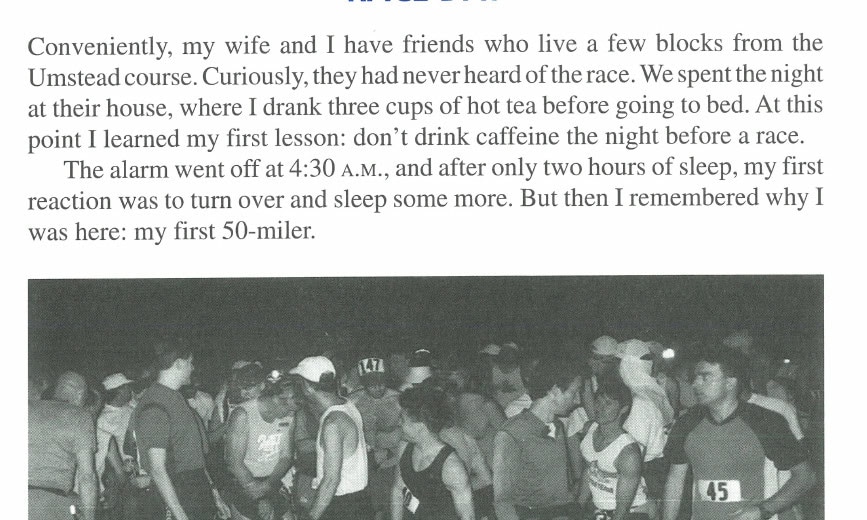
I dressed, and my wife and I drove the three-minute drive to Umstead State Park. There, we made our way down the long, dark, winding, rocky trail to race headquarters, where we heard lots of laughter and talking coming from the meetinghouse. Inside we found probably 75 (mostly) guys, hanging around talking and joking. What a sight at 5:00 A.M.!
After getting my race number, I did my quick prerace preparation. I applied Vaseline in the right places, ate a PowerBar, drank lots of water, and stretched. I also tried to eat some Hammer Gel I’d recently bought for the first time, but I had a hard time sucking it out of its plastic flask, so I tossed it away. I learned my second lesson: bring foods you know; this isn’t the time to try something new.
THE FIRST 10 MILES
Umstead is staged in Raleigh at Umstead State Park. It’s primarily a 100-mile event, but a 50-mile race option is also offered. The race consists of a 10-mile loop with an aid station at the start and halfway point. For the most part, the course consists of continuous rolling hills with 4,000 feet of elevation gain for the 50 and 8,000 feet for the 100. At first sight, the hills don’t look that difficult. The course is 100 percent trail and carpeted with small gravel rocks that (also) at first sight don’t seem to pose much of a problem.
My wife and I follow the crowd of about 150 runners heading down to the start, situated at the bottom of a short but fairly steep hill covered with small rocks. As the gun goes off I find myself at the front of the crowd and racing to the top of the hill. I make it up to the top first and am a bit surprised since I don’t have a flashlight and have no idea which way to turn, so I slow down and tuck in behind a couple of guys with flashlights. I take off at a fairly good pace and follow these two front-runners, who are chatting away.
I listen in on their conversation, which concerns some of the 100-mile races they’ve run, including Western States, Leadville, Wasatch, and Hardrock. Hearing the descriptions of these incredible mountainous races leaves me in awe. I join in the conversation and discover one of the guys is named Jose Wilkie, who seems to talk at 100 mph, and is attempting to run 13 100-milers in one year! (Wilkie ended up running 14. See Marathon & Beyond, volume 4, issue 5.) The other guy, Tom Green, seems to have run every major 100-miler in the United States. Both guys apparently know everyone in the race, as most runners we see on the out-and-back shout “Hi, Tom!” or “Hi, Jose!” as they pass.
At the five-mile point I run straight past the aid station crew, who stare at me, while Tom and Jose stop for a drink. After running down a tiny path for about two minutes, I hear Jose yelling behind me. I run back to the station to catch up with the two guys. They tell me the aid station was the turnaround
This article originally appeared in Marathon & Beyond, Vol. 5, No. 2 (2001).
← Browse the full M&B ArchiveMore like this
1,000+ stories from 19 years of Marathon & Beyond
The complete archive of the legendary long-distance journal — digitized and free to read.
