

A Transcon Primer
Write It and They Will Go
The Best—and Worst—Way to Get Inspired to Cross the Country on Foot Is to Read a Book About It.
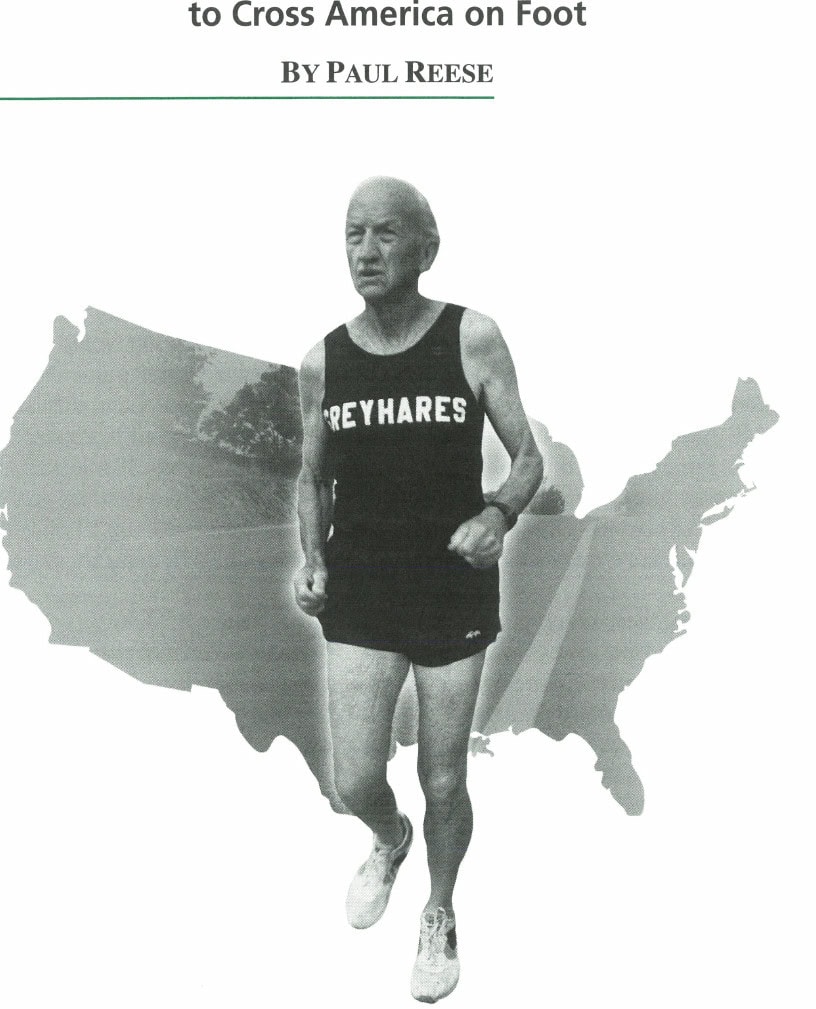
In all fairness, I begin this article with a caution: reading about someone who runs across the United States can become addictive.
I know whereof I speak. Back in 1972, as I read Don Shepherd’s book My Run Across the United States, I kept asking myself, “I wonder if I could do that? Could I run all the way across the country?” That question haunted me for 18 years and I finally answered it in 1990 by running across the United States. So consider yourself warned as you read about transcontinental (“transcon” in the parlance) runs.
Right from the start, let’s lay some ground rules—running/walking solo across America is defined as follows:
A. Running from coast to coast, Pacific to Atlantic or Atlantic to Pacific. Even though a north/south run from Canada to Mexico or a south/north run from Mexico to Canada would be across the country, such a run would not be within our ground rules mainly because it would be about 1,500 miles short of a coast-to-coast run. Come to think of it, I don’t know of even one such run.
B. Adhering to a point-to-point route that is uninterrupted from start to finish. For example, if there are two towns on the route that are 30 miles apart, the runner must cover all of those specific 30 miles. It is not running across America to run only 15 of those miles, ride into town, and then run 15 miles in town or around a track as some runners, especially those running for causes, have done.
Keeping these criteria in mind, you can’t always tell a book by its cover. A Walk Across America by Peter Jenkins doesn’t make the cut because Jenkins’s walk took him only from Albany, New York, to New Orleans. Curiously, this book alone sold more than the total of all the other books mentioned in this article. In fairness to Jenkins, by making a second walk (New Orleans to Florence, Oregon), he did make it all the way across the country. His second walk resulted in A Walk West (Ballantine Books, 1981, 431 pages). Similar to A Walk Across America in its title is Charles E. Lummis’s A Tramp Across the Continent (University of Nebraska Press, 1982, 270 pages), which is misleading in that Lummis walked only from Ohio to California—but that was quite a walk, in that it was made in 1884.
C. “Solo” defines itself and is used as a criterion to distinguish between books featured here and books about transcontinental races.
As for the races, they fall into two categories.
1. The C.C. Pyle Bunion Races of 1928 and 1929. Two books were written on these races, From L.A. to New York, From New York to L.A. by Harry Berry (undated, 181 pages, published by H. Berry) and The Bunion Derby by James H. Thomas (Southwestern Heritage Books, 1980, 133 pages). The subject of transcon races should not be left without mentioning Flanagan’s Run (William Morrow & Co., 1982, 444 pages) by Tom McNab, an American living in Britain; it is an excellent novel revolving around a 3,000-mile footrace based loosely on the Pyle races.
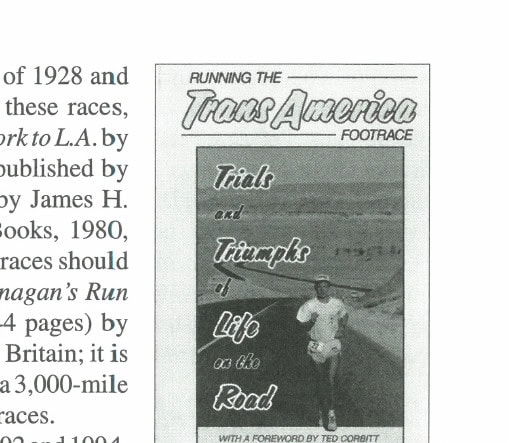
2. The Trans-America races of 1992 and 1994. Barry Lewis wrote a book on the 1992 race called Running the TransAmerica Footrace (Stackpole Books, 1994, 155 pages), which was presented in this magazine last year in a digested version.
SOLO, ON FOOT, AND WRITE A BOOK
Back to the solo transcontinental walks and runs. Five runners and three walkers meeting our criteria have written books that help document their adventures.
The focus of this article is on books about solo runs across the country but before talking about them I’ll briefly describe the three books by people who walked across the country.
Robert Sweetgall did considerably more than walk across the country. He plotted a route that took him through each one of 50 states, and he walked this route in 364 days, logging 11,208 miles. His route was well designed to get him into each of the 50 states. For example, following state borders north to south he was able to get into Louisiana, Texas, Oklahoma, Kansas, Missouri, and Nebraska with minimum mileage. In association with John Dignam, he tells the story of his walk in The Walker’s Journal (Creative Walking, Inc., 175 Elkhorn Rd., Newark, DE 19711, 1986, 116 pages). His route is easy to follow because he includes a day-by-day log giving the area and miles covered. Each of the 26 chapters contains two weekly logs for the 52 weeks that Sweetgall was on the road.
Doris Haddock, who walked from Santa Monica, California, to Washington, D.C., had more media coverage—press and TV—than any other transcon walker or runner. There were two reasons for that. She did the walk in her 90th year and she had a gimmick—campaign finance reform—which explains why her book is every bit as much about campaign finance reform as it is about walking. This great-grandmother of 12, a retired shoe factory worker, began her 3,200-mile walk at Santa Monica on January 1, 1999, and finished in Washington, D.C., on February 29, 2000. Writing in collaboration with Dennis Burke, she tells about her journey and the many people who accompanied her along the way in Granny D, Walking Across America in My 90th Year (Thorndike Press, 2001, 547 pages, large-print edition).
Among all the books mentioned in this article, this is the only one available in a large-print edition—for obvious reasons. Inclusion of a map would have enhanced the book because her route is often difficult to follow on the printed page. The book also includes the text of nine speeches she gave along the way.
ON TO THE SOLO RUN BOOKS
The first of the books about a solo run across the United States was a 68-page monograph titled New York to San Francisco by Abraham Lincoln Monteverde. It details his travels by foot—mostly walking with some running—3,415 miles from New York to San Francisco in 80 days in 1929 at age 60. (A detailed examination of Monteverde’s book follows later in this article.)
Monteverde was supported logistically along the way by two young runners, William McK. Meyers and Francis T. O’Donnell, each of whom in Depression times welcomed the opportunity to accompany Monteverde on a trip across the country since Monteverde was picking up the tab.
Meyers and O’Donnell alternated between walking with Monteverde and driving the secondhand and temperamental Chevrolet motorcar he bought for the trip, a car that Monteverde sold for $35 when he finished in San Francisco. It was because of O’Donnell that I was able to obtain a copy of Monteverde’s monograph, a document that is extremely rare. Doing research for his book about the Dipsea race, my son, Mark, interviewed O’Donnell, who won the Dipsea in 1931, and O’Donnell showed Mark the monograph and allowed him to make a copy.
INFLATED MILEAGE?
Monteverde’s average daily mileage of 43.22 miles seems high when compared with the strain of keeping up that kind of pace for even younger runners. Then there were the road conditions in 1929 and the fact that he walked most of the time. Don Shepherd, 38, averaged 43.65 miles a day running. Bruce Tulloh, a world-class runner in his 30s, averaged 44.31 miles a day running. In 1929 Monteverde was running on roads that were mainly crushed stone or dirt and rarely macadam, and his shoes were primitive compared with those worn by Shepherd and Tulloh, who did all of their running on paved roads.
“I made this trip,” Monteverde said, “because I wanted to do it, and I bore all the cost of it myself and I have not and shall not take any financial gain from it.” The trip cost him $4,860, including the car, the cost of two helpers, equipment, meals, hotels, and loss of earnings from his job as a bookbinder for three months. In 1929 that was a considerable sum of money.
“I am glad I did it,” he reported, “and each day as the hardships fade into the background and the pleasant and humorous things stand out, I grow more and more glad.” I’m not sure what “humorous things” he refers to since he reported only one in the 80-day trip.
Explaining why he wrote the monograph Monteverde wrote, “I am writing this in the hope of getting over to you, especially you men and women of fifty and sixty years of age, that it is never too late to do the thing you have always wanted to do. . . . Throw that old ‘too old to do it’ fable in the junk heap where it belongs.” Having run across the country at age 73, I couldn’t agree with him more.
SHEPHERD’S SOLO (BY DAY, SOCIALIZING BY NIGHT) TREK
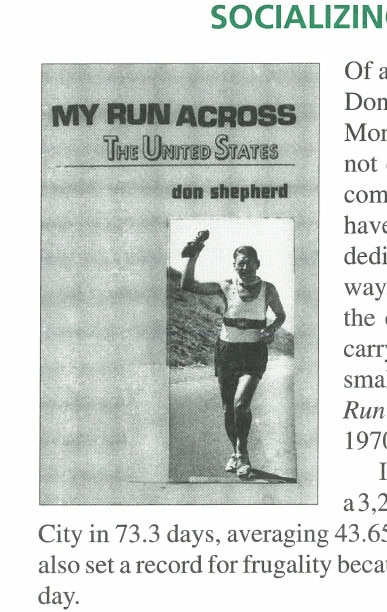
Of all the people who have run across America, Don Shepherd, a South African who followed Monteverde by 35 years, is unique in that he did not enjoy the benefit of a support crew or any companionship on the road. It seems that he did have companionship during the nights, for he dedicated his book to 37 ladies he met along the way, which leaves me wondering where he found the energy to run. Shepherd, who was able to carry all the logistical support he needed in a small rucksack, describes his adventure in My Run Across the United States (TAFNEWS Press, 1970, 187 pages).
In his 1964 transcon at age 38, Shepherd ran a 3,200-mile route from Los Angeles to New York City in 73.3 days, averaging 43.65 miles per day and setting a new record. He also set a record for frugality because he limited himself to a budget of $10 per day.
The strength of his book is that he gives a good accounting of what happens to him on the road: his experiences, his problems, the people he meets along the way. He comes across as a likeable bloke with a sense of humor that borders on being corny more than subtle or sophisticated. He also comes across as a strong, imperturbable individual— the kind of guy you would like alongside you in a foxhole in combat.
His general route is easy to follow because of maps that show the states he traveled through: California, Nevada, Utah, Colorado, Nebraska, Iowa, Illinois, Indiana, Ohio, and Pennsylvania. It is often difficult, however, to decipher what cities were on the route and, at times, which highway he followed.
The book is organized into 10 chapters. Chapter 1 is titled “Preparations,” chapter 2 is “Getting to the Start,” and the remaining eight chapters focus on an area such as the Mojave Desert, Utah, Indiana, and so forth.
In the “Preparations” chapter Shepherd discloses how he got the idea to run across the country. “When I completed my first ultra-long run from Johannesburg to Capetown which was tough and arduous and the longest ever in South Africa, 903 miles in all, the idea of running from Los Angeles to New York City was born in me and I started to plan the longest run in any one country in the world.”
In the same chapter Shepherd tells why he was successful on the road. “My formula for success on the road and most likely for other ones too is Faith, Clean Living, Training, and Purpose. Faith in God with whom all things are possible. Clean living: abstinence, non-smoking, eating of plain uncomplicated nourishing foods. . . . Training: nobody, but nobody, can tell another how to train . . . . The best instructor is the athlete himself . . . contrary to general belief a well-trained person can never overtrain. Purpose: one must use his brains nearly everywhere so why not in athletics too? Running around in circles is good for training but for nothing else.”
Shepherd, who worked as an underground locomotive driver in a South African mine, is not up to Bruce Tulloh or James Shapiro in literary style, but he is on par with them, and sometimes a level higher, in presenting what is involved in a transcontinental run.
TULLOH, WELL TAKEN CARE OF
Of all the people who walked or ran across the country, Bruce Tulloh was the most talented and the best supported. Among other things he was the British three-mile champion and had run a mile in 3:59.3. His cross-country run was sponsored by Schweppes, Pan American Airways, British Leyland Motors, Caravans International, and Adidas shoes. As he went across the country he was accompanied by three support vehicles: an Austin driven by his wife, Sue; an MGB towing a trailer and driven by his cousin Mark; and a Volkswagen camper driven by Maury Soward, who was employed by Schweppes to handle public relations.
In 1969 Tulloh came to the United States to achieve a record for running across the country by bettering Don Shepherd’s record of 73.3 days for 3,200 miles. Tulloh did that by covering 2,876 miles in 64.9 days (44.31 average), from April 21 through June 25, on a route that took him from Los Angeles to New York City.
Tulloh got the record but his route was 324 miles shorter than Shepherd’s; he was 35 years old compared with Shepherd’s 38; he had three people and three vehicles supporting him; and he always had food, drink, and shelter available. In contrast, Shepherd had to forage for food and drink and seek shelter; he was always solo (at least during the daylight hours), and he carried a rucksack. It’s understandable that Shepherd lost 33 pounds, while Tulloh lost only 6.
Since then several runners have reported running faster times than Tulloh’s, but none of these runs are documented to any degree approaching Tulloh’s documentation.
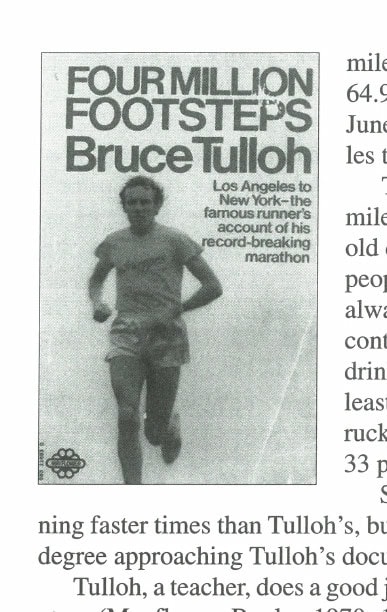
Tulloh, a teacher, does a good job of telling his story in Four Million Footsteps (Mayflower Books, 1970, 175 pages). He writes clearly and gives an accounting of each day on the road, reporting on what he sees and experiences and his problems.
Much of his reporting focuses on his relationships with his wife, Sue; his son, Clive; cousin Mark; and friend Maury.
Tulloh gives few reports about encounters with people along the way, which is probably due to his moving along at a rapid pace. He gives frequent calculations on where he stood against the record. It was obvious that he paid considerable attention to organizational and logistical details. He also appears to be something of a perfectionist.
Unlike Shepherd and Shapiro, Tulloh displays no sense of humor. He leaves the impression of being a very tense and intelligent person, one who is focused on his goal and would be a good and firm friend.
If running across the country is not sufficient evidence of his sense of adventure, take note that he spent several weeks running with and observing the Tarahumara (legendary Indian runners living in the Copper Canyon region of northern Mexico) and that he and his family lived for two years in Kenya where he taught and worked with young runners.
At times I found his route a bit difficult to follow and wished that the book had included a map of the course. Also odd, nowhere in the book did Tulloh mention his age.
“When I had finished,” he writes, “and I stood on the steps of City Hall, they asked me, ‘How does it feel to have done this?’ and I replied: ‘It feels grand,’ because that was the answer they expected of me. It was impossible then to explain in a word or two how I felt about this thing that had been an obsession to me for so long.”
In assessing the experience Tulloh wrote, “The human body has far greater powers of endurance and adaptability than most people give it credit for.” That’s a statement with which ultramarathoners would agree. Speaking of endurance and adaptability, neither Tulloh nor Shepherd was injured along the way.
THE SHAPIRO STYLE
Unlike Shepherd and Tulloh, James E. Shapiro was in no hurry to get across the country. In fact, his 3,026-mile trek in 1980, from Dillon Beach (about 40 miles north of San Francisco) to New York City, took 80 days.
He describes his journey in Meditations from the Breakdown Lane: Running Across America (Random House, 1982, 237 pages). A good indication of the quality of Shapiro’s writing is the fact that Random House, a major publishing house, bought his book.
Shapiro’s intent was to make the most of the trip alone, “without accompanying friends and support vehicles. I would carry necessary gear in a backpack, and forage for food, water, and shelter.” Most of the way he stuck to that resolve, but he did have help from Don Choi (a world-class ultramarathoner) for several days in California and handlers, from the California/Nevada border to Salt Lake City and in a bit of Wyoming. He also had company on the final days of his trip.
Shapiro doesn’t tell what “necessary items” he carried in his backpack, but it is clear that his biggest challenge was to get sufficient fluids. “The stretches between water are very long and I am pushed to heavy feats of concentration to ignore my thirst,” he writes. Except when he had a handler he was always faced with a water problem. As for food, he ate ravenously whenever he found a restaurant, and, bless him, here’s a runner who is not a diet freak. He orders chili, French fries, eight cinnamon rolls in a row (topped off with a can of soda pop), and some of my other favorite culinary delights. He slept in motels when available; otherwise, he camped.
NOT BRIMMING WITH CONFIDENCE
Unlike Tulloh, who brimmed with confidence (maybe too much so), Shapiro said, “I never assumed I could run a single mile until I’d done it and I never assumed I could make it to the end of any given day.” That was from a guy who ran as much as 51 miles in one day while crossing the country.
What I appreciate most about Shapiro is that he is a no-holds-barred guy when it comes to letting the reader into his mind. Often, as a fellow transcon runner myself, I found myself identifying with his thinking and wishing I could have expressed my thoughts as lucidly as he does.
Here is Shapiro’s thinking on his second day on the road. “Living as I was moment to moment, unsure of my own capabilities, overawed by the scale of the task ahead, battered by the brutality of new physical demands and having only one day’s experience behind me, I could hardly envision anything different ahead for weeks to come. Not until much later in the crossing would I see how the run expressed different cycles and seasons. I was so engrossed in the ongoing hour-to-hour demands of running down the road that the past hardly existed and the future did not consist of anything further than I could literally see ahead—a distance of about three miles.”
The book gave me the feeling that Shapiro would be an interesting guy to be around. He is highly intelligent, has a good sense of humor, and is a college graduate (Harvard ’68). He also is adventurous and is certainly a free spirit. He had been a student of Zen Buddhism for many years, was a Peace Corps volunteer, and besides being a writer has worked at a variety of jobs.
“This whole book,” Shapiro says, “is an attempt to render the feeling of crossing the country.” He does a very creditable job of doing that as he describes his feelings, his experiences, and his problems. The inclusion of three maps makes his route easy to follow.
Shapiro experienced more physical problems than did Monteverde, Shepherd, Tulloh, and Reese. He had injuries and pains that caused him to visit a podiatrist and a chiropractor. His major problem was an infected ankle that required him to take a week off in Harlan, Iowa, for recuperation. Since the other transcon runners were not delayed by injury, it’s strange that Shapiro was injured because he was an accomplished ultramarathoner who once did more than 138 miles in a 24-hour run.
It’s unfortunate that such an excellent book about running across the country is not readily available.
THE HARDEST REVIEW
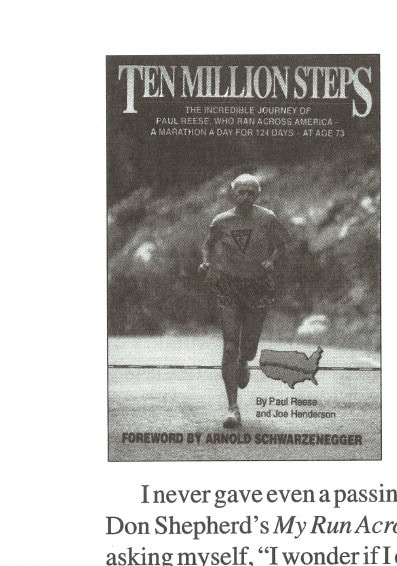
At this point, the review of the fifth and last book, I’m telling myself to “strain to be objective” about Ten Million Steps (WRS Publishing, 1993, 226 pages), the book Joe Henderson and I wrote about my 3,192-mile run across the country in 1990 at age 73. Being objective here is almost as difficult as passing a Krispy Kreme doughnut outlet without stopping. (Krispy Kreme doughnuts—now there’s a yardstick for comparing the five transcon runners. Monteverde and Shepherd would prefer a beer; Tulloh would be too concerned about his diet and his goal to stop; Shapiro and Reese would stop enthusiastically, each devouring at least a half dozen Krispy Kremes, and upon a regretful departure each would carry off the remaining Krispy Kremes for subsequent fortification and morale boosting.)
I never gave even a passing thought to running across the country until I read Don Shepherd’s My Run Across the United States. After a few chapters I started asking myself, “I wonder if I could do that—run all the way across the country.” Eighteen years later, in 1990, I found that I could when I ran from Jenner, California, to Hilton Head Island, South Carolina.
Before setting forth on the journey I had three resolves. I would try to average close to a marathon a day; I would not quit unless crippled or infirm; and I would fully document the run by keeping a daily journal, a task that I laboriously and painfully accomplished at the end of each day’s run. By the time I finished, that journal had grown to 420 single-spaced pages.
I had not thought about writing a book until W. R. Spence, of WRS Publishing, which then published inspirational books, contacted me. My journey was regarded as inspirational in that I was 73 years old, had 36 radiation treatments for prostate cancer at age 70, and have battled asthma all of my adult life. Doc Spence invented Spenco Second Skin dressing, among other medical advances that have benefited runners. I showed him my journal and his reaction was, “This is interesting stuff, but it needs to be trimmed by a good editor.”
Enter Joe Henderson, who whacked the journal to the 226 pages of Ten Million Steps. In the wake of that trimming I confess that I have never had the heart to go through the journal and learn which experiences, anecdotes, and comments Joe deleted. Frankly, I was just thankful to see the book in print. Remember that I was 73 when I plowed my way across the country. I reasoned that people who read that I averaged 26.08 miles for 122 consecutive days (my first and last days were ceremonial days of 5 miles each for media purposes) might come to realize the capability of the human body and the fact that a person can be active in the sunset years. Judging from the many letters I have received, that has proved to be true, which is one of the most satisfying aspects of having written the book.
It’s also satisfying that the Library of Congress recorded the book for the blind. As a result I have received some flattering letters from blind people and have a continuing correspondence with one lady, now in her 80s, who went blind at age 52. I have learned a lot from her about coping with blindness.
Before leaving Doctor Spence and WRS Publishing, let me mention that the title that Joe and I submitted for the book was Go East Old Man (Joe’s brainstorm), but it was changed by the publisher to Ten Million Steps. After WRS told me of the title change I replied, “The way I calculated it, using my shuffle stride, I took about nine million steps.” The answer from WRS was, “You’re probably right, but 10 million sounds better.” Incidentally, Joe’s title, Go East Old Man, did not go to waste. We used it for our second book, which is about running across all the states west of the Mississippi River.
One of the titles I considered was In My Moccasins, In My Mind, which typified what I was trying to do in the book—to have the reader identify with me throughout the journey.
After reading all the books about transcontinental runs and after experiencing such a run, what profound statement do I have about running across the country? Simply this—that if you are searching to find the person you are, running across the country is an experience that will bring it about. It is a baptism that influences a life and endures unto death.
The Mysterious Case of Abe Lincoln Monteverde
In 1929 a Runner With a Very Unlikely Name Set Off to Do a Transcon. But Did He Really Do It?
Maybe you can help me here. I’ve read Abraham Lincoln Monteverde’s account of his foot journey from New York to San Francisco three times, and I am still undecided on whether he did what he said he did. Let’s think of it as an unresolved mystery.
So read along as I quote some of the things he said, and then, as a jury of one, render a verdict on whether he did what he claimed.
Succinctly, he claims to have traveled 3,415 miles on foot—mostly walking, rarely running—from New York to San Francisco in 79 days, 10 hours, and 10 minutes, between May 6 and July 24, 1929.
The first thing that puzzles me is his claim of 79 days while starting on May 6 and ending on July 24. By my reckoning that adds up to 80 days: 26 in May, 30 in June, and 24 in July.
Moreover, in the 68-page monograph that he wrote about his journey, Monteverde includes a day-by-day accounting for 80 days, May 6 to July 24 inclusive. Nevertheless, after finishing, Monteverde received this telegram from his friend Bill Kennedy, who attended the annual meeting of the American Athletic Union at St. Louis in 1929:
St. Louis, Missouri, Nov 17, 1929
Your record has been allowed. Hope it’s never broken.
—Bill Kennedy
The only explanation for the difference between 79 and 80 days that I can think of was that two-thirds through his journey (June 24) Monteverde took a day off. As explained in his log for that day, “In the morning, I found myself no better, although I had been putting hot compresses on my feet and legs all night, so I decided to rest that day.”
Nonetheless, a day of rest counts the same as a day of walking or running when computing transit time across the country. Put another way, any day a runner takes off on a transcon run must be included in his total time. By his own log Monteverde was on the road 80 days and he walked/ran 79 of them.
His route across the country is easy to follow because he gives a daily account of places visited and distances covered. He claimed a total distance of 3,415 miles. I would quibble a mite here because after adding his figures three times I came up with 3,425 miles. At any rate, working with his 3,415 figure and realizing that he was actually walking/running for 79 days, his daily average was 43.22 miles.
COMPARED WITH . . .
Remember that he was 60 years old, that the roads in 1929 were mainly crushed stone or dirt and rarely macadam or concrete, and that shoes were primitive compared with shoes worn by succeeding transcon runners. Let’s compare his daily average with three well-documented transcon runners, Bruce Tulloh, Don Shepherd, and James Shapiro, all of whom were in their 30s when they ran across the country:
| Don Shepherd | Bruce Tulloh | James Shapiro |
|---|---|---|
| 3,200 miles | 2,876 miles | 3,026 miles |
| 73 days | 64 days | 80 days |
| 43 miles/day | 44 miles/day | 38 miles/day |
| 1964 | 1969 | 1980 |
Not only were these runners considerably younger than Monteverde but Shepherd and Shapiro were national-class ultrarunners in their respective countries and Tulloh was a world-class runner. It should be pointed out that Shepherd and Tulloh were chasing a record, while Shapiro was running for the adventure of crossing the country on foot.
Monteverde’s daily average seems extreme when these considerations are taken into account. Younger and better athletes averaged no better than he did; road surface conditions greatly favored Shepherd/Tulloh/Shapiro over Monteverde; Shepherd/Tulloh/Shapiro had better shoes and running gear (in fact, Monteverde wore a sweater and slacks throughout); and by his own account Monteverde was primarily walking and rarely running.
What we know about Monteverde’s journey is only what he tells us in his monograph, so let’s move to some specific statements in the monograph.
FANTASTIC PERFORMANCES
Describing his eighth day (May 13) on the road, he writes:
“I left Wolfsburg (Pennsylvania) in more cold rain, this time mingled with snow. Walking with wet shoes and raincoat made the going up the Allegheny Mountains very hard. . . . Our speed picked up from four miles an hour to eight without our knowing it. . . . That day I covered thirty-eight miles.”
He never mentions running, yet his speed increases from a 15-minute mile to a 7.5-minute mile, faster than that of a world-class distance runner, Tulloh, on his transcon run. Also, by his own account Monteverde was in rain and snow and was wearing a raincoat while traveling on a poorly surfaced road.
“Day 31, June 5, 1929. . . . Now the road was badly torn up, and began to be what they call out West ‘washboard road.’ The roads are made by scraping the earth from the side to the grade and width desired, and then covering it with coarse stone to a depth of six inches or more. The name ‘washboard’ is given because of the ridges of stone every thirty inches made by the cars. This forced me to adopt a shuffle walk, instead of my natural stride that I had been using. . . . We met Chief Black Cloud (and had a long visit with him). . . . We stopped at Marshalltown . . . and here I suffered much lost time and distance because of the custom to route the Lincoln Highway through the main streets of the town.”
Despite all that, he said he covered 42 miles that day.
Day 33, June 7, 1929. The road was a quagmire, mostly clay. Every 100 yards or so I had to stop and scrape four or five pounds of clay from my shoes. The best I could do was a mile an hour. It took me 8 hours to go . . . a distance of 8 miles. When I arrived at Ames (Iowa), a cloudburst occurred, which halted me for two and a half hours. . . . Then up a steep hill, through puddles and mud, I trudged on to Boone. . . . I had covered 34 miles.
Day 34, June 8, 1929. A cold rain was falling when I left Boone (Iowa) . . . deep puddles, wide ruts, and plenty of traffic made my going very hard. I will say now that from the time I started, I have never been free from pain. My legs had now become stiff, and I walked with an awkward shuffle. . . . It finally cleared up in the afternoon . . . at the end of 45 miles we stopped at Ralston (Iowa).
Day 41, June 15, 1929. [His entire entry for this day is quoted below and is typical of many other entries in being so sketchy.]
Grand Island, Nebraska, to Gibbon, Nebraska. The morning found me very upset and rather weak. Shortly after I started on my day’s work, I discovered another drawback—a detour over poor roads and a greater distance. I stopped at Gibbon for the night, with thirty-eight miles more of my journey behind me.
Day 47, June 21, 1929. . . . The thermometer registering about a hundred degrees, and a steady 50 mile wind blowing . . . the roads became very bad—all powdered clay and loose stone . . . I walked until nine o’clock covering 51 miles.
Day 50, June 24, 1929. Cheyenne, Wyoming. . . . I needed heavier shoes, so I stopped in a store. . . . The clerk showed me shoes used by men who work in gravel pits . . . they were the shoes for the job. They weighed four pounds apiece, and had stiff soles and rubber heels.
Day 51, June 25, 1929. . . . The new shoes worked wonders. . . . We lunched at Cheyenne in an old-fashioned German beer garden. . . . Three miles after we left Cheyenne, the big climb started up . . . 41 miles.
[Just try putting four pounds of weight on each foot and then walking (as I did) and ask yourself, “Could I cover 41 miles doing this?”]
Day 56, June 30, 1929. We were now in very desolate country, with nothing but desert on both sides of the road. . . . Every morning about eight o’clock the wind rose not to die away until sundown. The thermometer registered from 110 to 120 degrees. Forty-five miles.
[Not a word is said about how he survived this heat.]
Day 60, July 4, 1929. The morning found us with a broken-down car and into a garage it went. . . . I eventually found an old road running parallel with the Highway which gave me better footing and freed me from dust. However, this had its fault, for the car could not follow and give me drink. I was obliged to have some liquid every half hour.
[This entry left me wondering how he got his liquid because his car did not get out of the garage and rejoin him until four hours after he started, and soon after joining him it could not follow him because of the road he was on.]
ABOVE 130 DEGREES?
Day 64, July 8, 1929. I no longer walked, I hobbled. The hot morning began to make itself felt and the horrible torture of traveling through the desert began. The thermometer soon registered 130 degrees. What the temperature really was, I could not tell, for our thermometer did not register any higher . . . I had to halt every mile so I could get a cooling drink. . . . At noon we halted for two hours rest. My legs improved, but the dysentery continued. 35 miles.
On July 23, 1929, his 79th day on the road and 78th of walking/running, he covered 72 miles despite having blisters on his feet and dysentery. He describes the towns (Davis, Dixon, Vacaville, Fairfield) on his route from west of Sacramento to Benecia but is silent about his walking experience, except to mention his blisters and dysentery; the fact that he started at 4:00 A.M. and finished at daybreak the next morning; and that he made stops for breakfast, lunch, and dinner. Considering the time he was on the road that day, it is conceivable that he could have logged 72 miles. It would be an astounding feat for a 60-year-old man who had walked 3,309 miles in the previous 78 days.
Allowing Monteverde to speak for himself, here are some of his comments and observations, randomly selected.
Because of my name, I decided to follow the Abraham Lincoln Highway across USA.
I bought a second hand car and recruited two young guys, amateur runners, William McK. Meyers and Francis T. O’Donnell as drivers and companions. [Note: With McK. Meyers and O’Connell both dead, there are no eyewitnesses to testify to what Monteverde did or did not do.]
I am glad I did it; and each day as the hardships fade into the background and the pleasant and humorous things stand out, I grow more and more glad.
I have been running marathon races for 30 years. That being so, and granting that these races had to be on the roads, Monteverde had considerable problems with shoes for an experienced marathoner. What follows are some of his comments about shoes.
“I found the 14 pairs of shoes I had made were not serviceable,” he reported on his third day of travel. On his fifth day, this, “At a local store I purchased basketball shoes, which gave me some relief.” Sixth day, “I bought a pair of heavy-soled sneaks, thinking the rubber sole might keep the moisture from softening the shoes, as did leather-soled ones.” Fiftieth day, in Cheyenne, “The clerk showed me shoes used by men who work in gravel-pits. . . . He fitted me with a pair, and it proved to be the winning stroke, as they were the shoes for the job. They weighed four pounds apiece, and had stiff soles and rubber heels.”
THE WAYWARD CAR
Here is a typical entry from his 80-day journal:
Day 43, June 17, 1929. Overton, Nebraska to Gothenburg, Nebraska. I left early in the morning—a muggy, hot day. At twelve o’clock, Frank stopped in the barber’s for a haircut. Bill waited for him with the car, and through some poor management on their part, I continued on alone until five o’clock without water or drink of any kind through an arid and dusty country without habitation. Finally they found me and said they had taken the wrong road. The excuse was a poor one. We stopped for the night at Gothenburg, at a very nice camp, where we procured some good beer and food. Forty-seven miles.
Notice that not a word is said about what happened to him or how he felt during five hours in “arid and dusty country without water or drink of any kind.” No mention is made of anyone or anything seen in those five hours. Despite these conditions he logged 47 miles while walking more miles than Shepherd or Tulloh averaged while running.
The most baffling of Monteverde’s entries is the one for his 31st day, June 5, 1929, in which he states, “Frank, who was carrying notes of the trip and addresses, lost them . . . [this] robs me of many names, places, and incidents, which would have made this story of the trip much more readable.”
Since he lost all his notes, how was he able to record for the previous 30 days the distance he covered, the area he traversed, the names of places where he had lunch and dinner, the hotels in which he stayed, the names of people who operated places where he stayed overnight, and so forth?
One thing that struck me as I read Monteverde’s journal was how few encounters he reported with people on the road. Over an 80-day period he reported eight encounters: Bill Sheldon, a professional pedestrian, day 5; a
THE DAY that Ralph Paffenbarger (a good friend and world-renowned epidemiologist) and I finished running across the island of Hawaii, we had a long wait before catching a plane back to Oahu. Killing time, we visited a Borders bookstore. Among other things we were curious to see whether Borders stocked his book Life Fit or my book Ten Million Steps, the story of my run across the United States.
Checking her computer, the clerk, Camille Almy Sigmund, told me, “Yes, we do have Ten Million Steps in stock.” Then she led me to where it was shelved, pulled it out, and said, “Why, that’s you on the cover.”
“Guilty as charged,” I replied.
“That’s interesting,” she said, “because my father ran across the United States.”
“He did? What was his name?”
“Don Almy.”
As much as I had read about transcon foot crossings, the name did not ring a bell.
“Strange that I’ve never heard about him,” I said. “I’d be very interested in learning more about his run.”
“I’ve got all kinds of newspaper articles I can send you,” she said.
And that’s exactly what she did, because a month after I returned home I received a portfolio of articles about her father, all documenting his transcon crossing. What follows is the story of Don Almy and his run across the country.
If you have ever given thought to running across the country coast to coast or if you aspire to doing it but are holding back, doubting that you can, the story of Don Almy should dispel that doubt. We’re not talking here about getting across the country fast but about simply getting across the country on foot, with little regard for how long the journey takes.
AT AGE 68
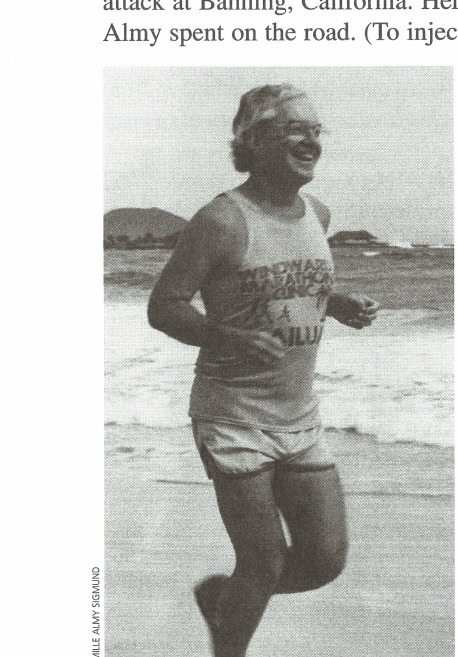
When he ran across the country at age 68, Don Almy set two records of sorts. By taking 419 days to complete the 3,067-mile journey and averaging 7.31 miles per day, he was on the road longer than any other transcon runner. Second, he notched a high in public relations for a transcon runner by being interviewed 97 times, by speaking to 113 groups (and nearly 3,500 people), by being on television programs 24 times and on the radio 20 times, and by having 35 newspaper articles written about his adventure. One thing is for sure about Almy’s trek: unlike some other reported U.S.A. crossings, it was well documented along the way.
A near disaster early in the trip caused Almy to lose a month. On May 1, 1979, he started from the Percy Andrus Gerontology Center at the University of Southern California. On May 13 his wife, Camille, suffered a mild heart attack at Banning, California. Her recovery took one month, none of which Almy spent on the road. (To inject a technical note here, if those 30 days of inactivity were subtracted from Almy’s total of 419 days, his daily mileage would move up from 7.31 to 7.88 without affecting his record of having been on the road longer than any other transcon runner.)
Camille’s recovery was vital to the adventure because she drove their motor home, tended to their two dogs (a German shepherd and a poodle), and served as public relations director, which she did magnificently, as attested to by Almy’s notching a record amount of media coverage.
The main reason Almy’s trek across the country took so long was that it was a means for him to preach the gospel of fitness. “The run is a gimmick,” he said, “to get audiences all across the country to listen to the story I have to tell them . . . how it’s possible for older people to improve their general physical health dramatically.” He had good reason to preach that gospel, for this was a man whom fitness brought from despondency and from being a physical disaster to happiness and being fit enough to finish marathons and a run across the country. All of this happened after he was 62, which is proof that it’s never too late to achieve fitness. He was so pleased with his change in lifestyle that he dubbed himself “the happy jogger.” When he ran across the country he had “Don Almy, The Happy Jogger” painted on the side of his motor home.
Just how much of a physical disaster was Almy before he was shown the light of fitness? Before he started running his blood pressure was 200/100, he carried 195 pounds on a five-foot-seven frame, and his heart was arrhythmic, at times exceeding 200 beats per minute during auricular fibrillation. His blood was loaded with fats and triglycerides and his cholesterol was “very high.” (He never gave a figure; “very high” was as close as he came to being specific.)
He began running at age 62 and after he had been at it for five years the change in his physical condition was dramatic. His blood pressure read 130/70, he lost 57 pounds, his resting heart rate went down to 44, and he stopped taking the four medications he had used for years. “Running saved my life,” he said. “I was in such bad physical shape I realized I had to do something. I knew I was headed for either a heart attack or a stroke.”
Diet was also important in his physical transformation. Once he began running he stuck to a rigid and disciplined diet that restricted salt, sugar, and refined flour. He ate only poultry, fish, vegetables, fruits, and whole-grain foods.
RID YOURSELF OF THE SEDENTARY LIFESTYLE
As Almy got better and better, he wanted more and more to get a message across to other people—especially older people—that the main enemy in the aging game is inactivity. He realized that he had turned his life around in 1974 when he began running. Five years later he embarked on his run across the country and on his mission of preaching fitness.
While on the road, Almy was comfortable with his running and living. He planned to run 10 to 12 miles a day but fell far short of that, with an average of just over 7 miles a day. His living situation was comfortable since he and his wife bought a large motor home for the adventure. He tried unsuccessfully to get sponsors to lend him a motor home and subsidize him but had to finance the trip himself, at a cost of $30,000 (a goodly sum in 1979).
His routine was simple. He and his wife would get up at 4:00 A.M., and he would be on the road by 5:00 A.M. While he was running his wife would drive to the nearest town and make arrangements for media appearances, interviews, and the talks he would make. The most he ever ran on any day was 16 miles. Almy ran six days of the week and took the seventh off for rest and recovery. In 3,067 miles on the road, he suffered only one injury, a breakdown in his right arch. “That was my fault,” he said. “I stuck with the same pair of shoes too long instead of changing to a new pair.”
Simple, too, was the three-point health program he advocated for older people. It stressed walking, joint exercises to relieve stiff joints, and a diet devoid of refined flours and sugars and with less fat and salt. “It is my firm belief,” he said, “that many of the ills of the elderly can be delayed, avoided, and reversed through physical fitness and good nutrition.”
Almy was qualified to speak about health. As an air force colonel he spent 11 years in the Pentagon, serving as a life sciences liaison officer during the nation’s preparation for the first moon shot. Following retirement he joined the staff of the Boeing Company in Seattle, where he worked in the company’s biotechnical program.
Rarely in the annals of running literature and history has there been such a well-documented case of a person past age 60 making the dramatic reversal of physical condition that Almy achieved. Therein lies the importance of what he did. He completely reversed the negative aspects of his health, ran a 3:55 marathon, and ran 3,067 miles across the country. He showed people what is possible. That was the gospel that he preached and lived. All the other transcon crossings have been faster but few, if any, have been as significant.
These pages consist entirely of advertisements (New Balance W715 Women’s Running Shoe, MDI Mount Desert Island Marathon, M&B Coolmax socks, New Balance technical apparel, and Inaugural Des Moines Marathon). There is no article content to extract.
This article originally appeared in Marathon & Beyond, Vol. 6, No. 4 (2002).
← Browse the full M&B ArchiveMore like this
1,000+ stories from 19 years of Marathon & Beyond
The complete archive of the legendary long-distance journal — digitized and free to read.
