

The Sahara Marathon
THIS IS a true story about running a marathon in a refugee camp in a third-world country, a place where time and schedules and cell phones and the Internet don’t much matter. Quite an unusual and tough marathon, as you will see, but hosted by some wonderful people—the Sahrawis (also spelled Saharawis)—who made our four-day stay in the desert an unforgettable experience.
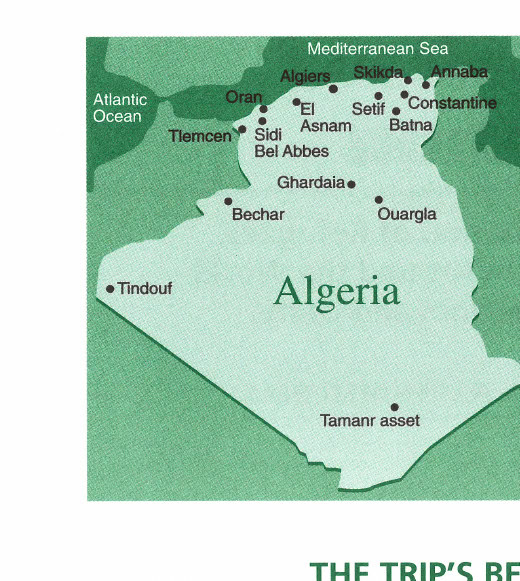
The story began when Karen was photographing the U.S. Olympic Marathon Trials in Pittsburgh, Pennsylvania. At the expo, she picked up a few applications for exotic-sounding marathons and brought them home to Clay. She only casually noticed the brochure about a marathon in Africa. Sometime later, Clay announced he would like to run a marathon in the Sahara Desert in Algeria. Karen, although usually adventurous, didn’t like the sound of this. When we checked the U.S. State Department Web site, we found that Algeria was considered one of the top-five most dangerous countries in the world and Americans shouldn’t travel there. (Although based in Algeria, on the trip we would be with Sahrawis, who are not Algerian but rather refugees from a land formerly known as Spanish Sahara, a region now claimed by Morocco.)
Over the next few months, Clay talked numerous times with the race chairman, Jeb Carney. Although it seemed the marathon would be at least reasonably well organized, there were lingering questions about security.
Because of our status as race photographers, we are acquainted with many Moroccan runners. We spoke with them whenever we bumped into them at races, and they, more than anyone else, convinced us that we would be safe. They assured us that the area in which the marathon would be run was far from the areas of conflict. More importantly, they told us that because this was an international sporting event, it would be considered special and important, and there would be no conflicts while we were there.
We decided to go. We would stay in tents with Sahrawi host families at refugee camps before and after the marathon, and we would participate in the 25th anniversary of the declaration of the Sahrawi Republic. We didn’t have much information about accommodations, food, or the customs of the people, but we were promised the people would be gracious and pleased with our being there.
THE TRIP’S BEGINNING
We flew from Philadelphia to Madrid, arriving on Saturday morning, February 24, 2001. We joined a group of 100 Americans, 200 Spaniards, 100 Portuguese, and others from Germany, Mexico, Great Britain, Hong Kong, Italy, and Austria, to name some of the 23 countries represented.
Many were runners, but some came for other reasons. The real Patch Adams (played by Robin Williams in the movie) came along with several other clowns who planned to visit the children and the hospital. A church group came because of their interest in the Sahrawi people.
We all left the same afternoon on two Air Algeria planes to travel to Tindouf, Algeria, a military base. When we arrived, it was not yet midnight. Nothing seemed very organized, and we stood in a crowded room, dealing with passports, papers, and customs agents. We stood around both inside and outside, where it was cold. After several hours, we got into dusty, rickety buses and began an hour-long trip through the desert to arrive at the refugee camps. It was pitch dark, and we were too tired to enjoy the big, black sky and starry night.
We arrived in the camps and endured some speechmaking, introductions, and instructions. Then we were divided by sex into groups of five or six and asked to follow our hosts to tents or small adobe buildings. More introductions and talking with our hosts and drinking tea, and finally, around 3:00 A.M., we lay down to sleep. (We should digress at this point to say that the tents and buildings were beautiful inside, with beautiful blankets and cushions. Our hosts were very gracious and accommodating.)
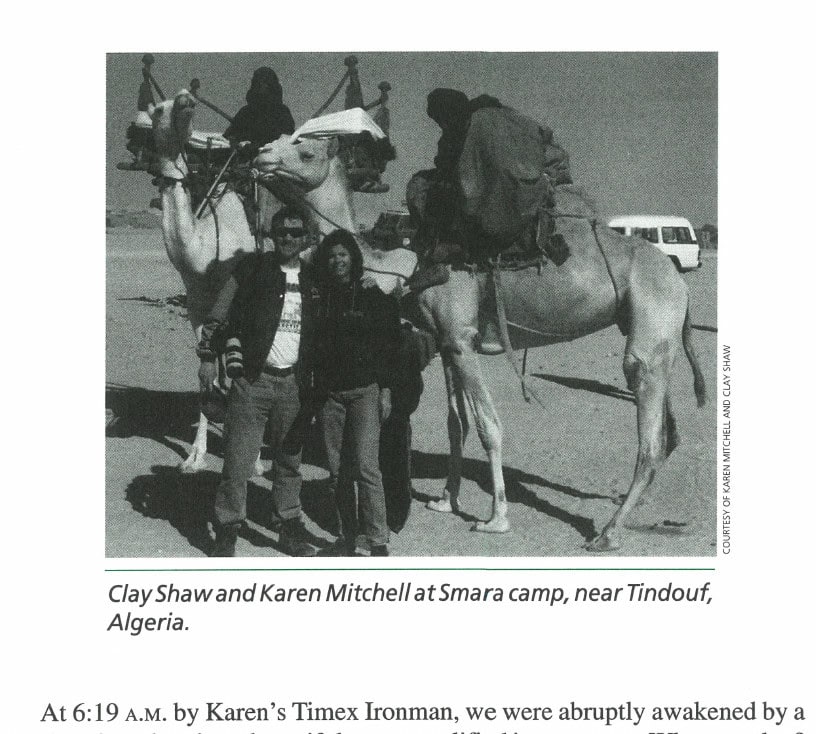
At 6:19 A.M. by Karen’s Timex Ironman, we were abruptly awakened by a man’s voice, chanting a beautiful song, amplified in some way. What was that? A call to prayer? In any case, we were roused from our too-brief sleep.
It was now Sunday and we learned that the marathon would be held Monday instead of Tuesday, as shown on the race application, the Web site, and all other communications. This change was due to the festivities surrounding February 27, the anniversary celebration.
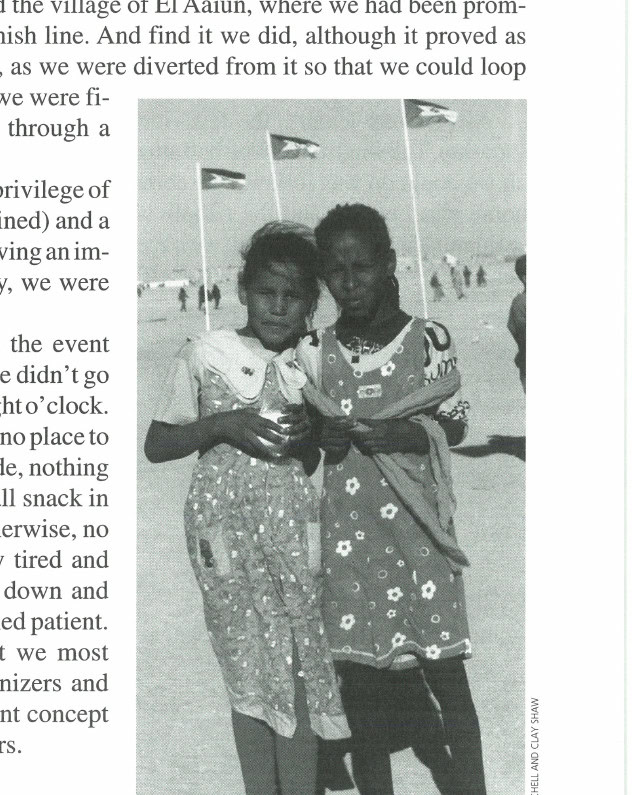
We spent Sunday enjoying some celebrations on our behalf, talking with our host families, and being with the children. The younger children continually asked, “caramella?” (candy)
Late in the afternoon there was a five-kilometer international parade, consisting of many Sahrawi people—and us.
The afternoon was sunny and there were colorful flags from many countries. Our carbo dinner was to follow the parade. A start-line banner was set up, along with an international collection of flags, while we waited patiently (for two and one-half hours!) for our carbo dinner.
As this was the evening before the marathon and most runners wanted to get some rest, it was difficult to be patient, but most managed. After dinner, the Sahrawis entertained us with dancers and musicians. We all appreciated the gesture, though many of us opted for a good night’s sleep instead.
MARATHON DAY
These preliminaries, exciting as they were, risked being as tiring as the race itself. After a clear, pitch-dark starry night, a cool morning greeted the 100 marathoners and 400 half-marathoners, 10Kers, and 5Kers. The runners had to bring along their packed luggage to the start, as we would relocate from Smara to El Aaiun after running the point-to-point course between the two communities.
Finally it was time for the events to begin.
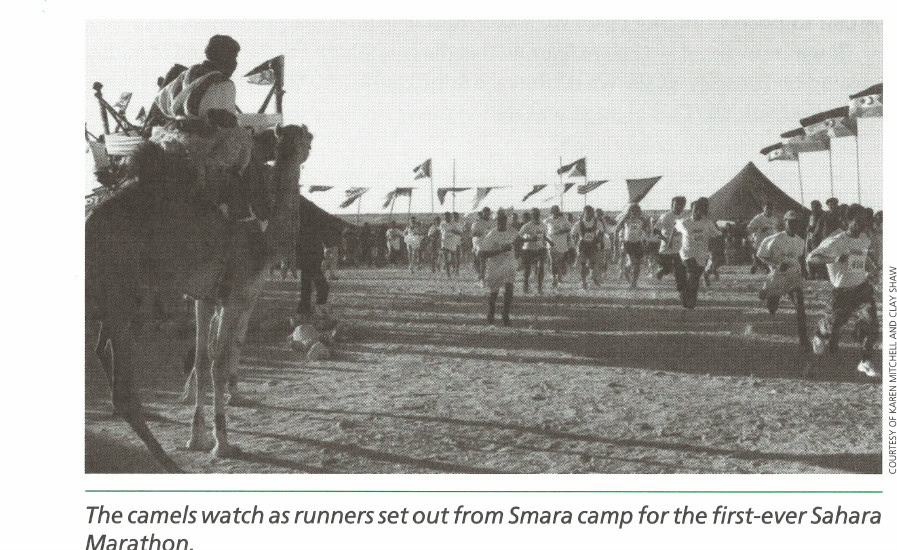
The excitement in Smara was tremendous as people and camels lined the course. The marathon began.
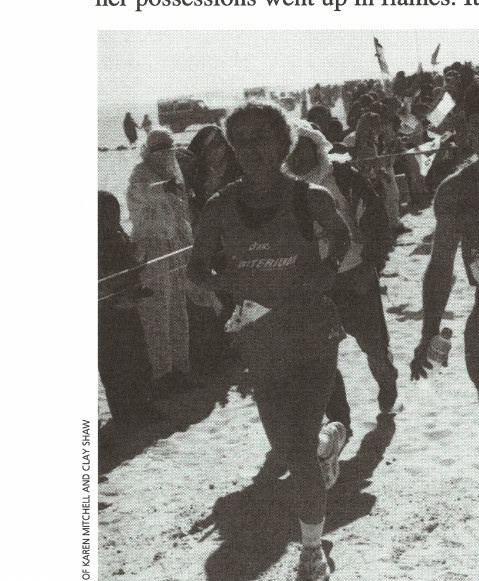
As we ran the first kilometer, we ran by Sahrawi women who, in unison, emitted a high-pitched trilling sound. Children ran with us and camels just watched. This was the best and most exciting start we’ve ever experienced in Clay’s 121 marathons and Karen’s 47. Clay photographed the start and then tagged the start banner and made his way through the crowds, losing 12 minutes altogether, with several additional photography stops along the way. His photo gear was transported in a Land Rover.
The surface of the course, hard dirt with some loose rocks, made running difficult from the start. In addition to dodging the rocks, we had to be especially careful not to run over the multitudes of Sahrawi children before they tired out.
The course turned onto a blacktop road for a brief four kilometers, after which we began our long trek north into strong winds across a barren, sandy
landscape. This part of the course had hills and varied terrain. At times we ran on soft sand, then rocks, then hard-packed sand. The strong winds carried fine sand, not sand that hurt as it hit our faces, but sand that got into every pore. The pack of runners gradually turned into a long line and eventually broke into small groups.
The half-marathon point came at the end of the village of Aoserd. It seemed the entire village had come out to watch, cheer, and trill. Past Aoserd it was just sun, wind, and dunes. The sand at times was so soft that it submerged our feet up to the ankles. For those of us who had come to Algeria from cooler climates, the sunny day was beginning to feel quite hot. There was general consensus afterwards that the second “half” was about 15 miles long.
Eventually, we reached the village of El Aaiun, where we had been promised we would find the finish line. And find it we did, although it proved as elusive as a desert mirage, as we were diverted from it so that we could loop around the village before we were finally allowed to reach it, through a gauntlet of Sahrawi flags.
Much later we had the privilege of cold showers (broadly defined) and a snack. That evening, following an impromptu awards ceremony, we were off to our new hosts.
Most runners finished the event about midafternoon, but we didn’t go to our host families until eight o’clock. During our wait, there was no place to sit except on sand. No shade, nothing much to do. We had a small snack in the later afternoon but, otherwise, no rest. Again, although very tired and wishing for a place to sit down and relax, most runners remained patient. It was at these times that we most noticed that the race organizers and the Sahrawis had a different concept of time than did the runners.
THE FESTIVITIES
February 27, the day after the marathon, was a day of wonder.
It was parades and festivities as leaders from all over Africa came to show support for the Sahrawi people. In fact, the two days following the marathon were the best of the trip. In the early morning, sand was blowing quite strongly, making us glad we had run the marathon the day before.
The people from all of the camps converged on our camp. We have photos that show masses of Sahrawis lined up along the parade route. The president spoke, while we read along with English versions of the speech, which had been given to us. There was a military parade. Soldiers, both men and women, marched in uniform. Vehicles with impressive-looking weapons drove down the way. Media from other African countries, Spain, and Great Britain had come to cover this historic event. More speeches, more pageantry. Children marched in their colorful school uniforms.
As we were leaving the festivities, people suddenly began running and shouting. The small child who had attached herself to Karen began running, and all we could do was follow. The commotion was caused by a fire—an adobe home was burning and the people were using a bucket brigade of sorts to extinguish it. As we watched, we observed a woman being comforted as all of her possessions went up in flames. It’s easy to see how fires could start. The homes use kerosene burners and are filled with flammable fabrics. Clay, always the photojournalist, snapped a few pictures. An official confronted him, asking him not to take pictures of their misfortune. Later we heard that some Spanish men had been staying in that home, and they lost their passports in the fire—a problem they apparently managed to resolve, as they did get home.
THE PEOPLE: LANGUAGE
Knowing Spanish would have been valuable. Although a few Sahrawis spoke English, German, or other languages, almost all spoke Arabic and Spanish. Francisco Vargas, a Mexican who lives in Dallas, Texas, helped immensely, as did a Sahrawi woman named Mumia. Much communication came through smiles and hand gestures and, for the most part, was satisfactory.
THE PEOPLE: FOOD
Our Sahrawi hosts fed us well. The marathon had organized some large group feeds, which didn’t work out very well, but our hosts fed us more than enough with breads, tasty stews, and even some camel and goat meat.
The tea ceremony was a ritual that was performed frequently when we were in our host families’ homes. The tea was brewed on kerosene burners and poured and re-poured. The person making the tea, often a man, poured it from arm’s length to give it a nice, foamy head. He would then pour it into very small glasses and pass one to each person. We would each drink a glass and pass it back to the server. This would happen three times. The first glass was said to represent “Bitter as life,” the second “Sweet as love,” and the third “Soft as death.” (We’re not completely sure of the translation.) The tea was refreshing and rejuvenating and the ceremony gracious and friendly.
THE PEOPLE: OTHER CUSTOMS
The women ran the camps in the Western Sahara, partly by necessity, since the men have been consumed by military pursuits. The homes are neat, and the women take pride in keeping them nice.
Before the trip, we wondered what the host families’ homes would be like. We found they lived in either tents or one-room adobe buildings, both with beautiful carpets. Around the perimeter of the homes they had cushions to sit on, and at night the women put out beautiful, warm blankets. There was no electricity or running water, but most homes used a car battery for one light or even a small stereo. The outhouses were a traditional squat-type hole in the floor but clean. Some families cultivated a small garden patch, and many had a few chickens or goats.
The children were well educated in the camps, and some go away to university. One man we stayed with had studied electrical engineering in Cuba; a woman told me that she and her friend had both studied in Algeria. During the summer, some of the children spend time in Spain or other countries, including the United States. There is a hospital and some small stores in the camps.
We found the people to be friendly and outgoing, and as interested in us as we were in them. The children “mobbed” all of the visitors, wanting to talk and touch. They were hospitable and pleased that we were there. When we would thank them for their hospitality, they would often say that next time we visit them, they hope they will be home (in their former land), so they could be better hosts.
One other thing: all the women do henna, a sort of temporary tattoo. So many of us went home hennaed, which was great fun.
THE BOY
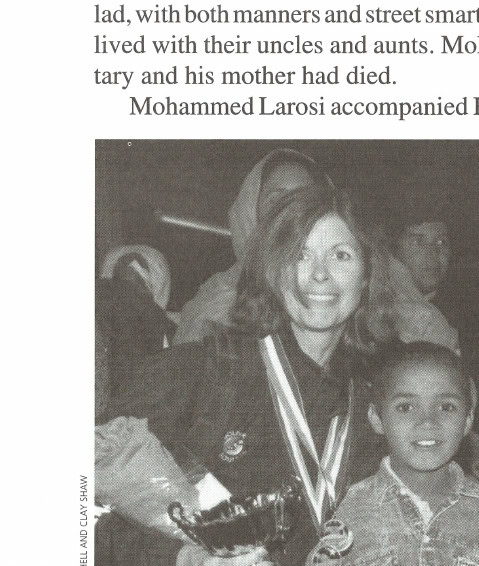
Mohammed Larosi Hassenna, an eight-year-old boy in the El Aaiun camp, became the focal point of the trip in an article written by one of our hometown newspapers. On arrival in El Aaiun, Karen and two other women moved to tent number 22, a lucky move, because this was the home of Mohammed Larosi. Karen and Mohammed Larosi quickly became friends. He was a good-looking lad, with both manners and street smarts. He and his brother, Ali Baba Hassenna, lived with their uncles and aunts. Mohammed Larosi’s father was in the military and his mother had died.
Mohammed Larosi accompanied Karen to the 25th anniversary parade and helped her find her way around the camp in the maze of adobe homes. Mohammed Larosi was especially proud when Karen was awarded third place in the marathon at a ceremony later that evening. Karen gave her marathon finisher’s medal to him.
Leaving Mohammed Larosi on the last day was difficult.
THE POLITICAL SITUATION
This brief history of the Republic is based on an interview with two Sahrawi men in the village of El Aaiun. Francisco Vargas, a Mexican native who lives in Texas, assisted in translation between Spanish and English.
Beginning in 1884, the area of Africa whose borders are the Atlantic Ocean, Morocco, Mauritania, and Algeria was known as Spanish Sahara. The people were called Sahrawis.
In 1975 Spain gave the northern part to Morocco and the southern part to Mauritania in exchange for 80 percent of its resources. On February 27, 1976, the Sahrawi people proclaimed the Sahrawi Republic. In 1978, desiring independence, the Sahrawi people attacked the capital of Mauritania. Mauritania backed off; however, the fighting continued with Morocco. Morocco, with assistance from French fighter planes, squashed the attack and the move for independence. Neighboring Algeria allowed the Sahrawi people to immigrate and become refugees in the Sahara Desert.
They have now been there for 23 years and number more than 180,000 people. About 85,000 other Sahrawis continue to live in the occupied territory claimed by Morocco and the Sahrawi Republic. According to Amnesty International, human rights violations have been committed against thousands of people in the occupied territory. Many of them have been jailed or tortured or have disappeared altogether.
The following is paraphrased from an e-mail by Jeb Carney, the race chairman:
Western Sahara is the last colonial possession in Africa. During the past 25 years, while the countries on the African continent have moved toward democracy, the struggle for the independence of Western Sahara has been mired in conflict because of Morocco’s claim to the former Spanish colony and its military occupation of two-thirds of the territory.
In 1975 the people of Western Sahara formed an independent state, the Sahrawi Arab Democratic Republic (SADR), which immediately became immersed in a two-front war for independence with Mauritania and Morocco. Mauritania withdrew from the territory and signed a peace treaty with SADR and relinquished its claim. Morocco, on the other hand, continued to pursue its claim to Western Sahara, despite a ruling by the International Court of Justice that denied the Moroccan monarchy any historical claim to the territory or people.
As a result, over 180,000 men, women, and children fled into the desert of neighboring Algeria to escape the advancing Moroccan forces. Four refugee camps were established under very difficult conditions and have been in place now for 25 years awaiting the outcome of the U.N.-sponsored referendum on self-determination. Today, even though Morocco has agreed to the protocol and substance of the referendum (most recently in Houston, Texas, through the mediation help of former Secretary of State James Baker), it continues to delay or protest all efforts by the United Nations and the Sahrawi to complete the referendum.
SADR ON THE WORLD STAGE
In the meantime, SADR has become a full member of the Organization of African Unity and pursued its peoples’ rights to self-determination. More than 75 countries now recognize SADR. Its greatest challenge is to raise awareness and vital humanitarian support for the refugees in the camps. The desert is unforgiving and provides little or no sustenance, resulting in a critical dependence on international food and medical aid for the refugees.
When the refugees arrived in Algeria, there was nothing but open desert with some underground saltwater deposits among the dunes and valleys. The refugees have relied on their desert Bedouin traditions to survive, coaxing saltwater gardens from the desert to feed the people and their herds of camels and sheep. Most food is shipped into the camps through humanitarian groups in Spain and the U.N. food program.
There are associations in Spain that take the children from the camps in the hot summer and distribute them to families, as well as provide medical aid to them. If aid stops even for a short period, the entire network in the camps becomes compromised and people begin to go hungry. In the face of renewed military tensions, the need to continue food and medical shipments to the camps becomes critical.
The Defense Forum Foundation, which briefs members of the U.S. Congress about issues on national security and human freedom, has been involved in this issue for six years. During a trip to the camps by a congressional staff delegation, it was suggested that the Sahrawi begin to participate in international sporting events to foster greater awareness of the situation. One such effort would be to build a running team, which could eventually compete in the Olympics. Another was to host a marathon to bring attention to the medical and nutritional needs of the refugee children. The first such marathon was planned to be held in conjunction with the 25th anniversary of the founding of SADR. More than 20 countries were represented in the marathon.
Although the situation remains precarious, the U.N. peace process still creates hope for a successful, free, and fair referendum for the people of Western Sahara and for peace in the northwestern African region.
OUR CONCLUSIONS
In retrospect, this was the toughest marathon we have ever run, mainly due to the strong winds and the soft sand. As race organizer Jeb Carney stated before the carbo dinner, “This is not a marathon in London or D.C.” This was quite an understatement, but Jeb seems not to want to describe the marathon as being the toughest. Truthfully, it’s an adventure run like no other.
Race Results
Women:
- 1st Monserrat Calvo Valverfu, Spain, 4:55:14
- 2nd Rute Sousa, Portugal, 5:01:11
- 3rd Karen Mitchell, USA, 5:13:26
Men:
- 1st Ouail Raban, Algeria, 2:59:03
- 2nd Juan Carlos Montero, Spain, 3:16:56
- 3rd Hanani Brahim, Sahrawi Republic, 3:16:56
Would we run it again? We’re always interested in going to new places, so the answer is probably no. But we would go back in a heartbeat to see the people and try to help them if possible. Would we recommend this trip and event? Definitely, but it’s not for wimps or whiners.
The marathon was a catalyst to bring many runners to the Sahrawi people, and the fondest memories of this event will be the privilege of sharing four days in the desert with the people of Smara and El Aaiun. These wonderful people were among the most hospitable we’ve ever met, and we will never forget them.
This article originally appeared in Marathon & Beyond, Vol. 6, No. 4 (2002).
← Browse the full M&B Archive1,000+ stories from 19 years of Marathon & Beyond
The complete archive of the legendary long-distance journal — digitized and free to read.
