

Accessing The “Zone”
“You can be anything you want to be, Just turn yourself into anything You think that you could ever be . . .” “Innuendo,” Queen
The last two miles of the four-mile run fly by like a whirlwind. Following a train of thought only his body understands, the runner, feeling isolated, stays on track for a PR. The straight, out-and-back course becomes a tunnel shielding the athlete from the outside world. While acutely aware of all his senses, he barely feels his feet touch the ground. For several moments, nothing else exists but the task at hand. He has reached the nirvana of all athletes: the zone. He smashes his course record with a time of 20:07 in this solo time trial.
Sir Roger Bannister, who in 1954 became the first man to break the fourminute mile, described similar sensations felt during his record run in his book, The Four-Minute Mile: “No longer conscious of my movement, I discovered a new unity with nature. I had found a new source of power and beauty, a source I never dreamt existed.”
Dr. Bannister’s description of “the zone” paints a vivid, accurate picture of what I felt in my aforementioned time trial and countless other races and training runs in which barriers were broken and breakthroughs achieved. It is well documented that Bannister, his coach, and his training partners truly believed years in advance that he could run a 3:59.4 mile.
This audacious self-belief, enhanced by vivid visualization and relaxation, is a key to accessing the zone. Despite the seemingly mythological status of this athletic nirvana, most athletes can reach this state of consciousness and unlock their full potential.
Long before he became governor of California, Arnold Schwarzenegger utilized this mind-set to become the greatest bodybuilder of all time. “The mind is the limit,” the “Governator” once proclaimed. “As long as the mind can envision the fact that you can do something, you can do it, as long as you really believe 100 percent.”
Or, as Jedi Master Yoda told Luke Skywalker, “Try not! Do, or do not. There is no try.” Very early in my 37-year running career, these lessons became clear. During my first high school cross-country season, I was rewarded for my hard-won success with a spot on the varsity team of Mesquite High, a 5A Texas school— heady stuff for a sophomore who was an average track runner his freshman year. Coach Pat Mitchell’s “Skeeters” were a perennial cross-country and track powerhouse in the 1970s and ’80s, boasting a lengthy list of district champions and regional and state qualifiers.
Less than hoped-for performance But my inexperience showed in the countdown to one of the toughest district meets in the state, and I overlooked a couple of meets before it and posted subpar performances.
This failure to focus got me bumped down to the junior varsity squad for the district meet, which infuriated me. But Coach Mitchell in his wisdom dangled a carrot in front of my relentless appetite for competition: run well enough and get promoted back to varsity for the regional meet.
I vowed a better result, guaranteeing that I would obliterate all comers in the JV field. Although I was brash, my heavy training base gave me the confidence to do my Joe-Namath-atSuper-Bowl-III impersonation. As Broadway Joe said, “If you like to win but don’t think you can, it’s almost a cinch you won’t.”
Photo by Ralph Dryk
▲
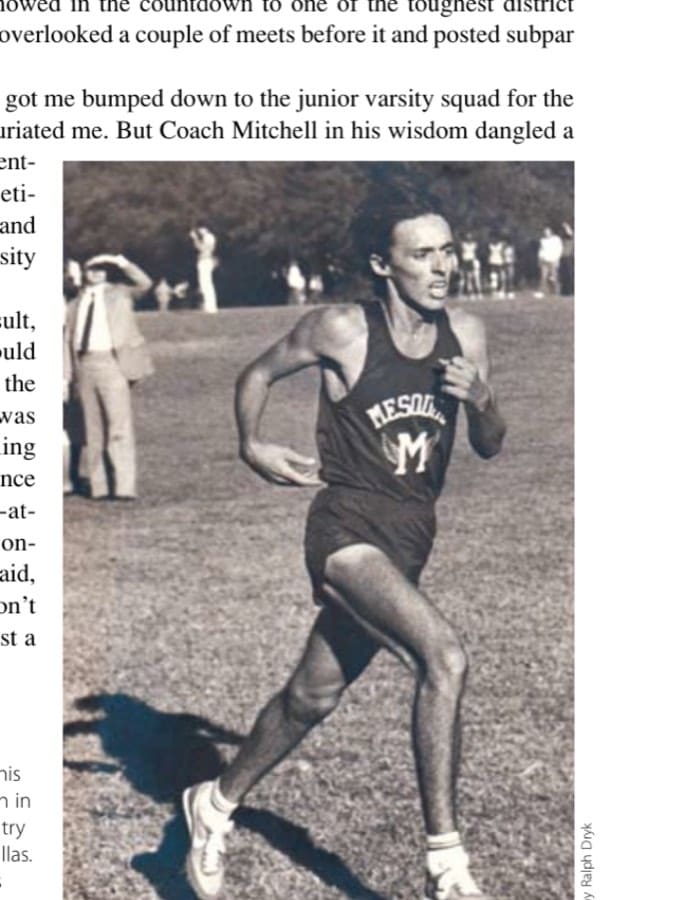
Ron McCracken powers his way to a second-place finish in the 1980 district cross-country meet at Norbuck Park in Dallas. The race established him as one of the top high school runners in Texas.
The lessons of that autumn afternoon at Dallas’s Norbuck Park still resonate. As promised, I led the race from start to finish. My 9:57 on the painfully hilly two-mile course would have placed me in the top five of the varsity race and second to only one teammate, senior Ronnie Foster.
Focus found, lesson learned. My foray into the zone transported me back to varsity. The race itself was a blur and remains so, which brings us to the problem of how to access this key to athletic performance.
One thing I do recall with razor clarity is how relaxed I was in this and other top performances through the years. Relaxation breeds focus, and again, just as Dr. Bannister and Yoda said, focus and self-belief are the keys to the kingdom. And you don’t have to run a world record or become a Jedi Master to employ these tools.
We are talking about maximizing potential, whether you are a three-hour marathoner or an Olympic contender. This connection between mind and body in physical performance is examined in a gem of a book published in 1984, Peak Performance: Mental Training Techniques of the World’s Greatest Athletes, by Charles A. Garfield and Hal Zina Bennett. The book details the efforts of Soviet sports scientists to examine and document this phenomenon.
In the 1970s, Stanley Krippner, PhD, a psychology professor, journeyed to the Soviet Union to study his counterparts’ research on the development of “human reserves” and “latent human possibilities.”
By studying the work of leading sports psychologist Alexander Romen, Dr. Krippner concluded that Dr. Romen’s mental-training methods were successfully used to “combat anxieties and fears, to imbue the athlete with confidence, to role-play successful competition, to prevent ‘prestart fever’ and nervousness, and to provide athletes with a way to rest deeply before and between meets.” He reported that athletes were able to “accelerate their reaction times” and “relieve fatigue” through relaxation and mental imagery.
Mental resources from the East Dr. Romen and his associates learned about the human reserves of energy: “ki” in Japan, “prana” in India, and “chi” in China. More important, they learned how to access these powers, which facilitate near-miraculous physical performances in judo, karate, and other sports. The Soviet doctors discovered, to their surprise, that these meditation techniques were not limited to religious devotees but sprang from a state of relaxation known to the medical profession for years. “
The same results achieved in the martial arts through meditation could be attained using deep relaxation systems developed by German psychiatrist and neurologist Johannes H. Schultz of Berlin and by American physician Edmund Jacobsen,” wrote Garfield and Bennett in their insightful book.
Way back in 1942, Dr. Jacobsen documented the links between emotions and muscular responses. When a subject merely imagined himself running, subliminal stimulation of the same muscles used in running were electronically detected.
Back to “the Terminator” for more on the power of visualization: “A pump when I see the muscle I want is worth 10 with my mind drifting,” Schwarzenegger said. The former Mr. Olympia developed a mind-set of risk taking that constantly pushed his limits, resulting in greater performances and eventually movie stardom and a seat in the governor’s office. Shortly after his first election, Big Arnold explained the folly of self-imposed limits on sports or life. “Let’s say you’re lifting weights all the time and you can bench-press 490 pounds. But you don’t try to lift 500 pounds because you don’t think you can. How do you know if you don’t try?”
Another famous ruler concurred with Schwarzenegger on this point. “Impossible is a word to be found only in the dictionary of fools,” declared Napoleon Bonaparte. Kenyan running great Ben Moturi, who dominated the Texas road racing scene in the late 1970s and early 1980s, taught me a similar lesson about the mistake of placing limits on yourself. In 1981 and ’82, I witnessed Moturi’s magnificent talent and dedication on daily training runs during my freshman year at North Texas State University in Denton. From way behind, of course, I saw Ben (then a graduate student) push himself to the limit frequently.
He reminded me of the value of dedication a few years later after I ran a subpar five-mile road race. After hearing of my disappointment, he gave me a lesson worthy of Lance Armstrong or Michael Jordan. “How hard have you been training?” he asked in his inimitable, gentle African lilt. When I detailed the haphazard quality of my recent workouts, Moturi looked at me very sternly. “You have to train hard every single day. Every single day!” he exclaimed with his finger pointed at me. “You cannot come out one time and win!”
This relentless attitude rewarded Moturi with a 10th-place (2:17) finish at the 1982 Boston Marathon, the grueling “Duel in the Sun” in which Dick Beardsley and Alberto Salazar ran each other into the ground and immortality on a hot and sunny Patriots’ Day.
Let your feet do the talking Moturi was long past his prime in the 1990s, when I witnessed (from behind, again) him running half-marathons in 1:12 and 15Ks in 46 to 48 minutes well into his 40s and 50s. When I asked him after his 1:12 half-marathon performance whether he had attained his time goal, he looked at me very strangely. But then he smiled, and pointing at his feet for emphasis, he told me in his soft accent, “I never set a time goal. If you have a time goal, then it is like you are running with a clock on your feet. Then you are watching that clock instead of racing as fast as you can.”
In other words, put away the heart rate monitors, stopwatches, iPods, cell phones, and other electronic distractions that rule our lives. Coach Mitchell and my other high school coach, Doug Robinson, constantly reminded us that if we ran hard and competed, then fast times would follow.
Seriously, a look back at the lion’s share of my best runs from the mile to the marathon reveals a striking absence of split times. And what do times matter if you are pushing yourself to the limit? Quick, what was Frank Shorter’s winning marathon time at the 1972 Munich Olympics? Joan Benoit Samuelson’s gold medal time in 1984 at the Los Angeles games? Sure, a few running nerds know, but most of us dweebs remember only the golden performances. Bet the bank, too, that Shorter and Samuelson really did not care what their times were. I have yet to hear a gold medalist say, “Yeah, it was OK to win, but I wish I had run 30 seconds faster.”
One of my own “gold medal moments” came at the Artfest 10K in Dallas in 2000. The Memorial Day weekend event illustrated how weather conditions can make times irrelevant. As usual, the searing Texas sun quickly made the early-morning race insultingly hot: 90 degrees with humidity hovering around 90 percent. What to do? Just shut up and run, one of my old training buddies likes to say to whiners.
Remembering Ben Moturi’s wise words, I did not look at my watch nor note a single split from start to finish. It quickly became a two-man race between me and a friend who had run a 2:35 marathon in Chicago the previous autumn. Complaining of the heat and the pace, he caved around mile four. I went on to win in 36:30, a good three minutes slower than my PR on the course I had run a dozen times since 1979—but this was my first win at this event, at age 37. Look, Mom, no clocks!
Contrast my single-minded focus with my talented friend’s negativity. He was listing the problems of the day while I was just running my tail off. And,
ad
yes, the conditions were mean and miserable. But focusing on things out of our control drains both mental and physical energy from an athlete, thereby blocking access to the zone. Martial arts king Bruce Lee employed specific mental imagery to rid himself of negative thoughts, according to Peak Performance. “When such a thought enters my mind, I visualize it as being written on a piece of paper. Then I visualize myself wadding the paper into a tight ball. Then I mentally light it on fire and visualize it burning to a crisp. The negative thought is destroyed, never to enter my mind again.”
After purging negative thoughts, replace them with positive thoughts. A mantra, quotes, or song lyrics that overflow with positivity are strongly recommended. I’ve used the lyrics from Queen’s “Innuendo” to successfully access the zone in dozens of races and workouts.
Take a good, long look in the mirror Can’t recall his name, but in the 1990s I read about a national-class American marathoner who used these techniques to dramatically improve his times. “Every day I look in the mirror and tell myself ‘You are the greatest marathoner in the world’,” he told Runner’s World magazine. He never won a world title, but his marathon PR dropped from the low 2:20s to 2:13 in about two years.
Olympian wunderkind Michael Phelps provided a more recent example at the Beijing Olympics while setting seven world records on the way to eight gold medals in swimming. “When you put your mind to something, and you really focus on doing it, anything’s possible,” he said, echoing the Schwarzenegger philosophy.
The Olympics always rekindle memories of the early days of my running career, originally fired by Shorter’s gold medal triumph in Munich. Just shy of age 10 and armed with a shiny new stopwatch, I measured off a mile around my block and ran headlong around it at least three or four days a week. I didn’t understand (or care) that no one sets a PR every time. I was furious with myself if I didn’t set a record every single time. Thus, a ferocious competitor was born.
In a few short years, I ran a sub-6:00 mile for the first time. The memory of the solo time trial on the cinder track at McDonald Middle School still burns brightly. A mid-January arctic front tends to leave an impression on the skin and the brain. And all my brain was thinking was faster, faster, faster, ignoring the subzero wind chill. I can still picture the bank clock off in the distance: 11 degrees. The 5:58 on the stopwatch warmed me up.
That relentless, focused kid still shows up at my best races and workouts, urging me on. “Faster, faster, faster,” he screams, not giving a rip about split times or pain. He knows the way to the zone. He has the keys to the kingdom.
This article originally appeared in Marathon & Beyond, Vol. 13, No. 5 (2009).
← Browse the full M&B ArchiveMore like this
1,000+ stories from 19 years of Marathon & Beyond
The complete archive of the legendary long-distance journal — digitized and free to read.
