

Anatomy Of Adnf
Matias Saari
DNF. Those three letters of apparent ignominy have happened to Bill Rodgers, Amby Burfoot, both Johnny Kelleys, and untold thousands of unknowns. In the 107th Boston Marathon, the dreaded Did Not Finish happened to me.
A DNF doesn’t just happen, however, nor is it deserving of disgrace or shame. There are myriad reasons why a runner drops out of a marathon, and I had plenty of company at Boston in 2003. Of the 20,223 entrants, 537 runners started the race in Hopkinton but did not cross the finish line on Boylston Street, and 2,656 were no-shows. And of the surprisingly high 97 percent who persevered, many surely contemplated an earlier cessation to their suffering. For a runner in distress, a DNF can be a difficult yet prudent decision. It also makes a more compelling story than “I ran Boston and everything went just great.”
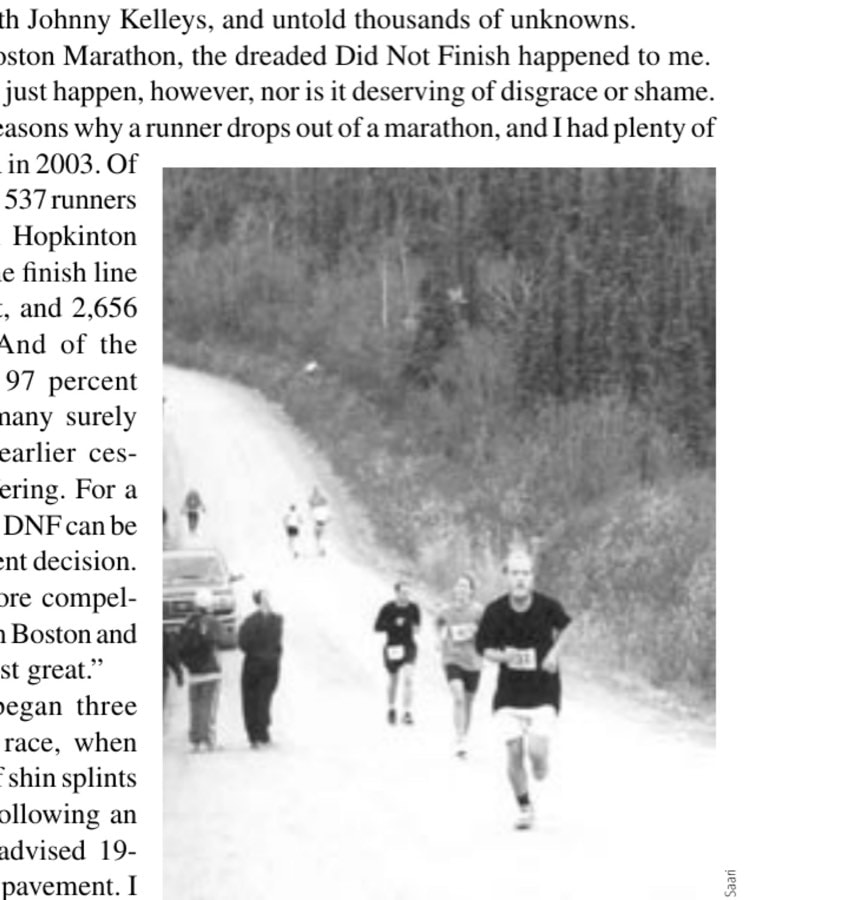
My troubles began three weeks before the race, when the first evidence of shin splints manifested itself following an (in retrospect) ill-advised 19mile tempo run on pavement. I had nearly completed the most strenuous training program of Seventeen miles into the 1998 Equinox Marathon, my young running career—with my first marathon, and shortly before I cramped up. I mileage peaking at 78 miles one struggled to finish in 3:49.
week—and was forced to back off more than intended during my taper. But the shin splints intensified. In the two weeks leading up to Boston, I ran all of 14 miles, including a painful and discouraging three-mile jaunt 72 hours before the race that left me seriously doubting my ability to go the distance on race day. I spent much of the final fortnight resting, applying ice and heat, popping ibuprofen, and praying my right shin would heal.
READY TO KICK DOWN MY PR
Matias Saari
Physical complications aside, my expectations going into the race were high. I was in the best shape of my life and had completed eight 20-mile-plus training runs, most at a pace faster than seven minutes per mile. I was confident. In train
ing I had hung with, even pushed at times, a Fairbanks friend (Kevin Brinegar) who was accustomed to finishing in less than 2 hours, 35 minutes at Boston. Our group had trained through an interior Alaska winter, overcoming darkness, subzero
temperatures, and poor running surfaces. I was also determined to atone for what I considered a failure in my first Boston attempt two years earlier: in that race, I perhaps ran too aggressively based on my conditioning and bonked—experiencing
both mild vertigo and severe cramping—before shuffling to a 3:13 finish. This time I knew I was capable of shattering my marathon PR of 2:51. My Patriots’ Day strategy was to at first run conservatively and gauge whether
the shin could last 26.2 miles. Clocking an average 6:52 pace over the first three miles, I was elated that—thanks possibly to anti-inflammatories and painkillers—it felt fine. So I sped up. But soon the effort for 6:20s felt
like that of six-minute miles. My heart rate soared to more than 90 percent of maximum, a number I questioned as accurate because it was so out of line with my breathing rate and running pace. I sweated profusely in the breeze and 70
degree heat, guzzling fluids and dumping water on my head. I couldn’t understand why a pace that had felt relatively routine in training was so difficult now. Mentally I was a train careening toward a wreck.
Soon I adjusted my prerace goal of sub-2:45 to about 2:50. I tried to settle into 6:30 miles. But it only got shockingly
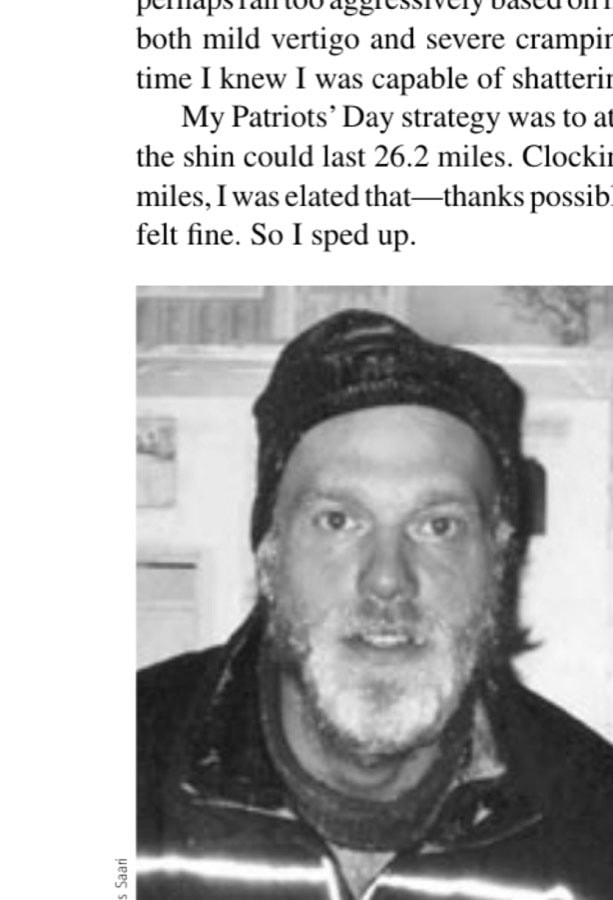
Here I am in 2002, after a winter training run in Fairbanks, Alaska.
harder. I passed halfway in 1:25:10 knowing I couldn’t repeat that split but too stubborn to slow down further. I figured, or hoped, I could gut it out. Along the way, the wind picked up. Having started in the fourth corral thanks to my qualifying time (a disappointing 3:07 run three months earlier in Charlotte, North Carolina), I weaved through and around hundreds of runners but found no one running my pace to tuck behind for relief from the breeze.
Though I had trained regularly on rolling pavement to simulate Boston’s course, my quadriceps were becoming thrashed. Then, around mile 17, my right hamstring tweaked. Despite knowing this likely foreshadowed a full-blown cramp, I ran on without stopping to stretch.
At 19 miles, and after 2 hours, 6 minutes, disaster struck: the hamstring, hardly surprisingly, seized. I attempted to stretch and compose myself—but essentially conceded mentally—then slowly resumed running. A half mile later, the hammy again went into spasm.
THE MOMENT OF DECISION Rendered hamstrung, decision time was upon me. Do I trudge through a runcramp-walk cycle for seven agonizing miles? Or do I drop out, thereby speeding my recovery and lessening further risk of injury? I chose the latter, primarily because my lofty expectations meant that trudging to the finish would have been just as disappointing as, and decidedly more painful than, my first DNF. Plus, I had finished Boston once before and knew there would be other chances.
I stepped off the course and began walking toward friends from Watertown whose family had for several generations cheered from a sadistic spot near the crest of Heartbreak Hill that had undone so many runners. When I approached, they were more than surprised to see me traveling along the sidewalk. Suddenly I was no longer anonymous and had to tell my secret. The weight of the disappointment flooded over me, and I was soon inconsolable. Shortly thereafter, George, the brother of one of my Fairbanks training partners and my host in Watertown, and I walked to a nearby Red Cross medical station where I hoped to catch a ride to the finish line.
Adding insult to injury, the journey by foot and subway to the finish area took well over two hours, a patience-testing marathon in itself. I could have walked to the finish line faster, for once I stopped running, brisk walking was surprisingly manageable. But after the Red Cross told me that only one other runner needed a ride and I might have to wait several hours, I walked down the hill to the subway station at Boston College (halfheartedly sticking out my thumb to passing vehicles), where I pleaded my way on for free because I carried no cash. However, the Green Line’s circuitous milk-run route took seemingly as long to negotiate five miles as I had to run 19. Finally, I disembarked into a mass of
humanity near mile 26, fighting my way to the finish area only to get hopelessly mired in the family meeting area. By then, I was frustrated as much by the travel ordeal as I was by the botched marathon. Eventually I worked my way to Clery’s bar, my friends’ traditional unwinding spot near the finish. I endured 15 minutes in line, then after some searching located my training partners in the packed bar. They had guessed the result of my race but not its cause, suspecting shin splints. First I found out how they had done: 2:39, 2:55, and 3:07, respectable, though for them unsatisfactory times, as their Boston PRs were six to 27 minutes faster. Like most others, they had run considerably slower than hoped for. While struggling in the deceptively difficult conditions, I hadn’t realized the feeling was mutual for so many. (Later we were elated to learn that Brinegar’s 2:39, though six minutes slower than his 2002 effort, achieved 51st place overall among men, a personal best at Boston.)
ANALYZING THE EVENT, AND THE AFTERMATH Soothed by pints of ale and stout, I began an earnest search for answers that would continue for months. Did my legs rebel after the two-week layoff? Should I have compensated further in view of the unfavorable conditions and how poor I felt?
Should I have heeded my irregular heart rate readings? Was taking Vioxx, a prescription anti-inflammatory, for the first time in my life (along with extra-strength Tylenol) a mistake? Could a strengthening and stretching regimen limit future cramps and injuries?
Was I somehow inherently prone to cramping? Why didn’t I stretch the hamstring when I first felt it twinge? Had I adequately hydrated and fueled? Did I make training mistakes, such as running too often on pavement and going too hard on long runs?
Had I overestimated my conditioning and abilities, chosen too ambitious a goal pace, and selected the wrong marathon (a notoriously difficult one) to attempt a PR? Only three questions could I confidently answer right away. One, was I demoralized about the DNF? Not exactly: within hours, my reaction evolved from being upset to angry to disappointed to having a greater resolve. Two, did I regret the decision? No, I felt, and still feel, that given the circumstances I made the right choice. And three, will I run Boston next year? No, but perhaps in 2005.
The other questions required further examination, but talking (and later writing) about them proved cathartic. By determining causes of adversity, I hoped to
minimize them in the future. I’m certainly no proponent of the DNF and wish to never drop out again. But put in perspective, a DNF is just one race in a runner’s portfolio. I returned to Alaska with crumpled bib number 4012 signed by Amby Burfoot with the advice, “Run long & healthy,” and by Johnny A. Kelley, then 95 years old, who had done just that. Research revealed that Burfoot, Boston’s 1968 winner, DNF’d five years later at mile 21. And Kelley dropped out in 1928, 1932, and 1956, but completed the race an astounding 58 times. He donned the laurel wreath twice, the first time in 1935 after vomiting at Kenmore Square, the second time a decade later.
Meanwhile, on a nail in my cabin hangs my Boston 2001 finisher’s medal attached to a bib autographed by 1972 Olympic gold medalist Frank Shorter, who managed just 23rd and 75th in his Boston attempts, and by hometown hero Bill Rodgers, who DNF’d after Heartbreak Hill in 1973 and 1977 but four times was crowned champion of the world’s oldest and most famous marathon.
It’s reassuring that we DNFers have such reason for hope, and travel in such good company.
EPILOGUE As with many human-caused disasters, my DNF had a slew of contributing and compounding factors, and I spent considerable effort and anguish after Boston 2003 seeking to determine exactly what had gone wrong. It wasn’t until four months later that with help I made an illuminating discovery. I had gone to a physical therapist to be fitted for an orthotic that would help offset my severe pronation. She watched me run a short straightaway and within seconds noticed several mechanical deficiencies, the most important being an inordinately high back kick, where my lower leg lifted 18 inches above the ground and virtually parallel to it. For a sprinter or even middle-distance runner, this is not unusual; but a marathoner’s most efficient gait is essentially a power shuffle with a low back kick. Instead I was engaging my hamstring to hold my leg up on every stride. “I’d be shocked if you didn’t cramp in a marathon,” Heini, from Finland, told me. And the Finns, boasting legends like Paavo Nurmi and Lasse Viren, know their distance running.
This revelation came just 25 days before my first marathon since Boston, September’s Equinox Marathon, which includes a cumulative elevation gain of 3,000 feet. I consciously worked at lowering my back kick and forced myself to run a style contrary to what had become ingrained. Days later I celebrated an epiphany of sorts when late in a 23-mile training run I realized I could still run fast and long while keeping the back kick lower. On race day, I had my best Equinox by 14 minutes, finishing second to Brinegar and holding hamstring cramps at bay,
Marcus Dammayer
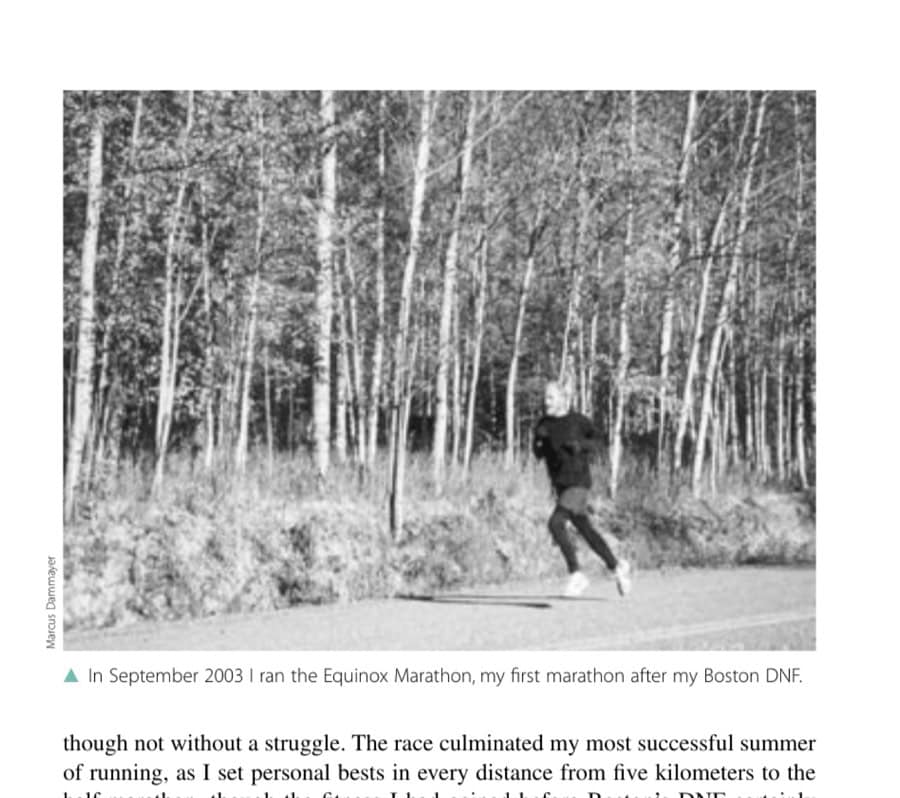
In September 2003 I ran the Equinox Marathon, my first marathon after my Boston DNF.
though not without a struggle. The race culminated my most successful summer of running, as I set personal bests in every distance from five kilometers to the half-marathon, though the fitness I had gained before Boston’s DNF certainly
helped. While I’m not so naive as to believe that training injuries, race-day issues, cramping problems, and even DNFs are behind me, Boston 2003 helped me assess what was going well in my running life and what needed improvement and change.
I also gladly held to my knee-jerk reaction of taking at least a year off from Boston and enjoyed a winter of cross-country ski-marathon racing instead. When Patriots’ Day 2004 rolled around, part of me longed to be in Hopkinton alongside
my Fairbanks friends, though I was also thankful to have avoided the 85-degree heat and the resulting carnage. But I can accept a Did Not Enter, learn from my Did Not Finish, and know there will be other Boston Marathons for me, ones I
hope to run with a little more humility, wisdom, and speed. Postscript: Saari recently clocked 2:54 at the Cape Cod Marathon, qualifying him for the 2005 Boston Marathon, which he plans to run—and finish.
This article originally appeared in Marathon & Beyond, Vol. 9, No. 1 (2005).
← Browse the full M&B ArchiveMore like this
1,000+ stories from 19 years of Marathon & Beyond
The complete archive of the legendary long-distance journal — digitized and free to read.
