

First, a confession: I am addicted to racing, and the time of year is irrelevant to me. Unless a race is canceled because of snow or some other unusual circumstance, if I am registered, I will go. My calendar is full year-round. That said, I have discovered that the autumn months of September, October, and November are filled with a bounty of wonderful marathons.
There are many reasons why autumn is prime racing season. Children return to school, vacation time is over, the weather generally cools, and there is a brief respite before winter holiday madness takes over. Race directors must understand this, because the autumn months are filled with marathons to pull you in and entice you to ramp up your training. It’s a great time to sign up for one or more races.
This certainly explains why autumn is a great time for racing; however, there are still some drawbacks that runners should consider. One is training. While the hot weather of summer recedes during the fall, most training plans are 12 to 16 weeks long. This means that training must begin during the warmer months when heat and humidity may still be a problem.
Another important consideration is timing. Popular races fill extremely quickly—certain races require planning almost a year in advance. Unless you qualify as an elite or through special dispensation, races with lotteries like New York City and Chicago require getting your name in the hat as soon as registration opens. It is critical to plan ahead for these races and to have backup plans in place if you don’t make entry through the lottery.
Expenses are another factor, especially if you are traveling some distance to the race. Of course, money is a factor regardless of time of year. However, because many of the larger well-attended autumn races are held in major cities with pricey hotels, the expense can be significant.
The choices: Something for everyone Whether you like your races small and intimate, large and impressive, or somewhere in between, there are marathons designed to meet your needs. I have divided
my favorite autumn races into the following categories by size: small (under 1,000 participants), medium (between 1,000 and 10,000 participants), and large megamarathons (more than 10,000 participants). My own preference is for races in the middle range, with around 5,000 participants, but I also enjoy the special distinctive features of very large and much smaller races as well.
Once you have decided on the preferred size of your race, there are several other things to consider before you register. While it is impossible to accurately predict the weather, looking at previous weather conditions can give you some idea of what to expect. Don’t rely on this too much, but use it as a general gauge. If you intensely dislike cold weather, stay away from the Midwest and New England in November. Be prepared for the unexpected. Nobody knew that Chicago in 2007 would be abysmally hot, causing the marathon to be cancelled midrace.
Also consider the distance from your home and other transportation and travel factors. Do you want a race close by that you can drive to, or are you planning to fly? Some smaller airports are more economical than big-city terminals (think Midway versus O’Hare). It’s also important to consider the ease of getting to the race start and finish, hotel availability, need for rental car, shuttle, or taxi, and other expenses.
In addition to weather and travel logistics, ask yourself how important each of the following is to your overall enjoyment of the race: • Number of runners—Do you prefer to be surrounded by people, or would you
prefer space to be alone with your thoughts? • Locale/atmosphere—Rural or urban, country or city? • Course type—Loop (or double loop) or point-to-point? Paved or trail? Fast and flat or hilly and challenging? • Spectators—Cheering crowds or birds and wildlife? • Expo—Massive with lots of vendors or simply a place to get your bib and T
shirt? (At larger expos, I look forward to some serious shopping and budget accordingly.) • Medal—Sizes and designs often vary from year to year, but some are traditionally large and impressive while others are small and almost an afterthought. • Time limit—Do you need extra time on the course? If so, is there an early start? • Associated races—If there is a half-marathon or 5K or 10K, will other family
members want to run? • Entertainment—Larger races usually have nonstop bands and musical groups; some races prohibit the use of iPods, so if music is critical to your enjoyment, find out beforehand.
On to the races! Let’s start with the biggest first Big races—you either love them or hate them. If you are convinced that bigger is better, there are two autumn marathons that fit neatly into the large category: New York City and Chicago. These are also included among the six World Marathon Majors (the others are Boston, Tokyo, Berlin, and London). Because of their immense popularity, both races require a good deal of advance planning. Consequently, if you have a burning desire to run NYC and/or Chicago, start early and have a backup plan in case you don’t get in.
New York City Marathon With more than 50,000 runners and walkers, the New York City (NYC) Marathon, held on the first Sunday in November, is the largest in the world. Getting into the race is almost as hard as running it unless you qualify or are extremely fortunate. I made it on my first try, so it is possible. One workaround is to commit to raising money for a local charity; this often brings additional perks like training programs and special tents at the start. The registration lottery usually opens in mid-January and remains open until the middle of February. Check the website (www.tcsnycmarathon.org) for dates and the latest information.
In 1970 Fred Lebow and Vince Chiappetta first came up with the idea of a New York City Marathon. The 127 entrants paid $1 apiece to run 26.2 miles in Central Park; only 55 finished. The race expanded both geographically and numerically in 1976, thanks to the efforts of Lebow. The course at that point went through all five boroughs and had more than 2,000 runners. Obviously, Lebow was on to something; unfortunately, he died of brain cancer in 1994, but he was able to complete the race one last time in 1992. Race numbers have increased dramatically over the course of the race’s history. Winners have included such superstars as Bill Rodgers, Grete Waitz, Alberto Salazar, and Meb Keflezighi.
Once you’ve found out you have been accepted into NYC, it’s time to figure out logistics. It’s important to decide how to get there (LaGuardia? Newark?), where to stay (a host hotel? Airbnb?), where to eat, and how to spend your free time. You may want to opt for a four-hour motor-coach tour of the course or the prerace pasta dinner. Both require a fee ($40 and $30 respectively in 2015) and advance reservations, so it’s important to act quickly.
The good stuff: • The point-to-point course is not flat, but there are only a few major hills; however, some of them are in the later miles, so reserve some energy. • Because the course takes you through all five boroughs from the start at Fort Wadsworth on Staten Island through Brooklyn, Queens, and the Bronx, to
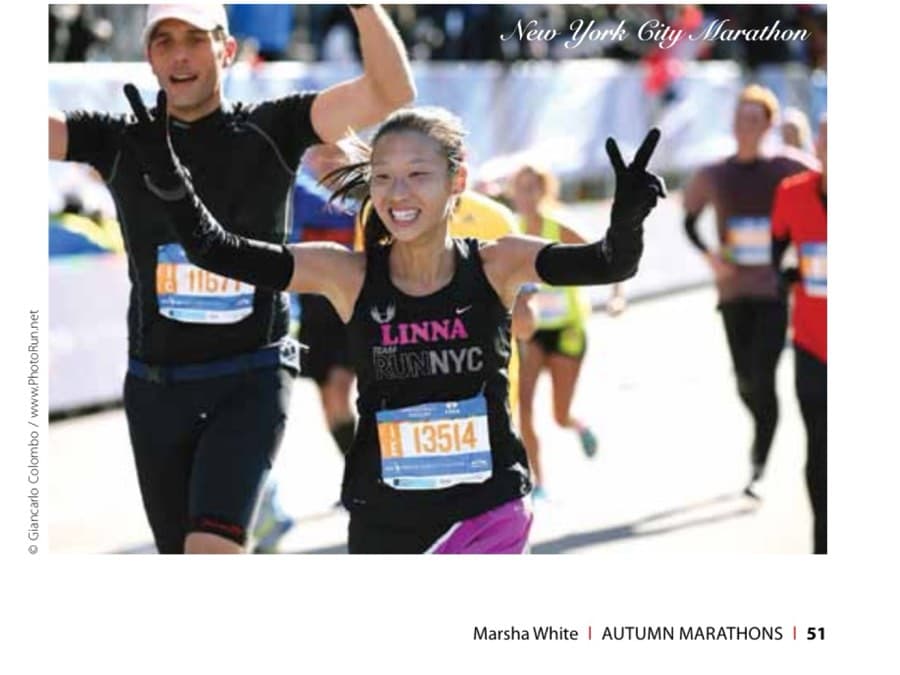
the finish line in Central Park in Manhattan, you will see a microcosm of numerous ethnic and religious neighborhoods. I enjoyed wandering through the quiet Hasidic community in Williamsburg, crossing the 59th Street Bridge, and viewing the skyline with the skyscrapers of Manhattan in the distance. • There is enormous crowd support. If a million cheering fans are crucial to your enjoyment of a race, you couldn’t choose a better marathon than NYC.
The not-so-great: • You will be spending long hours at the start village on Staten Island in unpredictable but usually cold and windy weather. • Thousands of participants means the course is very crowded for most of the race. • Aid stations are crowded as well. Be prepared to wade through tons of discarded cups and gel packs. Volunteers simply can’t keep up with the sheer volume of detritus. • There is a long walk after you cross the finish line to get your belongings and meet up with family. Central Park is very congested, so decide on a meeting point beforehand.
© Giancarlo Colombo / www.PhotoRun.net
• Marathon registration is expensive and so is almost everything else in New York. Budget for it.
Some hints: • Consider staying at a Staten Island hotel and taking a taxi to the Marathon Village. This will help minimize the long wait at the start. A bunch of us grabbed a cab just an hour before our start time. (If you do this, get a Metro card and
use the bus, ferry, and subway to wander around Manhattan and play tourist on race weekend.) • Dress in layers and throwaway clothes and bring something to sit on before the race. • If you don’t eat at the official pasta dinner, be sure to make dinner reservations
somewhere. Restaurants are packed on the weekends. • Try not to do too much sightseeing before the race. Your legs will thank you. • Wear a costume. People will definitely notice. Or carry a funny sign or write
something humorous on your shirt—anything to draw the attention of spectators, who will respond with cheers. I liken it to the London Marathon for its sheer party-like atmosphere. • Relax and have fun.
Bank of America Chicago Marathon I admit I had reservations about signing up for this race. I had always thought of Chicago as just a big Midwestern city with nothing very special about it. I was so wrong! Chicago is a great place to visit, and the race is lots of fun. I entered in 2009 (before the lottery) and was immensely impressed with the race and the city.
Until recently, all you had to do to enter Chicago was to watch for the opening of online registration. Nowadays it is not that straightforward. The race has become so popular that unless you qualify for a guaranteed entry, you must apply through the lottery, which runs for six weeks beginning in March. Dates and times are announced in February on the race website (www.chicagomarathon. com). Unlike NYC, there is no fee to enter the lottery, and if chosen you have a week to accept and pay. To avoid the lottery, you must have a recent qualifying finishing time, be a legacy finisher (more than five Chicago Marathons within the past 10 years), or raise money for an official charity.
The original Chicago Marathon can trace its roots all the way back to 1905, but the contemporary race dates from 1977 when it was called the Mayor Daley Marathon. As the NYC Marathon began to grow, so did Chicago, and the two began to vie for runners and popularity. Today, Chicago consistently attracts around 40,000 participants. It is usually held on the second Sunday in October.
Organization of the race is first-rate and geared to runner needs. An expansive expo at McCormick Place makes for easy packet pickup, and dozens of vendors will tempt you with both goodies and essentials; free shuttles from downtown
© MarathonFoto.com
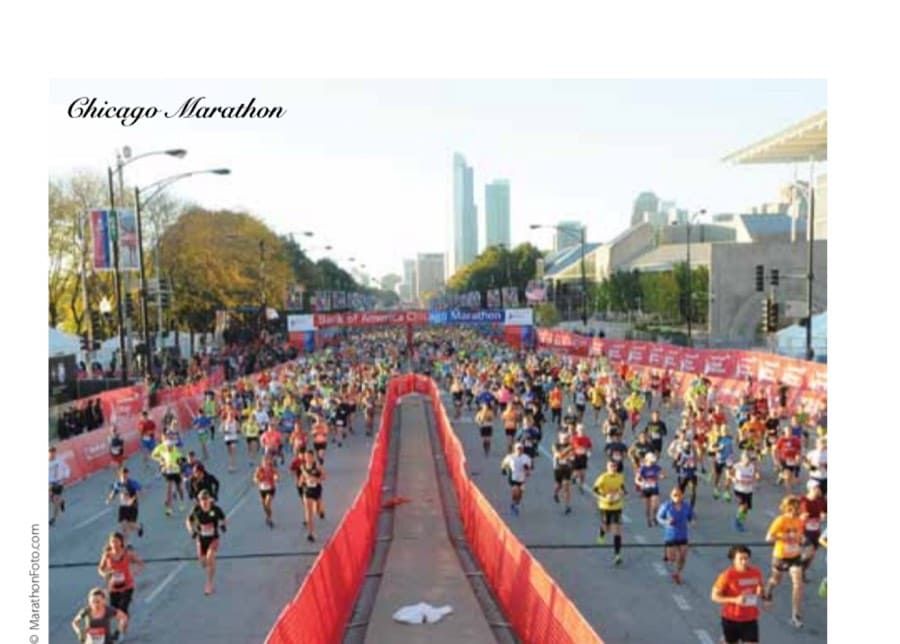
hotels make getting to and from the expo an easy task. Since the loop course begins and ends in Grant Park, near dozens of hotels, logistics are simplified.
The good stuff: • The course is flat and very fast, with only minor inclines on bridges and one relatively steep hill at the end. • Interest never wanes because the course showcases 29 distinctive neighborhoods, each with its own special flavor. • Spectators and volunteers are enthusiastic and energetic; their cheering makes the miles fly by, and there is a tremendous carnival atmosphere. • The race is big news locally and is well supported by the city and its people. Media as well as the average citizen are extremely supportive and knowledgeable. • The 20 well-supplied aid stations are several blocks long and consistently arranged.
The not-so-great: • With so many runners, and many first-timers, the course is extremely crowded, especially in the early miles. Don’t expect to attain your goal pace for a while. • Be wary of potholes, banana peels, and other slipping and tripping hazards.
• Weather can be iffy; some years are extremely hot (in 2007, the race was stopped early when temperatures reached 88 degrees), while others are cold and windy.
Some hints: • Check the website listing of downtown hotels. Distances to and from the start /finish, expo, airports, and rail lines are listed for each hotel, so deciding where to stay is simplified. • On the other hand, to save money, consider staying at an airport hotel and taking public transportation to downtown. The (approximately) 30-minute ride each way is efficient and easy. • Sign up on the website for e-mail newsletters to keep abreast of the latest race news and helpful training advice. • Chicago is a clean and impressive Midwestern city with many attractions, great food, and friendly people, so build in several days for sightseeing.
A happy medium Perhaps big-city races seem too overwhelming. Instead of being herded into huge corrals and having to shoulder your way through thousands of runners, you might prefer medium-sized races with most of the advantages of big cities minus many of the downsides. There are a number of marathons that fit this description. Two of my favorites in the medium category include Detroit (Michigan) and Portland (Oregon).
Detroit Free Press Marathon One of the most distinctive marathons of any size, the Detroit Marathon remains one of my favorites. Begun in 1978, for its first 20 years the race began in Windsor, Ontario, Canada, and finished in the city of Detroit. In 1999 the course was changed so both start and finish are now in downtown Detroit. The race is held on the third Sunday in October.
Although the course has had various permutations over the years, it usually manages to include several outstanding and distinctive features. I will never forget crossing over the Ambassador Bridge to Windsor, Canada, as I watched the sun rise. The impressive Detroit River is icy blue from pristine Canadian snowmelt. After running several miles along the Canadian border, the course crosses back into the United States via the Detroit-Windsor Tunnel, the only official underwater mile in a marathon. The second half of the race has been changed several times in recent years, but it always includes a circuit of Belle Isle, the impressive Riv-
© Romain Blanquart / Detroit Free Press
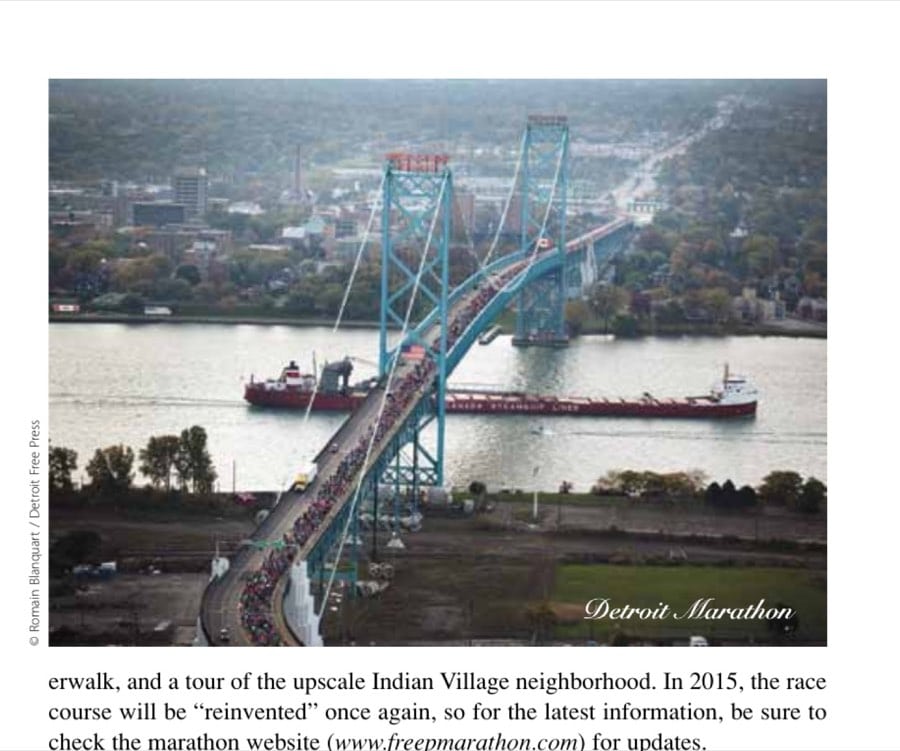
erwalk, and a tour of the upscale Indian Village neighborhood. In 2015, the race course will be “reinvented” once again, so for the latest information, be sure to check the marathon website (www.freepmarathon.com) for updates.
Registration is available online and there are usually about 5,500 runners who fill the 5,800 marathon slots, so no lottery is necessary. While getting in to the race itself does not pose a problem, downtown hotels do fill up fast, so don’t delay in
making a hotel reservation. I stayed at the Detroit Marriott at Renaissance Center and had just a short walk to the start and finish. The course is fairly flat with only a few minor climbs. Some runners do PR here, and the race is a Boston qualifier,
but the real reason to run is for the experience. The race is well organized, from expo to postrace party. There are plenty of well-stocked aid stations with water and Gatorade Endurance, lots of police and
volunteer support, and enough enthusiastic spectators and varied scenery to keep runners from getting bored.
The good stuff: • Running across the Ambassador Bridge into Canada as morning dawns is an unforgettable goose-bump experience. • So is running along the Detroit River on both the Canadian and US borders. • Ditto for returning to the United States through the Detroit-Windsor Tunnel, a unique subterranean mile.
Alternate Races If you don’t hit the lottery for New York or Chicago, try Marine Corps at the end of October. If you prefer a medium-sized race, try Des Moines (Iowa) with around 1,500 finishers or Milwaukee Lakefront (Wisconsin) with about 2,000 finishers.
There are a number of other autumn medium-sized races that are excellent, including Seattle (Washington) and Space Coast (Florida), both held on Thanksgiving weekend. Other good races in this category are Baltimore (Maryland) in October
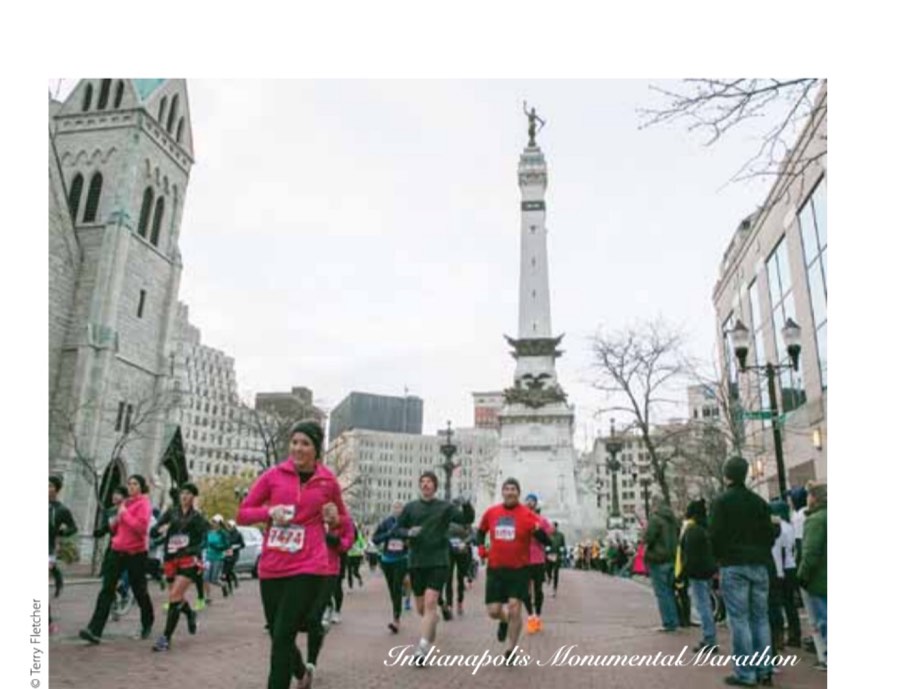
and the Indianapolis Monumental (Indiana), Richmond (Virginia), and Outer Banks (North Carolina) marathons, all in November. Smaller races that are especially attractive include Manchester City (New Hampshire), Atlantic City (New Jersey), and Sioux Falls (South Dakota).
Labor Day weekend has several choices for smaller marathons: Tupelo (Mississippi) with the slogan “Trample the weak, hurdle the dead,” Heart of America (Missouri), and Marquette (Michigan). Coupling a three-day (or longer) holiday weekend with a marathon may be
a good last-minute opportunity for a vacation weekend before school starts. Several Canadian provinces have excellent autumn marathons. Both the Toronto Waterfront Marathon (Ontario) and the Victoria Marathon (British
Columbia) are held in October and qualify as midsized races. Victoria has about 1,500 marathoners and Toronto around 4,000.
The not-so-great: • Although the race has a reasonable number of marathoners, the addition of about 15,000 half-marathoners can make the early miles of the course a challenging gridlock. The wave start helps, but it can still get fairly crowded in the beginning. • Though October weather in Michigan can be cold, the tunnel can be hot and humid, so be prepared to dress accordingly. Some hints: • Be sure to bring your passport or enhanced driver’s license; this is an international race, and you will need to show your government-issued identification
© Terry Fletcher
at the expo. For additional security reasons, registrations are vetted in advance by the Department of Homeland Security and Canada Border Services Agency. • There are other races in addition to the full, half-marathons, and five-person relay. Family members who might be interested in doing a shorter race might opt for the 5K or the kids’ fun run on Saturday. • If you are driving to the race, consider parking a little farther out and taking the People Mover to downtown. This will avoid traffic hassles.
Portland Marathon Now in its 44th year, the Portland Marathon (portlandmarathon.org) has long been a premiere event of the Northwest’s “Rose City.” The event is held during the first weekend of October, and all event activities are located in downtown Portland, only 20 minutes from the city’s airport. The expo, start, and finish are all located within three blocks of each other. There are many great things about this event. For one, like other races noted herein, it is exceptionally well organized and runs like a well-oiled machine. The race’s October date has experienced rain only twice in the last 34 years. The mean temperature at the start is nearly always 50 to 55 degrees.
Courtesy of Portland Marathon
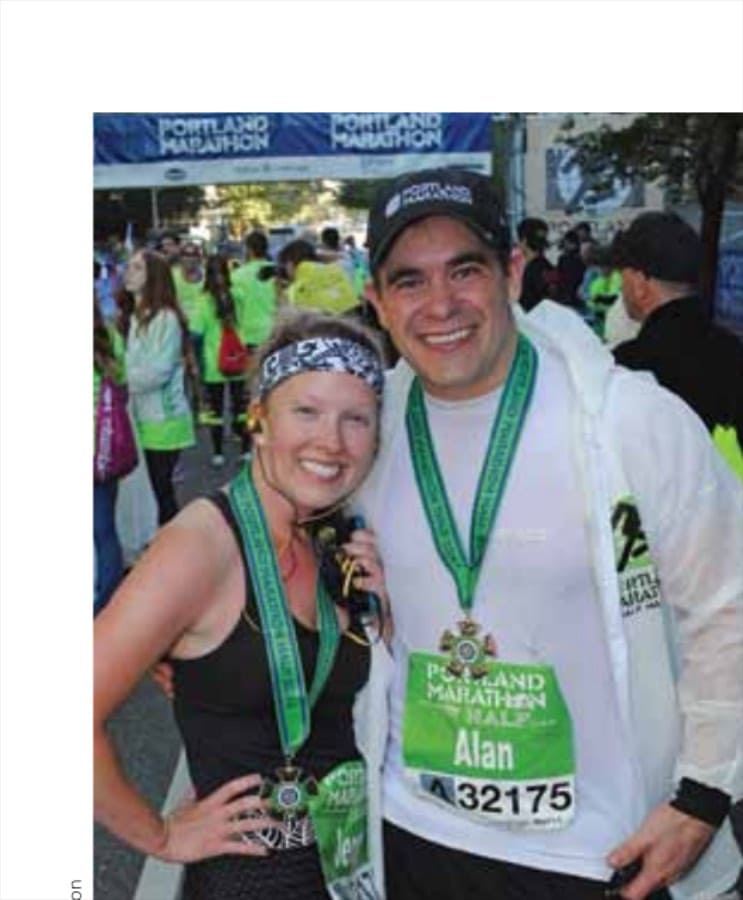
The course is fast and forgiving, and annually 25 percent of the participants run personal bests. The route is an elongated loop that follows the general contours of the Willamette River. You’ll run along a waterfront park with views of the Cascades, including majestic Mount Hood. The downtown Portland loop includes Chinatown, parts of the new Pearl District, and countless monuments and fountains. You’ll run through the refurbished warehouse district and along tree-lined neighborhoods near Forest Park, Portland’s largest park. And, at mile l8, the course goes over the iconic St. Johns Bridge (a 135-foot climb over a one-mile distance), in full view of once-smoldering Mount St. Helens.
The good stuff: • At the start, it is a tradition for everyone to sing “The Star-Spangled Banner”—a nice touch started in 2001. • Fifty-seven percent of the marathon entrants are women. And Portland has
welcomed walkers since 1987. • There are over 80 entertainment groups on the course. And iPods and other headsets are allowed on the event’s closed course. • Numerous aid stations are approximately two miles apart, with water, an elec
trolyte drink, and medical attention, if needed. Because of the race’s “green” status, little gel packs are neither offered nor encouraged. • With a registration fee that increases during the season from $115 to $145,
the event provides some great swag: a poster, a runner’s bag, a personalized bib, a long-sleeved performance finisher shirt (gender-specific sizing), a rose, a fantastic medal, a pendant, an event coin, a disposable cover-up, and a fir or pine tree seedling (since 1992, over 200,000 planted).
• The focus is on the “average runner.” There is no prize money, and the time limit is a generous eight hours.
The not-so-great: • There is no gear check (city security regulations), so bring an old sweatshirt to toss. All thrown-away clothing goes to needy families. • There is so much music on the course it can interrupt your listening to your own music. Some hints: • You can carry electrolyte treats (but be green). There are several pretzel and
Gummi Bear stations, but I personally prefer fruit or energy bars, so I carry my own sustenance. • Portland hotels can be pricey (for the Northwest), but the host hotel (the Portland Hilton), the site of the expo, offers a substantial early registration
discount. A two-night stay is required, with the usual 48-hour cancellation policy and an advance deposit. • Be sure to take advantage of Portland’s microbreweries and local cuisine. • If you love books, visit Powell’s Books, the largest private bookstore in the
country (and bring along an extra suitcase for your purchases).
Small but outstanding Sometimes even medium-sized urban races may feel too regimented with corrals and rules. Smaller, more intimate races can be just the ticket. These smaller races are frequently put on by track clubs that are deeply in tune with what runners want and need. In other cases, the races are put on by organizations with a close connection to a museum or a charitable institution. In the latter case, the races are designed to raise awareness and money for the particular group. Race directors seem to go out of their way to connect with runners to make the races immensely satisfying to all participants.
But be forewarned: runners should not expect throngs of spectators, aid stations every mile, photographers at every landmark, and a huge expo. On the plus side, there are no crowds and no long lines. You are often allowed to pick up your race packet the morning of the race. Small races can be hidden gems, offering wonderful experiences for runners who discover them.
Cape Cod Marathon An excellent example of a small marathon in a pristine location is the Cape Cod Marathon (www.capecodmarathon.com). Sponsored by the Falmouth Track Club,
Tips for Training in the Heat Take time to adjust to warmer temperatures. Run early in the morning before sunrise or later in the evening after the sun goes down. Divide your runs to avoid the hottest part of the day, usually between 10:00 a.m. and 4:00 p.m.
If you must train during the heat of the day, don’t forget sunscreen and sunglasses, and look for shady trails or roads. Wear a visor rather than a cap to avoid retaining heat and sweat. Dress in light-colored lightweight clothes.
Drink water regularly, sip slowly, and consume electrolyte drinks like Gatorade and Powerade on longer runs. Expect that extreme temperatures will slow your pace; focus on stamina and endurance rather than speed.
On the hottest days, stay indoors and run on a treadmill in an airconditioned room. Recognize and pay heed to signs of hyperthermia and heat exhaustion. Marathon Training Tips to Stay Healthy in the Summer Heat (www.
rushortho.com/news/marathon-training-tips-stay-healthy.cfm) Summer Training Tips for Your Fall Marathon (www.active.com/running/ articles/summer-training-tips-for-your-fall-marathon) Ten Tips for Surviving Summertime Marathon Training (www.theactivetimes.com/10-tips-surviving-summertime-marathon-training)
the marathon attracts 700 to 1,000 people each year. A few hardy souls register for the Clam Chowdah Challenge and do a half-marathon on Saturday and the full marathon on Sunday, with the promise of three T-shirts, two medals, and a clam chowdah bowl at completion. I really wanted that bowl, so I did the Challenge in 2010 and found it was worth every sore muscle.
From 1978 to 1983, the marathon was run entirely on Otis Air Force Base, but in 1984 the course was changed to its current single loop beginning and ending on the Village Green in picturesque Falmouth. The first half of the course is flat with a couple of small inclines, but by mile 15, runners will test their stamina with a series of challenging rolling hills.
The marathon takes place on the last weekend in October. Logistics are fairly simple. There are numerous inns and lodging opportunities within walking or easy driving distance to both packet pickup (at the local middle school) and the race start and finish.
The good stuff: • This course is notable for its remarkably beautiful scenery—from beachfront seascapes to cranberry bogs to the Nobska Light—all highlighted by glowing autumn leaf colors. You will not tire of the changing landscapes, especially if you enjoy maritime views. • Neat lodging is available, from small distinctive resorts to hospitable bed-andbreakfast inns. I stayed at the Captain Tom Lawrence House Inn and was very pleased. Most places offer special marathon rates for a two-night minimum stay. • Postrace food is exceptional, especially the clam chowder.
The not-so-great: • Take care while running, because the narrow streets remain open to cars (though traffic is fairly light and well monitored by police and volunteers). • Medical care is available only at the finish line and the school. If you require
assistance, try to make it to the next aid station where volunteers can summon a support van. • The closest airports are Boston’s Logan, Manchester in New Hampshire, and T. F. Green in Providence. All require a one- to three-hour drive to the Cape.
I prefer Providence since you can avoid most major city traffic. • The Cape in late October can be brisk with blustery winds, especially along the coastline. In 2012, Hurricane Sandy made an appearance, so be prepared for all kinds of weather.
Some hints: • Hold back some energy for the challenging hills in the last half of the course. Don’t be fooled by the easy terrain in the beginning. • Save some time to explore Falmouth and its walkable downtown, quaint shops, and seafood restaurants. Autumn is a great time to visit the Cape. • There are only 11 water stops, so you may want to carry extra liquids (on the other hand, there is an official Halloween candy stop at one of the later aid stations). • Don’t wait to sign up, especially if you want to register for the challenge (it has a 200-runner cap).
• As at any small race, if you are a slower marathoner, you may find that the final miles can get a bit lonely. As long as you are on pace to finish within the strict six-hour time limit, relax and enjoy the beautiful scenery and the quiet and peace of the rural countryside.
Soldier Marathon
© vpbphoto.com
A new kid on the block, the Soldier Marathon (www.soldiermarathon.com) is building a solid reputation among runners who want a great race with all the frills of big-city races and few downsides. Since its inaugural race in 2010, the marathon has attracted dedicated runners who return again and again to the small city of Columbus, Georgia, every Veterans Day weekend. I am usually hesitant to run an inaugural race, but I was so pleasantly surprised with the seamless organization of Soldier during its first year that I too came back for a second run and plan to do so again in 2015.
The race has almost doubled the number of marathoners since that first year. It now has more than 600 runners, primarily from the Southeast; however, the race is gaining wide popularity with 50 State Club members and Marathon Maniacs.
Packet pickup and a very small expo are located inside the National Infantry Museum at Fort Benning, an Army post in Columbus. There is plenty of free
parking around the museum. The race begins and ends just outside the museum, and runners can wait inside to stay warm on race morning. The first seven miles of the loop course take place on the Army post. Runners then move onto the paved Riverwalk section along the Chattahoochee River, the boundary between Georgia and Alabama. At mile 16, runners cross a wooden bridge over the river to Phenix City in Alabama, run a mile in that state, and return to Georgia by another bridge at mile 17. The course then circles around an area bordering downtown Columbus and then follows the Riverwalk back to the base and the finish line at the museum. Depending upon timing, a Veterans Day parade may alter the route somewhat, but the essentials remain the same. The course is open for seven hours.
The good stuff: • The course begins and ends along the inspiring Avenue of Flags. • This is a good course for a PR. The only hills on the course occur during the first seven miles—and drill sergeants are strategically positioned along “Drill Hill” to shout at you to keep on pace. I might not enjoy this so much during the last few miles, but right at
the beginning it is fun. • Honor a deceased veteran by wearing a special “Fallen Hero” bib. You can select someone you know or pick a name from one of the many available at the expo. I chose a soldier who had the same birthday as I did and ran in his
honor. The concept gave the race special significance for me. • Soldier has many of the benefits of a much bigger race: gear check, runner tracking, pacers, free postrace massages, plus 14 aid stations with water and
Powerade and four gel stops. • Bask in the peace and quiet of a small rural race; during the first few miles several deer crossed right in front of me. • The medal reflects the military theme and is in the shape of dog tags with the
lanyard a chain rather than a ribbon. The not-so-good: • Try as I might, I cannot think of anything negative about Soldier. It is the quintessential small race. Some hints: • Hotels fill up fast—be sure to make your reservation early. The most con
venient hotel is a Hampton Inn situated right on the base. However, when I called in February to make a reservation for this November’s race, the hotel was already sold out. There are numerous alternatives, however; I usually stay at a nearby Holiday Inn.
• Weather in this section of Georgia can be very cool at the start but warms up quickly. Dress in layers that you can shed or tie around your waist. • Family members can take part in one of the shorter weekend
events (a half-marathon, 5K, and kids’ marathon) and then tour the museum while waiting for you to finish. • Columbus is an inviting small town with much to see and do—shopping, restaurants, whitewater rafting, kayaking,
ziplining across the Chattahoochee River, Civil War Naval Museum, and Coca-Cola Space Science Center. • The National Infantry Museum is not only the site of packet pickup and the prerace pasta dinner but a place to visit before
or after the race. The exhibits are excellent and should not be missed. • Columbus has a small regional airport, so most people will probably fly into Atlanta, rent a car, and drive a few hours through pleasant back roads to Columbus.
Go for it! Regardless of whether you prefer huge races with plenty of company, crowds of cheering spectators, and well-supplied aid stations or quiet, rural, scenic races on country roads, the autumn season has an enormous variety of marathons to suit every taste. Plan ahead, train hard, and choose an autumn race to add to your resume of running achievements. You will be glad you did!
This article originally appeared in Marathon & Beyond, Vol. 19, No. 5 (2015).
← Browse the full M&B ArchiveMore like this
1,000+ stories from 19 years of Marathon & Beyond
The complete archive of the legendary long-distance journal — digitized and free to read.
