

Basic Training for a 3:00 Marathon
Parts 1 and 2 of Rich Benyo’s marathon training series appeared in our last two issues and covered training for a first and 3:30 marathon, respectively.
MORE THAN a decade ago, I had the occasion to attend a party thrown by a West Coast doctor who was celebrating with his running friends the milestone he had reached earlier in the day: his 100th marathon.
The congratulations came hot and heavy, and the good doctor basked in the glory. He was the first person in the county in which he lived to notch 100 marathons.
But as the celebration moved into the darkness and the insects orbited the Tiki lamps he had lit around his deck, our host seemed to withdraw. He became nearly morose.
“What’s the problem?” I asked as he stood in the shadows near the edge of the deck. He waved his hand dismissively, as though it were nothing. I was about to turn away, to leave him to his self-imposed quarantine, when he began muttering to himself. I stepped closer, in an attempt to understand what he was saying. He was muttering the names of a half dozen of his running friends who were enjoying the balmy evening on his deck.
“What about them?” I asked.
“They’ve done it,” he said. “So have you.”
I was puzzled. “Done what?” I asked.
He sipped the foam off the beer he had just popped. A frown crossed his forehead, making him look even farther withdrawn into shadow. “Broken three—”
“Broken three—?” I asked. The instant it was out of my mouth, I realized to what he was referring. They had broken three hours in the marathon.
I shrugged. “Yeah—?” I said, still not getting it.
He raised an eyebrow. “I’ve broken 3:30, but I’ve never come close to 3:00.”
“Mmmmm,” I replied.
He looked at me as seriously as a surgeon about to tell a patient that he was unable to get all the cancer. “I’d gladly trade all 100 of my marathons for one sub-3:00,” he said.
I could see he meant it. I patted him on the back in the rather awkward manner that passes for physical closeness in some guys. I knew from past experience he didn’t like to have guys touch him beyond the obligatory handshake.
“Put your mind to it,” I said lamely. “You can still do it.”
He never did put his mind to it and he never did it. Eventually he stopped running marathons altogether, his 100 marathons apparently a reminder of all he hadn’t done—like breaking 3:00.
* * * * *
At one time breaking 3:00 in the marathon didn’t seem like such a big deal. That’s not to minimize its importance. Runners new to the sport ran hard 10Ks and half-marathons as a buildup to running a marathon; some runners didn’t consider themselves real runners if they didn’t run a marathon—hard. Many of them assumed it was just a few more steps from running a marathon to racing to a sub-3:00. For many of them, determined and single-minded, it was.
Just before the world of marathoning exploded in the late 1970s, Joe Henderson, the editor of Runner’s World, used to collect marathon results sheets and then transfer the times to three-by-five-inch cards, which he would store by times so that at the end of the year he could list every man who ran the marathon under 3:00 and every woman under 4:00. The lists were presented in an annual handbook. I have before me the 1975 Marathon Handbook (a six-by-nine-inch, perfect-bound trade paperback book) in which it takes 18 pages of small print in two columns per page to list all the American males who broke 3:00 in 1974, led by Frank Shorter’s 2:11:31. This was in a year still several away from the Boom of ’77-’78. There were probably only 5 percent as many Americans running a marathon each year as there were in 2001.
When the Boom came, it became impossible to keep up with it.
Each February issue of Runner’s World was a special issue on the marathon. The February 1978 issue boasted a 39-page special section but carried U.S. male performances from 1977 only up to 2:35 (topped by Bill Rodgers’s 2:10:55). The issue also featured a 2-page spread promising “The Marathoner Is Coming.” Thank goodness, because in 1979, the special marathon section had to be spread across two issues (February and March).
The Marathoner magazine, a 120-page, full-sized, perfect-bound quarterly, arrived in the spring of 1978, and the first issue carried a 24-page section that carried the names (in 6 point type) of every American male who had broken 3:00 in 1977 and every female under 3:30. It appeared that every guy who strapped on a pair of running shoes was going under three hours.
Of course that wasn’t true. The median time for males running the marathon in 1978 was roughly 3:30. But so many were going under 3:00 that it seemed understood that, once you had a few marathons under the waistband of your running shorts, you would go under 3:00.
It was assumed that virtually every male runner could do it.
And because it was assumed, we assumed we could do it. And sometimes did.
My own first sub-3:00 came in October 1980, after I decided to change my training in order to go faster rather than more often.
I had taken up running in June 1977, lost 45 pounds, and in 1978 ran eight marathons (all in the 3:30 range). In 1979 I ran fewer marathons but began inching down toward 3:00, with a 3:05 at the initial Humboldt Redwoods Marathon in October of that year.
By running with guys faster than I was, by running track events (in the Corporate Cup series) for which I was not genetically adept (I could never break 60 in the 400, stalling at 61, and never broke 5:00 for the mile, stymied at 5:07), by keeping up a good base of mileage, and by racing at shorter distances almost every weekend but not overracing marathons, I hit 2:57:48 in October—again, at Humboldt.
When I came back to the Runner’s World offices on Monday, the resident marathoners who regularly went under 3:00 were waiting at the door to congratulate me. It was as though I had crossed a threshold and had become, at least in their eyes, a genuine runner rather than a jogger.
Getting down below 3:00, however, had been hard work—damned hard work. Consistency was paramount. Hard/easy was essential. And patience and delayed gratification were capital tools.
Looking back at the experience from a distance of two decades, it was one of the most uplifting experiences in my life. The marathon, unlike much in life, had been fair to me: I had put in the necessary work and effort, and the results were . . . well . . . as predicted by the experts of the time, prime among them Arthur Lydiard, the New Zealand coach whose training theories, no matter how out of vogue today, have never been proven to be anything but rock solid.
What follows is an intense 16-week program toward a sub-3:00 marathon.
Just before the program itself, there is a key to abbreviations used within the program; it is the same as was used in the sub-3:30 program in the last issue.
Following the program is a segment discussing six areas of concentration in expanding and refining training that would benefit the would-be sub-3:00 marathoner; several of the areas relate directly to the implementation of the 16-week program, while others involve becoming a more well-rounded athlete.
RACING MATTERS
We also need to discuss the subject of racing during the 16-week training program. The basic program does not include racing; instead, it includes long weekend runs pegged at a specific pace that will allow the runner to build to the endurance and strength needed to maintain a sub-7:00 pace for the entire marathon.
Racing can be very beneficial to a marathoner training to break three hours. It can serve to keep the runner sharp, to augment the fast track workouts, and to eliminate some of the drudgery of doing the long runs—which can often be run much easier with a comparable partner or in conjunction with a race.
Should you wish to continue racing through this program, feel free to do so. Use the race, which you would run roughly 30 seconds per mile slower than your potential race pace for that distance, as a launching pad for the remainder of that day’s long run. For instance, week 8 (in other words, 9 Weeks Out) calls for a 15-mile run on Saturday at an even 7:00-per-mile pace. If you can find a Saturday morning race of 10K, run the 10K race at roughly 30 seconds per mile slower than the speed at which you are capable (likely, a 6:10 or thereabouts, which means you would “race” the 10K at 6:40 pace). Immediately after crossing the finish line, and being careful to not cool down, roll into the remainder (nine miles) of your long run at a 7:00-per-mile pace.
As discussed in the last installment, if you must move your long run to Sunday, slide every other workout one day so that you are guaranteed the two rest days when they are scheduled relative to your hard workouts for the week.
Don’t waste your time embarking on this program if you cannot do the “Base Week” comfortably for 4 weeks in a row leading up to the 16-week program. The program becomes progressively more difficult, and if the base is going to be too much for you, the actual program will be way too much for you to handle. The essence of racing the marathon is to be brutally honest with yourself; deceiving yourself as to just where you are in your long-term training is going to generate some very ugly desserts later in the program and/or on race day.
THE PROGRAM ABBREVIATIONS
NE = Nonrunning Exercise. Activities such as bicycling, cross-country skiing, swimming, walking, or easy hiking—all done at a casual, recreational level.
R = Rest. This one may be difficult for the long-running athlete and may take some practice, but Rest refers, literally, to doing nothing of a physical nature. Who says a marathon training program is all work? Rest is an integral
element of training. Come to the next hard training session tired or sore and its effectiveness is seriously undermined.
E/R = Either Exercise or Rest. Sundays call for either a bit of Exercise or Rest. If you are particularly tired after the Saturday long workout, opt for Rest, considering the volume of work you face on Monday. If you are feeling particularly spry on Sunday, some casual Exercise is OK.
F = Fartlek. This is a Swedish training method (translated as “speed play”) in which the workout is broken up by throwing in speed surges at regular intervals. An easy way to do this is to run on a road with telephone poles. Throw in a surge between poles or between every other pole; continue alternating throughout the workout. In Fartlek workouts, as in Hill workouts, the number of miles indicated includes a one-mile warm-up jog and a one-mile cool-down jog at the end. For example, if the schedule says week 10 calls for “F: 7 miles,” this means jog one mile, do Fartlek for five miles, then jog one mile as a cool-down.
H = Hills. Like the Fartlek workouts, the distance listed includes a one-mile warm-up jog and a one-mile cool-down jog. Hill workouts should be run on moderate hills, that is, never more than a 4-5 percent grade. The run up should be done with attention to style/form and strong use of the legs but not at an exhausting or sprinting pace; the run back down the hill should be done in a relaxed manner but with attention to striding out comfortably.
F/H = Fartlek with Hills. While most Fartlek workouts are done on level or rolling terrain, this workout is done incorporating hills up which you can accelerate, recovering on the descent on the other side.
T = Track. Track miles are calculated differently from Fartlek or Hill miles. Jog one mile as a warm-up before doing the mile repeats; jog one lap (400 meters) between each repeat, and do a minimum of a half-mile cool-down jog at the end. The mile you jog to warm up your legs does not count in the total listed for the workout; neither do the one-lap jogs between timed miles and the half-mile cool-down following the workout.
S-Mixed-LR = Saturday Mixed Long Run. For those who like to race and those who feel that racing adds spice to training and that it leads to a runner’s maintaining an “edge,” an option is offered to do a combination Long Run workout on Saturday. This would consist of a race immediately followed by a run to complete the called-for Long Run mileage for that day. For instance, if the schedule calls for a 20-mile Long Run on Saturday and there is a local 10-mile race, you can go to the race, run the 10-miler at 30 seconds per mile slower than you are capable (i.e., if you are capable of a 70-minute 10-mile race, run it in 75 minutes), then immediately (before you begin to cool down) roll into a run, completing the remaining 10 miles at the prescribed pace.
19H-mile run = 19-mile hilly run. For the Saturday Long Run two weekends before your marathon, an H (Hill) is indicated behind the scheduled 19 miles. This key workout should be done on a relatively hilly course (the hills should be rolling hills, not staggering mountains). This workout should not be an S-Mixed-LR but should be a sustained effort at a 7:00-per-mile pace average.
BASE WEEK
You should be able to do this weekly workout comfortably for 4 weeks in a row before embarking on the 16-week 3:00 program:
- S E/R
- M F/H: 10 miles
- T 3-mile gentle run
- W T: 4 repeat miles at 6:30-6:40
- T 3-mile gentle run
- F R
- S 15-mile run at 7:30
16 WEEKS AND COUNTING TO A 3:00
16 Weeks Out
- S E/R
- M H: 8 miles
- T 3-mile gentle run
- W T: 4 repeat miles at 7:00
- T 3-mile gentle run
- F R
- S 18-mile run at 7:15 (or S-Mixed-LR)
15 Weeks Out
- S E/R
- M H: 6 miles
- T 3-mile gentle run
- W T: 4 repeat miles at 6:50
- T 3-mile gentle run
- F R
- S 14-mile run at 7:00 (or S-Mixed-LR)
14 Weeks Out
- S E/R
- M H: 8 miles
- T 3-mile gentle run
- W T: 5 repeat miles at 6:50
- T 5-mile gentle run
- F R
- S 20-mile run at 7:00 (or S-Mixed-LR)
13 Weeks Out
- S E/R
- M H: 6 miles
- T 3-mile gentle run
- W T: 4 repeat miles at 6:40
- T 3-mile gentle run
- F R
- S 15-mile run at 7:00 (or S-Mixed-LR)
12 Weeks Out
- S E/R
- M H: 8 miles
- T 3-mile gentle run
- W T: 5 repeat miles at 6:40
- T 3-mile gentle run
- F R
- S 19-mile run at 6:50 (or S-Mixed-LR)
11 Weeks Out
- S E/R
- M H: 6 miles
- T 5-mile gentle run
- W T: 4 repeat miles at 6:30
- T 8- to 10-mile gentle run
- F R
- S 15-mile run at 7:00 (or S-Mixed-LR)
10 Weeks Out
- S E/R
- M H: 8 miles
- T 6-mile gentle run
- W T: 5 repeat miles at 6:30
- T 8- to 10-mile gentle run
- F R
- S 20-mile run at 6:40 (or S-Mixed-LR)
9 Weeks Out
- S E/R
- M F: 6 miles
- T 8- to 10-mile gentle run
- W T: 4 repeat miles at 6:20
- T 5-mile gentle run
- F R
- S 15-mile run at 7:00 (or S-Mixed-LR)
8 Weeks Out
- S E/R
- M H: 10 miles
- T 5-mile gentle run
- W T: 5 repeat miles at 6:20
- T 6-mile gentle run
- F R
- S 21-mile run at 6:30 (or S-Mixed-LR)
7 Weeks Out
- S E/R
- M F: 7 miles
- T 3-mile gentle run
- W T: 4 repeat miles at 6:10
- T 5-mile gentle run
- F R
- S 16-mile run at 7:00 (or S-Mixed-LR)
6 Weeks Out
- S E/R
- M H: 8 miles
- T 3-mile gentle run
- W T: 5 repeat miles at 6:10
- T 5-mile gentle run
- F R
- S 23-mile run at 6:40 (or S-Mixed-LR)
5 Weeks Out
- S E/R
- M F: 8 miles
- T 5-mile gentle run
- W T: 4 repeat miles at 6:00
- T 6-mile gentle run
- F R
- S 15-mile run at 7:00 (or S-Mixed-LR)
4 Weeks Out
- S E/R
- M H: 10 miles
- T 3-mile gentle run
- W T: 5 repeat miles at 6:00
- T 5-mile gentle run
- F R
- S 25-mile run at 6:45-6:50 (or S-Mixed-LR)
3 Weeks Out
- S E/R
- M F: 10 miles
- T 3-mile gentle run
- W T: 4 repeat miles at 5:50
- T 5-mile gentle run
- F R
- S 19H-mile run at 7:00
2 Weeks Out
- S E/R
- M 3-mile gentle run
- T 8- to 10-mile gentle run
- W T: 2 repeat miles at 6:00
- T E
- F 3-mile gentle run
- S 13-mile run at 6:50 (or S-Mixed-LR)
1 Week Out
- S E/R
- M 3-mile gentle run
- T R
- W 3-mile gentle run
- T 6-mile gentle run
- F 3-mile gentle run
- S R or 2-mile jog
Marathon Week
- S MARATHON in sub-3:00
- M 3-mile gentle walk
- T 2-mile gentle jog
- W E
- T 6-mile mixed walk/jog
- F R
- S 6-mile gentle run
Race Strategy and Cautions
On race day, get to the start area at least 40 minutes in advance. Walk a quarter mile, roll into a gentle jog for a quarter mile, pick up the pace for a quarter mile, then do a half dozen 50-yard strideouts to loosen the legs.
Line up near the front on one side or the other so as not to get hemmed in when the gun goes off. Since you are going to break 3:00, you belong near the front.
Control yourself when the gun goes off. By doing all the track workouts you’ve done, you should have a feel for a 6:45 pace. Don’t get pulled along by the excitement. Check your pace at one mile. If you’re too fast, ease back to average out to 6:45 over the next few miles. Get into a rhythm and constantly monitor your breathing, your pace, your leg turnover. (Since 6:45s are difficult to calculate while you run, get a pace band or write the splits on a three-by-five-inch card that you can cover with transparent tape, then pin it upside down to the bottom of your bib number—upside down so that you can read it from above.)
Be cautious that once you get out around five miles, where the deep muscles are warmed up, that you don’t feel so strong and fit that you pick up the pace. Other than the first several miles where you are caught up in the excitement of the start, the next potential trap is the 7- to 15-mile range, where you are warmed up and feeling invincible. You may feel invincible, but you aren’t. Monitor your pace constantly; hold yourself back to a 6:45 pace no matter how powerful you feel. If you don’t, you won’t be feeling so chipper out around 20 miles.
Plan on having to “work” a bit harder out beyond 20. However, if the training went according to plan and you didn’t blow it in the “invincible” section between 7 and 15, you should still be running with a good rhythm; it should require a bit more effort out there beyond 20 in order to keep the pace. It is common knowledge among marathoners that the race doesn’t begin until 20 miles; the first 20 miles are merely a journey to get you to the race. Try to remain relaxed as you start to work; remember that any tension you put into the final 10K is going to rob strength from your muscles that could better be used moving you toward your goal.
If you have something left in the last half mile, it is OK to pick it up, but do not, under any circumstances, sprint. That’s a good way to cramp up, which could, in an instant, bring you up short of your goal.
After you cross the finish line, keep going. Do not drop to the ground; your muscles will cramp, and it’s a tremendous strain on your heart. Keep walking for a mile or two to pump some of the incoming stiffness out of your leg muscles. Put on your warm clothes as soon as you can. Congratulations. You’ve arrived in the rare air.
Six Areas of Concentration
Now that you are about to embark on an intense 16-week program toward racing a marathon at a sub-7:00-per-mile pace, there are several areas of the training program that would benefit from some further elaboration and several areas of training that, if mastered at this point, will complement and augment your training as well as increase the good results of that training.
Upper-Body Workouts
Very few runners capitalize on an ongoing program of upper-body workouts. The strength of most distance runners is in their legs, lungs, and heart—the primary tools of the runner who typically competes in races beyond 5K. Long-distance runners think muscles in the upper body are for sprinters, and besides, strong upper-body muscles are merely extra weight to carry through all those miles.
The type of upper-body workouts to which I’m referring have little to do with those a sprinter uses. The last thing distance runners need is bulked-up muscles. What they do need, however, is all the strength and endurance they can beg, borrow, or buttress, even if it means carrying along an extra pound or two of muscle tissue.
By adopting a simple, modest routine of upper-body workouts, you can make major strides toward increasing endurance and strength with a minimal addition of weight. For best results, do these four exercises every other day; they can be incorporated into the cool-down process:
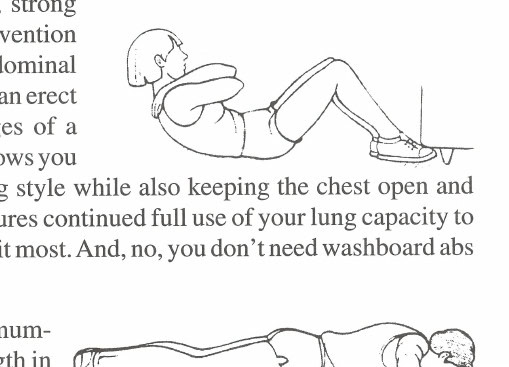
Sit-Ups. Limited range-of-motion sit-ups minimize the chance of lower-back pain yet strengthen and define your abdominal muscles. Since they are opposite the lower-back muscles, strong abdominals contribute to the prevention of lower-back pain. Strong abdominal muscles also help you maintain an erect posture even in the latter stages of a marathon. And good posture allows you to maintain an efficient running style while also keeping the chest open and unobstructed, which in turn assures continued full use of your lung capacity to process oxygen when you need it most. And, no, you don’t need washboard abs to make them effective.
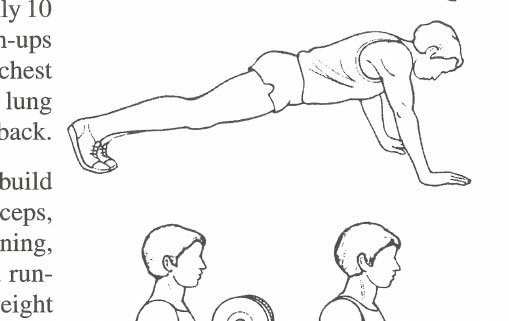
Push-Ups. Even a modest number of push-ups increases strength in the upper arms. Remember that efficient use of the arms adds roughly 10 percent to running strength. Push-ups also expand and strengthen the chest muscles (thereby allowing full lung expansion) as well as the lower back.
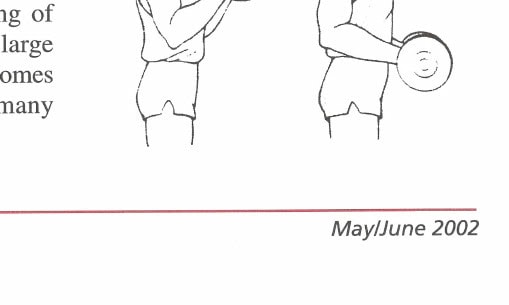
Basic Arm Curls. These build strength and endurance in the biceps, which are important for hill running, speed workouts, and sustained running rhythm. As long as the weight that you use is modest, there is little if any muscle bulking. Bulking of muscles comes from moving large weights a few times; endurance comes from moving small weights many times.
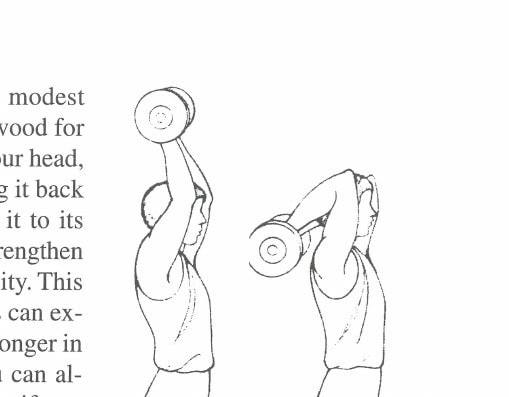
Chest Openers. By hefting a modest weight (I use the same piece of firewood for arm curls and chest openers) over your head, lowering it behind your neck, hefting it back over your head, and then returning it to its original position in front of you, you strengthen your arms and expand your chest cavity. This increases the area in which the lungs can expand when taxed. As you become stronger in the curls and the chest openers, you can always increase the size of your weight if you feel you need additional resistance.
How much is enough upper-body work for the ambitious marathoner? As with the yearly cycle of building mileage, racing, and then backing off so that the body can recuperate, upper-body workouts should be increased as your running program expands toward a particular race, then decreased to a maintenance level over the winter months.
If you haven’t done an upper-body program before, start with the following:
- 10 Sit-Ups
- 5 Push-Ups
- 20 Arm Curls
- 20 Chest Openers
If you have trouble initially doing the Push-Ups, do them from the knees instead of from the toes.
Each week add 1 Sit-Up to your program and 2 Arm Curls and Chest Openers; add 1 Push-Up for each 2 additional Sit-Ups. When you reach 50 Sit-Ups, 25 Push-Ups, 100 Arm Curls, and 100 Chest Openers, hold at that level. You can count back on your marathon-training calendar so that you reach the maximum level of upper-body workouts two weeks before your marathon.
Training with a Partner(s)
The beauty of long-distance running is that it is an individual sport that can be done anywhere at any time. But for those runners who find they are less motivated to run, stick to a program, or run tough when the program calls for it, hooking up with one or more running partners may be advisable—as long as the running partner is of similar abilities. While running with someone who is a hair better than you tends to encourage you to run a little better to keep up,
training with someone who is markedly superior can be frustrating and masochistic at this stage of the game.
Actually, running with someone moderately slower than you is ideal on days that call for easy runs. Such a partner will tend to slow you down to an easy pace, something you may not easily do if you run solo.
Although you will run your marathon without help from anyone else, a partner can be a wonderful training adjunct, especially if he or she is also training for the same marathon. Try to arrange to run at least two or three workouts a week together—particularly the long Saturday run, which almost always goes better if you are able to feed off a running partner.
Even if you have a good running partner, however, reserve several workouts each week for yourself—especially your track workout. There you need to get into the pacing and your running style, and a running partner can distract you from your primary objectives.
Do not be afraid to take on running partners even if they are not training for your marathon. By having one along for some of the more mundane workouts during the week, you can prevent the runs from becoming boring and monotonous.
HOW TO FLOW UP THE HILLS
Running hills well seems to be a specialty some runners are apparently born with and others spend their lives envying. Often, however, those who run hills well do so because they practice regularly and they have managed to convince themselves that they “like” hills. As you can imagine, being able to do that gives you an incredible advantage over most other runners.
Most people who run hills badly are scared of them and therefore “attack” rather than roll with them. When you attack you expend a great deal of energy and are likely to tire yourself long before the hill is behind you. Attacking a hill allows it to dictate your breathing pattern, which puts you behind in your breathing; you may therefore quickly go into anaerobic (breathless; without oxygen) breathing or gasping. Runners attacking hills also maintain a stride length that is much too aggressive for the pitch of the hill, which forces the legs to increase their workload to pull the body through the elongated stride.
Whether your weekly hill workouts, which are used to build thigh strength, lift, and endurance, are during a longer workout or during a race, here are some tips to keep in mind when you approach a hill:
- Picture yourself flowing up the hill well before you reach it; then make the picture a reality.
- Use your momentum from the terrain leading to the hill to begin your ascent.
- Begin increasing your breathing rate and depth as you approach the hill so that you control your breathing patterns before you actually reach the hill instead of it controlling you.
- Gear down your stride length in relation to the pitch of the hill, just as you would gear down if you were riding a 15-speed mountain bike.
As you do your weekly hill workouts, work on maintaining breathing patterns that are under your control and that fit the pitch of the hill. At the same time, experiment with dropping your legs into various gears—that is, stride lengths—for different pitches; always attempt to pick a shortened stride that is strong and determined, but practical, when it comes to maintaining it through the entire hill.
Positive psychological reworking can change your perception of hills. Regard the hill as a pleasant challenge on an otherwise featureless course. Convince yourself that if you can become a better hill runner, you will outstrip most other people in the races you run because they will continue to be daunted by them. Play games with the hills you encounter, mentally flowing up the hill before you actually reach it.
Continue to control your breathing after topping out until it becomes easy again. Also, practice good downhill running; in a race, most people work so hard to reach the crest of a hill that once they top out, they forget to continue running efficiently when gravity again begins to work with them instead of against them.
PSYCHOLOGY AND RUNNING
When running exploded in the late 1970s, it did so in large part because it was prepared to accommodate virtually anyone who wanted to strap on a pair of training flats to jog around the block. The running movement emerged from the grass roots, from a generation that wanted to head off the negative effects of aging. Because running was a populist movement, the raw materials that entered it were a varied lot.
Many runners had little sports background, and certainly most had never been competitive runners.
Participants in the running revolution who managed to stay with it did so for the long haul because they gradually began to picture themselves as runners. It became a big part of their lives and helped to define them in a world where physical endeavor was increasingly downplayed. Suddenly every office in America had one or two joggers or runners. These people who had seemed so normal six months before were now referred to, sometimes with a touch of derision, as “joggers.” Little by little, those people began to see themselves not as joggers but as runners, as athletic animals instead of passive spectators in the human race. Once they accepted and then embraced that appellation, they moved to another plateau in their running. Running was no longer something they merely did; it helped define who they were.
To be successful at the marathon, the runner who intends to graduate to that plateau must begin to think in terms of being a marathoner long before toeing the starting line. Once the runner begins to think like a marathoner, the goal of running the first one takes on a whole new dimension. Each workout becomes more important, more personal, more integrated with the runner’s daily life and long-term goals.
For some runners, the realization that they have taken that one very important step from thinking like a runner and a racer to thinking like a marathoner comes very early in the process, sometimes at the moment when the decision to go for the marathon is made. Others may be 6 weeks into their 16-week marathon-training program when suddenly, during the middle of a six-mile run, the mental transition is made. And for still others, the transition comes at the last minute, as they lay out their running gear the night before the race or on the way to the starting line the next morning.
When, on a long run, with the legs warmed and the breathing strong and regular like a metronome, the hint that you are becoming a marathoner appears, allow it to infuse the rest of your run—and the rest of your life. The transition is even more powerful once you drop below three hours.
MIND GAMES
No 16-week-long training program is going to come easy every day. If it is, you probably aren’t working hard enough at it. There will be some wonderful, unforgettable days when everything clicks, and there will be days when it takes a tremendous amount of willpower just to get out the door. But if you allow the workouts that are purely painful work to have their way, they will overshadow the truly wonderful days.
Don’t be reluctant to insert your own fantasies and games into your workouts, especially those that start out as though they are a job you don’t particularly like. You will not be the first person who has gutted out a workout by pretending that Khalid Khannouchi or Catherine Ndereba is on your shoulder, going stride-for-stride with you, waiting for you to weaken.
There is nothing wrong with playing mental games to take your mind off the exertion of doing hill repeats. And there is certainly nothing wrong with making deals with yourself to get you through the dreaded track workouts: “If I can do my fifth and last mile repeat five seconds under a 7:00 pace, I’ll stop on the way home and have a frozen yogurt cone.”
The more you can turn your workouts, especially the tough ones, into a game, the more likely you will be to come back to the next scheduled workout refreshed and ready to kick ass. Your imagination can be one of your greatest tools toward keeping a tough 16-week marathon-training program on the right track. Make your running a creative act, not a chore.
“BURNERS”
Early in 1980, I interviewed Henry Rono, then the best distance runner in the world. In 1978, he set four world records (3,000 meters, 3,000-meter steeplechase, 5,000 meters, and 10,000 meters) in an 80-day period. One point he made about training stood out.
Rono felt that “surging” (the act of breaking your competition in the latter stages of a race by unexpectedly picking up the pace) was something most runners didn’t do well because they did not hold the surge long enough. A surge, Rono contended, should not be measured as a 100-yard tool but rather in half-mile, mile, and even mile-and-a-half segments. Hold a surge longer, he said, and you will truly break your competition; practice a longer surge in your workouts and you will break your fear of pain.
Because I had dedicated 1980 to running a 3:00 marathon, Henry’s talk of practicing extended surges struck home. I was certainly not going to be up in the lead pack where I would need to throw in a surge to break my competition, but if I could surge for a mile or a mile and a half in practice runs (essentially overextending the principle of fartlek workouts to an extreme), perhaps in the latter stages of the race my legs would be strong enough to sustain a faster-than-usual pace. I began penciling in extended surges (I called them “burners” for
reasons that will become clear to runners who try them) into my Arthur Lydiard-inspired 16-week training program, easily at first, and then with more vigor.
When I ran a 2:57:48 at the Humboldt Redwoods Marathon that October, I felt these burners were the ingredient I had needed to get the extra strength and speed in the latter stages of the race.
A burner is simply an increase in speed (15 to 45 seconds per mile faster than scheduled) thrown into the long middle of a weekday workout or long run when your legs feel fresh enough to sustain the increase without jeopardizing your subsequent workouts.
If your legs feel stale and dead, don’t try a burner on that day. If they feel springy and full of running after the initial 15 to 20 minutes of warming up in the early miles, increase the per-mile pace for a mile, a mile and a half, or two miles and hold it there, easing back to the prescribed pace through the rest of the workout. This is in sharp contrast to fartlek, which is a series of short surges at regular intervals. During the burner phase, however, you must be very conscious of how well your legs are behaving. At the first hint that they are straining toward injury or exhaustion, back off.
The use of burners is at the discretion of the runner. They are not quite as useful in the 3:30 training program we presented last issue. They should not be used by runners with less than three years of racing experience on their legs, because the extra effort can easily strain the legs of the runner who has not become biomechanically built up.
Even for the experienced runner, burners should not be used in more than two workouts a week. If your program is going especially well, however, it might be appropriate to throw a burner or two into your long weekend runs, but keep it to the mile or mile-and-a-half length. Used judiciously, the burner can be an effective tool to build race-day confidence as well as leg strength and speed.
IN CONCLUSION
The sub-3:00 marathon is one of the most sought-after goals for runners who have been practicing their art for several years. As with anything in long-distance running, it isn’t easy. It takes hard work, dedication, and focus, just like anything else in life that is worthwhile. In marathoning, you get out of it what you put into it; you are rewarded for engaging your brain and your self-control to pace yourself well; your whole existence benefits from successfully completing a program to run below three hours. It is an accomplishment that will rank with the most important and satisfying things you’ve ever done in your life.
This article originally appeared in Marathon & Beyond, Vol. 6, No. 3 (2002).
← Browse the full M&B ArchiveMore like this
1,000+ stories from 19 years of Marathon & Beyond
The complete archive of the legendary long-distance journal — digitized and free to read.
