

Beautiful Sunday
A friend can have a face Or it could be—just a beautiful place
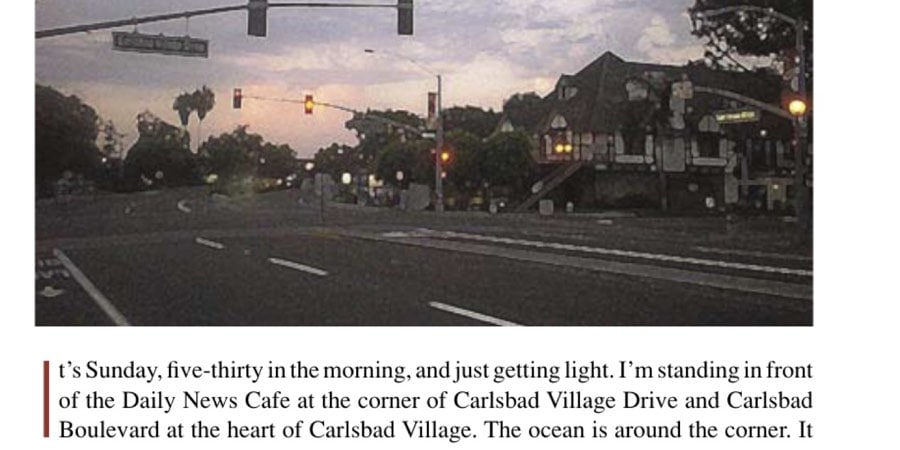
It’s Sunday, five-thirty in the morning, and just getting light. I’m standing in front of the Daily News Cafe at the corner of Carlsbad Village Drive and Carlsbad Boulevard at the heart of Carlsbad Village. The ocean is around the corner. It sends greetings: a gentle breeze, the sound of the surf, an invigorating essence.
Across the street, a delivery truck drops San Diego newspapers by the side of the Pipelines Surf Shop. Later this morning a young man will stand in the middle of the street peddling those papers to passing motorists. The delivery truck door slams, gears grind, and the driver pulls away. Headlights sweep across me. The driver honks and rattles by. I wave.
He ran the red light, but it doesn’t matter. There is no traffic. There’s no one around. Everyone is asleep. For now, I own the town.
Those who rise early for the Sunday-morning long run know something of these feelings. If in a city, we own that city. If in the country, we own the paths, the ponds, the fauna and the flora. If stars glimmer, who else sees them—no one? So they belong to us, too. It’s a wonderful delusion, a privilege to experience. Two cormorants fly close overhead in tight military formation. They give me the beady eye. Their look suggests resentment. “This is our territory; who are you?” “I’m a runner, that’s who.” Who do they think they are, anyway? The sun will be up soon and I’m eager to get going. I’ve decided to run 12 miles.
She has a story “Relax,” she whispers. “What’s the hurry? It’s a lovely morning.” She always sneaks into my consciousness like that. In my mind’s eye, Carlsbad is a beautiful woman—thin and strong. And she’s right. What is the hurry? How often is a morning as beautiful? “
How far will you run this morning?” she asks, tossing her head—her short, blonde hair swirls. “Twelve miles,” I tell her, “we’ll go six miles south to the first antique shop in Leucadia and back. I’ll try for a tempo of 9:30 miles.” I punch the start button on my stopwatch and step out. “
Wait a minute,” she says excitedly, “Slow down. You just got here.” She turns toward the intersection. “You see all those stoplights? See how they hang, dangle, and droop all over the place?” “Uh-huh,” I nod. She wants to tell me a story, as she has so many times before. Her blue eyes sparkle. She starts slowly; she wants to reminisce. “You know that back in the late 1930s, I was just a small-town beach lady. Hardly anyone knew me. But this corner has always been one of my favorite places. I love being here.” “
I was only about 7 years old then,” I interrupt. “I know,” she says, then hesitates and looks at me in a curiously tender way. “Anyway,” she clears her throat and continues, “what you would have seen at this corner then were the famous Acme Traffic Signals. They were magical,” she bubbles, and her eyes widen. “Each was like a music box, like something from a penny arcade. They were very popular all around Southern California.” She takes a deep breath and sighs in a melancholy kind of way. “
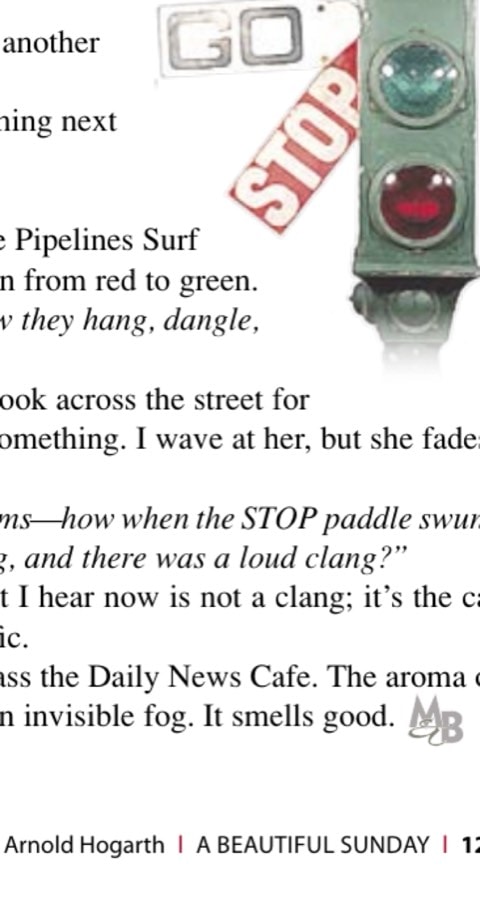
Go on,” I urge, “I remember those traffic signals. They were all over Long Beach where I grew up. I was fascinated by them, too.” She gathers herself and in a dreamy voice says, “Do you recall the little semaphore arms—how when the STOP paddle swung into view, the GO paddle went into hiding, and there was a loud clang?”
“Yes, yes, I hear the clang,” I exclaim, “it’s the same clang a merry-go-round makes when it starts to go so little kids know to hang on tight.” “Exactly,” she says, talking faster now and gesticulating with her hands. “Cars that stopped here were mostly Fords and Chevies. Can you just see those little stop-and-go paddles swinging in and out. They moved slowly. It was as if they were driven by bicycle chains.” “
It’s funny you say that,” I tell her, surprised that we remember it the same way. “It always sounded like bicycle chains to me, too.” “And the cars,” she said, waving an arm toward the intersection, “the drivers needed those paddles to move slowly. After all, it took time to push the clutch pedal in, fumble around to find first gear with the wobbly gearshift stick that protruded from the floorboard, and then let the clutch out carefully so the car didn’t stall.” “It was a sweet time,” I murmur. “Yes. It was,” she agrees.
It’s time to go I reset my watch. It’s almost six o’clock. A light comes on at the back of the Daily News Cafe. The manager and some of the help must have arrived. By the time we return from this morning’s run, the aroma of bacon and coffee will have spilled far out onto the street. “Gibson, party of three please,” the hostess will call, and a dozen more will be waiting: not so patiently.
The folks at the Pipelines Surf Shop will have stacked colorful surfboards against the outside wall of their shop. The pile of newspapers left by the delivery truck will be half gone. The newsboy will be in the middle of the street hawking those papers. “
You still going to try for 9:30 miles?” Carlsbad asks. “Yes,” but as soon as I say it, I wish I hadn’t. It’s August. It’s already hot and muggy. I’m 75. There’s no real reason to do 9:30 miles. I’m not training for anything. But since I already committed, I’ll go for it.
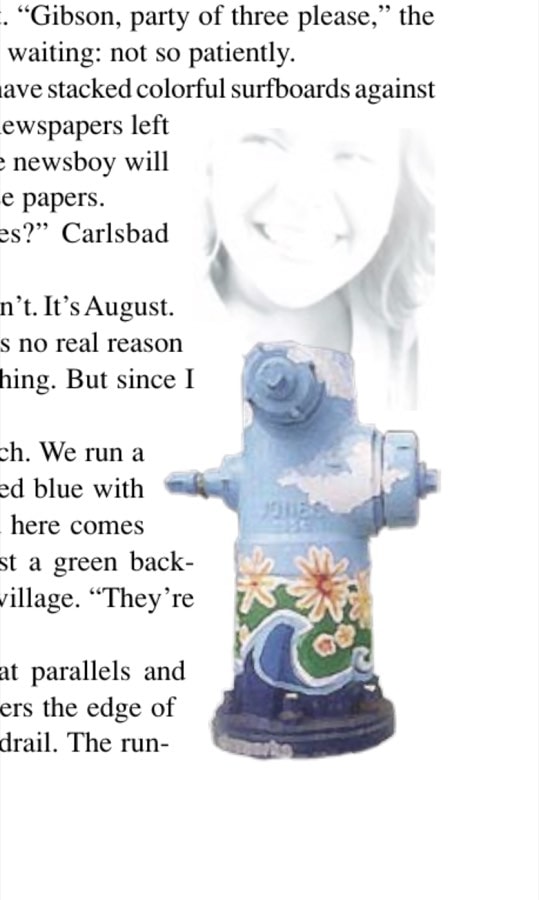
I punch the start button on my stopwatch. We run a few steps and see a fire hydrant. It’s painted blue with an orange octopus wrapped around it, and here comes another with bright daisies painted against a green background. Carlsbad has these all around the village. “They’re my tattoos,” she says with a wide grin.
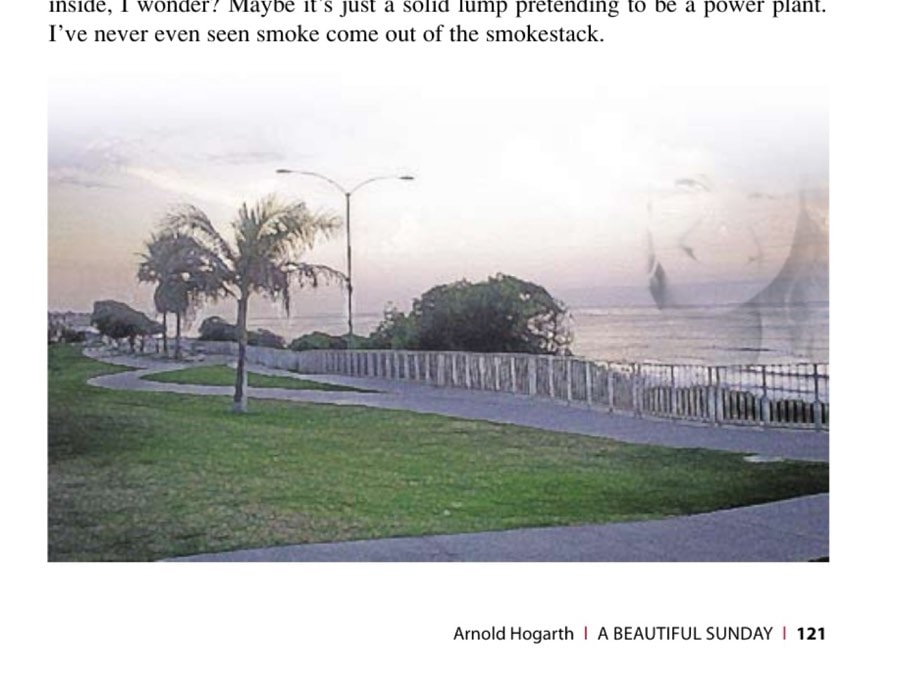
We reach the concrete promenade that parallels and overlooks the beach. The promenade borders the edge of a craggy 50-foot bluff protected by a guardrail. The run-
ning is easy; it’s level for almost a mile. The views are incomparable. I can see 30 miles south to La Jolla and make out Catalina Island 60 miles to the west. Just short of a mile, the promenade splits. We pass under some trees, by some drinking fountains, and past several benches. When we return, the benches will be full—people reading, rocking babies, petting dogs, chatting, and many sitting alone looking at the ocean and hoping for, well, who knows?
Past Tamarack Avenue, over a bridge, drop to beach level, and we’ve gone a mile. It’s a little after six o’clock. To our left, across the highway, is a large lagoon. It’s where the pelicans live. To the right, on the beach, a mixed assortment of seagulls, blackbirds, pigeons, crows, and sandpipers eye one another suspiciously. Beyond, waves collapse in uneven rows of white foam that follow one another toward the beach. As each row washes on shore and disappears, another is right behind to assure the show never ends.
The big news this morning, though, is the sunrise. Diaphanous layers of cumulus lie across the eastern horizon. As the sun rises, its luminous effervescence dissolves into the clouds, creating a brilliant shade of orange that pours slowly across the sky. It is a magnificent work of art. A fleeting canvas though it may be, it’s worth a good look. I stop running. I want to watch.
As I start to run again, we approach the Encina Power Plant—a huge concrete extravaganza with a 400-foot concrete smokestack. There are no windows. I don’t see any doors, and I’ve never seen a human being on site. Is there really anything inside, I wonder? Maybe it’s just a solid lump pretending to be a power plant. I’ve never even seen smoke come out of the smokestack.
Constructed over 50 years ago, it is purportedly worn out. It resides, however, on a premium knoll 200 feet from the ocean with unobstructed views. There’s talk of tearing it down. They say it’s obsolete, and wouldn’t a condo complex in its place be just dandy? I have suspicions that “they”—sitting around conference tables and down at city hall—have saliva dribbling down their chins. “Don’t be cynical,” Carlsbad says. “It will be a good project.” “
I try not to be,” I say, “I really do—but in this day and age?” We run up the modest incline opposite the power plant to the two-mile mark at Cannon Road. Three-quarters of a mile beyond is the fork to Palomar Airport Road. If we veer left there, we would be guided inland to the vicinity of the famed Carlsbad Flower Fields, Legoland, and Carlsbad’s world-renowned La Costa Resort and Spa. This was a portion of the Carlsbad Marathon that I ran last January where, after six attempts, I finally qualified for the Boston Marathon. Four hours and 45 minutes was the required qualifying time for my age group, 75 to 79. I did 4:32.
However, we do not go inland. The terrain along the coast is not without challenge, but the grades are mostly easy going. Next we pass Solamar Drive, then Breakwater Road at four miles and Avenida Encinas at five. Just past La Costa Avenue, I run to a faded plywood sign in front of the tiny antique shop, give it a tap, and reverse directions. Six miles down, six to go.
I’ve averaged 9:50 miles, well off my goal of 9:30. It’s almost seven o’clock. It’s warm and humid. I am soaked through. “So,” Carlsbad asks, “do we go back at 9:15 miles to make up the difference?” “
We’ll try.” But it occurs to me that I stopped for at least two minutes to watch the sunrise and forgot to stop my watch. That means I am close to 9:30 miles. I tell Carlsbad. “Oh, no,” she insists, “you stopped for no more than 30 seconds.” “
Really?” I respond. “It seemed much longer.” “So?” she says, looking at me for an answer. “I’m thinking,” I say, and finally tell her, “let’s just split the difference.” She raises her eyebrows and tilts her head but doesn’t say anything.
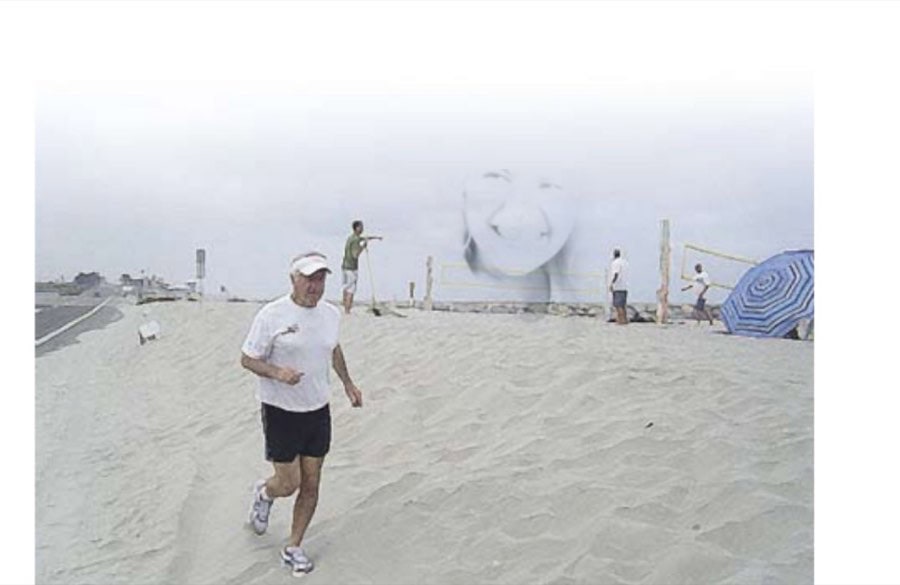
The way back On leaving Leucadia, we run by a couple of circa-1950s motels, the Rebel Tool rental store, the Cabo Grill, and then a short downhill to the beach. The road actually drops slightly below beach level where sand has piled up on the edge of the road. We run through that and past some teenagers working hard to string up a couple of volleyball nets. A few feet farther, the beach widens. This is a favorite spot for fishermen. Several have already congregated. They move slowly and deliberately, attending
to their paraphernalia. Portable chairs, ice coolers, umbrellas, reading material, and tackle boxes are organized just so. Their fishing poles, high tech and expensive looking, stick upright out of the sand. Nylon lines swag well beyond the surf line. The fishermen stay to themselves. Certainly they will catch fish, but I sense there is a greater calling.
The road becomes fairly steep as we ascend back toward Avenida Encinas and then shallows out for a mile and a half to a place well beyond Breakwater Road where, once again, it dips to the beach. This is the best view of the whole run. The sea is in the shadow of the cliffs. I can see all the way to Dana Point. Ruddy-colored cliffs hug the beach on one side, the sea kisses it tenderly on the other, and the beach sparkles with joy for the glorious sunrise and a new day.
The steepest climb of the run lies ahead. It’s about a third of a mile long and leads back to Solamar Drive and the highest elevation of the run, around 300 feet. Life is becoming more abundant. We encounter runners, bicyclers, and walkers. Parking places along the road are filling quickly. Young surfer boys and girls—and many not so young—haul their surfboards toward the beach. “Hi,” “Good morning,” “How’s it going?” I wave. They wave. Auto traffic has picked up, too. An antique car parades by. It deserves a thumbs up. The driver smiles proudly and waves back.
A short distance beyond Solamar, we run along a wide section of asphalt that looks to be a remnant of the old 101 Coast Highway. We are still 300 feet above the beach and close to the edge of the cliff.
A skinny young guy with baggy cargo shorts draped down to his calves and a ball cap on backward is holding something. I wave and ask, “How’s it going?” “Great—aargh!” He suddenly whirls. I stop. “Damn,” he curses and strides quickly to the edge of the bluff and points the antenna of his radio-control device toward his faltering model glider. “Gotta be careful,” he says in a frustrated tone, “the heat makes the air unstable. I almost lost it.” “Well, good luck,” I say encouragingly and start running again. “Thanks,” he says, and then his little glider shoots way up into a group of seagulls gliding by, oblivious. The gulls squawk indignantly and scatter.
Pelecanus patrol Just offshore, a gaggle of pelicans fish for their morning meal. Three float by us heading for the festivities. They are incredibly graceful flyers. How they glide with hardly a flap is a mystery.
Here comes another group. I count seven. For such primitive and ungainly looking animals, they convey spectacular elegance. As they near, the leader looks at me suspiciously. I get the feeling he is on duty—beach patrol. A California Highway Patrol badge hanging from his neck would not seem out of place.
Pelicans have always fascinated me. If reincarnation is in order, I hope to return as one. I have watched them closely over the years and noticed that as they skim across the sea, they check their position by tapping the surface of the water with the tips of their wings now and again—as only a pelican can, whose bill we know holds more than his belican, and from what’s in his beak he can eat for a week, yet no one has ever figured out how the helican (with apologies to Dixon Merritt).
And when they fish from 30 to 40 feet above the sea, their power dive starts in frenetic discombobulation. Each part of their body goes in a different direction. One foot sticks out this way, the other sticks out that way, their bill twirls, and their wings flap wildly. But in the end, when they spot their prey and line up for the dive, the final plunge is an aerodynamic dagger that nearly always ends with a quick gulp.
The last lap Cannon Road and the Encina Power Plant are getting close again. It’s not far now to the Daily News Cafe. This is a section that was also part of last January’s Carlsbad Marathon course. After crossing Cannon Road, I check my time. We’ve gone 10 miles and averaged 9:50 miles. My goal of 9:30 miles is not to be. “You have only two miles to go,” Carlsbad says. “Come on, pick it up.”
“I would have to do eight-minute miles for the last two miles,” I complain, “and that, for me, is impossible. I think I’m gonna take a walk break,” I tell her. “I’m really tired.” But we are approaching a downhill, so I keep running and let gravity help. I leave the asphalt for the sidewalk, where I hope it may be cooler. My water bottle is empty. There’s a fountain by the lifeguard station up ahead. I decide to make a quick stop. It shouldn’t cost me more than 15 seconds. Maybe I won’t have to take any walk breaks.
I crank the handle on the water fountain. There’s barely a dribble. “Carlsbad! You need to turn the pressure up on these fountains,” I pant. “I have to put my mouth on the spigot and suck to get any water. There are germs, you know.” She puts her hands on her hips and just smiles.
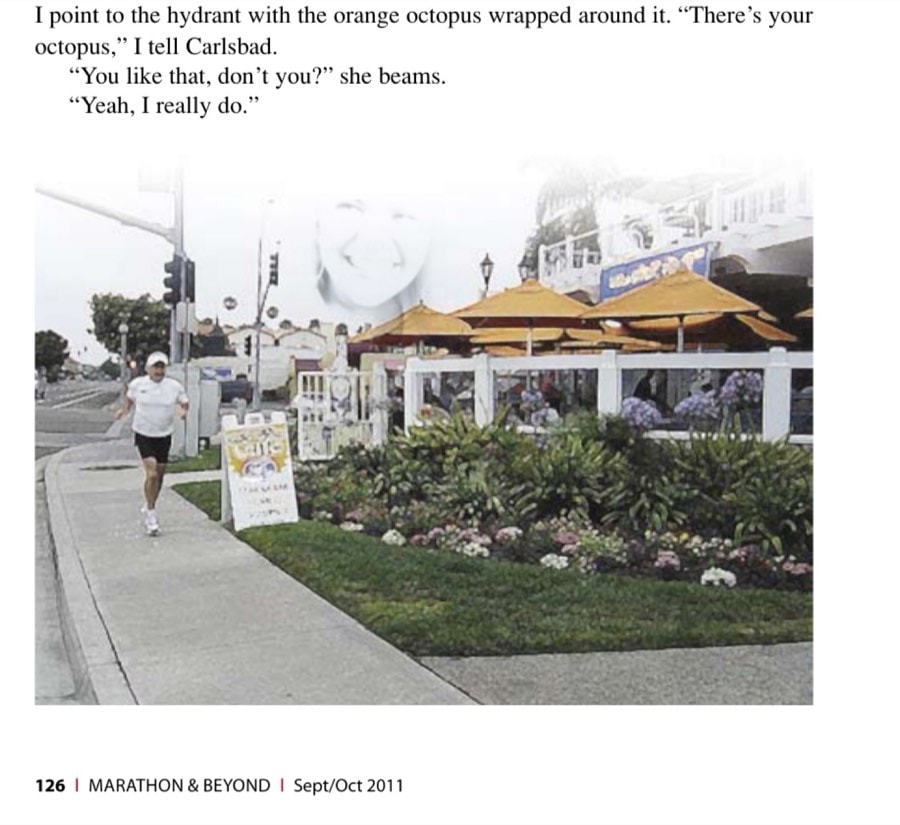
We pass Tamarack, start up the concrete promenade, and run by the trees and benches we passed a couple of hours ago. It’s 7:45. There are scores of surfers bobbing on the ocean now. The promenade is crowded—too crowded. I run across the grass to the side of the street. The shoulder is narrow, but I’m facing traffic. There’s a breeze. I feel better. With a couple of hundred yards to go, the path leads away from the beach, up an incline, and back to the Daily News Cafe. I point to the hydrant with the orange octopus wrapped around it. “There’s your octopus,” I tell Carlsbad. “You like that, don’t you?” she beams. “Yeah, I really do.”
We cross in front of the Daily News Cafe and stop. Total time for the run was 2 hours, 1 minute, and 32 seconds. I subtract 45 seconds for the sunrise stop and a little bit for the glider-pilot stop. I won’t count the drink stop. That works out to around 10-minute miles—nothing to write home about, that’s for sure.
Carlsbad asks if I ever run without my stopwatch. “No,” I answer, “I always wear it when I run.” “Have you thought about running without always timing yourself?” she inquires. “Oh, sure,” I admit. “It’s just that I’ve been timing myself for so long it’s a habit, probably a compulsion.” “
You might find,” she coaxes, “that you would enjoy a run without worrying about time. It would be like a vacation. You could relax, look around, even stop now and again and enjoy the scenery or the moment. You’d still get a good workout.” She’s right, of course, and I have thought about it.
My car is a block away. We cross Carlsbad Boulevard, and I wave at the newsboy. He’s down the road buried between cars and doesn’t see me. At the car, I stretch for a few minutes and proceed to the restroom close by to change. When I get back, I ask Carlsbad if she wants to drive to the edge of town with me. “Sure,” she says, “I’ll go a little ways.”
I put the top down and head for the newsboy to pick up a paper. “How’s it going?” I ask, and put three quarters in his hand. “Great,” he says, and hands me a newspaper. “See you next week?” I say. “OK.” And he smiles and bolts off to another car.
Carlsbad decides to get out. “You coming next Sunday?” she asks. “You bet,” I say. She walks across the street toward the Pipelines Surf Shop. Traffic lights at the intersection turn from red to green. “
You see all those stoplights? See how they hang, dangle, and droop all over the place?” The cars in front of me pull ahead. I look across the street for Carlsbad. She throws a kiss and hollers something. I wave at her, but she fades from view and is gone. “
Do you recall the little semaphore arms—how when the STOP paddle swung into view, the GO paddle went into hiding, and there was a loud clang?” “Yes, yes, I hear the clang.” But what I hear now is not a clang; it’s the car behind me, honking. I’m holding up traffic.
I drive through the intersection and pass the Daily News Cafe. The aroma of coffee and bacon swirls around me like an invisible fog. It smells good.
This article originally appeared in Marathon & Beyond, Vol. 15, No. 5 (2011).
← Browse the full M&B ArchiveMore like this
1,000+ stories from 19 years of Marathon & Beyond
The complete archive of the legendary long-distance journal — digitized and free to read.
