

Bernard Gomersall, in his day the world’s best ultrarunner, four times winner of the London-to-Brighton (1963-66), record breaker in the 1965 Comrades Marathon, is moving to America. I caught up with the ultra legend, with his daughter, Berni, and her husband, Kevin, when they were guests of the Utica Boilermaker National Distance Running Hall of Fame weekend, July 2012. Gomersall is now a friendly, forceful, fit-looking 80-year-old (as of August 2012). His pithy Yorkshire stories and vigorously rounded north-of-England vowels took me back to the year I once spent in his home town of Leeds. We used to meet at cross-country and road races in that bitter northern winter—and winter that year hung on cold and windy till mid-June, as I recall. Up there, it’s Wuthering Heights country, all furze and whinstone, windswept hilltops, brick factory chimneys, and row houses lined up below the crags that lead to bleak moors. They breed them tough up there, like Bernard Gomersall, or the Leeds Rugby League team he supported for 30 years.
But they are generous and loyal in West Yorkshire, too, once you earn their respect. Gomersall shared some memories that were warm but never fuzzy. “I was lucky to know two great runners who were also true gentlemen—Ted Corbitt and Jackie Mekler,” he remembered, with a touch of emotion. One an African American grandson of slaves, the other a Boer South African in the apartheid era—such labels do not matter in a sporting community where people are judged as tough runners and true gentlemen.
That tribute and Gomersall’s whole life story tell us a lot about an era when ultrarunners were marginalized eccentrics from modest backgrounds and usually with limited incomes who willingly met the demands of an uncompromising sport because it gave them significance, self-respect, and comradeship. Not money. Running was punitively amateur. Not media fame or spectator acclaim. There
Courtesy of Bernard Gomersall family
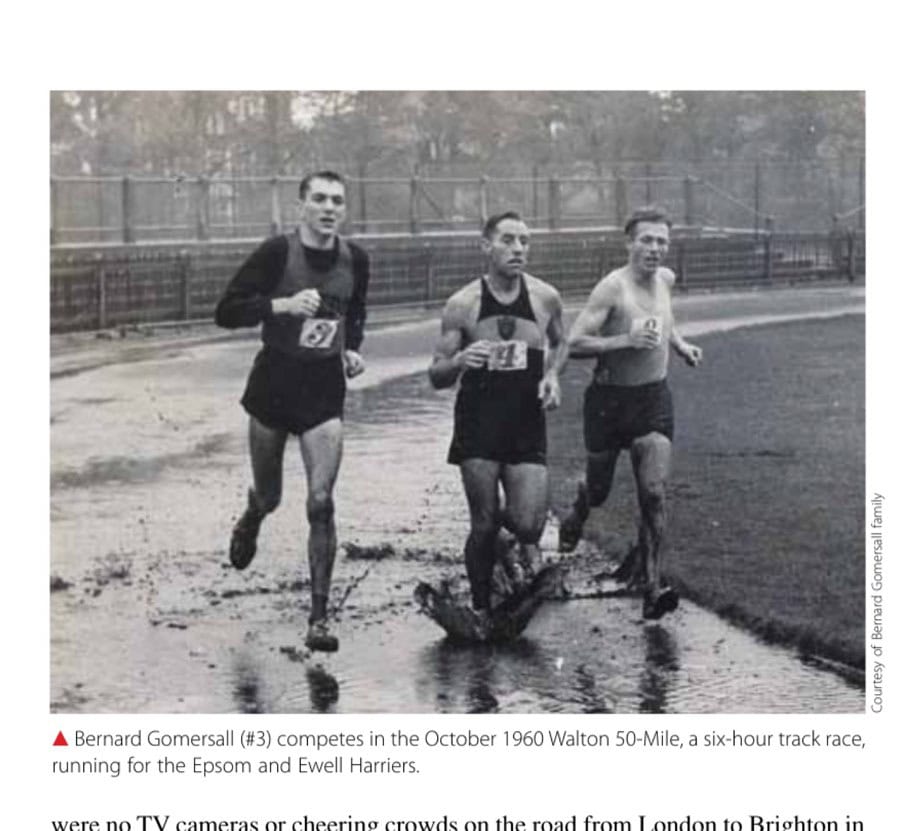
▲ Bernard Gomersall (#3) competes in the October 1960 Walton 50-Mile, a six-hour track race, running for the Epsom and Ewell Harriers.
were no TV cameras or cheering crowds on the road from London to Brighton in the 1960s, only hostile drivers and heartbreaking hills and a scattering of resolute and resilient ultrarunners like Gomersall. * * * Bernard Gomersall was born in Leeds in 1932 and has lived there ever since, in the same house for 57 years. He told me he lives not far from the Wars of the Roses (York versus Lancaster) battlefield of Towton Moor, where 28,000 were killed on a cold, windy (meaning normal) March day in 1461, the bloodiest battle ever fought on British soil. As I said, this is tough country. Gomersall was 13 when World War II ended, 14 when he left school and went out to work. His childhood was lived through the Depression; wartime bombing; shortages of food, clothing, electricity, and everything else; and then the gray austerity of the postwar years. Capable and intelligent though with no opportunity for academic education, he found a job as a records clerk in a laboratory making copper tubes and fittings, and with the persistence that made him a great ultrarunner, he stayed with the firm for 46 years, rising to a position of inspector of electronic facilities.
Seeking significance beyond that routine, he aspired—like most British boys of that era—to succeed in sport.
“I tried cricket, football [soccer], tennis—but I was absolute rubbish.” (He emphatically pronounces it “abb-sloot roobish.”) “I wanted to do something well in sport. I tried running and joined Harehills.” That’s Harehills Liberal Club Harriers, a famed historic running club in the east of Leeds. Early running clubs often began as extensions to social clubs founded by churches or the like.
But the success he sought still did not come. “I was rubbish at running. Couldn’t run well in wet cross-country. The lads always said, ‘If the course is dry, just spit on it and Bernard will be rubbish.’”
His dad was a soccer referee, so young Bernard did that for a while, controlling lower-level games in the Leeds & District and West Riding Leagues, not an easy way to get your sport. He is a man who can carry responsibility.
But one day in 1956, age 24, sitting in a clanking Leeds Corporation tram on his way to Roundhay Park, Bernard Gomersall found his destiny. “I looked out from t’tram, and there were these lads running a 10-mile road race. No wet mud, and some of them looked nowhere near as good as most of the harriers. So I thought, I can do that.”
And he did. His first marathon was 2:44. Not rubbish. He told his father he was giving up the refereeing. “He was disappointed with me. But later he understood.” Fifty-six years later, Gomersall has run 118 races at marathon distance or beyond. But he was no mileage freak. He kept to a mix of training, with some emphasis on hard track workouts. He also found new meaning in the team contests that are so important in British running, more important than individual placings. Club teams for road races and marathons are usually only three to score, instead of the six or more for cross-country and relays, so each man was crucial to the team’s points. “
We had runners like Eric Smith, Alan Lawton, Kenny Pawson, and Arthur Cockcroft. I was usually third scorer, but I had to keep going. One of my worst was the Peterborough Marathon, a hot day, a scorcher, and at 20 miles I was done for. But they said, ‘Coom on, Our Bernard, keep going, we can place in’t teams.’”
Like some other runners, Gomersall began to learn that “the longer I ran, the better I went.” And in 1958, he had another epiphany moment when he saw a short TV item about the London to Brighton Road Race. “
It was won that year by Mike Kirkwood, one of the slowest times for years, and I thought, Well, if he can win it, I can at least run it.” And so a new LondonBrighton legend was in the making. A seaside resort about 55 miles from London, Brighton is famous as the place where sea bathing first became fashionable and where from 1783 to 1803 or so the grossly overweight Prince Regent (later King George IV) used to bounce about with his secret wife, Maria Fitzherbert, perhaps consoling himself for the recent defection of the American colonies. Since the coming of railroads, Brighton’s ocean air and downmarket risqué ambience have lured less-regal Londoners for
day excursions. (The train ticket was called “Cheap Day Excursion.”) They come for breezy sea trips on the Skylark, for sunbathing on towels laid across the hard shoe-size pebbles that make the beach less than user friendly, and for the whelks and winkles—tiny, chewy, salty shellfish—that are Brighton’s delicacy. And they come for the seedy plebeian allure of Brighton pier. For working-class Londoners in the earlier 20th century, a penny spent on the “What the butler saw” peep show and another penny on a postcard with a gaudy colored cartoon and smutty caption was their annual outburst of lechery.
People have walked or run from London to Brighton since the first primitive road was laid. The route crosses the two ranges of hills known as the North and South Downs. (With English logic, “Downs” means where you go up.) The climbs are not high by American standards—800 feet at the highest point—but they are a lot bigger than Heartbreak Hill and they wind up and down with enough severity and often enough to be very testing in the middle of a race of more than 50 miles. The exact distance has varied over the years with the effects of road construction. The earliest person documented as walking the route was John Bell in 1804. John Townsend beat Jack Berry in the first recorded race, in 1837, timed at 8 hours, 37 minutes. The formally organized annual race that Gomersall won began in 1951, but before that the hilly old road saw innumerable record attempts, wagers, high-stakes head-to-head races, interclub relays, vintage car rallies, and every kind of cycle race. The first bike race was in 1872, on penny farthings, on a dirt-andshingle surface. This year, 27,000 cyclists rode on carbon-fiber machines for the British Heart Foundation. The London-Brighton Road Relay was England’s most prestigious interclub running contest, effectively the national teams championship, the Premier League of running, through the 1950s to the 1970s.
Almost all these culturally rich and quirkily human events, alas, have succumbed to the modern world’s obsession with driving at unimpeded speeds in automobiles. Gomersall’s first attempt at “The Brighton” was in 1959, when it was still possible to have runners on the road accompanied by attendants on bikes. He calculated beforehand that he might run eight hours, but that proved too modest for a man on the cusp of discovering his greatest talent. When he got within sight of Brighton, his bicycle attendants told him he still had two hours to spare to meet his target. “
I ran 6:15, finishing ninth,” he said. The race that year was won in 5:43:58 by Fritz Madel, one of the sequence of visiting South Africans who most years made the race an unofficial world championship of ultrarunning. In the 1960s, Gomersall’s sequence of victories was achieved against overseas competition that the slightly more affluent world of that decade made possible, with opposition notably from South Africa, New Zealand, and New York’s Millrose AA club, including Ted Corbitt.
Courtesy of Bernard Gomersall family
Those wins still lay ahead. In his early efforts, Gomersall was, if not rubbish, not much more than a willing midpacker, certainly not a winner. In 1960, he was seventh; in 1961, he was ill with anemia; and in 1962, he was 11th, in 6:20.
But that old desire to do something in sports well still drove him along. He got a coach, teammate Arthur Cockcroft, and cranked up the track repeats. “Twice a week I did intervals, 20 x 440, or repeat 880s, or miles. Over the years I got faster. Not many of the Brighton lads could run repeats at five-minute-mile speed. Most of them just ran long miles. I only increased to 100 a week after I won the Brighton.”
And in 1963, Bernard Gomersall won a race for the first time in his life—at any distance. It was the London to Brighton, the race that had become the center of his life. “The Brighton was my mecca. Every year, I started in October preparing for the next September’s race. I was willing to lose any other race because they were stepping-stones to the Brighton.”
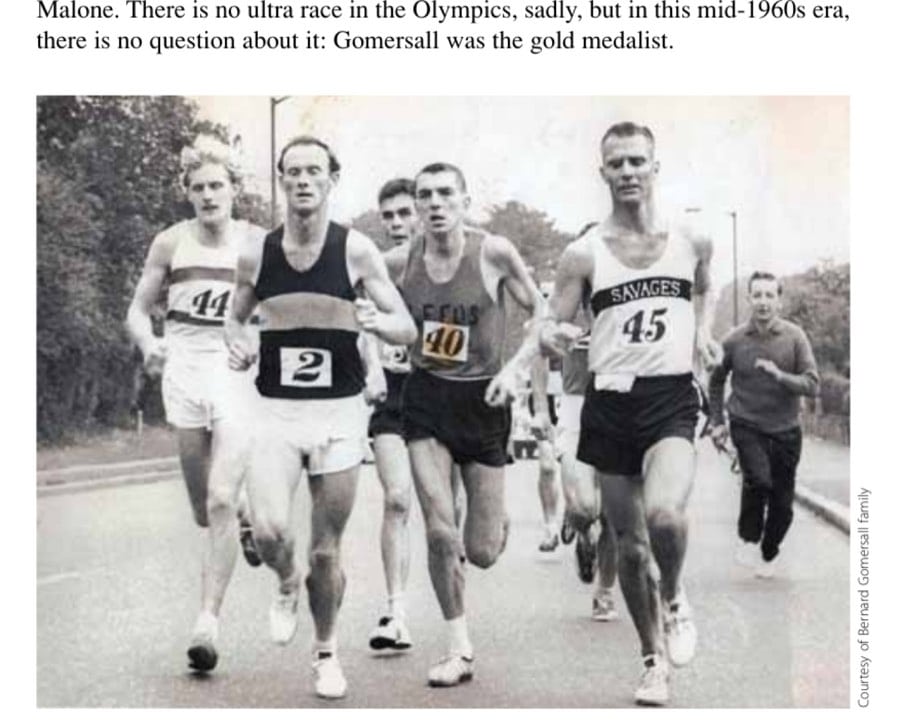
He won three more times, in 1964 and 1965 having to hold off the American challenge of Ted Corbitt, and in 1966 the South Africans, Manie Kuhn and Tommy Malone. There is no ultra race in the Olympics, sadly, but in this mid-1960s era, there is no question about it: Gomersall was the gold medalist.
▲ Gomersall, wearing #40, shown here in the 1964 race, won London-to-Brighton four times.
▲
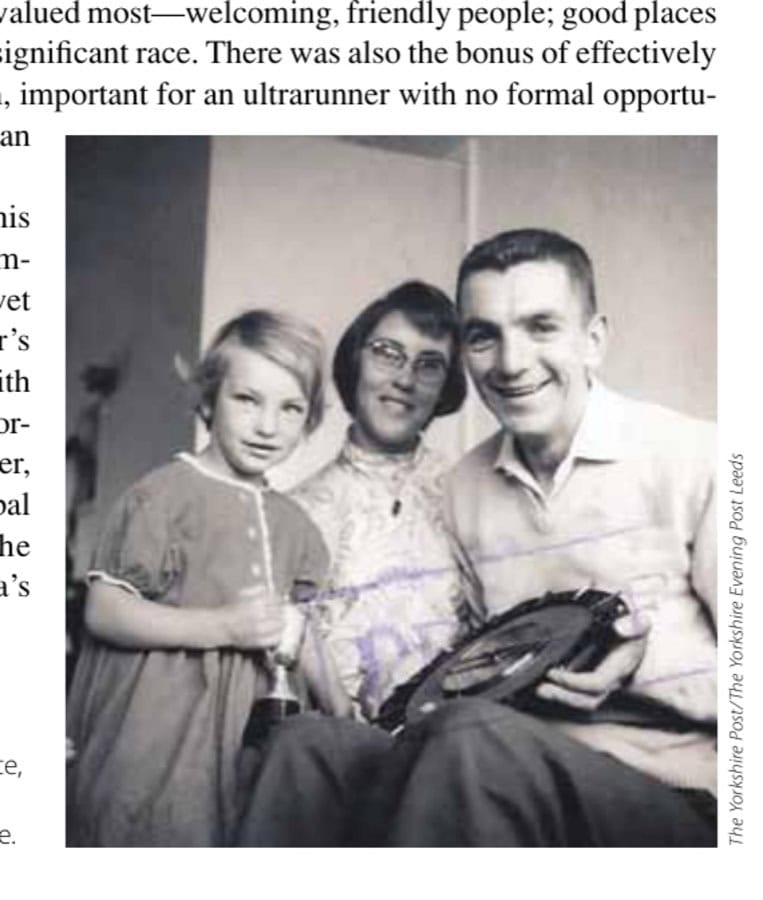
Gomersall with his wife, Ruth, and daughter, Bernadette, after returning home from his victorious 1965 Comrades race.
The Yorkshire Post/The Yorkshire Evening Post Leeds
What did it take? Well, if he had a race coming, he would work overtime several Saturdays to get the money for his train fare to London, or wherever. In those days they didn’t all whiz around in cars or combine races with destination tourism. Luxuries like running marathons in every state or on every continent were unthinkable. When Gomersall finally found funds to give his family a real holiday, his small daughter asked, “Are we going to a race?” because that was the only kind of trip away from home that she knew.
So when little Bernadette brought him a letter early one morning in 1965 that asked if he would like to compete in the Comrades Marathon in South Africa, he said, “If I hadn’t been lying down, I would probably have finished like that anyway.” It was his dream. “After a long discussion with my wife and gaining the necessary leave from my firm, it was my great pleasure to accept the invitation.”
The invitation came from Britain’s Road Runners Club, which in 1958 had been the inspiration for Browning Ross to establish the Road Runners Club of America. Both filled the gap left by the track and field federations in their inadequate provision for road running. The RRC had no money but set up a fund to raise Gomersall’s fares to South Africa. Ordinary road runners donated their few shillings each. He had never been out of England before, and his inexperience of immigration documents and baggage systems got him into “every kind of trouble, all a muddle,” he wrote later in an article for the RRC magazine. But he found in South Africa the three things he valued most—welcoming, friendly people; good places to run; and a long, tough, significant race. There was also the bonus of effectively representing Great Britain, important for an ultrarunner with no formal opportunity to win selection for an international team.
He is modest about his win in the legendary Comrades race, and despite wet conditions he broke Mekler’s downhill course record with 5:51:09. Not a rubbish performance. Almost 50 years later, in an era of full-time global professional runners, the downhill record, by Russia’s
Leonid Shvetsov, is only 30 minutes faster, 5:20:49. For comparison, Shvetsov is a 2:09 marathoner, 13th in the 2004 Olympics and, according to the banned Eddy Hellebuyck, a supplier and user of performance-enhancing EPO. So Gomersall in 1965 ran only 30 minutes slower than the full-time professional, Olympian, and possibly enhanced Shvetsov could run in 2007. On his first overseas trip, after begging for leave from his job, after training in the dark through a cold Yorkshire winter, racing on a rainy day in Natal, it suggests Gomersall had something special.
Probably that was an ability to race for a long distance at close to his peak speed, a skill familiar to elite marathoners but rarer in ultradistance. All those fast track repeats he had in the bank meant his peak speed was higher than most ultrarunners aim for.
Comrades gave him one thing he wasn’t used to in England—crowd support. “I was struck by the tremendous enthusiasm for this event. In pouring rain, the streets of Durban were lined with spectators. I can hardly see that happening in Brighton or Blackpool.” He also received “a wonderful ovation” at the awards ceremony and (the thing that mattered most) a telegram of congratulations from RRC President Ernest Neville, the father of modern ultrarunning in the United Kingdom. * * * Then it was back to work and family in Leeds, another year of races for Harehills Harriers, and another win in the London-Brighton. This time he had to cope not only with the famously persistent Ted Corbitt but also with the tempestuous competitiveness of John Tarrant, the former “Ghost Runner,” the man who was banned for years because of a brief and unsuccessful teenage attempt to be a professional boxer. Tarrant grew up in a wartime orphanage and carried the weight of deep, angry insecurity. Even when he was reinstated as an amateur, after a campaign supported by most of England’s road runners and some newspapers, Tarrant still raced with a searing and often self-destructive compulsion to prove himself. “
John’s trouble was every race was a crusade,” reflected Gomersall, whose own fires burned deeper down. In the middle stages of the 1965 Brighton, Tarrant crusaded away in the lead while Gomersall quietly worked at closing the gap, until at 40 miles, suddenly there was Tarrant lying helpless at the roadside, being, one report said, “violently sick. . . . Well, he is the wiser man for it.” The real wiser man won that day, that’s for sure. Gomersall used his customary pace judgment to win by four minutes over his friend Ted Corbitt and a brace of Scots.
Gomersall’s fourth and fastest win at Brighton came in 1966, 5:32:50, the fifth-fastest winning time ever at that date. He was third in 1967 and 1968, both behind the improving Tarrant, and seventh in the 1968 Comrades. But he was more eager to tell me about his worst ever race, his “black spot,” the Beverley Marathon in Yorkshire, when he had “mental” problems and “ran like absolute rubbish, the only marathon I didn’t finish.” The point of the story is that his first
granddaughter was later named Beverley, “so she reminds me of my worst day.” Yorkshire humor can be on the dark side. But Bernard was genial in celebrating at Beverley’s engagement party in America in July 2012.
Two things ended his serious running. At work, he got a major promotion, inspecting electronic facilities at harbors and aboard ships, requiring constant travel. “My last race was in Lahore, Pakistan.” And there was a neck injury in a car collision at Tilbury Docks in London. He doesn’t want to talk much about that.
Settling for a more conventional northern English route onward from middle age, he and his wife, Ruth, bought season tickets to watch the Leeds Rugby League team. The club’s list of famous fans includes Russell Crowe and Wayne Rooney, but not Bernard Gomersall, an oversight. They followed the team every year from 1978, rewarded when Leeds won the World Club Trophy in 2005 and 2008.
He also became an enthusiast for lawn bowls, elected as longtime president of the League and qualifying as a bowls referee. He had two knee replacements, “both totally free on the British National Health,” he announced proudly at Utica, well aware that debate was raging about America’s less-generous health care. When Ruth died in 2011, planning began for him to move to Gaithersburg, Maryland, to join his daughter, Berni, and her husband, Kevin, another Yorkshireman, who shares his father-in-law’s self-mocking humor. Kevin works for the Space Agency, controlling satellites for Intelsat, but when you ask he likes to say, quirkily, “I am an alien and I work in space.” * * * Bernard and I reminisced as old runners like to do about diverse aspects of British running culture in the 1950s and 1960s, and the contrast with the much more affluent and indulgent runner demographic that was milling around us at the Boilermaker Expo, cheerfully laden with their race chips, goody bags, and apparel purchases. With some embarrassment, Bernard even displayed the special therapeutic tapes he had just been given at one booth, “free,” for his knees, black crisscrosses that
ad
The Yorkshire Post
▲
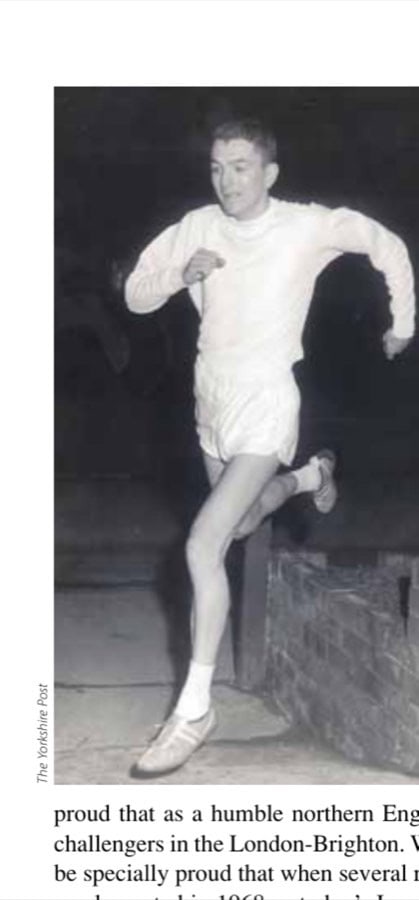
Gomersall training at home in February 1965.
made his surgery scars look like something out of Frankenstein or The Munsters. He reminisced. “A 15-mile run after work was good for relieving stress. But all this water they drink now! In my day, you
weren’t allowed any water for races below 15 miles, and in marathons there were rules about where the first water was permitted. They believed it would cramp your stomach. And we adjusted. In one scorcher in 1968, I
lost 18 pounds. The whole of Comrades, I drank less than a pint.” His memories are almost all positive—successes, humor, friends. His stories are often self-deprecating, like the “Beverley” one. There is no van
ity in him, though he is proud to have a special Road Runners Club medal, proud that as a humble northern Englishman he held off four years of foreign challengers in the London-Brighton. With his usual roguish smile, he pretends to
be specially proud that when several rival Leeds area clubs, including Harehills, amalgamated in 1968 as today’s Leeds City, he was the very first to race in the new blue colors because that year’s London-Brighton started early on the morning
of the official date of the merger. “I was the first ever to run for Leeds,” he says. The only glimpse of bad memories or resentment came when I mentioned a longtime road-running official who lived in the south of England. “
He was a total snob. He never had a good word for me. He thought I was a nobody from the north,” Gomersall says. He doesn’t linger on such things and ends with another joke, about the process of applying for his American green card. “
On the form to become a permanent resident, you have to state that you have never done anything to the detriment of the United States. But what if they find out about the three times I stopped Ted Corbitt from winning the LondonBrighton?”
This article originally appeared in Marathon & Beyond, Vol. 17, No. 6 (2013).
← Browse the full M&B ArchiveMore like this
1,000+ stories from 19 years of Marathon & Beyond
The complete archive of the legendary long-distance journal — digitized and free to read.
